
Nine of Swords
Descriptions and symbolism are based on the card’s classic illustration in the Rider–Waite–Smith deck. Details of the artwork may differ in other editions of the deck.
This guide brings together traditional and modern readings. Interpretations and answers may differ between authors and schools.
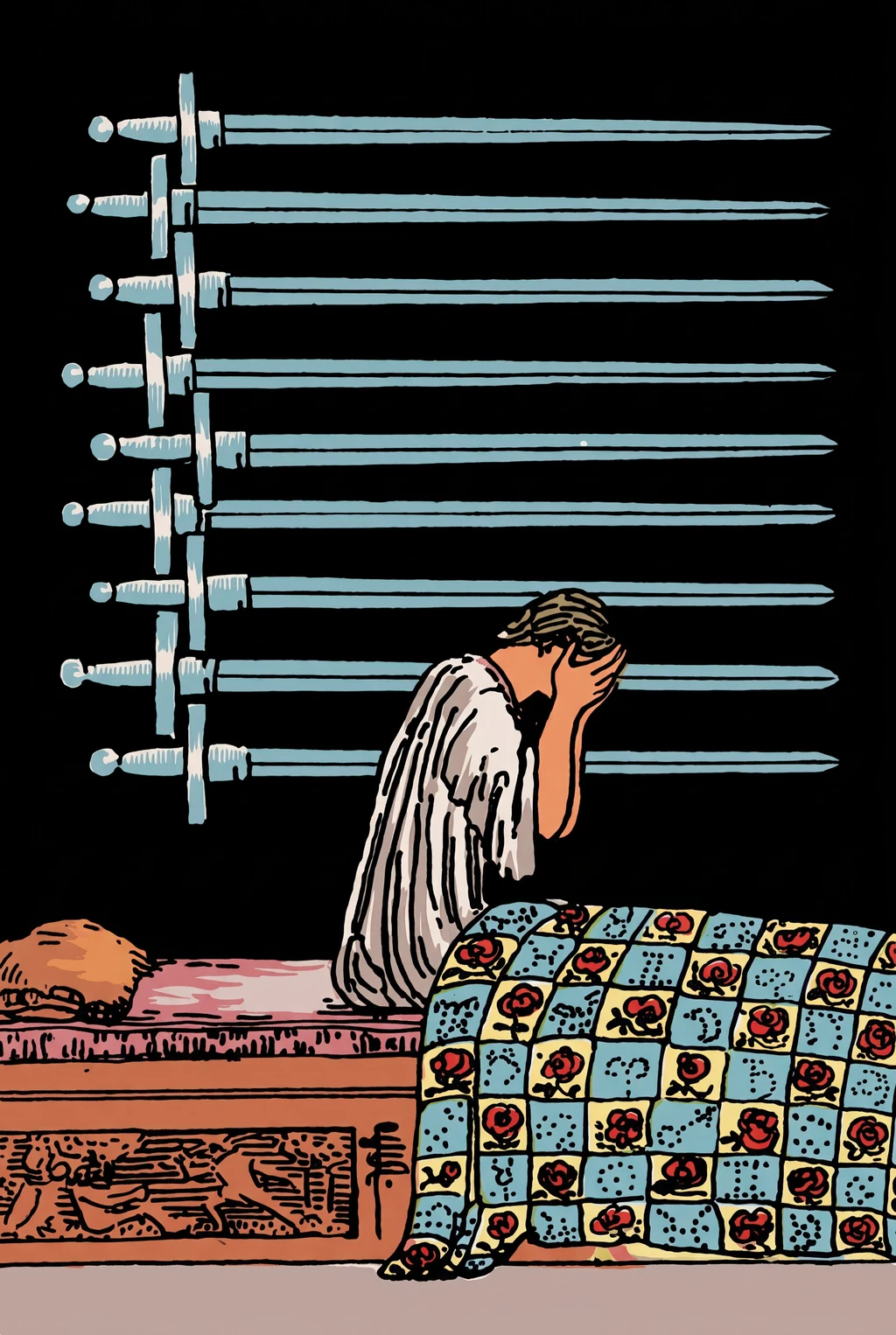
A person sits in bed with their face buried in their hands. The room is still dark, and the world has narrowed to what they cannot get out of their mind. Swords hang above them without touching their body; the anguish remains even without a visible blow. The silence of night brings no rest.
Their hands are raised as though thoughts could be shut out with the same gesture used against a sudden bright light. The quilt is still there, the bed unchanged, but they cannot retreat beneath the covers and fall asleep again. A single distress has grown to fill the night. Everything else exists somewhere beyond this hour.
Core meaning
Anxiety, guilt, and distressing thoughts that will not let go. The Nine of Swords portrays the pain of dwelling on a situation; reversed, it can suggest either relief or fears kept hidden from others.
- Key meanings:Anxiety
- Nighttime fears
- Guilt
- Emotional pain
- Recurring thoughts
- Insomnia
- Key meanings:Easing anxiety
- Hidden fears
- Seeking help
- Shame
- Self-criticism
- Persistent worry
Image and symbols
Card image
A person in a light-colored shirt sits on a bed. Their head tilts toward the viewer’s right, and both hands cover their face. Nine horizontal swords appear against the black background behind the figure: the hilts are on the left, and the blades extend beyond the right edge of the image.
A checkered quilt covers the legs and lower body. Red roses appear on the yellow squares, while the blue squares bear astrological signs. Two figures in conflict are carved into the side panel of the wooden bed; one towers over the other.
Traditional context
For Waite, this is an image of deep grief and desolation. His list of divinatory meanings is markedly harsher than the familiar modern description of anxiety: death, failure, miscarriage, delay, deception, disappointment, and despair. For the reversed card, he names imprisonment, suspicion, doubt, justified fear, and shame.
In the Golden Dawn system, the card is called the “Lord of Despair and Cruelty.” Book T also allows for other nuances, including loyalty, patience, and selflessness, depending on the combination of influences. This is a separate occult source, not a list of reversed RWS meanings; its description of the card image also differs from Smith’s illustration.
Modern RWS readings focus on nighttime distress, guilt, and recurring thoughts. Reversal allows for two paths: finding a way out of anxiety, or anxiety deepening and being concealed. The modern meaning of relief is not the same as the reversed meanings listed by Waite.
Face covered with both hands
A gesture of grief and dejection: the experience so consumes the person that everything else falls away.
Nine swords arranged one above another
A buildup of distressing thoughts. One fear leads to another until the repeating sequence takes over all attention.
Bed
Sleep and rest interrupted by troubling thoughts. The distress persists even in a place usually associated with recovery.
Carved scene of conflict on the bed
It may represent a painful conflict that continues to play out in memory, even though the event itself has passed. Another reading emphasizes a feeling of being attacked and a need for mercy.
Roses on the quilt
In an esoteric reading, the roses may symbolize desire.
Astrological signs in the quilt squares
A reminder of the ongoing cycles of life and the passage of time. The distress of one night is only part of a larger picture.
Colors
- Black background behind the figure
The darkness of night underscores the solitude of facing your own thoughts when everyday distractions disappear.
- Yellow background of the squares with roses
In an esoteric reading, yellow may represent mental activity and intellect.
Meanings
Nine of Swords — Upright
General
Overall meaning
The Nine of Swords describes deep distress: fear, guilt, regret, or grief that the mind returns to again and again. Sometimes the anticipation of something that has not happened is the most painful part; sometimes it is an event that has already taken place. Shame can make painful experiences difficult to talk about.
Anxiety can magnify a threat, but there may also be a real reason for concern. The card does not simply mean that someone has imagined the whole problem.
Possible support
The perspective of someone you trust: from the outside, it may be easier to notice what gets lost among recurring fears.
Possible difficulty
Each new round of the same thoughts strengthens the old fear. It becomes a closed loop rather than a new understanding of the problem.
Focus
Try to distinguish a frightening assumption from the situation that actually needs attention. Feeling reassured does not replace dealing with a real difficulty.
Reflection questions
- What thought do I keep returning to without learning anything new?
- Which part of my worry is connected to something that has already happened?
Relationships
Overall meaning
In a romantic relationship, the card may describe mistrust, fear of rejection, and guilt over something said or done. After a breakup, it may reflect regrets that make it hard to open up to someone new.
Friendships can bring a similar but distinct experience: distress over an argument, awkward words, or worries about how a friend sees the relationship.
Possible support
In a partnership, support may come from talking about a specific fear, with room for a response and compassion rather than only private assumptions.
Possible difficulty
Fear can lead you to avoid the very conversation that could address the problem. Mistrust and regret then remain unresolved.
Focus
Consider which fears are connected to what is happening between you and which are fueled by expectations of rejection or past disappointment.
Reflection questions
- What fear about our relationship is hard for me to discuss?
- What worries me about specific words or actions, and what am I only assuming?
Work and study
Overall meaning
Work responsibilities may feel overwhelming, while thoughts of making a mistake, having your performance judged, or losing your job continue long after the workday ends. The card allows for both an exaggerated expectation of failure and genuinely difficult working conditions.
Under constant pressure, ordinary problem-solving can turn into an exhausting return to the same fear.
Possible support
It may help to talk through work difficulties calmly with someone who can see them without sharing your fear of failure.
Possible difficulty
Fear of falling short of expectations adds to the workload itself. Continuing at the same pace may deepen exhaustion.
Focus
Distinguish the demands of your work environment from your own assessment of your abilities. Difficult conditions and fear of not measuring up call for different responses.
Reflection questions
- What exactly about work stays on my mind after the day is over?
- Is the task itself overwhelming me, or is it the expectation that I will not be able to handle it?
Money and resources
Overall meaning
In money matters, the Nine of Swords is associated with anxiety about debt, obligations, or the possible loss of financial stability. The distress may be greater than the financial difficulty itself, but that does not make the difficulty disappear.
Possible support
An outside perspective on your financial situation may help: not just reassurance, but a discussion of the options available.
Possible difficulty
When financial worries take up all your attention, it becomes difficult to assess the scale of the problem without panic.
Focus
Focus on specific obligations and possible ways to address them. Mentally replaying the worst-case scenario will not make them clearer.
Reflection questions
- Which financial obligation worries me most?
- Who could help me take a practical look at this situation?
Wellbeing and self-care
Overall meaning
The card describes a state in which thoughts interfere with falling asleep or resting peacefully. Nighttime worries may be accompanied by nightmares, fatigue, and a sense that the tension never lets up.
Possible support
Rest and the ability to seek help can offer support, rather than silently continuing to carry the same burden.
Possible difficulty
Worries take up time that could be spent resting. Even in bed, inner tension continues to hold your attention.
Focus
Pay attention not only to what is causing anxiety, but also to how much disrupted sleep and tension affect everyday life.
Reflection questions
- What thoughts return when I try to rest?
- How does lack of sleep affect my usual day?
Personal growth
Overall meaning
The focus is on how you relate to yourself: regret over an action, doubts about your worth, or fear of rejection. The card invites you to examine an inner critic that drowns out a calmer view of your experience.
Possible support
A kinder inner dialogue: acknowledging what you feel without adding more blame.
Possible difficulty
Doubts about your own worth may take up more space than understanding what is actually hurting.
Focus
Notice the words you use when speaking to yourself in a difficult moment, and the particular feeling behind them.
Reflection questions
- What words do I use to judge myself after a mistake?
- What exactly hurts when I begin to doubt myself?
Nine of Swords — Reversed
General
Overall meaning
The reversed Nine of Swords may show tension beginning to ease: fear becomes easier to understand, and there is more room to talk about it and return to everyday life.
Another reading concerns anxiety that is hidden or growing deeper. Shame and the feeling that you must cope alone can persist behind an outward appearance of calm. Reversal does not automatically mean improvement.
Possible support
Speaking openly with someone who can listen. Even the chance to stop hiding what you are going through can be a meaningful source of support.
Possible difficulty
An outward appearance of composure may conceal an unresolved problem. Other people remain unaware of the difficulty, leaving you to face it alone.
Focus
It is important to recognize what is actually within your control. This helps separate actions you can take from endless worrying.
Reflection questions
- Where am I already noticing relief, and what is still hard to acknowledge?
- What anxiety have I not yet spoken to anyone about?
Relationships
Overall meaning
In a partnership, this may mark a shift from silent fears to conversation and a gradual return of trust. Support becomes easier to find when fears can be discussed openly.
Following an earlier relationship, the card may also suggest that painful feelings are easing and there is more openness to meeting someone new.
Possible support
A supportive partner with whom you can share your worries without pretending that everything is fine. What matters here is the willingness to listen, not simply being in a relationship.
Possible difficulty
Before meeting someone new, a difficulty may remain in feelings about a past relationship that still stand in the way of new closeness.
Focus
A conversation may reveal that some fears felt more overwhelming than the situation itself. Notice what has actually become clearer between you.
Reflection questions
- What fear is easier for me to discuss with my partner now?
- What became clearer between us after an open conversation?
Work and study
Overall meaning
Tension around work may be easing: you can assess difficulties more realistically or have found a way to manage the workload.
In another reading, the work situation has genuinely worsened and exhaustion has reached its limit. Relief from anxious thoughts and an improvement in working conditions are therefore not the same thing.
Possible support
Ways you have already found to manage work stress, along with practical changes that have made difficulties more manageable, can offer support.
Possible difficulty
If things have taken a difficult turn, exhaustion may make it hard even to begin working. This is no longer just fear of a possible mistake, but the weight of your current condition.
Focus
Look at the whole work situation: is your perception of the workload changing, or are the circumstances themselves changing? Do you still have the strength to keep working?
Reflection questions
- What has helped reduce the tension I feel about work?
- What still feels unmanageable at work, even when I try not to worry?
Money and resources
Overall meaning
One reading points to easing financial fears: the situation is becoming clearer, and manageable solutions are coming into view.
Another reading allows for a genuine worsening of financial circumstances. Reversed, the card can represent not only worry about not having enough, but an actual lack of funds.
Possible support
Help that is available during financial difficulties. Support from outside your own worries remains important whether the situation is improving or worsening.
Possible difficulty
A real shortage of money may limit your options more than your earlier financial fears did.
Focus
Separate actual financial difficulties from anxious assumptions. If it is hard to make sense of things alone, a trusted person’s perspective can help.
Reflection questions
- Has my anxiety eased, or has my financial situation actually changed?
- What help is available to me with financial difficulties?
Wellbeing and self-care
Overall meaning
Reversal may suggest that nighttime anxiety is easing, rest is returning, and you are feeling calmer. But it can also point to hidden tension, shame about what you are experiencing, or emotional overload that still needs care.
Possible support
Seeking support, including professional support, and connecting with people around whom you do not have to hide how difficult things feel.
Possible difficulty
Suppressed anxiety can still weigh heavily even when no one else knows about it. Shame adds another obstacle to caring for yourself.
Focus
It matters to acknowledge tension that remains rather than demand that you feel better immediately.
Reflection questions
- In what ways am I finding it easier to rest?
- What tension am I still hiding, even though I need support?
Personal growth
Overall meaning
The card draws attention to a harsh inner voice and beliefs that make it hard to act. A shift in this pattern may be beginning: fear is no longer accepted as the final judgment of your worth.
Another reading shows how deeply self-criticism has taken root. Repeated self-reproach gets in the way of assessing your abilities more calmly.
Possible support
Learning to acknowledge what you have accomplished and speak to yourself without putting yourself down. This offers a concrete alternative to habitual self-dismissal.
Possible difficulty
Fear and self-doubt can stop you before you even try. Believing you are incapable then narrows the choices you can see.
Focus
Notice what your inner voice judges you most harshly for, and what that judgment is based on.
Reflection questions
- What success do I dismiss with a familiar criticism?
- What fear stops me before I even try?
Roles in a spread
Position examples
A position gives the card a question, such as what helps or what gets in the way. That question shapes how you read its meaning.
Nine of Swords — Upright
Situation
The situation is dominated by anxious anticipation or painful memories of what has happened. Attention is fixed on possible misfortune, guilt, or regret.
Influence
A painful past experience may be shaping how you see the present. Unresolved distress returns in your thoughts and intensifies your current anxiety.
Motivation
Decisions may be driven by fear of an unfavorable outcome, prompting the same anxious thoughts to run through your mind again and again.
Support
A perspective beyond your own cycle of thoughts can offer support. Someone else may help you see beyond a single frightening version of events.
Obstacle
The obstacle is repeatedly imagining the worst: anxiety grows, but clarity does not.
Focus of attention
The underlying cause for concern deserves attention. It may be real even when anxious thoughts make it feel more overwhelming.
Next step
Face the issue causing the most anxiety instead of putting it off out of fear. If handling it alone feels difficult, asking for help can be the next step.
Possible development
If you keep returning to the worst-case scenario in your mind, each fear may reinforce the next. The current pattern then deepens the distress rather than bringing clarity.
Nine of Swords — Reversed
Situation
The focus turns to how someone handles their worries: they may be starting to talk about them and let them go, or they may still be hiding significant distress.
Influence
An unresolved experience from the past may continue to stir anxiety and make relief hard to feel, even when you want to move forward.
Motivation
The driving force may be a desire to escape an exhausting cycle of anxiety and stop living inside the same recurring nightmare.
Support
A willingness to let others into an experience you previously faced alone. Being able to speak openly and hear another perspective becomes a source of support.
Obstacle
Fear of a possible outcome may stop you before you even act. The harder it is to test your fears, the narrower your choices begin to feel.
Focus of attention
Notice the difference between genuine relief and the habit of appearing calmer than you feel inside.
Next step
Stop hiding what is troubling you and give it clear expression in conversation. You can also begin letting go of recurring fears when there is no action available to address them.
Possible development
Talking about the experience and receiving support may gradually ease the tension. But if fear continues to block action and stays unspoken, the distress may persist.
Combination examples
Card combinations are in development. For now, here are a few examples.
Nine of Swords + The Star
Nine of Swords ( upright) + The Star ( upright)
- Example question:
- What helps me regain a sense of calm after a period of anxiety?
- Example interpretation:
The Star softens the weight of the Nine of Swords: alongside anxiety, there is hope and the possibility of gradually regaining peace of mind.
Nine of Swords + The Devil
Nine of Swords ( upright) + The Devil ( upright)
- Example question:
- What keeps me caught in recurring anxious thoughts?
- Example interpretation:
This pair intensifies the themes of despair and a cycle of anxiety that is hard to escape. Worry becomes especially consuming and obscures other parts of life.
Nine of Swords + Three of Swords
Nine of Swords ( upright) + Three of Swords ( upright)
- Example question:
- What is the most painful part of this experience?
- Example interpretation:
The two cards reinforce the themes of emotional pain and heartache. Together, they highlight the weight of an experience that offers no peace.
Nine of Swords + The Tower
Nine of Swords ( upright) + The Tower ( upright)
- Example question:
- How is change connected to my current anxiety?
- Example interpretation:
Anxiety may accompany sudden change or arise in anticipation of upheaval. This pair can also describe distress after an event has already disrupted familiar patterns.
Nine of Swords + Ten of Wands
Nine of Swords ( upright) + Ten of Wands ( upright)
- Example question:
- How is my workload connected to my exhaustion?
- Example interpretation:
This combination links emotional exhaustion with working too long and too hard: the burden of responsibilities is accompanied by draining tension.
Reading example
An imagined one-card reading shows how the meanings above can apply to a question. This is one possible interpretation.
Nine of Swords — Upright
Situation:
There is an opportunity to change jobs, but no decision has been made yet. Each evening, the same thought returns: what if nothing works out at the new job?
Question:
What will help me make sense of this choice?
-
Card drawn:
Imagine drawing a card for the position «What Will Help» and getting Nine of Swords (upright).
Interpretation:
The Nine of Swords draws attention to a fear of failure that begins to replace a careful look at the offer itself. In this situation, it helps to distinguish the real demands of the new job from frightening assumptions about your abilities.
One possible step is to discuss your concerns with someone who can offer a calm assessment. This can help you return to the choice itself instead of repeatedly imagining the worst outcome.
Nine of Swords — Reversed
Situation:
There is an opportunity to change jobs, but no decision has been made yet. Each evening, the same thought returns: what if nothing works out at the new job?
Question:
What will help me make sense of this choice?
-
Card drawn:
Imagine drawing a card for the position «What Will Help» and getting Nine of Swords (reversed).
Interpretation:
The reversed Nine of Swords offers a way to examine how to move beyond the old pattern of worrying about this choice. Perhaps some fears are already easier to assess calmly; perhaps they are still being kept inside and making the decision harder.
An honest conversation, without trying to appear confident, could offer support here. It is worth naming exactly what feels frightening and noticing which doubts become clearer through discussion. That does not automatically make the job offer the right choice.
Yes / No
Nine of Swords — Upright
Why this answer
Probably not. Anxiety, doubt, and expecting the worst make it difficult to decide clearly and move toward what you want. In this reading, the card does not favor expecting an easy, positive outcome right now.
A clarification
The qualification here concerns anxiety that makes the question hard to see clearly. Support and a closer look at the fears themselves are needed before expecting a more favorable development.
A question to consider
What fear is keeping me from considering this question calmly?
Nine of Swords — Reversed
Why this answer
Probably yes. Fear is beginning to ease, making it possible to consider the question more calmly. The possibility of moving toward what you want grows as you gradually emerge from anxiety.
A clarification
This is about gradual relief, not the instant disappearance of every worry. There is no need to rush a decision just because you feel a little calmer.
A question to consider
Where do I notice that anxiety is already having less influence on this question?
Correspondences
Connections with numbers, elements and other symbols add depth to the card’s imagery. They can differ between traditions.
Number — IX (9)
Nine marks the culmination before the numerical sequence ends. In Swords, it is associated with reaching the limit of how much distressing thought a person can carry.
Element — Air
Air connects the suit of Swords with thought and communication. In the Nine, attention rests on thoughts that heighten inner tension.
Astrology — Mars in the second decan of Gemini, 10°–20°
The restless drive of Mars meets the quick thinking of Gemini. In modern readings, this combination speaks to mental agitation and recurring fears.
Tree of Life — Yesod of Vav
Yesod represents the ninth level in the card’s Kabbalistic framework. In the suit of Swords, Book T associates this position with the weight of suffering, oppression, and despair.