
Three of Swords
Descriptions and symbolism are based on the card’s classic illustration in the Rider–Waite–Smith deck. Details of the artwork may differ in other editions of the deck.
This guide brings together traditional and modern readings. Interpretations and answers may differ between authors and schools.
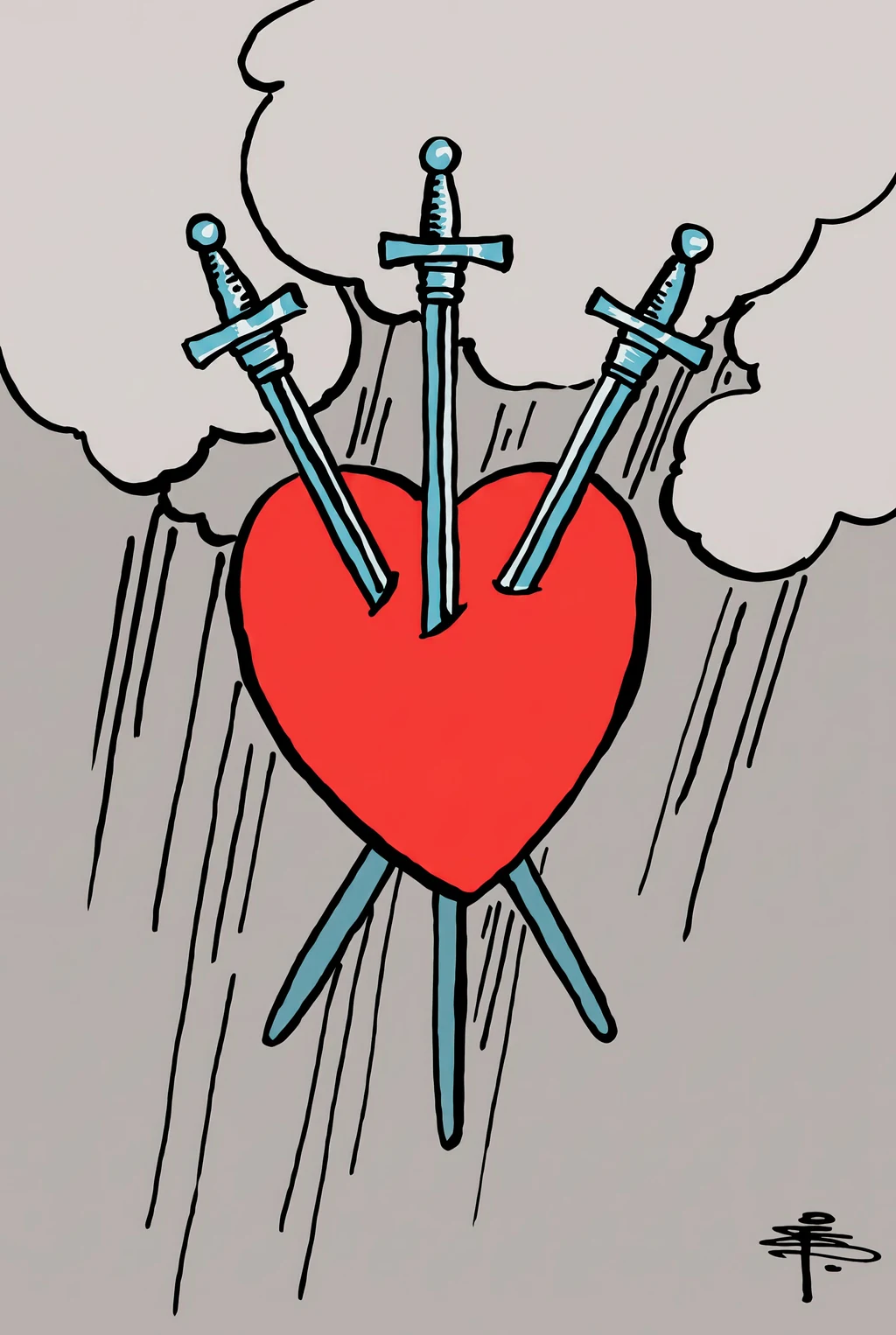
Sometimes a conversation has ended, but the words spoken still hurt. You go over them again, even when there is no one left to answer, or no reason to. On the Three of Swords, that experience has no face: a red heart is pierced by three blades, with nothing to shield it from the rain.
The image leaves the cause of the breakup and the person who inflicted the wound outside the frame. Pain is shown without explaining who was right. A person might choose calm words and try to hold themselves together; the exposed heart has no such protection. Heavy clouds fill the entire sky, as though, in this moment, the pain has eclipsed everything else.
Core meaning
A painful truth, a breakup, or a disappointment that is hard to ignore. The Three of Swords is also about acknowledging pain and finding a way to express what you're feeling.
- Key meanings:Heartbreak
- Disappointment
- Separation
- Rejection
- Uncomfortable truth
- Grief
- Key meanings:Acceptance
- Healing
- Reconciliation
- Unspoken pain
- Self-criticism
- Confusion
Image and symbols
Card image
At the center is a red heart pierced by three swords. One sword is vertical, while the other two cross it diagonally; the hilts are at the top, and the tips extend below the heart. Behind it are clouds and slanting lines of rain against a gray background. No people appear on the card.
Traditional context
In Waite's account, the main list of meanings extends beyond romantic disappointment: it includes removal, absence, delay, division, rupture, and dispersal. For the reversed card, he names clouded thinking, error, loss, distraction, disorder, and confusion.
In Book T of the Golden Dawn, the card is called the “Lord of Sorrow.” Its meanings include not only discord and tears but also keeping promises and honesty in financial dealings. The interpretation depends on surrounding cards, which can strengthen or weaken its meaning; this system does not follow the upright/reversed division.
Modern practice places greater emphasis on the emotional side of the image. The reversed Three of Swords may be read as healing, acceptance, and reconciliation, but also as pain that has yet to be expressed or released.
Sergey Savchenko specifically emphasizes the subjective nature of pain: the same event may barely affect one person and deeply hurt another. The intensity of someone's hurt does not necessarily match the scale of the external event.
A heart shown without a human figure
Love and vulnerability. The isolated image captures a state in which pain takes up almost all of one's attention.
Three swords piercing the heart
Hurtful words and actions, broken trust, and coming face to face with an uncomfortable truth.
Clouds and rain behind the heart
The setting conveys grief and the weight of the experience. In a modern reading, the changing weather also suggests that this state does not have to remain the same.
Colors
- The red color of the heart
Heightens the intensity of emotion, especially love and anger.
Meanings
Three of Swords — Upright
General
Overall meaning
Grief, rejection, and disappointment; a painful gap between expectations and what actually happened. The card may describe separation, a broken connection, or an uncomfortable truth that is hard to accept. Traditional meanings also include absence and delay.
Alongside the hurt itself, there is room to express it. The upright Three of Swords is not simply a picture of suffering with no way forward.
Possible support
Being able to name a painful fact clearly and let your feelings out instead of pretending nothing happened.
Possible difficulty
Becoming so absorbed in hurt that all your attention stays on what happened while the rest of life recedes into the background.
Focus
Hurtful words should be distinguished from an accurate assessment of the situation: a strong emotional reaction does not make someone else's judgment true.
Reflection questions
- What hurts me most about this situation?
- What uncomfortable truth am I struggling to acknowledge?
Relationships
Overall meaning
In a romantic relationship, the card can point to hurt feelings, an argument, a loss of trust, separation, or a breakup. Sometimes a third person's involvement is part of the reading. After a relationship ends, old pain may get in the way of meeting someone new.
In friendship, it may reflect a painful conflict or a crossed boundary that makes it difficult to relate as before.
Possible support
A respectful conversation and a willingness on both sides to work through disagreements. In friendship, an honest discussion may also help rebuild trust.
Possible difficulty
Unresolved disagreements and ongoing arguments deepen the distance between people; the connection becomes difficult to maintain.
Focus
After a breakup, notice your own readiness to meet someone new rather than rushing into closeness while the earlier loss still hurts too much.
Reflection questions
- What remains unspoken in our disagreements?
- Am I still carrying pain from a past relationship?
Work and study
Overall meaning
Disappointment at work, conflict with coworkers or clients, or the loss of an opportunity you wanted. A more difficult reading involves losing a job or a business closing. Looking for a new position may also bring discouragement.
Possible support
Clearing things up with a coworker or manager. After losing a job, taking time to recover may offer support, if you have the option to pause.
Possible difficulty
A lack of clear communication adds tension to the work problem itself.
Focus
What remains unresolved between the people involved in the conflict and needs a direct conversation.
Reflection questions
- What disappointment at work am I still carrying?
- Who do I need to clear things up with?
Money and resources
Overall meaning
A material loss and the feelings that come with it. Another possible theme is the financial impact of a breakup: dividing property or facing expenses that are difficult to cover alone.
Possible support
The possibility of reaching out for support rather than facing the feelings around financial loss alone.
Possible difficulty
The emotional weight of a loss can make it harder to deal with its practical consequences.
Focus
Current financial obligations that may be difficult to address while you're hurting but will not disappear on their own.
Reflection question
What money matter is hard for me to face because of how I feel?
Wellbeing and self-care
Overall meaning
Acute sadness, distress, or grief takes up a great deal of attention. In this reading, the card relates to experiencing loss and needing to express feelings, including through tears.
Possible support
Talking with someone you trust or writing down what hurts. The opportunity to express what you're going through becomes a source of support.
Possible difficulty
The experience may consume your attention and push self-care aside.
Focus
Everyday self-care, which may receive little attention in the midst of disappointment.
Reflection question
Does talking or crying it out help me when I'm hurting?
Personal growth
Overall meaning
A painful experience can change how you see yourself and what you once expected. In this reading, the Three of Swords is about recognizing mistakes and drawing lessons from disappointment.
Possible support
A willingness to look at what happened as an experience that can teach you something about yourself.
Possible difficulty
Pain temporarily narrows your perspective: it can be hard to see anything in what happened beyond the disappointment itself.
Focus
The difference between useful feedback and someone else's hurtful judgment that you may be tempted to accept as the final truth about yourself.
Reflection questions
- Whose judgment am I taking too much to heart?
- What has this experience helped me understand?
Three of Swords — Reversed
General
Overall meaning
Pain you've lived through begins to change shape. The card may suggest accepting a loss, emotional healing, forgiveness, or reconciliation; the initial sting gradually gives way to a calmer perspective.
Another reading concerns pain kept inside: feelings are suppressed, an old hurt holds your attention, and letting go of what happened remains difficult. In Waite's historical list, the reversed card is also associated with errors, loss, distraction, and confusion.
Possible support
Some distance from an emotionally charged situation can help you look at it more calmly.
Possible difficulty
Trying to hide pain can lead to irritability or emotional numbness rather than relief.
Focus
The difference between accepting what happened and trying not to feel it.
Reflection questions
- What has become easier for me to accept?
- What am I trying not to think about even though it still hurts?
Relationships
Overall meaning
In a romantic relationship, reconciliation and renewed understanding are possible. After a breakup, the card may point to a gradual release from old pain and a readiness to meet someone new. In friendships and families, it may indicate restored communication and trust after an argument.
Yet outward calm can also come from leaving grievances unspoken. Painful distance then remains, and the relationship may be moving toward an end.
Possible support
Being willing to acknowledge your own mistake and apologize.
Possible difficulty
Accumulated resentment gets in the way of reconnecting, even when the open argument has ended.
Focus
The words you choose in conversation: a harsh remark can undermine an attempt to make peace.
Reflection questions
- Have my words hurt someone close to me?
- Am I mistaking the absence of arguments for a resolved conflict?
Work and study
Overall meaning
Resolving a workplace conflict and recovering from a setback. Communication with coworkers may become calmer, making it possible to focus on work again.
Another reading involves lingering resentment: disagreements have not been resolved and continue to affect the workplace atmosphere.
Possible support
Reviewing past mistakes and changing how work is organized to avoid repeating the same conflict.
Possible difficulty
Lingering grievances make it harder to put a workplace setback behind you.
Focus
Misunderstandings with coworkers or a manager that remain after the conflict.
Reflection questions
- What past mistake at work do I need to avoid repeating?
- What still needs to be clarified with my coworkers?
Money and resources
Overall meaning
Recovering from a financial setback, including gradually rebuilding savings and stability.
In another reading, the loss feels increasingly difficult to bear: changing familiar spending habits and letting go of a previous standard of living are hard.
Possible support
Acknowledging that your circumstances have changed can help you reconsider expenses and gradually rebuild stability.
Possible difficulty
Resistance to changing spending habits when the previous standard of living has become difficult to maintain.
Focus
Whether your usual expenses still fit your current means. Refusing to acknowledge a loss may make an already difficult situation harder.
Reflection question
How do I react when I have to cut back on familiar expenses?
Wellbeing and self-care
Overall meaning
Sadness gradually easing and a return to emotional balance, though some sorrow may remain.
An alternative reading concerns feelings kept hidden that surface as irritability or a sense of emotional emptiness.
Possible support
Having support in talking about what feels too heavy to face alone, including the option of seeking psychological help.
Possible difficulty
Wanting to avoid difficult feelings entirely gets in the way of working through them.
Focus
Outward calm does not always mean relief. Notice whether there is still room to feel, or whether the feelings have simply been pushed aside.
Reflection question
Is there something I've been through that I find hard to talk about?
Personal growth
Overall meaning
Reconsidering how you relate to yourself after a painful experience. Your inner dialogue matters here: self-criticism and limiting beliefs can continue to hurt even after the external situation has changed.
Possible support
A kinder inner voice that supports confidence instead of constant self-belittling.
Possible difficulty
Repeatedly telling yourself that you are not good enough becomes an obstacle to change.
Focus
A painful reaction to feedback may be an opportunity to examine your own behavior and let go of what no longer helps.
Reflection questions
- Am I repeating someone's hurtful judgment to myself?
- What behavior of mine can I reconsider without putting myself down?
Roles in a spread
Position examples
A position gives the card a question, such as what helps or what gets in the way. That question shapes how you read its meaning.
Three of Swords — Upright
Situation
Disappointment or a breakup has become central to the situation. Earlier expectations no longer match what is happening, and that gap is painful.
Influence
Hurtful words, actions, or news may be shaping the situation. Their effects can linger even after the conversation or event itself is over.
Motivation
Disappointment may prompt a desire for change and a willingness to learn from past mistakes.
Support
Being able to acknowledge your pain openly and express it can offer support. Tears and an honest account of what happened give an outlet to feelings that are hard to hold inside.
Obstacle
Pain may take up all your attention and push the rest of life aside. Repeatedly returning to the loss can then make it harder to notice the possibility of healing.
Focus of attention
It is worth distinguishing how much words hurt from how fair they are. Criticism may contain something useful, but the fact that it hurts does not make everything said true.
Next step
Give the experience a form you can put into words: tell someone you trust about it, or write down what is still difficult to say aloud.
Possible development
When pain finds expression, its intensity may gradually give way to relief. This reading is about acknowledging feelings, not demanding that you forget what happened more quickly.
Three of Swords — Reversed
Situation
The situation may be moving from acute pain toward acceptance and healing. Another possibility is that things look calmer on the outside, while the feelings remain unspoken.
Influence
An old hurt may still shape your reactions today, even when you try not to notice it. A new criticism or disagreement can then stir up that earlier pain as well.
Motivation
Avoiding a conversation may come from not wanting to revisit feelings that seem too painful.
Support
Some distance from the conflict can help restore a more objective perspective. Stepping back from repeatedly trying to settle things may be more useful than immediately continuing the argument.
Obstacle
Unspoken pain may surface as irritability or emotional numbness. Trying not to feel anything anymore is not the same as resolving the conflict.
Focus of attention
Notice your inner dialogue: has regret about what happened become a habit of putting yourself down? Self-critical thoughts can keep pain alive longer than the event itself.
Next step
Turn toward what still hurts rather than facing it without support. If talking about what happened feels too difficult, you could start with someone you trust or a professional.
Possible development
Acknowledging what happened and being willing to let go of resentment can make gradual healing possible. If the pain is only kept quiet, the outward calm may leave the old tension intact.
Combination examples
Card combinations are in development. For now, here are a few examples.
Three of Swords + Five of Cups
Three of Swords ( upright) + Five of Cups ( upright)
- Example question:
- What can help me understand my feelings after the breakup?
- Example interpretation:
Both cards reinforce the themes of loss and heartbreak. Together, they draw particular attention to the pain of separation or lost love.
Three of Swords + Ten of Cups
Three of Swords ( upright) + Ten of Cups ( upright)
- Example question:
- How does this painful conflict relate to my desire to preserve closeness?
- Example interpretation:
These images contrast with each other: love, peace, and a sense of togetherness stand opposite heartbreak and separation. The pairing invites a look at where the experience of conflict diverges from the wish to be together.
Three of Swords + King of Swords
Three of Swords ( upright) + King of Swords ( upright)
- Example question:
- What matters when making a difficult decision?
- Example interpretation:
A decision may be necessary and still painful. The King of Swords emphasizes its severity, while the Three of Swords keeps attention on how it feels to live with that decision.
Three of Swords + The Hermit
Three of Swords ( upright) + The Hermit ( upright)
- Example question:
- What should I notice about my solitude after a breakup?
- Example interpretation:
Loneliness may feel especially sharp after a relationship ends. This pairing draws attention to solitude and the possibility of remaining open to support from friends or family.
Reading example
An imagined one-card reading shows how the meanings above can apply to a question. This is one possible interpretation.
Three of Swords — Upright
Situation:
After a breakup, you're trying to return to everyday life, but you keep replaying the last conversation in your mind.
Question:
What will help me through this breakup?
-
Card drawn:
Imagine drawing a card for the position «What Can Help» and getting Three of Swords (upright).
Interpretation:
The Three of Swords highlights the pain of loss and the need to give it expression. In this situation, endlessly replaying the argument may leave the most important thing unsaid: what hurt you so deeply.
You could write it down without preparing a response to your former partner, or tell someone you trust. The point is to acknowledge what you're feeling, not to find the final words that would change a conversation already in the past.
Three of Swords — Reversed
Situation:
After a breakup, you're trying to return to everyday life, but you keep replaying the last conversation in your mind.
Question:
What will help me through this breakup?
-
Card drawn:
Imagine drawing a card for the position «What Can Help» and getting Three of Swords (reversed).
Interpretation:
The reversed Three of Swords may point to emerging from pain, but it also draws attention to the self-criticism that can keep it alive. Here, it is worth noticing whether the conversation in your mind has become a repeated accusation against yourself.
You could begin by finding more precise words for what happened: what did not work in the relationship, without concluding that you are unwanted. If that feels too difficult to approach alone, talking with someone you trust may offer the support you need.
Yes / No
Three of Swords — Upright
Why this answer
The card associates the outcome in question with disappointment, a painful truth, or regret. It therefore does not support a yes answer.
A question to consider
What potential disappointment should I take into account?
Three of Swords — Reversed
Why this answer
The reversed card leaves room for a positive answer through healing, forgiveness, and moving beyond a painful period. The answer is cautious: old pain still needs to be addressed.
A clarification
The earlier experience needs to be acknowledged, along with whatever continues to hurt. A positive reading refers to healing, not pretending nothing happened.
A question to consider
What have I already managed to accept, and what is still hard to revisit calmly?
Correspondences
Connections with numbers, elements and other symbols add depth to the card’s imagery. They can differ between traditions.
Number — III (3)
Threes signify an action that has already begun and taken shape. In the Three of Swords, the emphasis falls on its disruption: rupture, discord, and interruption.
Number — III (3)
The number three is associated with self-expression. For this card, that includes expressing sadness, anger, or disappointment, including through creativity.
Element — Air
The Swords suit's correspondence links the card with thought and words. Here, the focus is on how something said or understood can hurt someone's feelings.
Astrology — Saturn in Libra, 10°–20°
This is the correspondence for the second decan of Libra. In Book T, the card is called the “Lord of Sorrow” and linked to separation, discord, and the disruption of an established order.
Tree of Life — Binah of Swords (Binah of Vau)
The card is assigned to Binah, the third sephirah. Together with the suit of Swords, Book T connects it with misfortune, sorrow, and tears.