
Ten of Cups
Descriptions and symbolism are based on the card’s classic illustration in the Rider–Waite–Smith deck. Details of the artwork may differ in other editions of the deck.
This guide brings together traditional and modern readings. Interpretations and answers may differ between authors and schools.
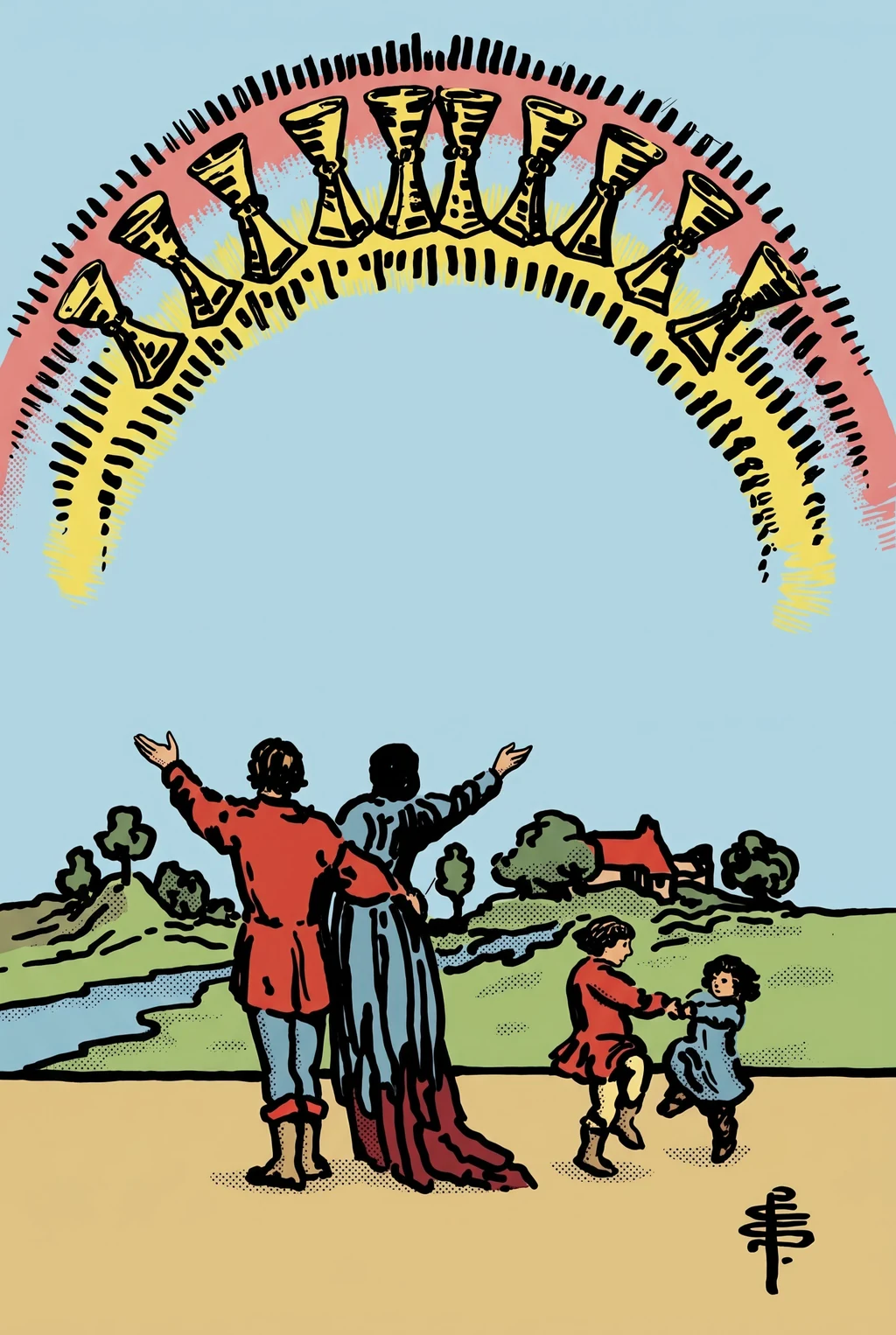
A man holds a woman around the waist, and both raise their free arms toward the sky. They seem to share their delight before they can find the words for it. Above them stretches a rainbow holding ten cups; far away, among green hills, stands a house. Extraordinary happiness sits alongside the simple possibility of being near the people you love.
Beside the couple, two children dance hand in hand. They do not even look up: their faces are turned toward each other. One moment holds different ways of feeling joy. While the adults marvel at the wonder in the sky, the children need only their game and someone to dance beside them.
Core meaning
Shared joy, loved ones, and the feeling that life has come together. Reversed, the card turns to discord, unmet expectations, and the difference between genuine closeness and an outward appearance of happiness.
- Key meanings:Shared joy
- Peace of heart
- Closeness
- Friendship
- Harmony at home
- Fulfillment
- Key meanings:Discord
- Estrangement
- Unmet expectations
- Outward show of happiness
- Conflicting values
- Family conflict
Image and symbols
Card image
Beneath a rainbow holding ten golden cups stand two adults with their backs to the viewer. On the left, the man puts his right arm around the woman and lifts his left arm toward the sky. The woman raises her right arm. To the right, two children dance hand in hand.
The man wears a red tunic; the woman has a blue upper garment and a dark red skirt. Behind them are green hills, trees, and a winding river. A house with a red roof stands in the distance on the right, with blue sky above the entire scene.
Traditional context
For Waite, the Ten of Cups signifies complete contentment of the heart, peace, the perfection of human love, and friendship. The family scene does not exhaust the card's meaning: closeness between friends matters too.
His list of divinatory meanings includes some less familiar interpretations: the town or village where the querent lives and, when several Court Cards appear nearby, someone who looks after the querent's interests. In an additional list, Waite associates the upright card with a fortunate marriage for a man, surpassing his expectations. This is historically gendered language, not a restriction on modern readings.
Waite's reversed meanings are notably harsher than the modern idea of “discord”: he lists the repose of a false heart, indignation, and violence, with sorrow and a serious quarrel added elsewhere. Modern readings also explore unrealistic expectations, an outward idyll without closeness, and the reconsideration of someone else's definition of happiness.
In the Hermetic system of the Golden Dawn, the card bears the title “Lord of Perfected Success.” In the published Liber LXXVIII, happiness, peaceable behavior, and generosity appear alongside possible wastefulness and excess, depending on the card's dignity—that is, its strength and how well it accords with the surrounding cards in a spread. This is not a separate list of reversed meanings.
Ten cups arranged along a rainbow
Emotional fullness: love and joy are presented as a whole that can be shared with others.
A rainbow spanning the entire scene
Reconciliation and hope after a difficult time; an image of blessing that embraces everyone in the scene.
Two adults standing together, embracing
A shared life, trust, and joy that belongs not to one person alone but to the relationships between people.
The adults' raised arms
An open expression of gratitude and joy for what is already there.
Children holding hands and dancing
Spontaneous, carefree joy. In Waite's description, the children are absorbed in their play, paying no attention to the rainbow the adults admire.
A house in the distance
Stability and the comfort of home: shared joy has a place in everyday life.
A winding river
The movement of feeling, linking the peaceful landscape to the emotional themes of the suit.
Colors
- Green — hills, grass, and trees
Growth and renewal, with well-being rooted in ordinary life.
- Red — the man's tunic
In modern esoteric readings, red clothing is associated with Fire, which is joined here by Water.
- Blue — the upper part of the woman's clothing
In modern esoteric readings, blue clothing is associated with Water and the emotional side of the scene.
- Light blue — the sky
In modern color interpretations, the open blue sky can emphasize inner sincerity and a willingness to trust one's feelings.
- Yellow — a band of the rainbow
Joy that is noticed and appreciated; conscious gratitude for what is good.
- Red — the outer band of the rainbow
Warmth and active presence in relationships: happiness finds expression through affection, connection, and shared joy.
Meanings
Ten of Cups — Upright
General
Overall meaning
The Ten of Cups describes a deep sense of fulfillment, when you can quietly appreciate the life you have built. This is less about a single pleasure than a lasting feeling of closeness, harmony, and belonging.
The card can suggest the completion of an important chapter, a reconciliation, a reunion, or a celebration where joy is shared. Unlike the personal satisfaction of the Nine of Cups, the emphasis here is on well-being shared with others.
Possible support
A supportive circle: people with whom you can share difficulties as well as joy.
Possible difficulty
The wish to preserve harmony can become a demand that everyone feel equally happy. Uncomfortable differences are then left unspoken to protect the picture of togetherness.
Focus
Notice what already brings you satisfaction. Quiet contentment is easy to overlook when you are focused on finding the next exciting experience.
Reflection questions
- What in my life has already turned out the way I hoped?
- What joy would I like to share?
Relationships
Overall meaning
In relationships, this is a card of mutual care, trust, and joy in a shared life. For a couple, it can suggest a stable partnership, readiness for long-term commitment, or a conversation about marriage or a home together.
Its meaning extends beyond romance to family, friendship, and communities where people find acceptance and mutual support. A reunion after time apart, a family celebration, or a shared vacation can all express this closeness.
Possible support
Mutual support and respect: loved ones not only enjoy one another's company but also help each person pursue what matters to them.
Possible difficulty
Closeness needs ongoing care. Harmony becomes fragile when shared goals and needs go undiscussed because the relationship is assumed to be settled.
Focus
Notice how you stay connected in everyday conversations. Is there room for openness and mutual understanding?
Reflection questions
- How do we support each other on ordinary days?
- Which loved one would I like to spend more time with?
Work and study
Overall meaning
Work brings a sense of belonging: a shared goal, supportive colleagues, and satisfaction in what you accomplish together. The card can suggest the successful completion of a project and recognition of everyone's contributions.
Life beyond work matters, too. When the question concerns a change in one's working life, the card is sometimes read as retirement or making more time for family, if that is the transition under consideration.
Possible support
Cooperation built on mutual respect and a willingness to help. A shared goal allows people to bring their efforts together.
Possible difficulty
Professional achievements may call for a new balance between work and personal life. The challenge is to preserve time for loved ones and for yourself.
Focus
Consider whether your current work leaves enough room for your personal life. For this card, satisfaction with a stage of your career also includes what happens outside of work.
Reflection questions
- What helps me feel part of a team?
- Does my work leave enough time for my loved ones?
Money and resources
Overall meaning
In financial matters, the Ten of Cups speaks to having enough and enjoying a stable home life: there is money for everyday needs, and finances do not disturb the peace at home. This does not necessarily mean great wealth.
When the question concerns shared finances, the card can suggest a household living within its means and support from loved ones.
Possible support
Shared material support: household income, available resources, and help from loved ones when the question concerns a shared home.
Focus
Consider how money contributes to a peaceful family life. Prosperity here is about stability, not necessarily great wealth.
Reflection questions
- Which everyday needs can I already cover without worry?
- What shared financial support can I count on under our agreements?
Wellbeing and self-care
Overall meaning
The card describes emotional peace and contentment, the chance to relax and spend time with people who put you at ease. In this reading, well-being feels like stability and a pleasant everyday life rather than a constant emotional high.
Possible support
Quiet time together and rest with loved ones can nurture warmth and emotional steadiness.
Possible difficulty
Trying to preserve family harmony at any cost can leave your own needs overlooked.
Focus
Make time for peaceful activities that support emotional balance, such as a walk in nature.
Reflection questions
- Who can I truly relax around?
- What quiet activities help me feel better?
Personal growth
Overall meaning
In personal growth, the card points to inner fulfillment and living in keeping with your values. What matters is not only outward success but whether the shape of everyday life truly suits you.
It also speaks to appreciating simple pleasures without constantly seeking validation from others.
Possible support
Knowing what brings you fulfillment helps you make choices without continually measuring your life against someone else's idea of success.
Possible difficulty
The desire to belong can mean setting aside your own needs and plans. Loyalty becomes an obstacle when preserving harmony requires you to keep putting yourself last.
Focus
Compare the possibilities ahead with your values. Separate the wish to live a certain way from the wish to be praised for it.
Reflection questions
- Which parts of my idea of a good life are truly my own?
- What simple pleasures do I value regardless of others' opinions?
Ten of Cups — Reversed
General
Overall meaning
The picture of happiness does not match how it feels. From the outside, life may look settled, yet closeness, harmony, or fulfillment is missing. Another reading involves open conflict and the loss of familiar support.
This does not necessarily mean that everything good is gone: the expectation of perfect happiness can also make real life feel disappointing. Reversed, the card may turn attention inward, toward the question of what kind of life truly suits you.
Possible support
If your usual circle cannot offer support, you can look beyond it. A lack of family support does not mean there is no one else to turn to.
Possible difficulty
Unresolved conflict among loved ones can make it hard to attend to other parts of life. Discord takes up attention, and attempts at reaching agreement keep returning to the same argument.
Focus
Notice the difference between wanting harmony and expecting others to fit a preconceived ideal. Maintaining appearances is not the same as maintaining a connection.
Reflection questions
- Where does the outward appearance of happiness differ from how I actually feel?
- Am I expecting everything to be fine only when there are no disagreements at all?
Relationships
Overall meaning
For a couple, the card can suggest mismatched expectations, a lack of open communication, or a relationship that looks happier than it feels. There may be difficulties with long-term commitment, a breakup, or the realization that the relationship's former shape no longer fits.
In family and friendships, it can be read as arguments, estrangement, or a loss of support. Sometimes it reflects a change in family life, such as the feelings that follow grown children leaving home, rather than an absence of love.
There is also an inward reading: reconsidering what you want from closeness and how you are willing to give and receive care. The card's appearance alone does not decide between repairing a relationship and parting ways.
Possible support
Common ground for reopening a conversation: a willingness to hear each other and acknowledge both people's needs.
Possible difficulty
Unrealistic expectations and unspoken hurts deepen the distance. For a couple, interference from relatives can be another source of tension.
Focus
Distinguish everyday disagreements from persistent differences over important matters. It is worth discussing not only whether reconciliation is possible, but also what kind of closeness each person truly wants.
Reflection questions
- Is there a subject we avoid to keep the peace?
- What kind of closeness do I actually want, apart from an ideal picture of a relationship?
Work and study
Overall meaning
Reversed, the card can describe a divided team, strained communication, and the feeling that your contribution goes unnoticed. Even interesting work can lose its appeal when cooperation or a sense of belonging is missing.
Another emphasis is overwork: the job takes up so much time that personal relationships and rest fall by the wayside.
Possible support
Clarifying shared work goals and rebuilding cooperation may provide support when team relationships are the central problem.
Possible difficulty
Personal conflicts can make it hard to focus on work; tension between colleagues can, in turn, undermine their shared efforts.
Focus
Identify what is missing from your current job: cooperation, recognition, or alignment with your professional goals. These are distinct sources of dissatisfaction.
Reflection questions
- What am I missing in the way we work together?
- Which of my plans keep getting pushed aside because of work?
Money and resources
Overall meaning
Money becomes a source of disagreement: how much to spend, which needs count as shared, and who controls the funds. Different priorities between partners or family members undermine a sense of stability.
The card can also suggest expenses that exceed available means or a decline in financial support once provided by family.
Possible support
Talking openly about a shared budget helps make differences in priorities clear before they turn into another argument about money.
Possible difficulty
The gap between expectations and available funds becomes harder to manage when people sharing a budget prioritize different expenses.
Focus
Review regular and unexpected expenses, and clarify which costs everyone has actually agreed to share. The focus here is on spending, not on seeking promised income.
Reflection questions
- Do we agree on which shared expenses matter most right now?
- Are there expenses my current budget cannot cover?
Wellbeing and self-care
Overall meaning
The reversed Ten of Cups can describe emotional exhaustion from strained relationships, disappointment, and loneliness even among familiar people. Your usual circle no longer feels supportive.
Possible support
Time alone, a favorite activity, or a peaceful spell in nature may help you reconnect with yourself.
Possible difficulty
The challenge is that emotional strain can leave you needing support while also feeling distant from the people you usually rely on.
Focus
Consider what boundaries in your interactions would bring you peace. Keeping the peace at any cost does not have to be the only way to care for a relationship.
Reflection questions
- Do I have enough time for quiet and peace?
- Is there a boundary I need to communicate in my relationships?
Personal growth
Overall meaning
The card may point to living by someone else's definition of happiness. Familiar goals look right on the surface but no longer align with your own wishes and beliefs.
This reading involves reevaluation: which inherited ideas are worth keeping, and which no longer need to be requirements for a fulfilling life?
In a constructive reading, it means letting go of the idea that there is only one right way to be happy. Home and close relationships can take their own shape without repeating a conventional family story.
Possible support
Reflecting on your own wishes and writing about your experiences can help you hear yourself more clearly when familiar points of reference no longer fit.
Possible difficulty
The difficulty arises when you gradually hand over to others the right to decide what will make you happy.
Focus
Clarify what you truly believe and what brings you fulfillment now. Having once agreed with someone else's expectations does not replace making your own choice.
Reflection questions
- Which goals am I holding on to mainly for approval?
- Which supposed requirement for happiness would I like to let go of?
Roles in a spread
Position examples
A position gives the card a question, such as what helps or what gets in the way. That question shapes how you read its meaning.
Ten of Cups — Upright
Situation
There is harmony and satisfaction with what has been achieved; a shared outcome and the chance to enjoy it together are central to the situation.
Influence
In Waite's historical interpretation, if several Court Cards appear nearby, the Ten of Cups can indicate someone who looks after the querent's interests.
Motivation
A desire to preserve togetherness and harmony. Taken too far, it can become an expectation that everyone must think and act alike for the sake of unity.
Support
A supportive circle of people becomes a source of strength. You can turn to them for care rather than facing everything alone.
Obstacle
The desire for harmony becomes an obstacle when it means hiding differences or conforming to a single accepted picture of a good life.
Focus of attention
Look at the well-being already present as a whole: one unpleasant detail does not necessarily erase the support and satisfaction within it.
Next step
Strengthen what brings people together: support your loved ones, invite someone who has been left out to take part, or suggest sharing a moment of joy.
Possible development
If supportive relationships and coordinated efforts continue, this stage may come to a satisfying close, bringing a sense of stability and things falling into place.
Ten of Cups — Reversed
Situation
Shared well-being has become uncertain: the relationship remains intact on the surface, but harmony and fulfillment are lacking, or conflict has already come into the open.
Influence
Tension among loved ones may affect the situation: family disagreements draw attention away and complicate other matters.
Motivation
Disappointment may inspire a search for more genuine harmony and emotional fulfillment. Another possibility is the wish to find them through others' unquestioning approval and agreement.
Support
When your usual circle is not supportive, help from outside it may offer a source of strength.
Obstacle
Unresolved conflicts and a lack of agreement stand in the way of progress. Their effects may reach far beyond the immediate conversation or relationship.
Focus of attention
Distinguish genuine connection from efforts to preserve its appearance. If arguments keep recurring, notice your own part in the pattern without making yourself solely responsible.
Next step
Stop trying to create unity through pressure. Clarify where you differ and discuss what you can genuinely agree on, without asking others to fit an ideal picture.
Possible development
If those involved cannot reach an understanding and support continues to weaken, this stage may end in disappointment and further distance between people.
Combination examples
Card combinations are in development. For now, here are a few examples.
Ten of Cups + The Lovers
Ten of Cups ( upright) + The Lovers ( upright)
- Example question:
- What connects us as people who are close to one another?
- Example interpretation:
Together, these cards emphasize family bonds and growing closer. The Ten of Cups highlights the happiness shared within a relationship.
Ten of Cups + The Star
Ten of Cups ( upright) + The Star ( upright)
- Example question:
- How does this pair describe the experience of joy?
- Example interpretation:
The Star and the Ten of Cups reinforce positive feelings and the ability to see what is good. Their shared emphasis is joy and a sense of well-being.
Ten of Cups + The Tower
Ten of Cups ( upright) + The Tower ( upright)
- Example question:
- What opposing states meet in this situation?
- Example interpretation:
The calm of the Ten of Cups contrasts with the upheaval and chaos of The Tower. The pair brings harmony face to face with its disruption.
Ten of Cups + The World
Ten of Cups ( upright) + The World ( upright)
- Example question:
- How can I read the feeling of completion and fulfillment?
- Example interpretation:
The World deepens the emotional fullness of the Ten of Cups: both cards focus on fulfillment and happiness.
Ten of Cups + The Magician
Ten of Cups ( upright) + The Magician ( upright)
- Example question:
- How can I use my skills toward a shared goal with loved ones?
- Example interpretation:
The Magician's initiative takes on a family focus. Skills are put toward a shared life and caring for everyone's well-being; one possible emphasis is a project loved ones conceive together.
Reading example
An imagined one-card reading shows how the meanings above can apply to a question. This is one possible interpretation.
Ten of Cups — Upright
Situation:
You and someone close to you are talking about living together. The thought of a cozy home is exciting, but you have not yet discussed how each of you likes to spend free time or divide household chores.
Question:
What matters to discuss before living together?
-
Card drawn:
Imagine drawing a card for the position «What to pay attention to» and getting Ten of Cups (upright).
Interpretation:
The Ten of Cups draws attention to the joy of everyday life together. In this situation, it invites you to discuss not only housing and responsibilities, but also what helps each of you feel at home.
You might tell each other what an ordinary evening together would ideally look like and what kinds of care matter most. That gives the conversation about moving in together a shared human meaning beyond the practical details.
Ten of Cups — Reversed
Situation:
You and someone close to you are talking about living together. The thought of a cozy home is exciting, but you have not yet discussed how each of you likes to spend free time or divide household chores.
Question:
What matters to discuss before living together?
-
Card drawn:
Imagine drawing a card for the position «What to pay attention to» and getting Ten of Cups (reversed).
Interpretation:
The reversed Ten of Cups highlights the gap between an appealing picture and real expectations. The same image of a cozy home can mean different habits to different people, even if no disagreements have surfaced yet.
Before deciding to move in together, you can compare your expectations around free time, personal space, and household responsibilities. There is no need to assume they are incompatible; it helps to let the differences come out in conversation.
Yes / No
Ten of Cups — Upright
Why this answer
Yes. The Ten of Cups links a positive answer to a satisfying conclusion, harmony, and support. This response is especially fitting for questions about shared life, cooperation, and long-term goals.
A clarification
In a multi-card spread, consider whether the surrounding cards support the overall positive picture. This “yes” fits especially well when challenges are manageable rather than standing in the way of agreement.
A question to consider
What exactly would count as a satisfying outcome for me?
Ten of Cups — Reversed
Why this answer
No. The reversed Ten of Cups connects an unfavorable answer with discord, conflicting expectations, and too little support for the desired outcome.
A clarification
If the question concerns an existing couple, consider whether interference from relatives is contributing to the tension. In that case, the partners' ability to support each other matters, not just the disagreement between them.
A question to consider
Is there a disagreement that needs to be discussed before the outcome I want can seem possible?
Correspondences
Connections with numbers, elements and other symbols add depth to the card’s imagery. They can differ between traditions.
Number — X (10)
The Ten brings its suit's theme to fullness: for Cups, this is joy, peace, and love among those close to us.
Element — Water
The element of Cups connects the card with feelings, closeness, and one's inner state.
Astrology — Mars in Pisces; the final decan of Pisces
An astrological correspondence associated with “perfected success” and completion. In this system, it also relates to peaceableness and generosity, or to excess when the card is poorly dignified.
Tree of Life — Malkuth
The tenth sephirah, associated with consolidation and completion. For the Ten of Cups, this means well-being brought into a stable form.