
The Tower
Descriptions and symbolism are based on the card’s classic illustration in the Rider–Waite–Smith deck. Details of the artwork may differ in other editions of the deck.
This guide brings together traditional and modern readings. Interpretations and answers may differ between authors and schools.
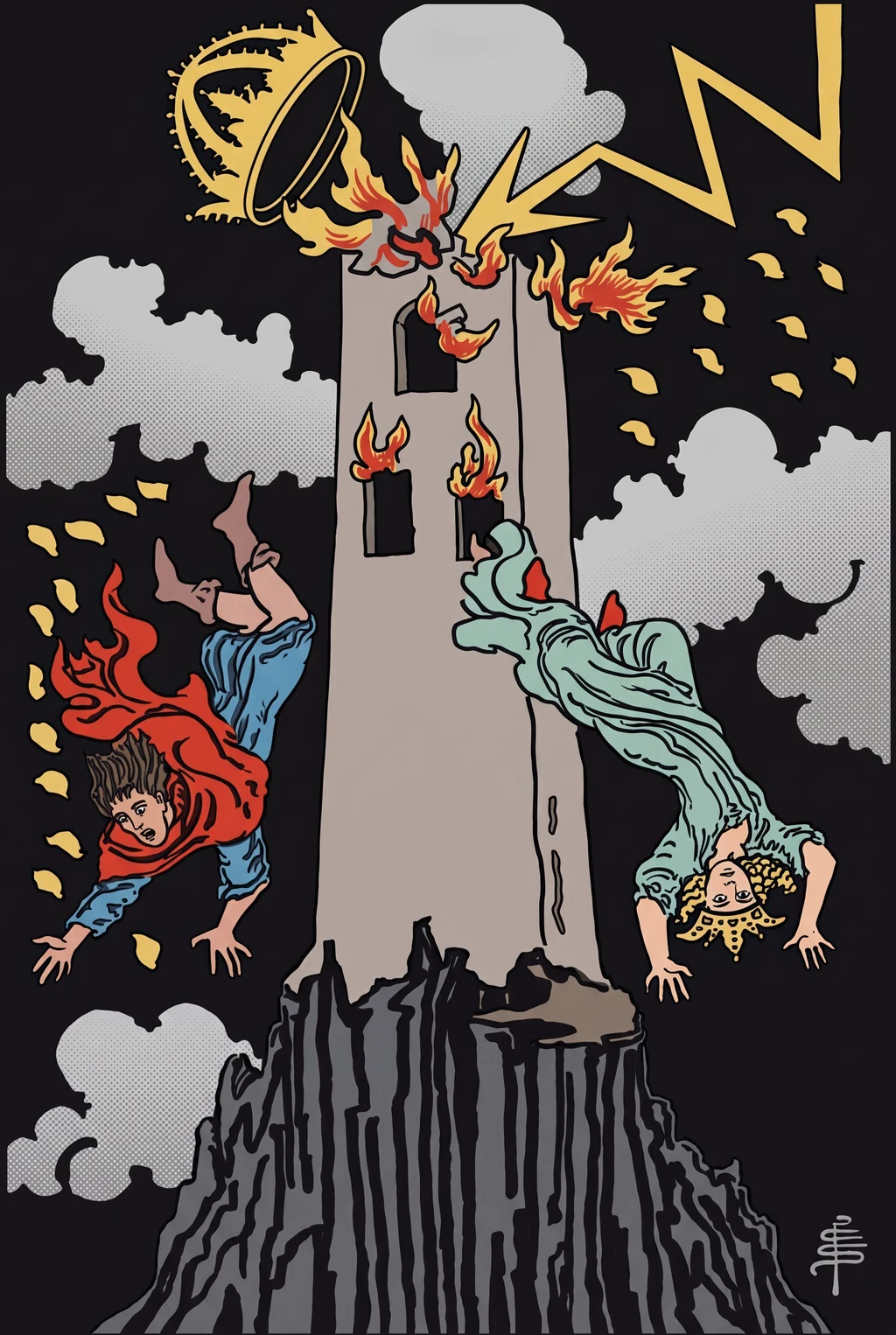
Two people are falling from a great height, and the tower behind them can no longer shelter them. Lightning knocks the crown from its summit, and fire bursts from the windows. The stone walls that once separated the space within from the danger outside no longer offer protection.
Waite saw this as the destruction of the “house of falsehood.” In this reading, the tower recalls beliefs that seemed so dependable they no longer needed to be questioned. Now it is impossible to remain inside the old explanations: the blow has struck their very foundation. The falling figures can still see the familiar walls, but there is no floor beneath their feet. Only air separates them from the burning tower.
Core meaning
The Tower represents a sudden break in the familiar order and a moment of abrupt clarity. It shows old assumptions or agreements falling apart, creating a need to build differently.
- Key meanings:Shock
- Sudden change
- Destruction
- Exposure
- Realization
- Release
- Key meanings:Resistance to change
- Inner reassessment
- Delayed crisis
- Lessened upheaval
- Recovery
- Restriction
Image and symbols
Card image
A tall tower stands on a rocky summit. Lightning strikes its top, knocking off a crown-shaped structure as fire bursts from the windows. On either side of the building, two figures fall headfirst with their arms outstretched. Small tongues of flame scatter around them.
Traditional context
Waite reads The Tower primarily as the destruction of false doctrine: a human-made system of explanations cannot withstand an encounter with truth. He distinguishes this intellectual catastrophe from submission to material desires in The Devil. Waite considers an interpretation of the scene solely as punishment for pride insufficient.
His list of divinatory meanings is notably harsher: calamity, distress, disgrace, deception, ruin, and above all unforeseen catastrophe. For the reversed card, he gives the same meanings to a lesser degree, as well as oppression, imprisonment, and tyranny. This list cannot be reduced to today’s shorthand of “fear of change.”
Modern practice also associates sudden crisis with realization, freedom from untenable beliefs, and eventual recovery. That does not mean every loss must be called beneficial: the possibility of rebuilding differently does not erase the pain of what has been destroyed.
Tall tower
An image of a belief system or an established order. For Waite, it is above all the “house” of false doctrine, being brought down.
Tower on a rocky summit
In modern readings, it emphasizes an unstable foundation: an imposing structure may rest on flawed assumptions.
Lightning striking the top of the tower
A sudden realization or outside force that sharply disrupts the established order. Hermetic tradition associates this force with Mars.
Crown-shaped top knocked loose
The loss of former authority and certainty in being right. The crown may stand for the rule of reason, whose explanations can no longer hold everything together.
Two falling figures
Their fall conveys a loss of safety. Waite offers a particular reading of the two figures: one is associated with the literal word that has lost its power, the other with its false interpretation.
Fire in the windows
The building is no longer a refuge. In a Hermetic reading, the burning house points to the need to leave the old order behind rather than continue living as though nothing has changed.
Twenty-two small tongues of flame around the tower
In modern esoteric readings, these are associated with the twelve signs of the zodiac and the ten sephiroth of the Tree of Life. A sefirah here means one node in a symbolic model of the cosmos.
Meanings
The Tower — Upright
General
Overall meaning
The Tower points to an abrupt break with the old order. A plan falls through, a familiar structure stops working, or a fact comes to light that makes the previous explanation untenable. What matters here is the suddenness and scale of the reassessment, not just any minor setback.
In an event-focused reading, this can be a crisis and a loss of stability; on an inner level, it can be an insight that shatters an illusion. Freedom from false certainty may open the way to rebuilding, but the change itself can be painful.
Possible support
The clarity that follows when an illusion falls away. It offers a more honest foundation for rebuilding, without restoring the old appearance of stability.
Possible difficulty
The shock can leave you without familiar points of reference. It is especially hard to let go of something that seemed dependable for a long time.
Focus
Look at what has already stopped working and where a problem now calls for direct attention. Trying to keep everything unchanged may conceal the very cause of the crisis.
Reflection questions
- What new information is changing how I see what is happening?
- What do I still consider reliable, even though it has stopped working?
Relationships
Overall meaning
In a relationship, The Tower can point to a sharp conflict, the unexpected disclosure of something important, or a breakdown in previous agreements. Sometimes the relationship itself comes into question; sometimes it is the way the partners build it together that changes. For someone who is single, the reassessment may concern ideas about love and personal expectations.
In family and friendships, the card can also reflect an upheaval in familiar dynamics: an argument, a disagreement brought to light, or an event that calls for a new way of relating to one another.
Possible support
An honest conversation can help both people understand what has changed and reach new agreements, if both are willing to sustain the relationship.
Possible difficulty
A serious disagreement may expose a weak foundation in the relationship: the familiar way of being together no longer holds up under pressure.
Focus
In a romantic relationship, notice the difference between the relationship as it actually is and an attachment to the role of a “good partner” that keeps an unsatisfying bond in place.
Reflection questions
- What changed in my relationship after our last serious conversation?
- What belief about intimacy might I need to reconsider?
Work and study
Overall meaning
At work, The Tower represents a sudden change in circumstances: a reorganization, a derailed project, a colleague leaving, or losing a job. The change can also look positive from the outside, such as a new position that unexpectedly increases responsibility and disrupts an established routine.
Possible support
The ability to adapt to new circumstances makes it easier to reconsider your career direction rather than simply try to restore the old order.
Possible difficulty
A sudden disruption leaves little time to adjust; familiar responsibilities or ways of working may no longer fit the situation.
Focus
In a tense conversation at work, pay attention to your tone. Harsh words can add personal conflict to an organizational problem.
Reflection questions
- Which aspects of my work have changed so much that the old plan no longer fits?
- How can I discuss the problem without making the conflict worse?
Money and resources
Overall meaning
In money matters, The Tower is associated with a sudden expense, a loss of income, or the collapse of a plan that seemed reliable. It draws attention to how vulnerable financial stability can be when circumstances change unexpectedly.
Possible support
Money set aside in advance can soften the impact of an unexpected loss or expense.
Possible difficulty
Expenses and obligations that are manageable only while income stays constant are especially vulnerable to disruption.
Focus
Check how reliable the estimates and agreements behind your financial plan really are.
Reflection questions
- Which unexpected expense would disrupt my budget the most?
- Which source of income am I counting on to remain unchanged?
Wellbeing and self-care
Overall meaning
The Tower can describe emotional upheaval: confusion, fear, and the sense that a familiar source of support has disappeared. At the same time, a sudden break can also feel like release from old constraints.
Possible support
Letting go of old internal restrictions may create room for a different approach to self-care.
Possible difficulty
Intense feelings can take over your attention and deepen the sense of instability.
Focus
It may be worth looking again at your daily routine, including accumulated sleep loss and habitual ways of coping with stress that no longer help.
Reflection questions
- What is troubling me after a recent change?
- What brings me relief?
Personal growth
Overall meaning
The Tower is associated with rethinking a belief that once explained a great deal but no longer fits lived experience. A familiar worldview, sense of identity, or trust in someone else’s authority may come into question. The realization can be sudden: the old idea can no longer be defended as convincingly as before.
Possible support
Freedom from a limiting belief makes it possible to seek a more honest explanation of your own experience.
Possible difficulty
When an important belief system falls apart, it can be difficult to know which earlier conclusions are still trustworthy.
Focus
Notice which beliefs you find yourself defending despite what has now become clear.
Reflection questions
- Which of my beliefs no longer fits my experience?
- What becomes possible when I stop defending it?
The Tower — Reversed
General
Overall meaning
The Tower reversed can point to delayed or internal change. The problem is already visible, but fear of losing what is familiar leads to postponing its acknowledgment. In another reading, a person is reconsidering their own beliefs, so an outward rupture is not necessary.
Other meanings include an upheaval that has been lessened or averted, as well as recovery after a crisis that has already happened. These distinctions matter: a temporary lull, a resolved underlying cause, and life after a breakdown are not the same thing.
In Waite’s historical list of meanings, there is also a distinct sense of lost freedom: oppression, imprisonment, and tyranny. It is not equivalent to the modern idea of fear of change.
Possible support
Early signs of instability give you a chance to prepare and reduce the impact of change.
Possible difficulty
Denial and attempts to hold on to the old order at any cost prolong the problem. A situation that looks calm on the surface may remain unresolved.
Focus
Distinguish between necessary restructuring and expecting the worst. In this orientation, The Tower also draws attention to excessive fear that can magnify the sense of catastrophe.
Reflection questions
- What am I putting off so that nothing has to change?
- What has already changed within me, even though everything looks the same on the outside?
- What can help me distinguish a real problem from the expectation of the worst?
Relationships
Overall meaning
In a relationship, tension may remain unspoken: an argument is avoided, but resentment and unresolved questions build up. Another reading concerns a conflict that has already happened and the gradual rebuilding of trust. Sometimes the card points to a readiness to leave a relationship that is not working.
With family and friends, it can suggest a conflict that is fading while questions remain that call for reconciliation and a new understanding of one another.
Possible support
Rebuilding trust through honesty and a willingness to work through remaining misunderstandings can provide support.
Possible difficulty
In a relationship, avoiding difficult subjects maintains outward peace while leaving the sources of tension untouched.
Focus
In a relationship, notice resentments left unspoken to avoid an argument. An issue that starts small can become serious if it is repeatedly sidestepped.
Reflection questions
- What subject am I avoiding just to prevent an argument?
- What remains unresolved for me after we made up?
Work and study
Overall meaning
The Tower reversed can mean that an upheaval at work was weathered without the worst consequences, or that you are now dealing with the fallout. Yet keeping a job does not necessarily mean being satisfied with it: fear of change can keep someone in a role that has not been right for them for a long time.
Possible support
Examining what went wrong can help improve work processes and avoid repeating earlier mistakes.
Possible difficulty
Familiar methods that no longer work, along with fear of changing direction, can delay needed career changes.
Focus
Separate the relief of keeping your job from the question of whether the job itself is right for you.
Reflection questions
- What keeps me in this job besides fear of change?
- Which cause of a past disruption at work can I still address?
Money and resources
Overall meaning
A financial crisis may have been eased or postponed, while its underlying cause remains. The distinction here is between temporary relief and resolving an ongoing shortfall.
Possible support
A reprieve is useful when it gives you a chance to reconsider obligations and strengthen a weak spot in the budget.
Possible difficulty
Maintaining an unaffordable arrangement can turn each new payment into a repeat of the previous crisis.
Focus
Check how much your budget depends on everything going according to plan. Growing obligations and unreliable income deserve particular attention.
Reflection questions
- What has changed for the long term in my budget, and what has only brought temporary relief?
- Which obligation keeps leaving me without the funds I need?
Wellbeing and self-care
Overall meaning
After a period of intense stress, relief may come alongside anxiety that the crisis will return. Another reading concerns inner tension kept hidden beneath an outward appearance of calm.
Possible support
A calmer attitude toward uncertainty can help: allowing yourself to feel what you feel without adding panic or expecting the worst.
Possible difficulty
Anticipating another upheaval can keep tension alive even during a quiet period.
Focus
Notice feelings you keep having to hide or hold back. Outward calm and the absence of inner tension are not the same thing here.
Reflection questions
- What tension remains in me now that things around me have become calmer?
- What is difficult for me to acknowledge about my own feelings?
Personal growth
Overall meaning
Change may be unfolding from within: a person is reconsidering their values, purpose, and sense of self, even though little has changed outwardly. The opposite reading involves refusing that reassessment and holding on to old beliefs for the sake of familiar certainty.
Possible support
Making sense of past upheavals can provide a foundation for new choices instead of a return to the same familiar pattern.
Possible difficulty
Fear of losing an old sense of identity can keep someone tied to beliefs that no longer fit.
Focus
Notice where a reassessment has already begun and where you keep putting off reflection because its conclusions feel uncomfortable.
Reflection questions
- Which of my views has already changed, even though I have not said so aloud?
- What lesson from a past upheaval have I not yet taken into account?
Roles in a spread
Position examples
A position gives the card a question, such as what helps or what gets in the way. That question shapes how you read its meaning.
The Tower — Upright
Situation
A familiar structure breaks down abruptly: the old order can no longer explain or sustain what is happening.
Influence
A change that cannot be fully controlled enters the situation, forcing you to account for new circumstances.
Motivation
The impulse may be to break free from an order that no longer feels right and stop maintaining an unstable structure. Sometimes a person is ready for a radical reassessment precisely because freedom from old constraints matters more than keeping up an appearance of calm.
Support
The Tower’s helpful quality here lies in clarity: once a falsehood is exposed, it no longer has to determine the next decision.
Obstacle
The shock disrupts stability, while the need to let go of what is familiar makes it harder to move forward.
Focus of attention
Focus on what has stopped working, and do not sidestep a problem that needs to be faced directly.
Next step
Acknowledge what is no longer working and consider a way out of the structure rather than endlessly propping it up.
Possible development
If the old order continues to lose stability, the situation may reach a breaking point and require rebuilding.
The Tower — Reversed
Situation
Change is being held back or experienced internally. In another context, this may be the aftermath of an upheaval and the beginning of recovery.
Influence
The effects of an earlier breakdown continue to shape the present situation.
Motivation
The desire to keep things as they are may come from fear of change and the loss of familiar certainty.
Support
Noticing a threat early creates an opportunity to prepare and reduce the severity of its consequences.
Obstacle
The urge to preserve the familiar order makes it harder to acknowledge the problem and delays a necessary change.
Focus of attention
Consider whether expecting the worst is making the problem you actually need to address feel bigger.
Next step
After an upheaval, focus on recovery. If the change is still ahead, consider a less abrupt way to restructure things.
Possible development
If an already visible problem continues to be denied, tension may grow and the necessary change may become more painful.
Combination examples
Card combinations are in development. For now, here are a few examples.
The Tower + Death
The Tower ( upright) + Death ( upright)
- Example question:
- How deeply is the situation in question changing?
- Example interpretation:
Both cards reinforce the theme of sweeping change that leaves the old order without a stable foundation.
The Tower + The Sun
The Tower ( upright) + The Sun ( upright)
- Example question:
- What became clearer after an unexpected turn?
- Example interpretation:
This pairing emphasizes clarity: the blow to an old certainty comes with the revelation of something that was not apparent before.
The Tower + The Star
The Tower ( upright) + The Star ( upright)
- Example question:
- How do upheaval and calm relate to each other in this situation?
- Example interpretation:
The Star offers a counterpoint of calm to The Tower’s unsettling suddenness. Together, the cards help distinguish upheaval from a more peaceful state without treating them as the same thing.
Reading example
An imagined one-card reading shows how the meanings above can apply to a question. This is one possible interpretation.
The Tower — Upright
Situation:
You and your partner had planned to move in together. During a conversation, you discovered that you have different ideas about living together. There is still time to change the plan, but you are unsure whether to keep preparing as though the conversation changed nothing.
Question:
What should I pay attention to before our next conversation about moving?
-
Card drawn:
Imagine drawing a card for the position «What to pay attention to» and getting The Tower (upright).
Interpretation:
The Tower highlights the moment when the old understanding no longer holds. The conversation revealed that your shared plan rested on different expectations. It is a reason to discuss not only the move itself but also how each of you imagines life together.
You can begin with the difference that is already clear and find out whether a new agreement is possible before continuing with the old plan.
The Tower — Reversed
Situation:
You and your partner had planned to move in together. During a conversation, you discovered that you have different ideas about living together. There is still time to change the plan, but you are unsure whether to keep preparing as though the conversation changed nothing.
Question:
What should I pay attention to before our next conversation about moving?
-
Card drawn:
Imagine drawing a card for the position «What to pay attention to» and getting The Tower (reversed).
Interpretation:
The Tower reversed draws attention to the desire to avoid returning to a difficult subject. After an uncomfortable conversation, you might continue preparing and mistake the absence of another argument for agreement, even though your different expectations remain.
It may help to return to the unresolved issue while there is still room to change the plan calmly. A starting point could be acknowledging that, for now, you understand this part of living together differently.
Yes / No
The Tower — Upright
Why this answer
No. In this approach to reading, the abrupt disruption of the old order does not support the expected continuation of the situation: the very conditions behind the question are changing.
A question to consider
What condition am I assuming will stay the same in my question?
The Tower — Reversed
Why this answer
No. This answer centers on resistance to change: an unresolved cause keeps the situation stuck and prevents progress.
A question to consider
Is my reluctance to change anything getting in the way?
Correspondences
Connections with numbers, elements and other symbols add depth to the card’s imagery. They can differ between traditions.
Number — XVI (16)
In a numerological reading, 16 is reduced to 7 by adding 1 and 6. This links The Tower with The Chariot: a sudden reassessment of the foundation is set alongside the search for a new direction.
Element — Fire
Emphasizes the suddenness of change and the image of fire destroying an old form. This is an additional elemental attribution; the primary planetary correspondence here is Mars.
Astrology — Mars
Associated with force, confrontation, and sudden disruption of order. In this system, The Tower expresses both destructive momentum and resolve in the face of radical change.
Letter — Peh (פ), “mouth”
Connects the card with words and the power of speech: the mouth is the organ of speaking. This is a Hebrew-letter correspondence, not the name of the falling flames in the illustration.
Tree of Life — Path 27: Netzach — Hod
Connects Netzach, associated with desire and feeling, with Hod, associated with reason and the shaping of thought. Here, The Tower is read as a clash between lived feeling and a rigid mental structure.