
Death
Descriptions and symbolism are based on the card’s classic illustration in the Rider–Waite–Smith deck. Details of the artwork may differ in other editions of the deck.
This guide brings together traditional and modern readings. Interpretations and answers may differ between authors and schools.
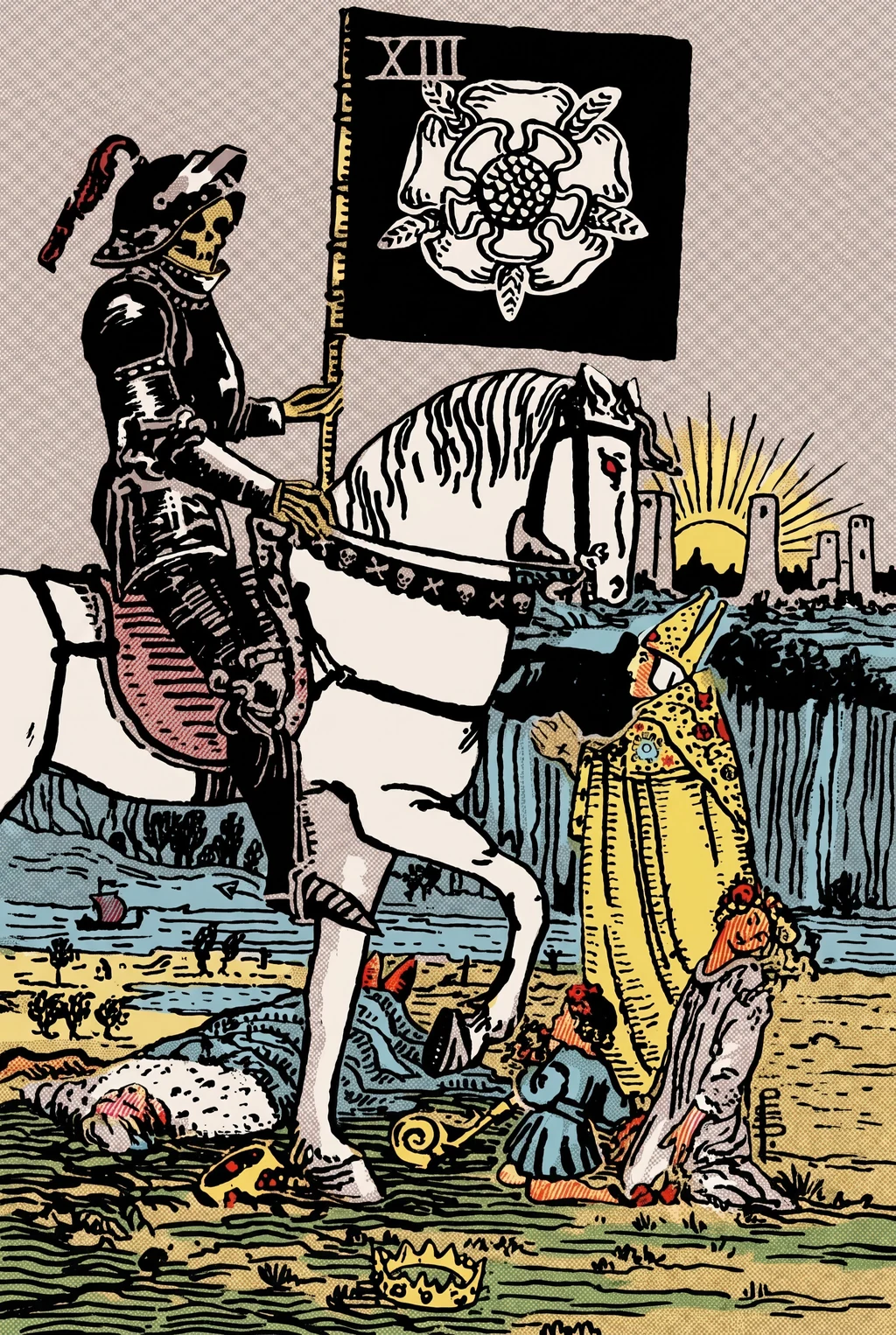
The cleric raises his hands before the rider, as though asking him to stop. The white horse continues at a slow pace. The king already lies on the ground, the young woman turns away, and the child looks toward the horse. Each meets the procession differently, but none of their gestures has changed its course.
The rider carries no visible weapon; he holds a black banner bearing a white rose. Waite saw it as a sign of life and associated the image with a transition between states of human existence. So the eye does not rest on the fallen crown alone. A flower rises above it, and far beyond the figures, sunlight appears between two towers. Even in this scene of loss, there is space the rider has yet to obscure.
Core meaning
Death marks an ending that changes the shape of a life or situation. The card brings together loss and release; reversed, it can point to resistance to change or inner renewal.
- Key meanings:Endings
- Transition
- Loss
- Release
- Profound change
- Key meanings:Resistance to change
- Prolonged ending
- Stagnation
- Fear of the unknown
- Inner renewal
Image and symbols
Card image
A skeleton in black armor rides a white horse facing toward the viewer’s right. A red feather is attached to the helmet, and the rider holds a black banner bearing a white, five-petaled rose. No weapon is visible.
At the lower left lies a king in a light-colored robe, with his crown on the ground nearby. Before the horse stands a cleric in yellow vestments and a miter, his hands raised in front of him. Nearby, a child dressed in blue and a young woman in pale clothing kneel: the child faces the rider, while the woman turns her head away.
Behind the figures is a river with a small boat. A rocky bank rises on the left; in the distance, between two towers, a yellow disk of the sun appears above the horizon. The sky is light gray.
Traditional context
Waite associates Death with life continuing through a change of form. Beyond the outward image of an ending, he sees a transition to another state; the rose on the banner and the sun reinforce the theme of life continuing. He also distinguishes a physical transition from a spiritual change a person may experience while alive.
His list of divinatory meanings is noticeably harsher than his symbolic explanation. Upright, he names ending, mortality, destruction, and decay; reversed, inertia, sleep, lethargy, petrification, sleepwalking, and shattered hope. It would therefore be inaccurate to claim that Waite understood the card solely as a positive renewal.
The Hermetic list in Liber LXXVIII also associates this arcana with time, age, and involuntary, sometimes sudden, change. In modern RWS readings, the focus often shifts to the ending of a relationship, a familiar way of life, or an idea of oneself. Loss may come with release, but neither cancels out the other.
Reversed Death is not read only as a delay: Brigit Esselmont describes an inner transformation not yet visible to others, while Theresa Reed allows for a pause when a person or their circumstances are not ready for action.
The skeletal rider
An image of what survives the destruction of an outer form. Death appears not as a random accident but as a force of transition.
Armor with no visible weapon
The armor conveys the inevitability of Death. The rider needs no battle to keep moving.
A horse with one foreleg raised
The force and steady forward movement of change. The rider approaches without a sudden charge.
A banner with a five-petaled rose
Waite calls the rose a sign of life. Modern interpretations also associate it with immortality, and its five petals with change.
The fallen king and the crown on the ground
Power and status offer no exemption from endings. The crown can no longer protect the one who wore it.
A cleric with hands raised before him
Prayer and an appeal to faith in the face of the inevitable. Religious office does not exempt anyone from a shared human fate.
The woman turning away and the child facing the rider
Different responses to change, from reluctance to look at it to curiosity about the unknown.
The river and a small boat in the background
A crossing between states. The boat recalls the mythological passage from the world of the living to another realm.
The sun between two distant towers
Waite calls it the sun of immortality: the visible ending is not the whole picture of life. The towers frame this distant passage.
The feather on the helmet
An echo of the feather worn by The Fool keeps a sign of vitality in the image of Death: endings and life inhabit the same figure.
Colors
- Black — the rider’s armor
Mourning and the unknown that accompany an encounter with an ending.
- White — the horse
Purity and cleansing as an aspect of change.
- White — the rose on the black banner
The pale flower brings purity and beauty into focus amid images of loss.
Meanings
Death — Upright
General
Overall meaning
Death marks the end of an old chapter or form: continuing as before is no longer possible. This might be a painful parting with the familiar, a release from what is no longer needed, or a profound reshaping of the situation.
What is new here comes through the ending of what was, rather than by adding another possibility to an unchanged life. Change can unfold gradually, but it can also be sudden and arrive regardless of what someone wants.
Possible support
Letting go of what has run its course can offer support by making space for what is truly needed.
Possible difficulty
The difficulty lies in the transition itself: you have to part with the familiar before knowing what will support you next.
Focus
Acknowledge an ending if that chapter really is over. You can make room for loss without demanding that you immediately feel happy about it.
Reflection questions
- What has truly ended in my situation?
- What changes when I stop trying to preserve the old order?
Relationships
Overall meaning
In romantic relationships, the card describes a change in the established form of a bond. This could mean separation, but it could also mean a significant renewal of an ongoing relationship, such as a move toward more clearly defined commitments.
For someone who is single, another perspective matters: an old attachment or familiar way of building intimacy no longer defines new relationships.
In friendship, communication may change, a bond may end, or it may deepen. In family life, the emphasis falls on changes to familiar routines and ways of relating.
Possible support
For an ongoing couple, a willingness to change established patterns of communication helps more than insisting the relationship remain as it was.
Possible difficulty
The need to change expectations and familiar reactions can feel like a threat to the relationship itself.
Focus
Clarify whether the relationship itself is ending or the way you are together. This distinction keeps significant change from being mistaken for an inevitable breakup.
Reflection questions
- What former shape of our relationship is hard for me to let go of?
- How does an experience from a past relationship affect the way I connect now?
Work and study
Overall meaning
A chapter of your working life is coming to an end: your role may change, a project may finish, or you may begin considering a different career path. Sometimes the work environment itself is changing, and the old sense of certainty is gone.
Another theme is parting with a professional identity that has long been part of how you see yourself.
In education, the card can suggest finishing a course or changing your field of study.
Possible support
Being open to another direction can help you leave work that no longer offers interest or growth.
Possible difficulty
A familiar workplace may hold you with the promise of stability even when the work brings apathy or disappointment.
Focus
Look at what has changed in the project’s tasks, responsibilities, and opportunities. Ending a role and changing how you work are different decisions.
Reflection questions
- What has stopped growing in my work?
- Which familiar professional role is difficult for me to reconsider?
Money and resources
Overall meaning
In financial matters, Death can represent the loss of some money or the end of an old way of managing it. Changed circumstances call familiar expenses and past ideas of what is necessary into question.
Another emphasis is a reassessment of what having enough means and which material priorities matter most.
Possible support
Being willing to change a financial habit that no longer fits your circumstances can provide a way forward.
Possible difficulty
Change may require acknowledging a loss or giving up a familiar comfort, and that can be difficult to accept.
Focus
Ask whether “I’ve always done it this way” has replaced a considered decision about recurring expenses or obligations.
Reflection questions
- Which regular expense no longer fits what I can afford?
- How has my idea of having enough changed?
Wellbeing and self-care
Overall meaning
On an emotional level, the card can describe the experience of loss and a change in your familiar sense of self. An ending may bring release while still being painful.
Possible support
It helps to make room to grieve a loss without having to find an immediate benefit in it.
Possible difficulty
Even a welcome ending can carry the pain of loss.
Focus
Notice whether you are rushing to call a loss beneficial before giving yourself space to feel what you feel.
Reflection question
What do I need to grieve before thinking about what comes next?
Personal growth
Overall meaning
The card describes parting with an old self-image, belief, or habit. The change goes beyond behavior: something that once felt like part of your identity no longer defines the life ahead.
Possible support
Releasing beliefs and attachments that now limit your growth can help.
Possible difficulty
Letting go of an old idea of yourself can be frightening when you do not know what will take its place.
Focus
Notice which specific habit or assumption is holding back your growth and needs reconsideration.
Reflection questions
- Which old idea of myself have I outgrown?
- Which habit do I want to leave behind?
Death — Reversed
General
Overall meaning
Reversed Death often describes resistance to a necessary change: the old way no longer works, but letting go feels difficult, or it is unclear how to do it. The ending stretches out, leaving the situation somewhere between old and new.
There is another reading: profound changes are already taking place within, even though almost nothing is visible on the outside. In Theresa Reed’s interpretation, the card can also allow for a sensible pause if a person is not yet ready or circumstances are not right for action.
Possible support
It can help to acknowledge a fear of change and consider what change might look like, without demanding an immediate overhaul of your outer life.
Possible difficulty
Trying to preserve the familiar at any cost can keep a situation stagnant and close off new possibilities.
Focus
Distinguish a pause with a reason from postponement driven only by fear. A lack of outward movement does not, by itself, mean nothing is changing.
Reflection questions
- What am I trying to preserve simply because it is familiar?
- What reason for my pause remains when I separate it from fear?
Relationships
Overall meaning
In a romantic relationship, the card can describe stagnation and a return to old conflicts. Sometimes habit, a sense of obligation, or fear of being alone keeps a relationship going, while the need to change how you communicate goes unaddressed.
Another possibility is rekindling a past relationship. Reconnecting does not, by itself, change the dynamic that caused the relationship to stall before.
In friendship, this can mean difficulty letting go of a bond that has run its course. In families, old roles and avoidance of overdue changes can keep relationships from growing.
Possible support
In romantic communication, it helps to stop repeating the old pattern rather than simply restoring contact.
Possible difficulty
A familiar bond may feel safer than a breakup even when it is no longer fulfilling. Unspoken problems continue to resurface.
Focus
Consider whether an old hurt has truly been released or keeps resurfacing in arguments. Reconnecting does not, by itself, mean the earlier conflict has been resolved.
Reflection questions
- What keeps me in a familiar way of communicating?
- Which old conflict keeps coming up between us?
Work and study
Overall meaning
The card can suggest a prolonged departure from an unsatisfying job or a refusal to change outdated methods. A familiar workplace keeps you there, although tasks have become repetitive, conditions have worsened, or growth has stalled.
Another emphasis is on repeating your own reactions at work, so similar difficulties recur even after changing jobs.
In education, a similar challenge appears as attachment to outdated knowledge or reluctance to learn a new approach.
Possible support
Reconsidering work habits that make it hard to adapt to new tasks or conditions can help.
Possible difficulty
Attachment to an old way of working can slow you down even in a new job: the requirements have changed, but the approach has not.
Focus
Compare your reasons for staying with your current responsibilities and conditions. Delaying may preserve a worthwhile option, or it may simply prolong a problem.
Reflection questions
- Which work habit no longer fits my new circumstances?
- What am I preserving by waiting, beyond the familiar routine?
Money and resources
Overall meaning
Reversed Death can describe difficulty adjusting to changed financial means. Spending stays the same even though there is less money available, and familiar comforts feel impossible to give up.
Possible support
Accepting what you can currently afford can help you rethink expenses instead of continuing an outdated pattern.
Possible difficulty
Reluctance to give up familiar expenses may sustain a pattern that no longer fits the money available.
Focus
Separate present expenses from the feeling of an earlier loss: regret about the past may influence a new decision without showing whether it makes sense.
Reflection questions
- Which expense do I still consider essential simply out of habit?
- Is an earlier loss affecting how I make financial decisions now?
Wellbeing and self-care
Overall meaning
In an emotional reading, this can be fear of the unknown, difficulty adjusting to change, or a sense that saying goodbye never ends. Sometimes a person holds on to an old self-image and cannot find room to grieve a loss.
Possible support
Writing down what you feel may help you name the fear that accompanies change.
Possible difficulty
Avoiding the feelings that come with loss can be accompanied by inner tension and a sense of emotional stagnation.
Focus
Notice which familiar reactions keep you in emotional discomfort, especially when circumstances have already changed.
Reflection question
Which change is difficult for me to process right now?
Personal growth
Overall meaning
Reversed, the card can describe an inner transformation that you are not yet ready to share with others: beliefs, habits, and your relationship with yourself are shifting. Outwardly, life looks the same, but personal change is already underway.
Another reading concerns being stuck in an old self-image. Familiar beliefs are held onto not because they fit, but because what comes next is still frightening.
Possible support
You can allow an inner change to unfold without immediately announcing a new life to everyone.
Possible difficulty
A familiar belief can limit growth even when it has long ceased to fit your current experience.
Focus
Identify the fear behind holding on to an old view. You can begin to examine it privately, without immediately changing your whole life.
Reflection questions
- What has already changed in me, though I have not spoken about it yet?
- Which belief am I keeping out of fear of the unknown?
Roles in a spread
Position examples
A position gives the card a question, such as what helps or what gets in the way. That question shapes how you read its meaning.
Death — Upright
Situation
An old chapter is ending; the situation is losing its former shape and moving into another.
Influence
A major change may be shaping the situation, with consequences that cannot be undone simply by wishing otherwise.
Motivation
The desire to leave the past behind and make a substantial change in your life, rather than adjusting one small detail.
Support
Ending what has run its course makes room and frees energy for what still has room to grow.
Obstacle
The scale of the transition itself can make moving forward difficult: you have to leave the familiar before anything new feels certain.
Focus of attention
Notice what has truly ended and the cost of saying goodbye, without rushing to call every loss a blessing.
Next step
Consider what it is time to end or stop sustaining, so you do not carry an exhausted pattern into the next chapter.
Possible development
Accepting an ending may open the way to a new chapter that no longer fits the old order.
Death — Reversed
Situation
An ending is being delayed, or a substantial change is taking place only within.
Influence
Old views and attachments still shape the situation, even as circumstances call for a different response.
Motivation
Holding on to the past may reflect a desire to avoid the unknown or the feelings that come with saying goodbye.
Support
Acknowledging resistance and beginning to explore it, without taking immediate outward action, can be a source of support.
Obstacle
Holding on to an old form obstructs the transition when it is driven by fear of the unknown.
Focus of attention
Look at why you are delaying: what does the delay preserve, and what change does it help you avoid seeing?
Next step
First, distinguish fear of change from genuine unreadiness. Fear is worth exploring; when circumstances are unfavorable, it is reasonable to pause before acting.
Possible development
If holding on to the old remains the main response to change, the transition may drag on and opportunities may narrow.
Combination examples
Card combinations are in development. For now, here are a few examples.
Death + The Tower
Death ( upright) + The Tower ( upright)
- Example question:
- How might a major change be experienced?
- Example interpretation:
The pairing strengthens the theme of change on a large scale: an ending comes together with a powerful disruption of the familiar order.
Death + Eight of Wands
Death ( upright) + Eight of Wands ( upright)
- Example question:
- What kind of momentum toward an ending does this combination suggest?
- Example interpretation:
Both cards reinforce the idea of a task or chapter coming to an end. The emphasis here is on bringing the situation to a close.
Death + Five of Cups
Death ( upright) + Five of Cups ( upright)
- Example question:
- Which aspect of parting deserves attention?
- Example interpretation:
The theme of an ending takes on a clear emphasis on loss and saying goodbye.
Death + Eight of Cups
Death ( upright) + Eight of Cups ( upright)
- Example question:
- How can we read the transition from a completed chapter to moving forward?
- Example interpretation:
Death and the Eight of Cups reinforce each other’s themes of leaving what is finished and moving on.
Reading example
An imagined one-card reading shows how the meanings above can apply to a question. This is one possible interpretation.
Death — Upright
Situation:
You have been thinking about leaving your familiar job for a long time. You have lost interest in it, but it is hard to imagine yourself outside the team and role you know. You keep putting off the decision.
Question:
What will help me think through leaving this job?
-
Card drawn:
Imagine drawing a card for the position «What will help me find clarity» and getting Death (upright).
Interpretation:
Death draws attention to the end of a professional chapter. Perhaps it is difficult to part not only with the work itself but with a role that has long shaped your sense of who you are.
You might begin by naming exactly what has run its course in this job and what you no longer want to return to. This can help you see leaving as the end of a particular chapter, not a rejection of everything you have experienced there.
Death — Reversed
Situation:
You have been thinking about leaving your familiar job for a long time. You have lost interest in it, but it is hard to imagine yourself outside the team and role you know. You keep putting off the decision.
Question:
What will help me think through leaving this job?
-
Card drawn:
Imagine drawing a card for the position «What will help me find clarity» and getting Death (reversed).
Interpretation:
Reversed Death highlights the reason for the delay. Perhaps a familiar role is holding you back, or perhaps the right conditions for a change are not yet in place.
It is worth separating what requires preparation from the fear of leaving the familiar. Then you can see what purpose the pause serves and what needs to become clearer before deciding.
Yes / No
Death — Upright
Why this answer
Yes. In this reading, the answer is tied to renewal through the end of an earlier chapter. The opportunity comes with significant change, not with keeping everything as it is.
A clarification
Consider what renewal involves: the old chapter must end before a new one can begin. This “yes” does not mean things can remain unchanged.
A question to consider
What will I need to let go of for this change?
Death — Reversed
Why this answer
No. This answer is associated with resistance to change: a familiar pattern is being maintained, delaying a necessary transition. The card does not support expecting a new result while keeping that pattern intact.
A clarification
For a question about making a change right now, consider your readiness to let go of the past. In this reading, “no” may reflect poor timing rather than a permanent prohibition against change.
A question to consider
What is keeping me from letting go of the old pattern?
Correspondences
Connections with numbers, elements and other symbols add depth to the card’s imagery. They can differ between traditions.
Number — XIII (13)
The number of the Death arcana. Waite associates this stage with transition and a change in the form of life.
Number — XIII (13)
The number expresses continuous creation and renewal. The ending of one form is connected with the beginning of a new cycle of life.
Element — Water
The elemental association comes through the sign of Scorpio, not through the river shown in the image.
Astrology — Scorpio
This Hermetic correspondence links the card to transformation and a change of state. It is an attribution of the sign, not a prediction of when an event will occur.
Letter — Nun (נ), “fish”
Nun corresponds to the thirteenth Key. In this school it expresses the continuous transformation of life and consciousness.
Tree of Life — 24th Path: Tiphareth — Netzach
The path is associated with Nun and Scorpio. Its spiritual meaning in this system is the transformation of personal desires and a move toward deeper self-understanding.