
Five of Cups
Descriptions and symbolism are based on the card’s classic illustration in the Rider–Waite–Smith deck. Details of the artwork may differ in other editions of the deck.
This guide brings together traditional and modern readings. Interpretations and answers may differ between authors and schools.
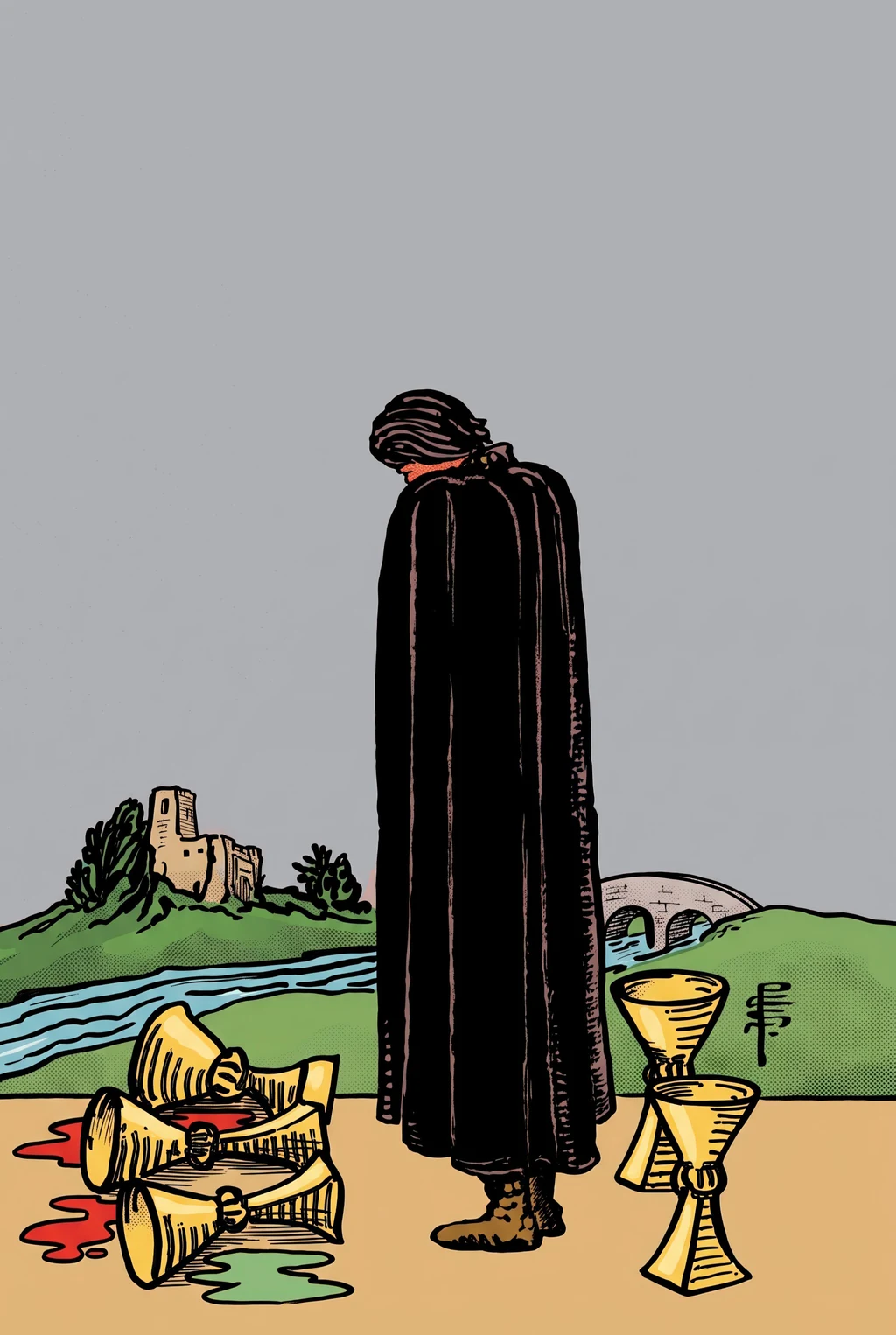
A figure in a black cloak stands before what can no longer be poured back into the cups. Their gaze rests on what has spilled, and their whole body seems to follow that gaze. Two intact cups stand behind them, but for now they have no place in their world. What has survived cannot draw the attention of someone absorbed in loss.
Across the river stands a house, with a bridge leading toward it. The path has not disappeared, yet crossing it would not mean that grief has ended. Between what is available to the figure and what they are ready to turn toward lies the time they need to grieve. The card allows them that time, without rushing to offer comfort. The two cups remain where they are, behind the figure: life can continue alongside loss, even before that possibility is strong enough to eclipse it.
Core meaning
The Five of Cups speaks to loss, regret, and disappointment. Something important has been lost, but not everything of value is gone.
- Key meanings:Loss
- Disappointment
- Regret
- Sadness
- Unmet expectations
- What still holds value
- Key meanings:Acceptance
- Self-forgiveness
- Recovery
- Reconnection
- Hidden sadness
- Unprocessed loss
Image and symbols
Card image
At the center stands a person in a long black cloak, with their back to the viewer and their body turned slightly to one side. Their head is lowered and turned to the viewer’s left; their hair is visible, while their hands are hidden by the cloak. Shoes protrude below its hem.
Three golden cups lie on their sides to the left, in front of the figure. Red and green puddles are visible nearby. Two other cups stand upright to the right, behind the person.
A river runs behind the figure. A pale bridge crosses it on the right; on the far bank to the left is a building with a tower and greenery around it. The nearby ground is almost bare, and the sky is gray. The Roman numeral V appears at the top.
Traditional context
For Waite, this is above all a loss after which something remains. His list of divinatory meanings also includes an inheritance or transfer of property that falls short of expectations and, for some interpreters, a marriage marked by bitterness or disappointment.
For the reversed card, Waite lists news, alliances, intimacy and family ties, ancestors, return, and false projects. The modern interpretation of recovery after loss does not encompass this entire historical range.
The additional meanings in the same book offer a different account: a favorable card, a happy marriage, an inheritance, gifts, and success in an undertaking; reversed, the return of a long-absent relative. Waite himself notes the contradictions in these supplementary lists. They should not be combined into a single unconditional promise.
Modern reference works tend to focus on the experience of loss and one’s relationship with the past. For the reversed card, they distinguish acceptance and recovery from hidden pain or prolonged difficulty accepting a loss.
Lowered head turned toward the fallen cups
Attention is absorbed by loss; the rest of the scene remains out of view for now.
Three overturned cups
An image of loss and unfulfilled expectations. What has spilled underscores that things can no longer be as they were.
Two upright cups behind the figure
What remains: possibilities and support. In relationships, these may be friends or loved ones whose help is hard to accept in a time of grief.
The river behind the figure
The movement of feelings and the flow of events, which continue even in the midst of loss.
The bridge crossing the river on the right
The possibility of moving through a difficult time and finding solid ground again.
A building with a tower on the far bank
An image of home, safety, and stability that now seem far away.
The nearly barren ground in the foreground
The foreground can convey the feeling that the place where one stands offers little emotional nourishment.
The black horizontal line separating the foreground
The line can be read as a symbolic boundary within the scene: the figure is so consumed by loss that it becomes their entire story.
Colors
- Black — the figure’s cloak
Mourning and immersion in sorrow. The dark clothing makes the experience of loss the scene’s visual focus.
- Gray — the sky and background
The muted backdrop reinforces the scene’s heavy, joyless mood.
- Red — two puddles beside the fallen cups
The red puddles may suggest spilled wine or blood. They represent painful loss, not a literal injury.
- Green — a puddle beside the third fallen cup
The puddle can be associated with the element of Earth and a loss of stability, including material security. Another possible reading is something spoiled or fallen into decay.
Meanings
Five of Cups — Upright
General
Overall meaning
Disappointment with how circumstances unfolded, a loss, or regret about the past comes to the foreground. What has been lost may be not only a person or an object, but also a hope, an opportunity, or an earlier vision of the future.
The card depicts a loss that is not total. The pain is real, yet focusing on it can obscure what remains. Recognizing what is still there does not mean having to stop grieving right away.
The experience may appear not only as sadness but also as anger, bitterness, or self-blame.
Possible support
Support may come from what survived the setback: help from others, remaining opportunities, and lessons you can take from what happened.
Possible difficulty
Revisiting how things could have been can keep your attention in the past and prevent you from seeing what is possible now.
Focus
Distinguish the loss itself from the conclusion that everything of value disappeared with it.
Reflection questions
- What do I regret most right now?
- What still matters to me, even though my expectations were not met?
Relationships
Overall meaning
In a love reading, the card may reflect the pain of a breakup, lost trust, or expectations that went unmet. In an ongoing relationship, it can point to sadness over arguments and disappointments, not necessarily the end of the relationship.
In family and friendships, it relates to strained ties and unresolved hurt. For someone who is single, it may also describe longing for a closeness that is not yet there.
If the question concerns the loss of a loved one, the card may reflect grief itself and the sense of isolation that can come with it.
Possible support
Loved ones you can tell about the loss may offer support. If the relationship continues, the willingness to speak honestly about the hurt can provide a foundation.
Possible difficulty
Past pain can take up so much space that present closeness goes unnoticed. Between partners, this may mean returning to old grievances instead of discussing what is happening now.
Focus
In an ongoing relationship, notice what has been damaged, what still connects you, and what the conflict may have taught you.
Reflection questions
- Is there hurt in my relationship that we have not yet been able to talk about?
- Whose support can I notice alongside the disappointment?
Work and study
Overall meaning
The card speaks to disappointment at work: a project failed, an opportunity was missed, or a familiar collaboration ended. Sometimes the grief comes from losing a job or seeing valued colleagues leave.
Possible support
Connections with colleagues and mentors can help, as can the parts of your work that can still be kept or put to use in another way.
Possible difficulty
Dwelling on an unsuccessful outcome makes it harder to learn from it and consider other professional opportunities.
Focus
Look at what went wrong and what remains valuable in the experience, the contacts you made, or the work you completed.
Reflection questions
- What from an unsuccessful project could still be useful?
- What mistake can I understand more clearly without dismissing all the work I did?
Money and resources
Overall meaning
In financial matters, the card can point to lost funds, a shortage of money, or disappointment with a material outcome. Waite’s list includes a specific nuance: an inheritance or property received turns out to be less than expected.
Possible support
The resources and skills you still have can provide a foundation for rebuilding material stability.
Possible difficulty
Nonessential spending can make an existing shortfall worse.
Focus
Revisit your financial expectations and earlier approach: which decision did not work, and what needs to change?
Reflection questions
- What financial outcome fell short of my expectations?
- What resources and skills do I still have?
Wellbeing and self-care
Overall meaning
Sadness, disappointment, and the experience of loss may take up nearly all your attention. Here, the card describes emotional heaviness and the need to make space for your feelings.
Possible support
A conversation with someone you trust and familiar activities that bring a little calm may help. You do not have to be completely over your sadness before caring for yourself.
Possible difficulty
Suppressing or ignoring feelings leaves them unaddressed and can make everyday life more difficult.
Focus
Notice whether you have the time and space to feel your sadness without demanding that you recover immediately.
Reflection questions
- Can I acknowledge my sadness without rushing myself?
- What familiar activity brings me a little peace right now?
Personal growth
Overall meaning
Disappointment can become an occasion to reconsider the past: what mattered, where expectations differed from reality, and which mistakes are clearer now. Growth here comes from making sense of what happened, not from being required to see the loss as a blessing.
Possible support
It helps to draw a specific lesson from a mistake without turning the whole reflection into self-blame.
Possible difficulty
Repeated self-blame keeps you in the past and obscures the possibility of changing your approach.
Focus
Distinguish what became clear afterward from what you knew when you made the earlier choice.
Reflection questions
- What do I understand now that I could not see before?
- Is there a useful insight in my regret beyond reproaching myself?
Five of Cups — Reversed
General
Overall meaning
The reversed Five of Cups can suggest a turn from regret toward acceptance: the loss remains part of your experience, but it no longer defines the whole picture. Support and possibilities for moving forward in a different way become easier to see.
There is another reading, too: the pain turns inward, hides behind silence, or finds no outlet. It helps to distinguish accepting what happened from trying not to feel it.
Possible support
A willingness to receive help and a gentler attitude toward your own mistakes become sources of support.
Possible difficulty
Shame may lead you to conceal your pain. Others may then have no idea how difficult things are, leaving support out of reach.
Focus
Even as your interest in life returns, some of the experience may still feel unresolved. Respect your own pace rather than demand a sudden turning point.
Reflection questions
- What can I accept now, and what is still hard to acknowledge?
- Is there help that has become easier for me to accept?
Relationships
Overall meaning
After a breakup, the card may speak to gradually releasing old pain and becoming open to new closeness. In an ongoing partnership, it can suggest moving from resentment toward conversation and rebuilding trust.
In family and friendships, this may mean reconnecting after an argument. Another reading applies when the past still has a hold on someone: outwardly moving on does not necessarily mean the old experience has stopped affecting their relationships.
Possible support
Open communication, a willingness to listen to one another, and letting go of the habit of revisiting old reproaches can help.
Possible difficulty
Comparing new relationships with past ones and holding on to old resentments make it harder to see the person and the connection as they are now.
Focus
Making peace with the past does not necessarily mean rekindling a romance. Sometimes it means ending the hostility or letting go of resentment without becoming a couple again.
Reflection questions
- What would reconciliation mean to me: reconnecting or bringing an old grievance to a close?
- Am I comparing my present relationship with a past one?
Work and study
Overall meaning
The card may describe recovery from a professional setback: interest in work returns, and new opportunities become worth considering.
In a business question, two paths are possible: revive a venture that is still viable, or recognize that the old approach has run its course and look for another job or undertaking.
Possible support
The skills and experience you have retained become a source of support. Professional connections may also help you see possibilities after a setback.
Possible difficulty
Focusing on past mistakes may keep you from recognizing your own skills and making use of a new opportunity.
Focus
Consider whether the former venture is still viable: is there something worth rebuilding, or does continuing only keep you tied to an option that has run its course?
Reflection questions
- What from the previous venture can genuinely be restored?
- What skills can I rely on after this setback?
Money and resources
Overall meaning
The main contemporary reading centers on rebuilding material stability and changing how you view an earlier financial setback. The experience of loss becomes a reason to reconsider your relationship with money.
In a specific reading about inheritance, the card may indicate a modest inheritance or competing claims to it. This narrower meaning is not the same as the broader theme of financial recovery.
Possible support
Remaining resources and lessons from earlier financial decisions can form the basis of a more stable approach.
Possible difficulty
In an inheritance question, the difficulty may involve a smaller-than-expected amount or claims from several parties.
Focus
Consider whether the way you handle money has changed since the earlier setback and whether it aligns with your long-term goals.
Reflection questions
- What did an earlier financial setback lead me to reconsider?
- What has changed in how I handle money?
Wellbeing and self-care
Overall meaning
Sadness may gradually give way to acceptance and a return to everyday self-care. But the reversed card can also relate to hidden distress: appearing calm does not always reflect what is happening inside.
Possible support
Self-kindness, support from loved ones, and returning to activities that bring calm or pleasure can help.
Possible difficulty
Trying to hide pain to avoid worrying others can leave someone carrying it alone.
Focus
Moving forward may be gradual. Notice the subjects that still hurt, even if things generally feel easier.
Reflection questions
- Is there a feeling I hide so I will not worry the people close to me?
- What has become easier for me, and where do I still need to be gentle with myself?
Personal growth
Overall meaning
The reversed card may suggest self-forgiveness and a new perspective on failure: it remains an event in your life, not a definition of who you are. Acknowledging past lessons makes room for new interests.
If accepting what happened is still difficult, the inner process may involve shame and silence about the mistake.
Possible support
It helps to separate your judgment of a particular action from your judgment of yourself as a whole, and acknowledge what you have learned.
Possible difficulty
Fear of being seen as a “failure” may make it difficult to admit a mistake and discuss it with someone you trust.
Focus
Notice which parts of the past have become experience you can draw on, and which you still hold onto as reasons to punish yourself.
Reflection questions
- Am I letting one mistake define how I see myself?
- What can I carry forward from this experience while letting go of self-reproach?
Roles in a spread
Position examples
A position gives the card a question, such as what helps or what gets in the way. That question shapes how you read its meaning.
Five of Cups — Upright
Situation
The situation is being experienced through loss and disappointment; what remains may be going unnoticed.
Influence
Past losses and conversations that bring disappointment back to the surface may shape how you see things now.
Motivation
The desire to recover what was lost, restore a connection, or undo an earlier choice may be driving you.
Support
A remaining opportunity or a supportive person helps keep the whole situation from being defined by loss.
Obstacle
Holding on to what is already gone deepens the pain and makes it harder to notice change.
Focus of attention
Bring your attention back to what still holds value, even though the most painful part is easier to see right now.
Next step
First, acknowledge what was lost and how it feels. Then look at what remains and what help you might turn to.
Possible development
When attention stays fixed on the past, new opportunities may go unnoticed. Acknowledging both the loss and what remains allows for a different way forward.
Five of Cups — Reversed
Situation
A shift toward acceptance and reengagement with life may be underway. Another reading points to quiet, hidden grief that has not yet run its course.
Influence
Support from others may change how you see what happened, reminding you of what remains and what you can still lean on.
Motivation
Behind an outwardly restrained manner may lie fear of seeming like a failure or a wish not to burden others with your pain.
Support
Being willing to speak about what happened and forgive yourself for mistakes makes support easier to accept.
Obstacle
Silence born of shame, or repeatedly returning to the same pain, can keep the situation from moving forward.
Focus of attention
Distinguish a readiness to let go of the past from an attempt to simply stop talking about it.
Next step
Reach out for support and move at a pace you can manage. When appropriate, you can return to an unfinished conversation and try to make amends for the hurt caused.
Possible development
As the loss becomes easier to accept, curiosity and a willingness to try new things may return. If the pain is only hidden, the same cycle of regret can continue.
Combination examples
Card combinations are in development. For now, here are a few examples.
Five of Cups + The Magician
Five of Cups ( upright) + The Magician ( upright)
- Example question:
- What can I rely on after disappointment?
- Example interpretation:
The Magician brings the ability to act, which remains even amid loss. Together, the cards draw attention to skills that did not disappear with the disappointing outcome.
Five of Cups + Death
Five of Cups ( upright) + Death ( upright)
- Example question:
- How am I experiencing the end of an important chapter?
- Example interpretation:
Death emphasizes an ending, while the Five of Cups reflects the sadness and regret that come with it. Together, they connect change with the need to acknowledge loss.
Five of Cups + Three of Swords
Five of Cups ( upright) + Three of Swords ( upright)
- Example question:
- What needs to be acknowledged in a painful situation?
- Example interpretation:
Both cards deepen the theme of emotional pain. Together, they invite you not to turn away from loss or demand that you recover too quickly.
Five of Cups + Three of Cups
Five of Cups ( upright) + Three of Cups ( upright)
- Example question:
- What support is available alongside sadness?
- Example interpretation:
The Three of Cups contrasts the Five’s solitude with companionship and shared joy. Here, support means being able to be among people rather than staying alone with the loss.
Five of Cups + Judgement
Five of Cups ( upright) + Judgement ( upright)
- Example question:
- How can I view my regrets about the past?
- Example interpretation:
In this contrasting pair, Judgement introduces release from self-blame. It shifts the focus from repeated regret to the possibility of forgiving yourself for the past.
Reading example
An imagined one-card reading shows how the meanings above can apply to a question. This is one possible interpretation.
Five of Cups — Upright
Situation:
An important plan you made with someone else fell through. You keep returning to how things might have worked out and wonder whether it is worth making new plans.
Question:
What will help me look toward the future again?
-
Card drawn:
Imagine drawing a card for the position «What will help» and getting Five of Cups (upright).
Interpretation:
The Five of Cups invites you to acknowledge the disappointment first, rather than tell yourself that nothing important happened. Here, the three spilled cups can stand for the loss of the plan itself and the hopes attached to it.
The two remaining cups invite you to look at what was not lost with the plan. One possible step is to name what you are grieving, then notice the support or possibility you can still lean on.
Five of Cups — Reversed
Situation:
An important plan you made with someone else fell through. You keep returning to how things might have worked out and wonder whether it is worth making new plans.
Question:
What will help me look toward the future again?
-
Card drawn:
Imagine drawing a card for the position «What will help» and getting Five of Cups (reversed).
Interpretation:
The reversed Five of Cups invites you to consider whether you can accept the failed plan as part of your experience, rather than as proof that there is no reason to hope again. In this reading, looking toward the future begins with easing the hold of past disappointment.
You can keep what the experience taught you and give yourself permission to make a different plan. But there is no need to rush: if the pain is still strong, support and a manageable pace are more fitting than trying to start over immediately.
Yes / No
Five of Cups — Upright
Why this answer
Probably not. Disappointment, loss, or unmet expectations make the hoped-for outcome difficult. But the card still leaves room for possibilities, so this is not an absolute or final no.
A question to consider
Where have my expectations already met with disappointment?
Five of Cups — Reversed
Why this answer
Probably yes. In this reading, past disappointments are gradually losing their hold, and accepting what happened makes it possible to see a way forward.
A clarification
Do not rush a decision simply because you feel better. Some pain may remain; choose a pace that does not require you to ignore it.
A question to consider
Am I rushing this decision while some of the pain remains unresolved?
Correspondences
Connections with numbers, elements and other symbols add depth to the card’s imagery. They can differ between traditions.
Number — V (5)
Fives are associated with disrupted stability, opposition, and struggle. In Cups, this appears as disappointment and the loss of emotional fulfillment.
Element — Water
The suit of Cups is associated with feelings and relationships. Here, the element of Water comes through in the experience of loss and a change in emotional state.
Astrology — Mars in Scorpio, first decan
In this system, the correspondence relates to disrupted pleasure, disappointment, and difficult experiences in close relationships.
Tree of Life — Geburah in the suit of Cups
The Five is assigned to Geburah. Within Cups, this connection is expressed through disappointment in love, a broken union, and the loss of friendship.