
Three of Cups
Descriptions and symbolism are based on the card’s classic illustration in the Rider–Waite–Smith deck. Details of the artwork may differ in other editions of the deck.
This guide brings together traditional and modern readings. Interpretations and answers may differ between authors and schools.
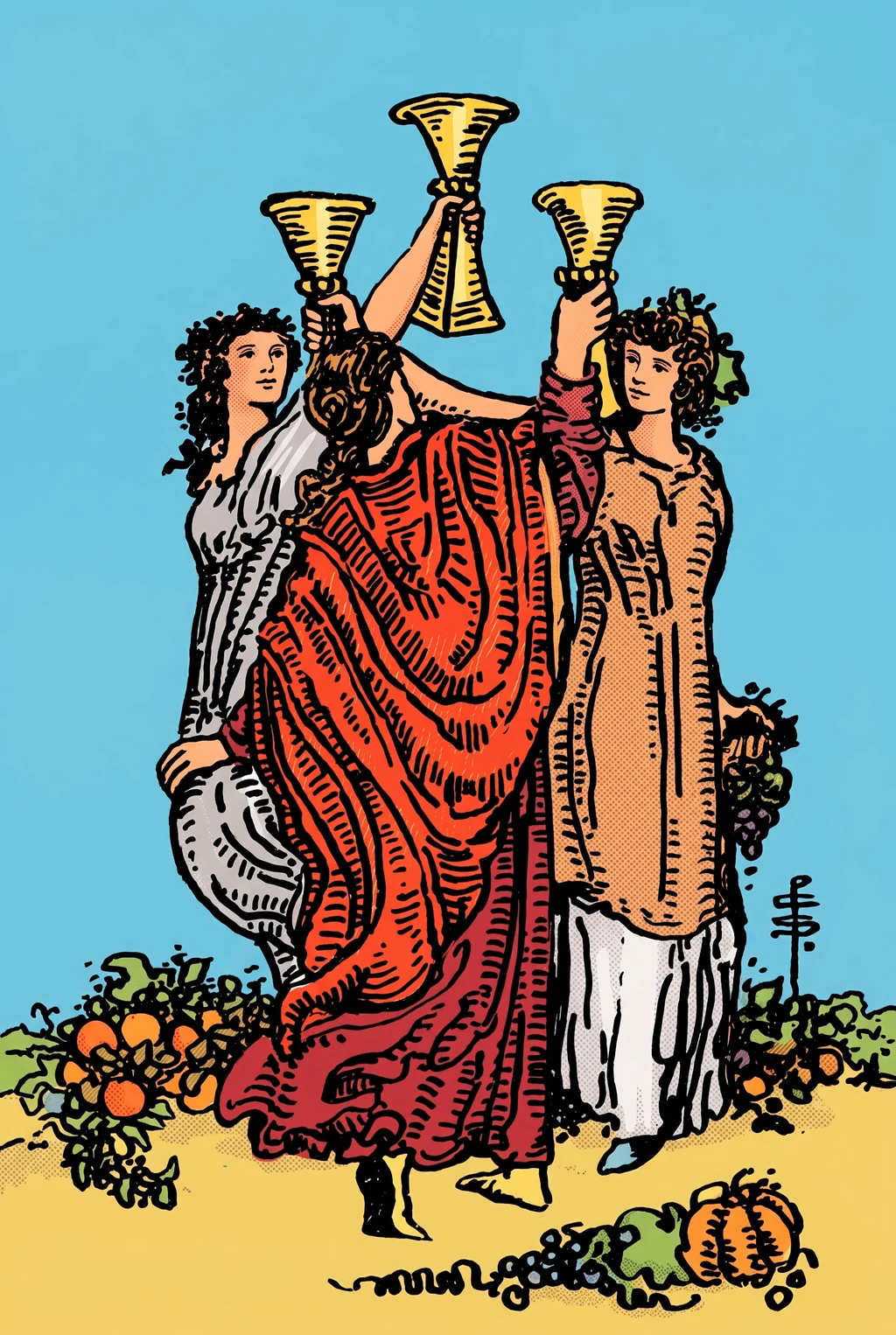
Three women raise their cups to one another, and the toast seems to become a dance. Their movements differ, but all three turn toward the center of their circle. One woman's joy is met by the other two; good fortune is celebrated together here.
The fruit at their feet recalls the harvest, when what has grown and ripened can finally be shared. The gathering becomes part of the pleasure itself: there are people to show the harvest to, to raise a cup with, and to set aside everyday cares for a while. The women are still dancing; the fruit can wait until their hands are free again.
Core meaning
Shared joy, a circle of friends, and a reason to celebrate what has been accomplished. The Three of Cups connects fulfillment with companionship, mutual support, and shared endeavors.
- Key meanings:Shared joy
- Friendship
- Support
- Collaboration
- Celebration
- Completion
- Key meanings:Disconnection
- Excess
- Solitude
- Lack of connection
- Group pressure
- Completion of a task
Image and symbols
Card image
Three women stand in a close circle, posed as if dancing, each holding a golden cup aloft. The central figure has her back to the viewer and wears red. The woman on the left wears white; the one on the right wears ochre-gold over a white lower garment. All three have leafy wreaths on their heads.
The woman on the right holds a bunch of grapes in her lowered hand. Fruit lies and flowers grow around their feet; a large orange pumpkin is visible at the lower right. The figures stand against an even blue background.
Traditional context
For Waite, the Three of Cups is associated above all with a happy conclusion: a full result, fulfillment, merriment, and solace. Healing also appears in his list; here it is a historical divinatory term, not a description of anyone's health.
His list of reversed meanings isn't simply the opposite: it includes swift fulfillment, achievement, and the end of a matter, alongside excessive sensual pleasure. An additional list again includes solace and the completion of a matter.
Contemporary RWS interpretations develop themes of friendship, support, and shared creativity. Reversed, the card can point to discord, too little connection, too much socializing, or chosen solitude. These possibilities depend on the situation; they are not stages in a required sequence.
Elliot Adam separately compares the three women to the Three Graces and uses their clothing to explore courage, sincerity, and warmth. This is his symbolic interpretation, not an established identification of the figures in the image.
Three women gathered in a circle
Community and emotional connection. The circle brings them together, turning one person's joy into something everyone shares.
Hands holding cups raised toward the center of the circle
A toast that acknowledges a shared reason to celebrate and a willingness to share that joy with others.
Dancing poses and flowing garments
The free expression of joy; their open postures suggest trust and ease.
Three cups, one held by each figure
Feelings shared in a gathering. Each person takes part in the celebration with a cup of their own.
Leafy wreaths on their heads
Recognition of success and a reason to celebrate what has been achieved.
Grapes held in one hand, a pumpkin, and other fruit and flowers at their feet
Harvest and abundance: what has grown and can now be shared. The lush foreground reinforces the sense of satisfaction with the outcome.
Open, cloudless sky
In a contemporary symbolic reading, the open sky reinforces the sense of harmony between the surroundings and the joy being experienced.
Colors
- Red — the central figure's clothing
In Elliot Adam's interpretation, red represents courage, vitality, and passion, adding an active note to the joy of the scene.
- White — the dress of the figure on the left
In Elliot Adam's interpretation, white clothing is associated with purity, truth, and spiritual light.
- Gold — the outer garment of the figure on the right
In Elliot Adam's interpretation, this color brings together success, prosperity, and warmth.
Meanings
Three of Cups — Upright
General
Overall meaning
The Three of Cups describes joy you have someone to share with: a gathering, a reconciliation, a shared achievement, or the successful completion of a task. This might be a celebration, or simply a sense of relief after a difficult time.
Another central theme is a circle of people with whom you can share feelings and ideas, support one another, and create something together. Connection matters here not only for enjoyment, but also for the sense of belonging it brings.
Possible support
A circle of friends where you can share your experiences and feel heard may provide support. The card emphasizes mutual help rather than having to manage everything alone.
Possible difficulty
In Elliot Adam's interpretation, difficulty arises when stress occupies so much attention that there's no room left for joy or lightness.
Focus
Notice what has already gone well and the people who were there for you. Make room to acknowledge everyone's contribution.
Reflection questions
- What would I like to share with people close to me?
- What shared achievement would I like to celebrate?
Relationships
Overall meaning
In friendships and family life, the card is associated with gatherings, reunions, and shared reasons for joy. It highlights the closeness that grows from spending time together and taking part in one another's lives.
In romance, it may point to meeting someone through friends, a friendship developing into affection, or a lighthearted, supportive period in a relationship. Romantic connection is part of a wider circle of people who matter.
Possible support
Among friends, a willingness to listen and support one another helps. For couples, friends and family can also help preserve a sense of connection.
Possible difficulty
Shared celebrations aren't a substitute for close friendship. Sometimes you need to rediscover the interests and activities that genuinely bring you together.
Focus
In a new romantic connection, pay attention to the foundation of friendship: is conversation easy, and do you enjoy spending time together? Intense feelings aren't the only measure of a meaningful bond.
Reflection questions
- Who can I freely share good news with?
- What do we enjoy doing together?
Work and study
Overall meaning
At work or in your studies, the Three of Cups highlights friendly collaboration and recognition of shared achievements. Completing a project, graduating, or reaching a milestone can be an occasion to acknowledge everyone's contribution.
In creative work, the card points to exchanging ideas and working in a group. Professional connections may also open opportunities to collaborate.
Possible support
Support comes from colleagues and like-minded people whose skills complement one another. For a new venture, a professional community, including potential partners and mentors, can be a source of support.
Possible difficulty
When choosing a work environment, it may be difficult to find people who share your interests and approach to collaboration. In that situation, a suitable position alone may not be enough to create a sense of belonging.
Focus
Notice the team culture and how shared contributions are recognized. When choosing a workplace, the card invites you to consider whether it offers room for meaningful collaboration.
Reflection questions
- Who would it help to join forces with?
- Whose contribution to our shared result deserves recognition?
Money and resources
Overall meaning
In financial matters, the card is associated with prosperity, reaching a financial milestone, and being able to afford enjoyable expenses. Generosity often goes toward gatherings and celebrations.
When money is shared, the card also highlights exchanging knowledge, shared goals, and results that everyone can enjoy.
Possible support
Sharing experience and seeking help from people who discuss financial goals with you can provide support. The card highlights the value of working together with a common understanding.
Possible difficulty
Generosity in celebration can lead to spending beyond what feels comfortable. This imbalance can arise even with the card upright.
Focus
Keep spending on gatherings, gifts, and entertainment in line with what you can afford. Celebrating success doesn't require spending everything you've managed to save.
Reflection questions
- Which shared expenses can I genuinely afford?
- Who can I discuss a shared financial goal with?
Wellbeing and self-care
Overall meaning
Here, the card is associated with emotional fulfillment, enjoyable company, and a break from everyday responsibilities. A warm gathering or shared activity can help you feel connected to life again.
It also evokes joy after a demanding period, when you can begin to notice relief and no longer have to carry everything you've been through alone.
Possible support
Supportive relationships can help you stay attentive to everyday self-care. What matters is having people around whom you can relax and feel included.
Possible difficulty
Stress can make it hard even to notice what brings you pleasure. In this reading, the difficulty isn't a lack of reasons to celebrate but an overwhelmed mind. Another possible imbalance is overindulgence that pushes self-care aside.
Focus
Notice whether enjoyable activities leave enough room for rest. In this reading, well-being is supported by moderation rather than an endless series of gatherings.
Reflection questions
- What kinds of social connection help me relax?
- Do I still have time for quiet rest?
Personal growth
Overall meaning
The Three of Cups connects personal growth with being part of a community: conversations, learning together, and support that helps you recognize your progress. Acknowledging your own achievements matters, even when more work lies ahead.
In Elliot Adam's interpretation, the card also speaks to self-expression: warmth, humor, and the ability to be yourself around others. These qualities can grow without turning every interaction into an attempt to impress.
Possible support
Mentorship and a circle of people you can learn with and talk to about your experiences can provide support. Growing together doesn't replace individual effort.
Possible difficulty
Focusing only on individual achievements can cause you to overlook what you might learn through connection. The card suggests that growth doesn't have to be a solitary pursuit.
Focus
Recognize achievements of your own that have gone unacknowledged. The point isn't to compare yourself with others, but to see how far you've already come.
Reflection questions
- What have I already accomplished that deserves recognition?
- What am I learning through my interactions with others?
Three of Cups — Reversed
General
Overall meaning
The reversed Three of Cups can describe a fractured sense of community: estrangement, gossip, exclusion from a group, or relationships that have become superficial. Another shift concerns quantity: there may be too many gatherings and pleasures, or work may be crowding out friendship and rest.
There is also chosen solitude: a desire for time apart, independent action, and space to consider whether your former circle still suits you. This isn't the same as being rejected. In Elliot Adam's interpretation, the card also points to joy continually postponed because of worries and responsibilities.
Waite offers another meaning: swift fulfillment, achievement, and completion. So a reversal doesn't necessarily indicate an unsuccessful outcome.
Possible support
Taking a break from socializing may help when gatherings have become too frequent, as can acting independently when a group stifles your way of doing things. If connection is lacking, support may instead come from returning to people you trust.
Possible difficulty
Gossip, peer pressure, and entertainment that crowds out everything else can weaken a sense of community. A lively atmosphere doesn't necessarily mean people truly support one another.
Focus
Distinguish between three situations: not enough connection, too much of it, or being in the wrong circle. That difference can help you decide whether to reconnect, take a pause, or rethink your involvement.
Reflection questions
- Do I need more connection right now, or more time without gatherings?
- Which group allows me to be myself?
Relationships
Overall meaning
Among friends, the card can suggest distance, exclusion, gossip, or disappointment with an old circle. It can also reflect losing touch with friends and family because of a busy schedule.
In romance, other nuances arise: a superficial connection, a brief attraction, or a third party interfering in a couple's relationship. That interference isn't necessarily romantic; it may come from the wider social circle.
Within a family, the card can also suggest disconnection, unresolved disagreements, or gatherings that no longer bring a sense of closeness.
Possible support
In a relationship, an honest conversation about what disrupted communication can help restore support. Stepping away from an unsupportive group can also be constructive; you don't have to preserve every connection just to belong.
Possible difficulty
In a relationship, distrust and interference from others can get in the way of direct conversation. Another difficulty arises when you give your time and attention to others at the expense of your own emotional needs.
Focus
Ask whether your interactions bring real support or whether you feel you have to pretend to be involved. In a relationship, also notice whether there's still time for a conversation between the two of you without the group's interference.
Reflection questions
- Which gatherings leave me feeling close to others?
- Is there a conversation we're postponing amid all the social noise?
Work and study
Overall meaning
At work, the card can describe a team that's out of sync, gossip, exclusion from group discussions, or a delay in an achievement people had hoped to celebrate. A less contentious possibility is that work has taken up all your time, crowding out rest and relationships beyond it.
In a creative project, the reversed card can sometimes suggest a need to work independently: the group demands conformity and doesn't welcome new ideas. Independence in this case is different from an inability to collaborate.
Possible support
Support may come from people with whom meaningful collaboration is possible, even if your usual team doesn't offer it. For creative work, the freedom to work independently for a while can also help.
Possible difficulty
Gossip, internal competition, and a lack of coordination can hinder teamwork. Pressure to 'do what everyone else does' may also limit creative contributions.
Focus
Consider whether a sense of exclusion comes from a temporary communication problem or an established team culture. When evaluating a new workplace, pay attention to how people actually interact.
Reflection questions
- Are my ideas considered on their merits, or am I expected to conform?
- What's keeping us from agreeing on how to work together?
Money and resources
Overall meaning
Reversed, the card highlights spending on pleasures and social obligations that begins to exceed your means. This might mean saying yes to every celebration or keeping up with the spending habits of your group.
In shared financial matters, another theme is conflicting goals and uncoordinated decisions. Expected support from others is no substitute for clarity about shared money.
Possible support
Clear agreements and independence in money decisions can be sources of support. It's useful to distinguish participating together from depending on someone else's choices.
Possible difficulty
Keeping everyone entertained can cost more than your budget allows. When finances are shared, conflicting goals can create further strain.
Focus
Look at which recurring expenses are tied to socializing and entertainment. Also check how clearly everyone understands the terms of shared spending.
Reflection questions
- Which social expenses can I reduce without affecting essential spending?
- What's still unclear about our financial arrangements?
Wellbeing and self-care
Overall meaning
Here, well-being is linked to a disrupted balance between socializing and rest. A stream of gatherings and pleasures may leave too little time for sleep and recovery; at the other extreme are isolation and a lack of close connection.
In Elliot Adam's interpretation, the Three also draws attention to simple pleasures forgotten amid duties and worries. Returning to an enjoyable activity doesn't necessarily require a large group.
Possible support
When life feels overloaded, quiet time and sleep may provide support; when you feel alone, a warm, accessible connection may help. A small enjoyable activity can also bring something besides obligations back into your day.
Possible difficulty
Both an excessive social load and a lack of support can be draining. Constant entertainment isn't the same as rest.
Focus
Check what you need right now: sleep, quiet time, the company of someone close, or a simple pleasure. You don't need more socializing if too much of it is what leaves you tired.
Reflection questions
- Which gatherings do I need a break from?
- What simple activity do I keep putting off, even though I enjoy it?
Personal growth
Overall meaning
The card can describe dependence on group approval: your interests slip into the background, and comparisons with others' achievements obscure your own. Belonging then begins to demand that you set aside what matters to you.
Another possibility is reassessing your old circle and seeking greater independence. Time apart can help you distinguish your goals from other people's expectations and choose more consciously how to take part.
It's also important to distinguish a needed break from avoiding gatherings out of fear that your efforts to connect won't be reciprocated. Solitude and withdrawing out of fear may look similar, but their causes are different.
Possible support
Time for independent reflection and boundaries that leave room for your own goals can help. A supportive community shouldn't require you to keep giving those goals up.
Possible difficulty
Other people's expectations and constant comparisons can replace your own sense of growth. Your efforts then go toward fitting in rather than learning what genuinely interests you.
Focus
Consider which goals remain important without others' approval. In this reading, what matters isn't how many connections you have but whether they support your independence.
Reflection questions
- Which of my goals depend on my group's approval?
- What would I like to keep doing even if no one recognizes it?
Roles in a spread
Position examples
A position gives the card a question, such as what helps or what gets in the way. That question shapes how you read its meaning.
Three of Cups — Upright
Situation
The situation may center on a gathering, a shared achievement, or reconnecting with people you feel close to.
Influence
Your close circle may be influencing events: their involvement fosters a sense of belonging and helps you through difficulties.
Motivation
The motivation may be a desire to create something together and feel part of a shared effort.
Support
Support comes through friends and like-minded people: you can share what you're going through rather than face difficulties alone.
Obstacle
In Elliot Adam's interpretation, stress that leaves little room for joy and lightness can be an obstacle.
Focus of attention
Recognize everyone's contribution: what has already gone well, and whose part in it deserves acknowledgment.
Next step
Share good news with people close to you, celebrate a shared achievement, or take part in an activity together.
Possible development
In Waite's traditional interpretation, one possible direction is a successful conclusion and satisfaction in a result you can share with others.
Three of Cups — Reversed
Situation
The group may lack closeness or harmony. Another possibility is choosing to take some distance because the old way of connecting no longer fits.
Influence
An unhealthy group dynamic may be an outside influence: talking behind people's backs and hostility among members undermine a sense of belonging.
Motivation
A wish to step away from a group may come from a need for personal time and greater independence. It's worth distinguishing this from unwanted loneliness.
Support
Independence can be a source of support: taking a pause lets you step away from group pressure and see more clearly what kind of involvement you actually want.
Obstacle
Gossip, discord, and excessive involvement in entertainment can all get in the way. Having fun together doesn't resolve what people have been unable to agree on.
Focus of attention
Clarify what's out of balance: too little connection, too many gatherings, or a mismatch with the group. Each calls for a different approach to distance.
Next step
Reconsider how you take part: cut back on draining gatherings, distance yourself from an unsupportive group, or reconnect with someone you've lost touch with because life got busy.
Possible development
For Waite, the reversed card can suggest progress toward achievement and the completion of a task. This historical meaning is distinct from contemporary readings about discord within a group.
Combination examples
Card combinations are in development. For now, here are a few examples.
Three of Cups + Four of Wands
Three of Cups ( upright) + Four of Wands ( upright)
- Example question:
- What brings the people at this gathering together?
- Example interpretation:
Both cards reinforce the theme of a shared celebration. The Three of Cups highlights the joy of friendship, while the combination emphasizes celebrating an occasion together.
Three of Cups + The Hermit
Three of Cups ( upright) + The Hermit ( upright)
- Example question:
- How do the desire for company and the need for time alone relate?
- Example interpretation:
This pairing contrasts taking part in a group with solitude. It helps explore the tension between gathering with others and spending time on your own.
Three of Cups + Six of Pentacles
Three of Cups ( upright) + Six of Pentacles ( upright)
- Example question:
- How is support shared within our circle?
- Example interpretation:
This pair connects shared joy with generosity and the exchange of help. Together, the cards highlight balance between what people give and receive.
Three of Cups + The Devil
Three of Cups ( reversed) + The Devil ( upright)
- Example question:
- When does entertainment begin to take up too much space in life?
- Example interpretation:
The reversed Three of Cups beside The Devil intensifies the theme of excess. Pleasure may take up more and more space, making it difficult to maintain your usual way of life without neglecting other areas.
Three of Cups + Seven of Cups
Three of Cups ( upright) + Seven of Cups ( reversed)
- Example question:
- How is the possibility of success read in a historical divinatory list?
- Example interpretation:
In Waite's supplementary list, the reversed Seven of Cups signifies success when accompanied by the Three of Cups. This is a specific traditional reading of the pair, without specifying the area of life or the Three's orientation.
Reading example
An imagined one-card reading shows how the meanings above can apply to a question. This is one possible interpretation.
Three of Cups — Upright
Situation:
A group of friends is planning to meet after a long time apart. You want to feel close again, but you're unsure whether the gathering will be enjoyable or just another obligation.
Question:
How should I approach this gathering?
-
Card drawn:
Imagine drawing a card for the position «Approaching a gathering» and getting Three of Cups (upright).
Interpretation:
The Three of Cups highlights the joy of spending time together and reconnecting with your close circle. Instead of seeing the gathering as an event you have to make perfect, you can see it as a chance to reconnect.
One helpful step might be to suggest something everyone used to enjoy doing together and leave room for simple conversation. A shared reason for joy doesn't have to be a grand occasion.
Three of Cups — Reversed
Situation:
A group of friends is planning to meet after a long time apart. You want to feel close again, but you're unsure whether the gathering will be enjoyable or just another obligation.
Question:
How should I approach this gathering?
-
Card drawn:
Imagine drawing a card for the position «Approaching a gathering» and getting Three of Cups (reversed).
Interpretation:
The reversed Three of Cups invites you to distinguish between a lack of closeness and social exhaustion. In this situation, hesitation about the gathering doesn't necessarily mean the friendship has run its course.
Start by considering what you want from connection right now. If a large group feels overwhelming, a quieter gathering might suit you; if you've lost touch because life got busy, a conversation with a friend could be the first step toward reconnecting.
Yes / No
Three of Cups — Upright
Why this answer
Yes. The card connects this answer with harmony, support, and the chance to share a positive outcome. This reading is especially relevant to questions about communication, gatherings, and collaboration.
A clarification
A foundation of friendship matters in a new romantic connection. The affirmative answer supports getting to know each other without rushing into commitment.
A question to consider
What already gives our connection a foundation of friendship?
Three of Cups — Reversed
Why this answer
Probably not. In this practical interpretation, discord, a lack of support, or misaligned expectations hinder shared progress. The card suggests pausing, especially when the outcome depends on several people's participation.
A clarification
Clear expectations matter in a new romantic connection. Before making commitments, take time to understand your needs and discuss possible differences with the other person.
A question to consider
What do I still need to clarify about my expectations for this connection?
Correspondences
Connections with numbers, elements and other symbols add depth to the card’s imagery. They can differ between traditions.
Number — III (3)
Three is associated with growth and expansion: connection extends beyond a pair to form a wider circle.
Element — Water
The suit's association with water highlights feelings and emotional bonds, expressed on this card through shared joy.
Astrology — Mercury in Cancer, second decan: 10°–20°
In the Golden Dawn system, the Three of Cups is titled 'Lord of Abundance.' This correspondence accompanies themes of plenty, hospitality, and the pleasure of companionship.
Letter — He (ה), the first He of the Tetragrammaton
This letter belongs to the water aspect of the system, to which the suit of Cups is assigned. Here, it refers to the suit as a whole rather than a particular letter path assigned solely to the Three.
Tree of Life — Binah in the watery realm of Cups
The card corresponds to Binah. The divinatory account of this correspondence names abundance, hospitality, eating, drinking, dancing, and merriment.