
Four of Cups
Descriptions and symbolism are based on the card’s classic illustration in the Rider–Waite–Smith deck. Details of the artwork may differ in other editions of the deck.
This guide brings together traditional and modern readings. Interpretations and answers may differ between authors and schools.
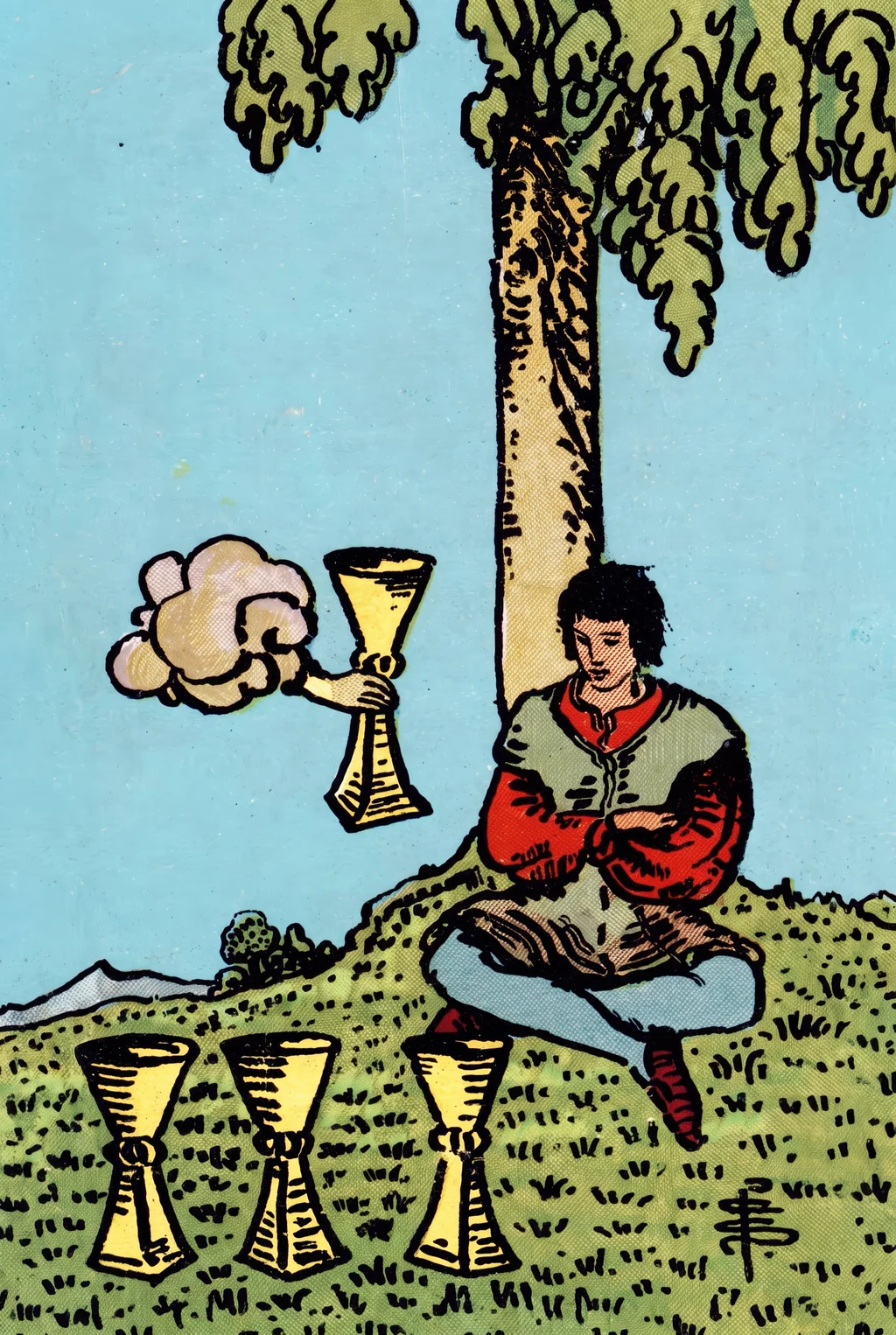
A cup is held out to a young man beneath a tree, but he makes no move to take it. His arms are crossed over his chest, his gaze lowered toward three other cups in the grass. Not even the wondrous appearance of a hand from a cloud breaks his withdrawal.
His posture recalls a moment when familiar pleasures no longer bring joy, yet no new desire has taken shape. Another cup does not change the feeling. The offer has been made, but the outstretched hand cannot want or accept it on the young man's behalf. The gift remains nearby as he sits alone with his silence.
Core meaning
What once brought pleasure no longer satisfies, and a new offer has yet to stir any interest. The Four of Cups brings together weariness and withdrawal with an opportunity to reconsider what you truly need.
- Key meanings:Satiety
- Indifference
- Dissatisfaction
- Solitude
- Reassessment
- Overlooked opportunity
- Key meanings:Renewed interest
- Openness
- Rethinking
- Reconnecting
- Turning inward
- Prolonged withdrawal
Image and symbols
Card image
A young man sits beneath a tree with his arms crossed over his chest and his legs crossed in front of him. From the viewer's perspective, his head tilts slightly left and downward. He wears a gray-green sleeveless garment with fastenings over a red shirt, blue clothing on his legs, and reddish-brown shoes.
Three golden cups stand in the grass before him. On the left, a hand emerges from a small pale cloud, holding a fourth cup out toward the seated figure.
The tree's trunk and roots are behind the young man, and its canopy fills the upper-right corner. A green slope leads to bushes and low hills in the distance; the background is light blue.
Traditional context
Waite associates the card with satiety and discontent: familiar pleasures no longer satisfy, yet a new gift offers no comfort. His list includes weariness, disgust, and imaginary vexations. That last phrase reflects the author's terminology; it does not mean a person's feelings are unreal.
The title 'Blended Pleasure' appears in Waite and in the Book T of the Golden Dawn. Within this system, pleasure is already mixed with discomfort or anxiety; an established state of well-being may be static and fragile. This is a more complex combination than mere indifference. The expanded list in Book T also mentions swiftness, pursuit, and gain through rivalry alongside passivity. These particular divinatory nuances belong to that system.
For the reversed card, Waite lists novelty, presage, new instruction, and new connections. A supplementary list gives vexations or contradictions for the upright card and presentiment for the reversed. These historical meanings cannot be reduced to simply more boredom.
Modern interpretations explore both renewed interest and the value of an inward pause. For example, Brigit Esselmont emphasizes solitude and examining one's priorities in the reversed position. Another reading points to prolonged withdrawal; the distinction lies in whether the pause brings understanding or takes the place of participation in life.
Crossed arms and legs
The closed posture can suggest withdrawal and a reluctance to accept what is offered. A more contemplative reading sees it as a focus on inner experience.
Three cups on the ground
Familiar pleasures, relationships, or experiences are already present but bring no satisfaction. Their presence contrasts with the seated figure's lack of response.
The fourth cup in an outstretched hand
A new offer or another source of fulfillment that has not yet been accepted. For Waite, it is a new gift that cannot comfort someone who has had their fill.
A hand emerging from a cloud
An image of a gift arriving from beyond familiar surroundings. In a spiritual reading, it may be associated with a divine or intuitive invitation.
A tree with visible roots behind the figure
The tree can represent support and a sheltered place for reflection. Tina Gong also draws a parallel between this scene and the Buddha meditating beneath the Bodhi tree. This is a modern symbolic comparison, not an identification of the tree species.
Low hills in the distance
In modern symbolic interpretations, distant hills can represent goals and challenges beyond the present pause.
Colors
- Blue — clothing on the legs
This color can be associated with a desire for inner peace and contemplation.
- Green — grass and foliage
The green landscape can emphasize vitality and the possibility of renewal surrounding the motionless figure.
- Light blue — the sky in the background
The calm, light backdrop contrasts with the dissatisfied, closed-off figure: outer circumstances and inner feelings do not always align.
Meanings
Four of Cups — Upright
General
Overall meaning
Things feel flat: what is familiar no longer brings joy, and it is hard to respond to new offers. This can reflect having had enough, feeling dissatisfied, or wanting to step away and understand yourself better.
The card distinguishes between a considered refusal and an automatic 'no'. Not every opportunity needs to be accepted; sometimes an offer truly is not right, or there is no room for it now. But disappointment can make valuable possibilities seem just as unappealing as those that do not fit.
Possible support
A pause gives you room to compare offers with what you want before taking on another commitment.
Possible difficulty
Habitually rejecting everything new keeps the situation from moving forward. Waiting for a flawless option can sustain dissatisfaction even when choices are available.
Focus
Consider what lies behind the lack of interest: the offer does not fit, fatigue has built up, or an earlier disappointment makes it hard to look again.
Reflection questions
- Which options genuinely do not interest me right now?
- What has changed about the things I used to enjoy?
Relationships
Overall meaning
In close relationships, the card may point to distance: less desire to see friends and family, and familiar conversations that no longer feel rewarding. Sometimes your usual circle or way of spending time no longer fits your changing interests.
In a romantic relationship, the emphasis shifts to boredom, feeling unappreciated, or a lack of mutual engagement. When looking for a relationship, past disappointment or attachment to an ideal image of a partner can make it harder to notice genuine connections.
There is also a more situational reading: after a significant shared event, such as a wedding, ordinary life can feel unusually dull. That drop in excitement does not, by itself, mean the relationship has run its course.
Possible support
A conversation without blame about what each partner is missing, along with a willingness on both sides to reconnect, can offer support.
Possible difficulty
Quietly growing apart makes it harder to explain how you feel. In a relationship, taking a partner's attention for granted can deepen the distance.
Focus
After a breakup, notice whether you are putting the present on hold while waiting for the former relationship to return. In an ongoing relationship, the question is different: is there enough mutual interest and appreciation?
Reflection questions
- How has my desire to connect with people close to me changed?
- Is there something in my relationships that has become so familiar I no longer notice it?
Work and study
Overall meaning
Work may feel repetitive, with tasks and offers no longer holding your interest. Difficulty concentrating and reduced engagement can sustain a sense of stagnation. Sometimes the shift is temporary: after a vacation, it can be hard to settle back into a familiar work routine.
The reasons vary. Sometimes you need rest; sometimes the work itself or the environment is no longer right for you. Declining a new project can also be a thoughtful choice if it does not fit your goals, rather than a reflexive resistance to change.
Possible support
Taking time to pause and examine what a project involves can help you distinguish a worthwhile task from an unnecessary commitment.
Possible difficulty
Waiting for a single perfect opening or role can close off other options. When dissatisfaction reduces your engagement, stagnation can begin to reinforce itself.
Focus
Consider exactly what feels wrong: daily tasks, the work environment, or accumulated fatigue. These point to different needs: rest, changes in your current role, or a search for other work.
Reflection questions
- What exactly has stopped engaging me at work?
- Why am I turning down this task or another role?
Money and resources
Overall meaning
In money matters, the card may describe dissatisfaction with your circumstances and little interest in available options. Comparing your resources with someone else's can obscure what you already have.
There is another nuance: disappointment may concern not the balance in your account, but the role of money itself or the way the financial system works. These are different sources of dissatisfaction.
Possible support
Revisiting your financial goals can help shift passive dissatisfaction into a clearer view of options you previously overlooked.
Possible difficulty
Comparing your options with those of others and losing interest in your own finances can make progress harder. Feeling dissatisfied does not yet explain what is missing.
Focus
Distinguish an actual shortage of funds from dissatisfaction driven by comparison with others or disillusionment with money as a goal in itself.
Reflection questions
- What am I comparing my financial situation to?
- What financial goal still matters to me?
Wellbeing and self-care
Overall meaning
This card can reflect emotional fatigue, a loss of familiar enjoyment, and a desire for fewer demands and experiences. When there have been too many gatherings and demands on your attention, one more invitation can feel like a burden.
Withdrawal may also conceal an unmet need that is hard to name at first. What matters here is understanding the reason for the pause, not demanding that joy return immediately.
Possible support
Quiet time without more gatherings or stimulation can support rest and help you understand how you feel.
Possible difficulty
Keeping up an active social life despite fatigue can add to the overload. At the same time, unresolved dissatisfaction may remain beneath an appearance of indifference.
Focus
Notice which gatherings or experiences leave you wanting to withdraw, and whether you have room to spend time without new demands on your attention.
Reflection questions
- What experiences leave me especially in need of quiet and solitude?
- What kinds of stimulation have become too much lately?
Personal growth
Overall meaning
Old pleasures, activities, and ideas of a successful life may no longer fit. The card invites you to examine the distance between your familiar way of living and what feels meaningful now.
This reassessment does not require an immediate new goal. First, you need room to hear what you want, especially when other people's stories and expectations occupy all your attention.
Possible support
Quiet reflection and less information noise can help you distinguish your own interests from the habit of following external measures of success.
Possible difficulty
Endless dissatisfaction or waiting for the ideal option can keep you from exploring what genuinely fits. Turning away by habit can replace an honest look at your own desires.
Focus
Notice which activities and ideas of a good life have remained out of habit even though they no longer bring the satisfaction they once did.
Reflection questions
- What activity remains in my life mostly out of habit?
- What interests me apart from other people's stories of success?
Four of Cups — Reversed
General
Overall meaning
A common reading of the reversed card centers on renewed interest. After boredom or withdrawal, people, ideas, and opportunities begin to feel engaging again; an earlier refusal can be reconsidered. Waite offers related meanings of novelty, new learning, and new connections.
In the approach of Brigit Esselmont, the movement may be inward: a person seeks solitude to understand their priorities and is not yet ready for outward activity. Another reading of the reversed card points to prolonged withdrawal, where refusing to engage is itself sustaining stagnation. Renewed interest and deepening isolation call for different interpretations.
Possible support
Willingness to accept offered help can break the habit of handling everything alone. When solitude is intentional, support can also come from having space to clarify your priorities.
Possible difficulty
Fear of becoming involved again can turn a pause into isolation. Refusing to notice problems does not remove them, even when nothing seems to be happening outwardly.
Focus
Notice the direction of the change: is genuine interest returning, are your choices becoming clearer, or is solitude simply keeping you away from questions that still need answers?
Reflection questions
- What is starting to interest me again?
- Is my time alone helping me understand things, or delaying a question that matters to me?
Relationships
Overall meaning
After a period of distance, the wish to meet people, accept invitations, or take a fuller part in a relationship may return. Sometimes preferences themselves change: a familiar kind of relationship or social circle no longer feels like the only possibility.
The need for time alone still has a place. In an introspective reading, the important thing is to explain your need for a pause to friends and loved ones rather than disappearing without a word.
In Elliot Adam's interpretation of long-term partnerships, the reversed card can point to exhaustion from giving without reciprocity. The question here is not how to find something new, but whether there is room for both partners' needs.
Possible support
Accepting a kind gesture or inviting a friend to meet can help restore contact. In a relationship where reciprocity has suffered, speaking directly about your needs may provide support.
Possible difficulty
Unexplained withdrawal makes connection harder. In romantic relationships, one imbalance can be a constant pursuit of novelty; Elliot Adam also describes the opposite: continually adapting to a partner without receiving the same care in return.
Focus
Distinguish a genuine desire to connect differently from trying to avoid loneliness or boredom at any cost. If you need a pause, explain it to loved ones; if unequal giving is exhausting you, focus the conversation on your own needs.
Reflection questions
- Who do I want to reconnect with, and what has changed about that desire?
- Can I speak about my needs without constantly adjusting to someone else's?
Work and study
Overall meaning
Interest in work may return, bringing a different view of your current role. Sometimes this leads to new projects where you already work; at other times, to considering another job.
In an introspective reading, the card describes an offer still under consideration: you have not agreed because you need to understand the project and your own readiness.
In learning-related questions, it can reflect a desire to return to books or a course that had long appealed to you but had been put off in favor of your usual social circle.
Possible support
A fresh perspective on familiar work, paired with a willingness to engage, can help you act on an opportunity you once overlooked. Waiting for a good offer alone is not enough.
Possible difficulty
Prolonged deliberation can mean missing a response deadline. Another potential imbalance involves overwork and too little rest, which can make it harder to stay focused.
Focus
Before responding to a work offer, check both what it involves and the response deadline. That way, an inner pause does not quietly turn into a refusal.
Reflection questions
- Which work opportunity interests me more now than it used to?
- How long can I consider this offer without missing the response deadline?
Money and resources
Overall meaning
Your attention may be returning to your own finances, bringing a willingness to examine routine expenses, savings, and previously missed opportunities. Instead of comparing yourself with others, you become more interested in what you can change in your own circumstances.
Possible support
Your own efforts and a willingness to revisit financial habits become sources of support. A fresh perspective can help you notice an option you previously overlooked.
Possible difficulty
Comparing your resources with other people's can distract you from your own needs and a thoughtful approach to money.
Focus
When reviewing spending and savings, focus on your own needs rather than trying to match someone else's standard of living.
Reflection questions
- What financial habit do I see differently now?
- What do I personally want my planned savings to make possible?
Wellbeing and self-care
Overall meaning
Emotional engagement and a desire to take part in everyday life may return. In another reading, someone still needs quiet solitude to understand themselves and does not have to leave it simply to meet other people's expectations.
If a pause becomes a habit of rejecting all help, feelings of disconnection can deepen. That differs from chosen rest, which makes room for your own experiences and feelings.
Possible support
You can allow yourself quiet rest and accept another person's help where it is manageable, without treating independence as an obligation to handle everything alone.
Possible difficulty
The habit of neither asking for nor accepting help can deepen emotional withdrawal. Fear of contact may keep you in a state you are already ready to leave.
Focus
Notice what kind of solitude you truly need and where automatically refusing support leaves you more tired and alone.
Reflection questions
- What help is difficult for me to accept, even when it would be appropriate?
- How do I feel after spending time alone?
Personal growth
Overall meaning
Inner reassessment may begin to change your familiar way of living. Curiosity returns, and personal interests that once had no room start to emerge.
Your usual circle may still expect you to join shared activities, even though your interests have changed. Books, courses, or new pastimes may have been postponed to gain others' approval; now there is a desire to choose more deliberately. Notice not only the new interest, but also what you learned during the pause.
Possible support
Understanding how your interests have changed can move you from vague dissatisfaction toward intentional choices about activities and relationships.
Possible difficulty
Fear of disapproval from your usual circle can keep you from pursuing your own interests. There is also an inner dead end: knowing something needs to change while continually postponing it.
Focus
Name what became clear while you were withdrawn, and consider whether your usual routine is pulling you back toward things that no longer fit.
Reflection questions
- What personal activity am I postponing for the sake of my usual social circle?
- What do I understand more clearly about myself after this pause?
Roles in a spread
Position examples
A position gives the card a question, such as what helps or what gets in the way. That question shapes how you read its meaning.
Four of Cups — Upright
Situation
There are choices, but neither the familiar nor the new feels compelling yet. A pause may be needed for reassessment, or it may reflect weariness and withdrawal.
Influence
Past disappointment may contribute to your current guardedness: expecting to be hurt again can make new possibilities harder to see.
Motivation
The desire to step aside may come from a search for something more meaningful, rather than a simple refusal to participate. What is happening no longer feels satisfying, and you want to understand your own interests.
Support
Not answering immediately gives you room to assess an offer calmly and decline one that does not fit. Solitude can help you recognize what interests you.
Obstacle
Automatically turning down offers and help narrows your choices. Dissatisfaction becomes an obstacle when everything new seems as uninteresting as what came before.
Focus of attention
Bring your attention back to what is already offered or available. Regret about the past and anxiety about the future can obscure the present moment.
Next step
Look at the offer again without pressuring yourself to accept it. The useful distinction here is between a considered refusal and a habitual reaction.
Possible development
If this protective withdrawal continues, even suitable offers may be turned away. The pause then stops clarifying your choices and instead keeps things at a standstill.
Four of Cups — Reversed
Situation
Interest is beginning to return, or an inner reassessment is still underway. It is important to distinguish renewed engagement, restorative solitude, and an ongoing refusal to participate.
Influence
Fear can sustain the habit of keeping others at a distance. In this reading, it affects your ability to notice and accept their offers of support.
Motivation
A desire is emerging to take part in life again, seek new experiences, and explore interests that previously had no room. This impulse differs from the earlier indifference.
Support
Being willing to accept help means independence does not have to become isolation. In an introspective reading, an honest conversation with yourself about priorities can also offer support.
Obstacle
Habitually rejecting help or hiding from difficult questions can prolong isolation. A problem does not disappear simply because you stop returning to it.
Focus of attention
Notice what your new understanding leads to: are you becoming more engaged, or are important questions still being put off?
Next step
Move from watching at a distance toward manageable participation: consider an offer, accept a kind gesture, or reconnect. When interest returns, further delay may no longer be needed.
Possible development
Nurturing renewed interest may lead to more active participation. But if the habit of shutting out problems persists, those problems remain part of what comes next.
Combination examples
Card combinations are in development. For now, here are a few examples.
Four of Cups + The Hermit
Four of Cups ( upright) + The Hermit ( upright)
- Example question:
- What could time alone offer me?
- Example interpretation:
Solitude becomes the central theme of this pairing. The Four of Cups' withdrawal finds a direction: understanding the reasons for dissatisfaction, rather than simply taking less part in what is happening.
Four of Cups + Four of Swords
Four of Cups ( upright) + Four of Swords ( upright)
- Example question:
- What would help more right now: a new experience or a break?
- Example interpretation:
This combination strengthens the themes of rest and quiet reflection. Instead of seeking new experiences, relief from demands and decisions may come to the foreground.
Four of Cups + The Star
Four of Cups ( upright) + The Star ( upright)
- Example question:
- Is there room for renewed interest in this situation?
- Example interpretation:
Against a backdrop of emotional fatigue, hope and returning inspiration come into view. This pairing invites consideration of a new interest without assuming the earlier fatigue has already passed.
Four of Cups + The Hanged Man
Four of Cups ( upright) + The Hanged Man ( upright)
- Example question:
- What might change if I stopped rushing the decision?
- Example interpretation:
A pause meets a shift in perspective. Rather than trying to overcome dissatisfaction immediately, this pairing asks whether resistance to another point of view is keeping it in place.
Four of Cups + Eight of Cups
Four of Cups ( upright) + Eight of Cups ( upright)
- Example question:
- Do I need this pause to reassess things, or am I already looking for a different direction?
- Example interpretation:
Reassessment may lead from boredom and having had enough to recognizing that a chapter has run its course. The question shifts from a lack of response to what might make it worthwhile to leave the familiar behind.
Reading example
An imagined one-card reading shows how the meanings above can apply to a question. This is one possible interpretation.
Four of Cups — Upright
Situation:
My familiar work has become boring. I have an offer to move to another team, but I am not sure whether my current role is no longer right for me or whether I simply do not want anything new.
Question:
How should I approach the decision to change teams?
-
Card drawn:
Imagine drawing a card for the position «A helpful next step» and getting Four of Cups (upright).
Interpretation:
The Four of Cups highlights a lack of response even when an offer is already on the table. Here, it suggests that boredom alone is not enough reason either to change teams or to decline.
You could first identify what no longer works in your current job, then compare it with the proposed role. This allows the pause to serve a deliberate choice rather than habitual delay.
Four of Cups — Reversed
Situation:
My familiar work has become boring. I have an offer to move to another team, but I am not sure whether my current role is no longer right for me or whether I simply do not want anything new.
Question:
How should I approach the decision to change teams?
-
Card drawn:
Imagine drawing a card for the position «A helpful next step» and getting Four of Cups (reversed).
Interpretation:
In a reading about renewed interest, the reversed Four of Cups invites a fresh look at an opportunity you previously wanted to put off. Perhaps, after a period of boredom, another role has begun to feel more appealing.
This is a reason to learn more about the team's work and check the response deadline. You can explore the offer before agreeing to anything: taking part in the decision does not mean you have to make the move.
Yes / No
Four of Cups — Upright
Why this answer
Leaning toward no. A lack of interest and willingness to engage leaves this possibility without a real response. The involvement needed for a yes is not there yet.
A clarification
Before making a final decision, it is worth clarifying your goals and priorities. The answer reflects a lack of interest; reconsidering can help you understand why, but does not obligate you to agree.
A question to consider
What about this option does not align with my goals?
Four of Cups — Reversed
Why this answer
Leaning toward yes. Openness and willingness to engage are returning. This possibility is beginning to spark interest where there was once withdrawal.
A clarification
Renewed interest may still be a transitional state. Before making an important decision, check your readiness to act rather than rushing simply because the earlier stagnation has started to lift.
A question to consider
What about this option has begun to genuinely interest me?
Correspondences
Connections with numbers, elements and other symbols add depth to the card’s imagery. They can differ between traditions.
Number — IV (4)
Four is associated with stability and an established form. In the Four of Cups, a familiar emotional state may provide calm while no longer bringing satisfaction.
Element — Water
Water links the suit of Cups with feelings, receptivity, and relationships. Here, the focus is on emotional fulfillment and the ability to respond.
Astrology — Moon in Cancer, third decan: 20–30°
Book T associates this part of the zodiac with blended pleasure: enjoyment mixed with discomfort or worry, where settled well-being does not necessarily bring satisfaction.
Letter — Heh (ה), letter of the suit of Cups
Heh represents the suit of Cups in the Book T formula 'Chesed Heh.' This is a letter correspondence for the suit as a whole, not a separate path-letter assigned exclusively to the Four.
Tree of Life — Chesed in the suit of Cups
The fourth sephirah is associated here with pleasure or kindness received, mixed with a measure of unease. This meaning comes from the system described in Book T.