
Four of Swords
Descriptions and symbolism are based on the card’s classic illustration in the Rider–Waite–Smith deck. Details of the artwork may differ in other editions of the deck.
This guide brings together traditional and modern readings. Interpretations and answers may differ between authors and schools.
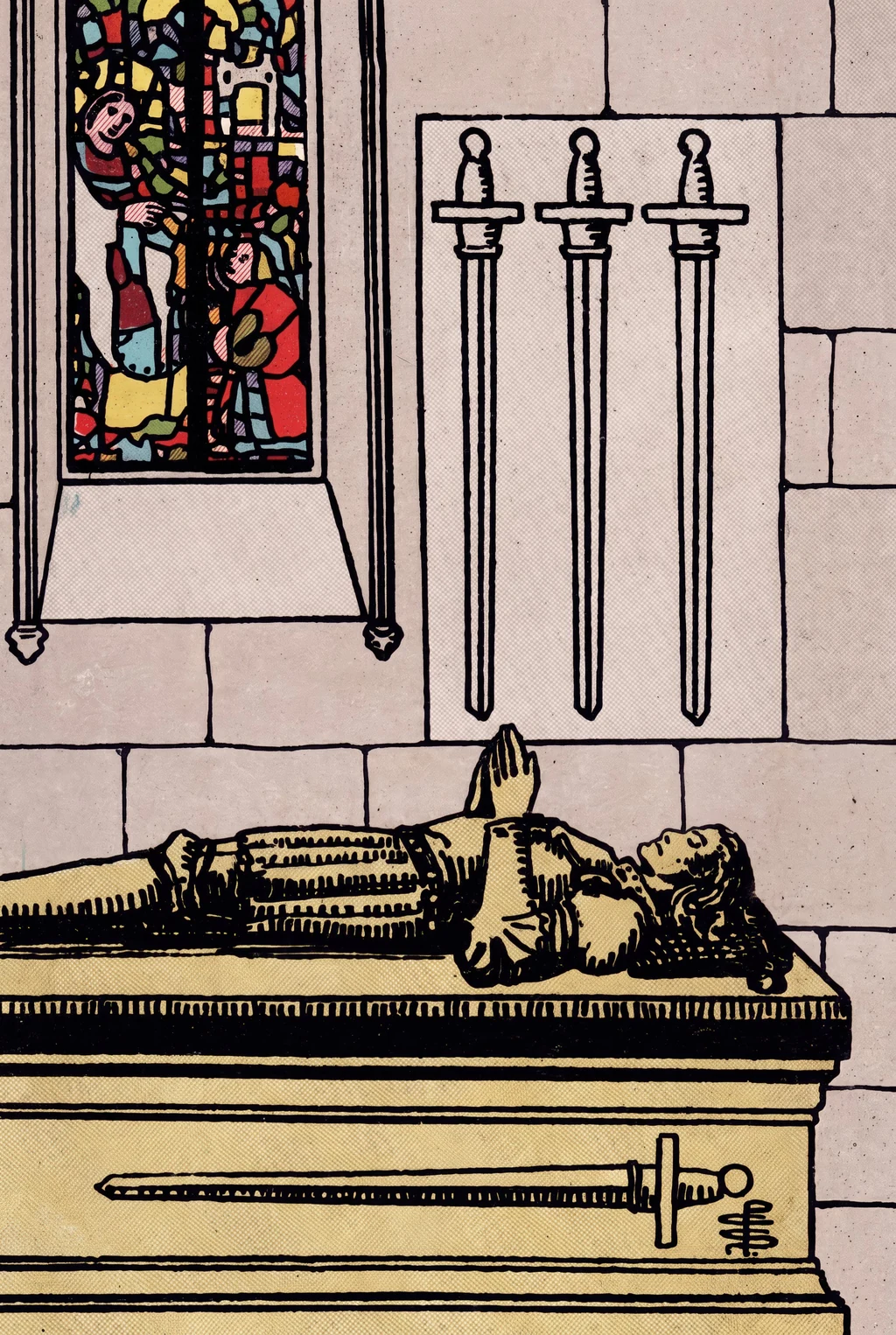
The knight in the Four of Swords still wears his armor, but his hands are folded in prayer. This is a tomb effigy: a warrior depicted at rest, where there is no longer any need to answer a blow. Waite associated this image with the repose of a hermit.
The weapons remain nearby. Three swords hang on the wall, but none is held in a hand. Beneath the stained-glass window, they can be observed without having to dodge a strike. The gesture of prayer conveys composure without an immediate readiness to act. The fourth sword lies along the tomb, echoing the calm horizontal line of the reclining figure.
Core meaning
A respite after a period of strain: solitude, rest, and time to consider your next step. Reversed, the pause may be coming to an end, stretching on too long, or failing to bring the recovery you need.
- Key meanings:Rest
- Solitude
- Recovery
- Reflection
- Preparation
- A respite from conflict
- Key meanings:Restlessness
- Exhaustion
- Stagnation
- Returning to activity
- Involuntary solitude
- Prudence
Image and symbols
Card image
A sculpted figure of an armored knight lies stretched out on a tomb. His hands are joined in prayer.
Three swords point downward from the wall above the figure. The fourth sword lies beneath him, horizontally along the tomb. A stained-glass window depicting two figures appears in the upper left of the composition.
Traditional context
Waite explicitly describes the knight as a tomb effigy. His principal list of divinatory meanings includes vigilance, retreat, solitude, a hermit's repose, and exile. He separately identifies the tomb and coffin as the inspiration for the composition.
For the reversed card, Waite lists wise administration, prudence, economy, avarice, precaution, and testament. In a supplementary list, he judges the upright card unfavorably and associates the reversed card with success through prudent management of affairs. In the same section, he cautions that supplementary meanings may differ from the principal meanings and from the images.
In Book T of the Golden Dawn, “rest from strife” encompasses peace after conflict, relief from anxiety, and well-being following effort. The meaning there is affected by neighboring cards; this is a distinct system, not a word-for-word restatement of Waite's list.
Modern Rider–Waite–Smith (RWS) readings place greater emphasis on recovery after strain and preparing for the next action. The reversal can describe either a return to life after a respite or rest that never truly happened or has turned into stagnation. These interpretations describe different states of the pause, not a simple opposition between good and bad.
The motionless effigy of a knight
In modern interpretations, the stillness suggests taking a respite and stepping away from external conflict.
Hands joined in prayer
Focus, prayer, and turning inward. In a spiritual reading, this can represent seeking support through what a person holds sacred.
The knight's armor
Protection from confrontation. In a narrative reading, the knight has temporarily withdrawn from the conflict his armor evokes.
The tomb beneath the effigy
A memorial image of rest. Waite specifically connected the tomb and coffin to the design of this scene.
Three swords above the knight
A reminder of past strain. In modern readings of the image, they echo the Three of Swords: the struggle has paused, but its traces remain.
One horizontal sword beneath the effigy
A single central question to focus on once the surrounding noise has fallen away.
The chapel interior
A refuge for rest and reflection, away from conflict.
Stained glass depicting two figures
A scene of blessing and a request for support. It gives the image of solitude a sense of acceptance and protection.
The inscription PAX in the stained glass
Latin for “peace.” In Elliot Adam's interpretation, it emphasizes inner peace as a central theme of the card.
Colors
- The golden color of the knight's effigy
In Lorelle Ajani's esoteric interpretation, the golden color is associated with insight that follows silence and concentration.
Meanings
Four of Swords — Upright
General
Overall meaning
The Four of Swords describes a respite after strain: retreating from conflict, finding solitude, and recovering. The pause may be a conscious choice or the result of fatigue.
There is less outward action, but more time to reflect on what is happening and prepare for the next stage. A quiet period does not, by itself, mean every difficulty has been resolved.
Possible support
Distance from a situation can help you see it more calmly. Before deciding, give yourself time to consider your options.
Possible difficulty
Stopping can be difficult even when you are deeply tired. Without a mental break, obstacles become harder to work through.
Focus
Look back at the stage you have completed: what worked, what did not, and which priorities may need rethinking?
Reflection questions
- What question would benefit from unhurried reflection?
- What might I see differently if I stepped away from the situation?
Relationships
Overall meaning
In a relationship, the card can describe a peaceful break, personal time, or temporary distance after a period of tension. This does not necessarily mean a breakup.
If you are actively dating, you may be tired of meeting new people. In your wider social life, the card can point to a need for a break from social obligations.
Possible support
Partners may benefit from separate interests and time apart. During a difficult period, a calm conversation with a friend or family member can also offer support.
Possible difficulty
Rushing toward closeness may get ahead of understanding your own needs. Even an established relationship sometimes needs room for individual reflection.
Focus
It is better to put your need for space into words so that silence does not lead to misunderstandings.
Reflection questions
- How can I explain to someone close to me that I need time for myself?
- What pace of meeting new people feels right for me now?
Work and study
Overall meaning
At work, this can be a period of reduced activity after a stressful stretch, or a need to step away from your duties. A break may be needed because of overload, disappointment in your work, or a desire to reconsider your professional priorities.
Some of the work happens without visible progress: you are thinking through your approach before moving forward.
Possible support
Rest and some distance from work-related concerns may help you see solutions that get lost in everyday pressure.
Possible difficulty
Your old way of working may no longer be effective. Continuing without reassessing that approach leaves the difficulty unresolved.
Focus
Pay attention to your workload and professional goals: does your current pace still serve the reasons you do this work?
Reflection question
What do I want to understand about my work before taking on more again?
Money and resources
Overall meaning
In money matters, the card can describe fatigue from constant financial worry. Your thoughts keep returning to money without yet leading to a decision.
Another emphasis is on pausing to reassess your financial goals and the approach you have chosen.
Possible support
Taking your time to reassess your financial goals and how you pursue them may provide a steadier foundation.
Possible difficulty
Habitual worry may take up all your attention without helping you understand the financial issue itself.
Focus
Notice when thinking about money turns into going over the same fears again and again.
Reflection question
Am I working through a financial question, or replaying the same fear?
Wellbeing and self-care
Overall meaning
The card points to a need for genuine rest after prolonged strain. Sleep, quiet, and a lighter load matter more here than an immediate return to normal activity.
Possible support
A quiet place, sleep, and a temporary break from demands can help you regain your strength.
Possible difficulty
A brief pause between tasks may not be enough. The kind of rest this card speaks to cannot always be rushed.
Focus
Notice any physical tension that has built up, and whether there is room in your life for real rest.
Reflection question
What kind of rest would let me truly put my tasks aside?
Personal growth
Overall meaning
The Four of Swords offers time to reassess the path you have taken: your priorities, your decisions, and what needs to change. Solitude here means looking closely at your life, not simply spending time away from others.
Possible support
Time spent reflecting on your own can help you see more clearly what truly matters to you now.
Possible difficulty
In Elliot Adam's reading, inner peace is hindered by rigid attachment to a particular outcome or to a direction that no longer feels fulfilling.
Focus
Reconnect with what holds deep meaning for you, and consider whether the need to control everything has weakened that connection.
Reflection questions
- Which of my former priorities do I want to reconsider?
- What single outcome am I holding on to too tightly?
Four of Swords — Reversed
General
Overall meaning
The reversed Four of Swords can point to a pause that does not restore you: rest keeps getting postponed, the mind will not settle, and trying to carry on deepens exhaustion.
Another possibility is that the respite is ending. Strength returns, along with the readiness to follow a carefully considered plan. But a prolonged retreat can turn into stagnation if waiting takes the place of participating in your own life.
Theresa Reed also offers a distinct reading of involuntary solitude, when circumstances impose isolation.
Possible support
As you come out of a respite, a plan you have already considered can help. You can begin acting on it instead of entering another cycle of waiting.
Possible difficulty
Impatience and an inability to relax make it hard to see the whole situation. At the other extreme is waiting for everything to change without your involvement.
Focus
Distinguish between getting too little rest and extending a break too long. What matters is not simply having a pause, but whether it restores your ability to engage with life.
Reflection questions
- Is my pause helping me recover, or postponing a confrontation with the problem?
- What carefully considered plan can I begin putting into action now?
Relationships
Overall meaning
After time apart, the desire to connect may return, and partners may find renewed interest in each other. But prolonged silence can leave a relationship in an unresolved state.
The opposite difficulty is also possible: trying to reconnect too quickly without allowing yourself or the other person enough personal space.
The reversal can also suggest that a relationship has run its course: the pause does not become the beginning of a recovery.
Possible support
Returning to honest conversation and contact with loved ones may help bring a long period of isolation to an end.
Possible difficulty
Focusing on a relationship all the time can crowd out personal time. Tension may then build even without an open argument.
Focus
As closeness resumes, respect the other person's pace. Pressure and persistence cannot replace their own choice.
Reflection questions
- Do I have the energy to connect with others again?
- Am I trying to speed up closeness by being too persistent?
Work and study
Overall meaning
The card may indicate returning to work after a break with a clearer head. But that return can also come too soon, while the need for rest remains.
If your work is still draining and the conditions have not changed, the question may be whether to reconsider your work situation itself, not just when to take your next vacation.
Another possibility is work that offers little prospect of growth or keeps you too isolated: you may be missing meaningful interaction with colleagues.
Possible support
Realistic workload limits, delegating some tasks, and accepting available help can make returning to work easier.
Possible difficulty
Trying to work ever harder without leaving time for rest and reflection keeps the overload going.
Focus
After a break, notice whether the old level of strain is returning. Going back to work does not necessarily mean the overload is behind you.
Reflection question
What needs to change about my working conditions so I do not return to the same overload?
Money and resources
Overall meaning
In modern interpretations, financial pressure may be easing: obligations are shrinking and expenses are becoming more manageable. Alternatively, the pressure of payments may be growing and wearing you down.
Waite's historical list of meanings adds a separate emphasis on thrift and careful management of affairs, as well as their extreme form, stinginess.
Possible support
Support may be available, even if you have not yet been able to accept it.
Possible difficulty
Growing pressure from bills and obligations can make it difficult to approach money matters calmly.
Focus
Notice whether you are turning down help even though the financial burden is still heavy.
Reflection question
Is there help available that I find difficult to accept?
Wellbeing and self-care
Overall meaning
Here, the gap between stopping work and truly recovering becomes especially clear. You may be physically at rest while continuing to argue, plan, and worry in your mind.
Reversed, the card may also point to emerging from a period of rest as your strength gradually returns.
Possible support
Rest helps when it genuinely reduces demands and distractions. A break that is constantly postponed cannot serve that purpose.
Possible difficulty
Continuing to push through obvious fatigue leaves less and less room for recovery.
Focus
Pay attention to the quality of your break: can you relax, or does it carry the same tension as being busy?
Reflection question
Do I have more energy after resting, or is the tension still there?
Personal growth
Overall meaning
Coming out of solitude may bring a new perspective on your life. The pause you have experienced can help you recognize your limits, reassess familiar ways of living, and put into words what you want to change.
Possible support
What you have learned can provide support: recognizing your limits and understanding that asking for help is not a sign of weakness.
Possible difficulty
Waiting for an unsatisfying life to change on its own may keep you stuck instead of prompting a real reassessment of old habits.
Focus
Consider how what you have learned fits with the life you want to lead. Past periods of overload and the habit of handling everything alone deserve particular attention.
Reflection questions
- What do I want to change about my usual way of life after this pause?
- How has my attitude toward asking for help changed?
Roles in a spread
Position examples
A position gives the card a question, such as what helps or what gets in the way. That question shapes how you read its meaning.
Four of Swords — Upright
Situation
Outward activity moves into the background. This situation calls for a respite, solitude, and time to consider what comes next.
Influence
Past stress may still be shaping events. After an intense period, it can take time to engage fully again.
Motivation
The motivation may be a need for peace: a desire to ease the pressure and regain inner clarity.
Support
The strength here lies in stepping back from tension and considering your options without reacting immediately.
Obstacle
Without a mental break, it is harder to work through problems. Exhaustion, rather than a lack of willingness to act, may be slowing progress.
Focus of attention
It helps to separate the central question from the worries surrounding it and give that question your attention.
Next step
Pause before taking the next step: weigh your options and prepare a plan rather than pushing forward at once.
Possible development
If this respite allows for recovery and reassessment, it may prepare you to return to your responsibilities with greater focus.
Four of Swords — Reversed
Situation
The pause is changing: either you are beginning to return to your activities, or rest remains elusive even though outward activity has stopped.
Influence
The feeling that too much depends on your involvement may keep you tense and make it hard to stop.
Motivation
The desire to get many things done or return to activity quickly may be pushing you harder than your current state allows.
Support
In Waite's traditional interpretation, prudence and sound management of affairs offer support.
Obstacle
Restless haste makes it difficult to stop and understand what is happening. Alternatively, the obstacle may be a pause that has become a way of avoiding action indefinitely.
Focus of attention
The key distinction is whether retreat is helping you recover or keeping you apart from life. That determines whether the pause needs to continue or come to an end.
Next step
If the respite has served its purpose, you can reconnect with others and put your plan into action. If exhaustion remains, the next step is different: make room for genuine rest first.
Possible development
If you keep waiting for unsatisfying circumstances to change on their own, the situation may remain stagnant.
Combination examples
Card combinations are in development. For now, here are a few examples.
Four of Swords + The Hermit
Four of Swords ( upright) + The Hermit ( upright)
- Example question:
- What will help me understand what is happening without rushing?
- Example interpretation:
The Hermit deepens the themes of solitude and reflection. Together, the cards highlight time spent alone without the pressure to respond to others right away.
Four of Swords + Eight of Wands
Four of Swords ( upright) + Eight of Wands ( upright)
- Example question:
- What matters about the pace of events?
- Example interpretation:
In Joan Bunning's comparison, these cards stand in contrast: the respite of the Four of Swords sits beside the rapid action of the Eight of Wands. The pair highlights the difference between pausing and accelerating.
Four of Swords + Three of Swords
Four of Swords ( upright) + Three of Swords ( upright)
- Example question:
- What matters in recovering from a painful experience?
- Example interpretation:
The Three of Swords represents a painful experience, while the Four of Swords highlights the respite that follows. Together, they describe recovery after hurt or heartbreak.
Four of Swords + Nine of Swords
Four of Swords ( upright) + Nine of Swords ( upright)
- Example question:
- What should I notice about the kind of rest I am getting?
- Example interpretation:
Outward stillness can coexist with thoughts that make it hard to relax. The Nine of Swords brings the unease within the Four of Swords' respite into focus.
Reading example
An imagined one-card reading shows how the meanings above can apply to a question. This is one possible interpretation.
Four of Swords — Upright
Situation:
The thought of changing jobs keeps coming back. I am not sure whether I want to leave because I am exhausted or because the job itself is no longer right for me.
Question:
What should I consider before deciding whether to leave my job?
-
Card drawn:
Imagine drawing a card for the position «What to consider» and getting Four of Swords (upright).
Interpretation:
The Four of Swords highlights the need for a pause before deciding. In this position, it helps separate accumulated fatigue from how you feel about the work itself.
You can first step away from work-related pressure, then return to your priorities: what you want to change about your work, and what still feels wrong even when you are rested.
Four of Swords — Reversed
Situation:
The thought of changing jobs keeps coming back. I am not sure whether I want to leave because I am exhausted or because the job itself is no longer right for me.
Question:
What should I consider before deciding whether to leave my job?
-
Card drawn:
Imagine drawing a card for the position «What to consider» and getting Four of Swords (reversed).
Interpretation:
The reversed Four of Swords draws attention to returning to the same overload. A break may end while the causes of your fatigue remain.
In this situation, it helps to consider your working conditions separately: can the workload be reduced, or is support available? If those conditions do not change, the question of changing jobs deserves consideration alongside the need for rest.
Yes / No
Four of Swords — Upright
Why this answer
For a question about rest, solitude, or time to reflect, the card suggests “yes.” For immediate progress or active change, it suggests “no”: its theme is taking a break, not picking up speed.
A question to consider
Am I asking about taking a pause, or about an action I want to take right now?
Four of Swords — Reversed
Why this answer
“Yes” applies to leaving solitude behind after a restorative pause. “No” applies to continuing to push yourself when strain and exhaustion remain. Reversed, the card distinguishes readiness to act from the need for more rest.
A question to consider
Has the break restored my strength, or is tension still getting in the way of recovery?
Correspondences
Connections with numbers, elements and other symbols add depth to the card’s imagery. They can differ between traditions.
Number — IV (4)
Stability and consolidation. Here, the number is associated with a halt in tense movement and a return to inner steadiness.
Element — Air
The realm of thought, reasoning, and conflict. The respite concerns mental activity above all.
Astrology — Jupiter in Libra, third decan: 20°–30°
In this system, the card is called the “Lord of Rest from Strife”: relief after tension and peace following conflict.
Tree of Life — Chesed, the fourth sephirah, in the suit of Swords
For this card, Book T connects Chesed with restoration and a change for the better.