
Five of Swords
Descriptions and symbolism are based on the card’s classic illustration in the Rider–Waite–Smith deck. Details of the artwork may differ in other editions of the deck.
This guide brings together traditional and modern readings. Interpretations and answers may differ between authors and schools.
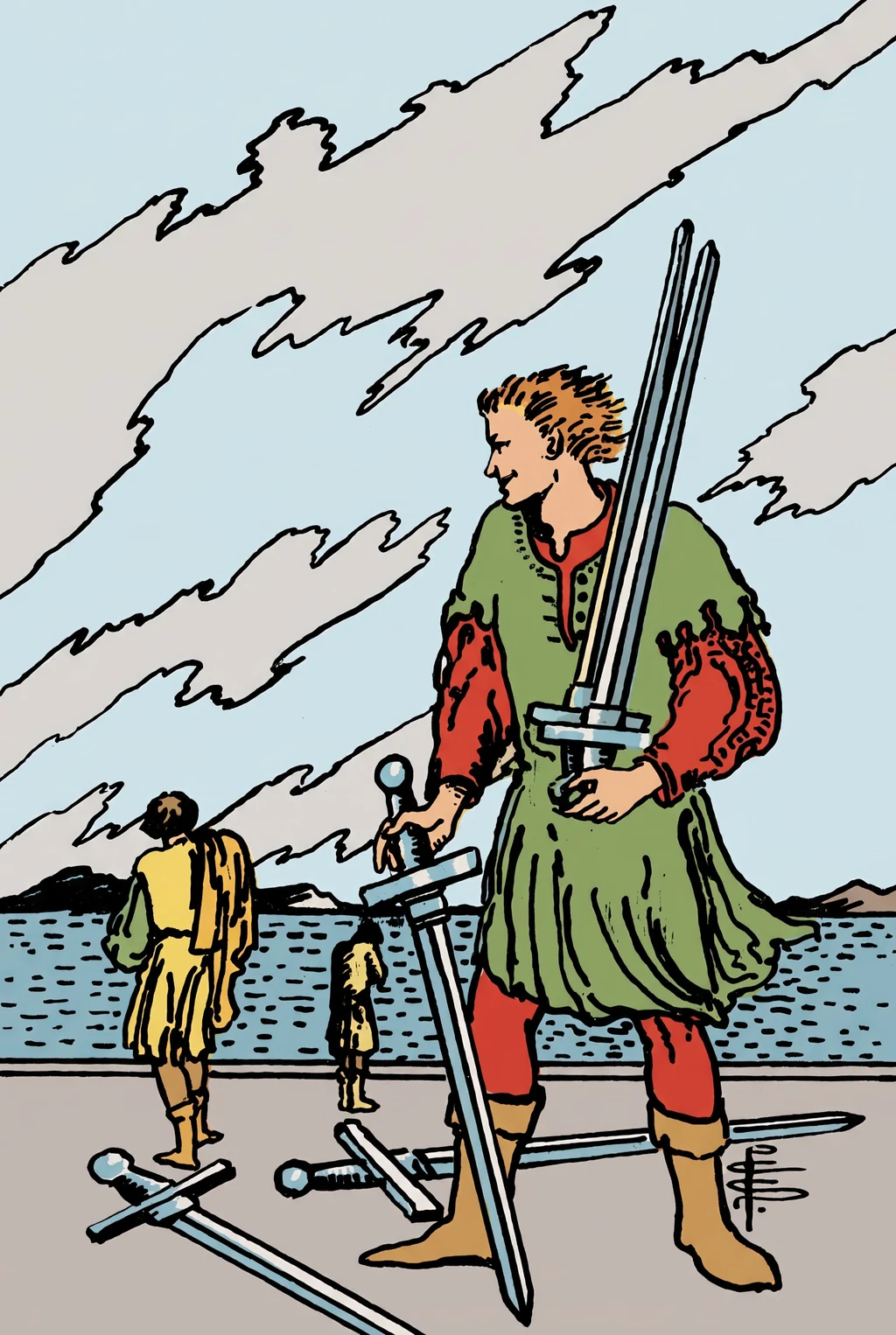
The fight is over, but there has been no reconciliation. A man holding three swords watches two figures walk away. His smirk is hardly an invitation to return: he remains master of the ground they are leaving and makes no attempt to hide his sense of superiority.
The departing figures have lowered their heads. Their defeat is visible in the weapons left behind, while the victor still holds his blades. Victory and humiliation have become parts of the same scene, experienced from opposite sides. He continues watching them, but neither looks back. Two abandoned swords lie between him and the retreating figures.
Core meaning
A conflict you can lose—or win at too high a price. The Five of Swords connects rivalry with the loss of trust and raises the question of whether the fight is worth continuing.
- Key meanings:Conflict
- Costly victory
- Defeat
- Hostility
- Dishonest tactics
- Defending your interests
- Key meanings:Reconciliation
- Acknowledging a mistake
- Stepping away from conflict
- Old resentment
- Renewed conflict
- Exposing deception
Image and symbols
Card image
In the right foreground stands a red-haired figure wearing green clothing over red sleeves and pants, with orange-brown boots. His head is turned left toward two figures walking away. In his left hand, near his shoulder, he holds two swords; in his right, he holds another with its point toward the ground. Two swords lie at his feet.
The two figures in the background have their backs to the viewer. The farther figure has a bowed head and hands raised toward the face. Behind them are rippling water and a low, distant shore. Long gray clouds stretch across the sky.
Traditional context
Waite describes a man who remains master of the field after two others retreat. Yet his list of divinatory meanings speaks of loss and dishonor, not a happy triumph: humiliation, destruction, revocation, infamy, and loss are among its themes. His additional meanings also include a threat to the querent's prosperity.
For the reversed card, Waite retains the previous meanings and adds burial and funeral rites; the supplementary list mentions grief and mourning. This is a historical interpretation of loss, not a basis for predicting anyone's death.
Modern Rider–Waite–Smith readings develop the theme of the cost of confrontation. Upright, the card encompasses both defeat and victory accompanied by a loss of trust. Reversed, it can suggest reconciliation and making amends, or an old resentment that keeps a conflict from truly ending.
Practical approaches also differ in their advice. Theresa Reed allows for necessary confrontation and strategic persistence in the upright card. The Five of Swords, then, is not an unconditional instruction to give way.
Elliot Adam offers a distinct perspective: the three swords being held become an image of a manageable workload, while the two left behind serve as a reminder that not everything needs to be taken on at once. This is the author's reinterpretation of the scene, not a historical description of its narrative.
The figure in the foreground looks back at those walking away
An image of having gained the upper hand after a confrontation. His dismissive expression suggests triumph over others rather than shared joy.
Two figures walk away with their backs to the viewer, one with head bowed
Waite describes them as dejected and retreating. They show the other side of the scene: the experience of defeat and the decision to stop fighting.
Three swords are held in the figure's hands, while two lie on the ground
The swords can represent the words, thoughts, and arguments used in a dispute. The three collected swords and the two left behind mark one participant's advantage; in Waite's description, he remains master of the field.
In Elliot Adam's interpretation, the same detail suggests taking on only what you can manage and leaving the rest for later.
Broken bands of clouds above the scene
The unsettled sky continues the theme of discord: the outward end of a confrontation does not necessarily mean the tension has disappeared.
Ripples in the water behind the departing figures
In a modern symbolic reading, the disturbed water conveys the emotional aftermath of conflict.
Colors
- Green — the foreground figure's outer clothing
This color can be associated with the earth and the need to stay grounded in reality.
- Red — the foreground figure's pants
This can suggest heated ambition that draws someone away from a clear-eyed assessment of the situation.
- Orange — the foreground figure's boots
In a modern reading, this color may represent trials and difficulties.
- Yellow — the clothing of the two figures in the background
This color can be associated with reflection and understanding. In this reading, the departing figures represent those who can see beyond personal victory.
- Blue — the water and parts of the sky
In a modern reading, this color may point to inner feelings and the unconscious; the touches of gray disturb the sense of clarity.
- Red hair — the foreground figure's hair
Elliot Adam connects the red hair with fire and initiative: thought is carried forward into action.
Meanings
Five of Swords — Upright
General
Overall meaning
The Five of Swords describes a confrontation with a painful outcome: defeat, resentment, or a victory that required sacrificing trust. You can get your way and still lose a relationship, someone's respect, or the desire to continue what you started.
The card also encompasses harsher ways of fighting: deception, intimidation, and exploiting another person's vulnerability. It does not assign the person asking the question a single role. You may be seeking an advantage, defending yourself, or dealing with defeat.
Possible support
The ability to stand firm in your position and think through your actions can offer support. In Theresa Reed's reading, sometimes a confrontation is necessary rather than another concession.
Possible difficulty
When the end justifies any means, a disagreement becomes a struggle for power. Humiliating someone or taking more than your share only deepens the divide.
Focus
Consider what will remain after the victory and what it will cost. It is worth distinguishing self-defense from the need to prove yourself right in every disagreement.
Reflection questions
- What am I risking to win this argument?
- What exactly am I trying to protect?
Relationships
Overall meaning
In a romantic relationship, family, or friendship, an argument can become more important than the connection itself. Giving way feels like losing, while harsh words leave resentment even after the conversation ends.
In romantic relationships, another perspective involves mismatched communication styles or trying to tolerate more of someone else's difficulties than you can reasonably handle. When getting to know someone new, this invites a distinction between attraction and a willingness to accept the relationship as it actually is.
Possible support
Talking directly about the disagreement can help you understand each other better. If a couple struggles to communicate on their own, a relationship counselor may offer support through mediation.
Possible difficulty
The desire to have the last word can crowd out concern for someone close to you. Repeated clashes of pride undermine the possibility of reaching an understanding.
Focus
Especially at the beginning of a romantic relationship, notice whether strong feelings are leading you to excuse something you actually find difficult to accept.
Reflection questions
- What do I want to clarify beyond who is right?
- What am I agreeing to in this relationship only because my feelings are so strong?
Work and study
Overall meaning
In the workplace, this card is associated with destructive competition, misunderstandings, and struggles for influence. Harsh communication or bullying undermines cooperation; a formal win may come at the cost of your colleagues' respect.
In Elliot Adam's interpretation, a work-related difficulty can also arise from overload: trying to accomplish everything at once and making less progress as a result.
Possible support
When facing pressure at work, established workplace procedures and help from a manager or human resources may offer support. Protecting yourself and your colleagues does not require retaliatory bullying.
Possible difficulty
Hostility grows when every objection is met with an attack. In that kind of exchange, discussing the work itself becomes increasingly difficult.
Focus
In Elliot Adam's reading, it is worth examining your workload: what can be handled one step at a time, and what actually belongs to someone else's responsibilities.
Reflection questions
- Who can I turn to for help with a conflict at work?
- Which tasks am I trying to handle all at once?
Money and resources
Overall meaning
Money becomes a source of disagreement: who contributed how much, who is entitled to what, and whether one side is benefiting at the other's expense. Limited funds may also make it necessary to reconsider nonessential spending.
In a dispute over a purchase or financial advantage, the card highlights the cost of competition: the desire to outdo someone else can lead you to pay more than the original goal was worth.
Possible support
In a disagreement over shared money, a willingness to discuss the terms and reconsider your position can help more than holding firm out of stubbornness.
Possible difficulty
Trying to take more than your fair share or secure a deal at someone else's expense turns a financial matter into a clash of competing interests.
Focus
Examine who benefits from the terms of an agreement and what the other side stands to lose. Consider separately whether the cost is rising simply because neither side wants to give way.
Reflection questions
- What am I preparing to pay for: something I need or the chance to outdo someone else?
- Which terms of our shared financial arrangement are unclear to me?
Wellbeing and self-care
Overall meaning
In everyday well-being, the Five of Swords is associated with exhausting tension: an argument keeps playing out in your mind, while the effort to endure more or prove your superiority drains your energy. The focus here is on what the struggle costs you in rest and emotional well-being.
Possible support
Rest and letting go of excessive demands may offer more support than another attempt to push beyond your limits. Joan Bunning also allows for self-care as a response to exhausting demands from others.
Possible difficulty
In Elliot Adam's interpretation, trying to carry too many other people's problems can also be exhausting. That leaves less energy for your own responsibilities and recovery.
Focus
Notice whether trying to prove your strength once again is costing you rest and leading you to ignore your fatigue.
Reflection questions
- Which arguments consume energy I need for rest?
- Whose difficulties am I trying to resolve instead of my own?
Personal growth
Overall meaning
In personal growth, the card places honesty alongside the desire to come out on top. Self-development can become a competition: trying to be smarter, more persuasive, or more "self-aware" than others instead of being willing to learn something.
Another important meaning concerns defeat. Acknowledging a failure and understanding its lesson is different from deciding that further effort is pointless.
Possible support
A willingness to learn from failure can be a source of strength: acknowledge the outcome without treating it as a final judgment of your abilities.
Possible difficulty
Believing that a personal goal justifies any means can lead you to compromise your own principles without noticing.
Focus
Look at what lies behind your persistence: something that genuinely matters to you or the need to prove others wrong.
Reflection questions
- What lesson can I learn from this failure?
- Which principle am I unwilling to compromise for the sake of winning?
Five of Swords — Reversed
General
Overall meaning
The reversed Five of Swords shifts attention to ending the struggle and dealing with its consequences. It can represent a truce, admitting a mistake, making amends for harm caused, or choosing to leave an argument where winning no longer offers anything of value.
There is another reading: the confrontation appears to be over, but resentment, hidden hostility, or a desire for revenge keeps it alive. In Theresa Reed's interpretation, this also includes exposing dishonest behavior and helping those who have been harmed.
Possible support
Acknowledging your share of responsibility without defensive excuses can help. In Theresa Reed's reading, a willingness to tell the truth and become less guarded offers a way forward.
Possible difficulty
Silence does not resolve a disagreement. Unspoken resentment, guilt, or passive aggression can keep everyone caught in the same confrontation.
Focus
Distinguish genuine reconciliation from simply ending a conversation. Notice whether the harm has been acknowledged or whether everyone has merely stopped discussing it.
Reflection questions
- What does ending this argument mean to me?
- What remains unresolved after the truce?
Relationships
Overall meaning
A couple may be moving toward reconciliation: less desire to win, more willingness to listen and give way. If conversations repeatedly cause pain and no agreement can be reached, the card also allows for distance or the end of the relationship.
Within a family, outward calm may coexist with deep resentment. Renewed contact does not necessarily mean trust has been restored.
Possible support
In romantic relationships, clear personal boundaries and support from people you trust can provide stability. Reconciliation does not require accepting what remains unacceptable to you.
Possible difficulty
Old resentment prevents closeness when an argument has been formally put aside but the underlying problem remains unanswered.
Focus
Before renewing a relationship, consider whether the way you discuss difficult matters has changed. Wanting to be together again is not enough if the old confrontation remains unresolved.
Reflection questions
- Is there resentment that makes it difficult for me to communicate calmly?
- Which boundaries do I want to maintain even if we reconcile?
Work and study
Overall meaning
A workplace confrontation may be easing: colleagues return to dialogue and a shared task. This is a path toward compromise and renewed cooperation.
In another reading, the conflict intensifies: pressure and attempts to interfere with someone else's work prevent cooperation from being restored.
Possible support
Being able to discuss shared work again while maintaining a respectful tone helps sustain a workplace truce.
Possible difficulty
Continued attacks or attempts to obstruct someone else's work make cooperation difficult, even if the open argument has subsided.
Focus
Look at whether meaningful dialogue has resumed. If pressure continues instead, it may be worth involving a manager or human resources rather than treating the conflict as resolved.
Reflection questions
- What work-related matters can we already agree on?
- What shows me that the pressure has genuinely stopped?
Money and resources
Overall meaning
A financial dispute may be moving toward resolution. With shared finances, it becomes possible to focus on common goals again, although the terms still need to be discussed carefully.
Another aspect involves relief from someone else's financial pressure: distancing yourself from a person who took advantage of the situation, or accountability for unfair actions.
Possible support
A shared goal and respectful discussion can help restore an agreement about money.
Focus
Compare any new agreement with what caused the earlier dispute: which terms have changed, and which could lead to another disagreement?
Reflection question
What has changed in our financial agreement since the dispute?
Wellbeing and self-care
Overall meaning
Calm may be returning after a conflict, but the reversed card can also describe lingering distress: guilt, resentment, or repeatedly revisiting a difficult conversation in your mind makes it hard to rest from what happened.
Possible support
A gentler pace may offer support: making room for rest and paying attention to how much energy you have now, without demanding that you recover immediately.
Possible difficulty
Self-blame and mentally replaying an argument can keep emotional tension alive long after the confrontation itself has ended.
Focus
Notice which memories of the conflict are still draining your energy. It is also worth recognizing whether acknowledging a mistake has turned into an ongoing form of self-punishment.
Reflection questions
- Which conversation do I keep replaying even though it is already over?
- What would help me rest without expecting myself to stop feeling upset right away?
Personal growth
Overall meaning
The focus here is on reconsidering the habit of living in conflict: acknowledging a past mistake, letting go of revenge, and trying a different way of responding to disagreements. Defeat can become an experience to learn from rather than a measure of your worth.
There is an opposite imbalance, too: avoiding every confrontation, even when something essential to you needs protecting. Being able to compromise is not the same as constantly setting your own needs aside.
Possible support
It helps to recognize that a single mistake does not define a person. That allows you to learn from the experience without remaining trapped in self-blame.
Possible difficulty
Fear of another conflict may cause you to abandon your needs before you even have a chance to express them.
Focus
Consider which of your old reactions you want to change and what lesson from a past argument could help you do so.
Reflection questions
- How can I avoid repeating something I regret the next time?
- What am I giving up to avoid an argument?
Roles in a spread
Position examples
A position gives the card a question, such as what helps or what gets in the way. That question shapes how you read its meaning.
Five of Swords — Upright
Situation
The confrontation has already divided those involved into opposing sides. Even an apparent advantage leaves questions about what has been lost and what remains unresolved.
Influence
A hostile environment may be influencing the situation, with people setting themselves against one another and treating every interaction as a struggle for advantage.
Motivation
One possible motivation is the desire to have your way, prove yourself right, or outmaneuver someone you see as a rival. The important distinction is between defending something essential and winning for its own sake.
Support
In a necessary confrontation, persistence and a carefully considered strategy can help. This kind of support is especially relevant when giving way would mean abandoning something that genuinely needs protecting.
Obstacle
The desire to dominate others or win through dishonest means turns competition itself into an obstacle. Getting ahead at someone else's expense undermines the possibility of working together.
Focus of attention
The focus is on the cost of gaining the upper hand: whether trust, respect, and the possibility of future communication are being lost along the way.
Next step
Decide what is worth continuing the argument for and where it matters more to stop hurting each other. If your words have already escalated the conflict, acknowledging your mistake may be a way forward.
Possible development
If proving a point becomes more important than the disagreement itself, the distance between those involved may grow. Even a winning argument can make future communication more difficult.
Five of Swords — Reversed
Situation
The confrontation is moving toward a truce or a decision to stop fighting. Its consequences may remain, however: an old hurt does not always disappear when the argument ends.
Influence
A previous confrontation may be affecting the present situation: its consequences return or bring back the possibility of experiencing the same pain again.
Motivation
The motivation may be a desire to end an exhausting struggle and return to more constructive interactions. Stopping the fight matters more here than being recognized as the winner.
Support
The ability to acknowledge what happened and speak openly can help you move beyond a defensive confrontation. In Theresa Reed's reading, support comes from honesty without trying to preserve an advantage at any cost.
Obstacle
Unresolved resentment keeps the conflict alive even after the outward struggle has ended. Trying to forget the conversation without addressing its consequences may prevent people from reconnecting.
Focus of attention
Pay attention to what has changed since things went quiet. Taking responsibility and trying to repair the harm are different from remaining silent while resentment continues beneath the surface.
Next step
Step away from a fight that no longer justifies its cost. Acknowledging defeat or giving up the last word can be a meaningful ending rather than another attempt to gain the upper hand.
Possible development
If those involved acknowledge the harm and change how they interact, cooperation may become possible again. If resentment goes unaddressed, tension may continue to shape their relationship.
Combination examples
Card combinations are in development. For now, here are a few examples.
Five of Swords + Temperance
Five of Swords ( upright) + Temperance ( upright)
- Example question:
- What might bring balance to the confrontation?
- Example interpretation:
Temperance offers cooperation and finding common ground as alternatives to the struggle for advantage. Together, these cards make the difference between defeating another person and finding a shared solution especially clear.
Five of Swords + Five of Wands
Five of Swords ( upright) + Five of Wands ( upright)
- Example question:
- What intensifies the sense of open rivalry?
- Example interpretation:
The cards reinforce the theme of discord, with participants set against one another. This combination emphasizes clashing interests rather than coordinated movement toward a shared outcome.
Five of Swords + Seven of Swords
Five of Swords ( upright) + Seven of Swords ( upright)
- Example question:
- How are dishonest tactics connected to division?
- Example interpretation:
The Seven of Swords intensifies the themes of dishonor and separation from others. Together, the cards bring questionable tactics and the resulting loss of connection into sharper focus.
Reading example
An imagined one-card reading shows how the meanings above can apply to a question. This is one possible interpretation.
Five of Swords — Upright
Situation:
You're planning a trip with someone close to you. After an argument about the plans, your messages have gone unanswered, and you want to resume the conversation without starting another fight.
Question:
What should I consider before having another conversation?
-
Card drawn:
Imagine drawing a card for the position «What to Consider» and getting Five of Swords (upright).
Interpretation:
The Five of Swords draws attention to the cost of winning an argument. You might get your way with the plans but make the trip itself less appealing because of how you reached the agreement.
Before sending another message, it may help to separate what truly matters to you from the desire to have the last word. That creates room to return to planning the trip without turning the discussion into another struggle over who is right.
Five of Swords — Reversed
Situation:
You're planning a trip with someone close to you. After an argument about the plans, your messages have gone unanswered, and you want to resume the conversation without starting another fight.
Question:
What should I consider before having another conversation?
-
Card drawn:
Imagine drawing a card for the position «What to Consider» and getting Five of Swords (reversed).
Interpretation:
The reversed Five of Swords helps distinguish a truce from a conflict that has merely gone quiet. The messages have stopped, but that does not mean the effects of the argument have disappeared.
Instead of returning straight to the plans, you could first acknowledge your part in the argument and suggest calmly discussing what happened. This shifts the focus from deciding whose preferred plan wins to finding a way to make decisions together again.
Yes / No
Five of Swords — Upright
Why this answer
Probably no. Following through with your plan may demand too costly a victory: you could get what you want but lose trust or deepen the conflict. The answer questions how you pursue the goal more than the goal itself.
A clarification
Consider what action your question concerns. If moving forward means applying pressure or winning at someone else's expense, the answer remains no. If the question is about leaving a fruitless conflict behind, yes becomes possible: stepping away from the fight is the action being considered.
A question to consider
Am I asking about continuing the fight or finding a way out of it?
Five of Swords — Reversed
Why this answer
It depends on the question. For reconciliation, correcting a mistake, or leaving a fruitless struggle behind, the card allows for a yes. If the question is about continuing a confrontation that has run its course in the hope of finally winning, no is the more fitting answer.
A clarification
Reconciliation requires understanding what kept the conflict going, not simply declaring a truce. If your question concerns walking away from a conflict, distinguish between giving up an unnecessary fight and habitually yielding even when you need to stand up for yourself.
A question to consider
- Am I looking for a way to end the conflict, or do I still want to win it?
- Am I giving up something essential to me just to avoid an argument?
Correspondences
Connections with numbers, elements and other symbols add depth to the card’s imagery. They can differ between traditions.
Number — V (5)
Fives are associated with opposition, confrontation, and difficulty. In this system, the number alone does not determine victory or defeat.
Element — Air
The suit of Air connects confrontation with thought and speech. In the Five of Swords' list of meanings, sharp intellect, malicious speech, and division are especially prominent.
Astrology — Venus in Aquarius; first decan of Aquarius
In Book T, this combination is given the title "Lord of Defeat" and associated with discord, loss, and ill will.
Letter — Vav (ו), correspondence to the suit of Swords
In the formula "Geburah of Vav," the letter denotes the suit correspondence. It is not a separate letter assigned uniquely to the Five of Swords in the way letters are assigned to the Major Arcana.
Tree of Life — Geburah in the suit of Swords
The Five is placed in Geburah, where the broader theme of opposition takes the form of defeat, loss, and hostile speech.