
Five of Wands
Descriptions and symbolism are based on the card’s classic illustration in the Rider–Waite–Smith deck. Details of the artwork may differ in other editions of the deck.
This guide brings together traditional and modern readings. Interpretations and answers may differ between authors and schools.
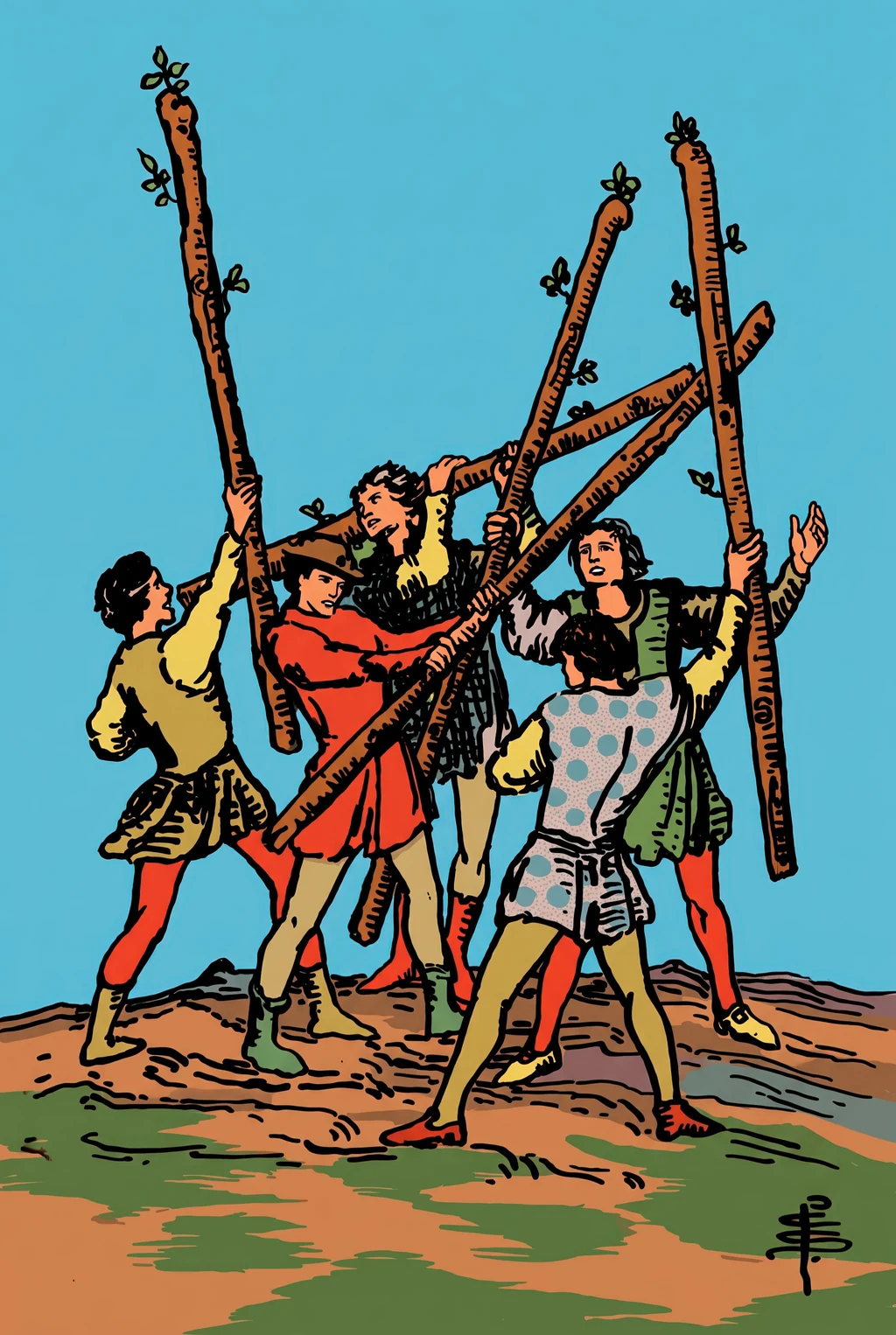
Five young men seem to be testing who can outmaneuver whom. Each holds a wooden staff in his own way, their movements crossing overhead. As soon as one makes a move, he has to contend with someone else’s staff. No one has a clear advantage, and no one stands apart.
Waite described this clash as a mock battle. In such a contest, excitement can sit alongside irritation: the desire to be more skillful, to stand your ground, to keep someone else from pushing you aside. None of this requires the participants to be enemies.
Even a playful contest takes real effort. You swing and meet another staff. You have to shift your stance, try again, and find room for your movement among all the others.
Core meaning
Rivalry, clashing opinions, and a test of strength. The Five of Wands distinguishes constructive competition from arguments in which people only get in one another’s way.
- Key meanings:Rivalry
- Disagreements
- Testing one another’s strength
- Lack of coordination
- Competitive spirit
- Key meanings:Reconciliation
- Avoiding conflict
- Inner conflict
- Weariness from conflict
- Escalating disagreements
Image and symbols
Card image
Five young men stand close together on uneven ground. Each holds a long wooden wand; the staffs are raised and cross at different angles. Small leaves can be seen on them.
The figures’ clothing varies in color and pattern. In the foreground, one young man has his back to the viewer. An open blue sky stretches behind the group, while patches of green and brown alternate on the ground.
Traditional context
For Waite, this is an imitation of combat: the young men seem to be practicing or competing. In his list of divinatory meanings, he connects the mock battle with intense competition for prosperity. This is where his references to gold, gain, and abundance come in.
In a supplementary list, Waite mentions success in financial speculation and, for the reversed card, gaining an advantage from a quarrel. These entries belong to the historical vocabulary of divination. In his main list, the reversed Five of Wands is associated with litigation, disputes, trickery, and contradictions.
Modern readings retain the themes of competition and disagreement but more often explore their everyday forms: uncoordinated actions, minor obstacles, and clashing personalities. The reversed card may suggest the end of a struggle, a conflict turning inward, or the return of an old dispute. These possibilities cannot be reduced to a simple rule that “upright is bad, reversed is good.”
Five young men holding up their wands
A test of strength and rivalry. Waite reads the scene as a mock battle, a kind of practice.
Wands crossing at different angles
Competing individual plans: there is plenty of activity, but no shared direction yet.
The figures’ different clothing
Different experiences, beliefs, and ways of acting. Diversity has not yet become cooperation.
Small leaves on the staffs
There is room for growth even amid conflict: testing and discussing ideas can improve them.
Uneven ground beneath the group
A shared undertaking without a firm foundation: the participants still lack common ground and coordination.
Colors
- Green patches of ground in the foreground
The scene’s vitality and active force, despite its tension.
Meanings
Five of Wands — Upright
General
Overall meaning
The Five of Wands depicts clashing efforts: several people pursue their own aims, argue, or test who is stronger. For Waite, this can be a contest resembling a mock battle rather than genuine hostility.
In an everyday reading, the card also covers minor obstacles: uncoordinated actions, objections, and irritating details that need to be sorted out.
Possible support
Constructive competition helps you test your abilities, clarify your priorities, and better understand your role.
Possible difficulty
When everyone insists on their own way and no one listens, disagreements obstruct a shared goal.
Focus
The issue at stake can get lost in the desire to win. It helps to distinguish the problem being discussed from a contest for dominance.
Reflection questions
- What really matters to me in this dispute?
- Which small frustrations are asking for my patience right now?
Relationships
Overall meaning
In a romantic relationship, the Five of Wands can suggest teasing, competition for attention, and frequent clashes of personality. A lively exchange of views can easily turn into trying to outargue each other.
Among friends, competition and disagreements may arise over whose wishes matter more. In family matters, the card can also point to relatives interfering in a couple’s life and disputes over the boundaries of that involvement.
Possible support
With minor disagreements, it helps to keep things light rather than turning every difference of opinion into a serious argument.
Possible difficulty
Competing family demands can leave a couple with little time to connect with each other.
Focus
Teasing may sting more when stress is high. Notice when a joke stops being enjoyable.
Reflection questions
- At what point does our teasing stop feeling good to me?
- How much room is left for us to connect amid family demands?
Work and study
Overall meaning
At work or in your studies, the card points to competition with people who also have skills and ideas to offer. This may be a normal part of professional life or a particular contest for a position, recognition, or a place on a project.
Another reading concerns teamwork: there are ideas, but everyone pushes their own plan, making it difficult to agree and act together.
Possible support
Discussing different ideas can get a stalled project moving when everyone has a chance to speak and the rules of discussion are clear.
Possible difficulty
Competition for status can replace any real examination of the proposals. Then discussion holds up the work instead of improving it.
Focus
How you compete matters, too: someone else’s dishonesty does not make dishonesty a useful rule for your own work.
Reflection questions
- Are we comparing the quality of the ideas or the influence of the people proposing them?
- What ground rules would help everyone have a say?
Money and resources
Overall meaning
In material matters, this card concerns competition and the need to stand up for your interests. Waite associates it with a tense struggle for prosperity.
In everyday terms, this may be a dispute over expenses, money owed, or how to divide a limited amount among several needs.
Possible support
It helps to calmly review which commitments you can manage now, rather than trying to meet every demand at once.
Possible difficulty
The desire not to fall behind others can encourage spending driven mainly by comparison and the need to prove yourself.
Focus
When money is shared, clarify differences in priorities and acceptable levels of risk before assuming an agreement has been reached.
Reflection questions
- Which expenses are competing for the same limited funds?
- Am I spending anything just to keep up with others?
Wellbeing and self-care
Overall meaning
Several demands pull your attention in different directions at once. This reading reflects a hectic daily rhythm in which it is difficult to pause and decide what to focus on now.
Possible support
A pause and some rest may be more helpful than another attempt to push yourself through frustration.
Possible difficulty
Prolonged competition can be exhausting, even if it felt energizing at first.
Focus
Notice the urge to tackle everything at once. It can add to the rush and leave you feeling that nothing gets enough attention.
Reflection questions
- Which responsibilities are demanding my attention at the same time?
- When does the excitement of competition turn into fatigue for me?
Personal growth
Overall meaning
In matters of habits and inner change, the card points to resistance: one part of you wants to change, while another keeps doing things the old way. Conflicting desires call for understanding, not just willpower.
Another perspective concerns self-esteem: the need to be better than others can reduce your sense of your own abilities to the outcome of the latest comparison.
Possible support
Encountering another perspective can help you express your beliefs more clearly if you examine the arguments rather than simply defending yourself.
Possible difficulty
Familiar routines can hold you back from change, even after they have stopped helping you grow.
Focus
Notice whether your self-worth depends on constantly comparing yourself with others and expecting to be the best at everything.
Reflection questions
- What habit do I want to change, and what keeps me attached to it?
- What happens to my sense of self-worth when someone else is more successful?
Five of Wands — Reversed
General
Overall meaning
The reversed Five of Wands changes the nature of the struggle. It may suggest reaching an agreement, stepping away from a pointless contest, or one person withdrawing from the argument.
Another possibility is calm on the surface: objections go unspoken, but tension remains. The struggle may also turn inward as your own beliefs come into conflict and you reconsider how you see the world.
The card also allows for escalating disagreements. Waite lists litigation, disputes, trickery, and contradictions.
Possible support
Openly discussing disagreements can bring an issue that was previously hidden beneath the surface into view.
Possible difficulty
The absence of an open quarrel does not erase accumulated resentment. Ignoring the problem can keep the tension alive.
Focus
Distinguish genuine agreement from ending a conversation simply to avoid further argument.
Reflection questions
- Is the current calm based on agreement or silence?
- Which argument no longer feels worth continuing?
Relationships
Overall meaning
In a romantic relationship, the card can point to disagreements softening and a return to cooperation. Yet outward calm can also come from keeping quiet: an uncomfortable conversation is postponed while resentment builds.
In friendships and family relationships, another reading concerns attempts to restore understanding through direct conversation. If conflict intensifies, a couple may need help from a mediator.
Possible support
Disagreeing without humiliating or trying to overpower each other can help clarify the relationship and deepen mutual understanding.
Possible difficulty
Suppressed objections can turn into resentment and gradually undermine trust.
Focus
In a relationship, look at the cause of a recurring disagreement, not just what sparked the latest argument.
Reflection questions
- What am I keeping quiet about to avoid starting another argument?
- How can I express disagreement without humiliating the other person?
Work and study
Overall meaning
Competition at work may be easing, bringing greater coordination and less need to keep proving you are better than others.
But a quiet period can be unproductive if people are afraid to disagree and proposals no longer receive useful scrutiny. Another reading points to overload: too many commitments, rushing, and a prolonged struggle to achieve results.
Possible support
Help from someone with relevant expertise means you do not have to handle workplace conflict alone.
Possible difficulty
Fear of a necessary conversation or a professional challenge can hold you back and leave the problem unresolved.
Focus
Consider whether rushing has pushed attention to detail and the quality of your work aside.
Reflection questions
- Are there fewer arguments at work, or fewer opportunities to voice objections?
- Which details am I missing because I am rushing?
Money and resources
Overall meaning
In financial matters, two readings are possible: disagreements over money are easing, or an old dispute is continuing and becoming more difficult. The reversed orientation alone does not mean a shortage of funds has been resolved.
Possible support
It can help to reconsider familiar assumptions about income and expenses, especially the belief that nothing can change.
Possible difficulty
Unnecessary comparisons with other people’s wealth may continue to shape financial choices even after an open dispute ends.
Focus
Postponing a conversation about shared money is not the same as reaching an agreement. Notice which decisions and commitments are still being avoided.
Reflection questions
- What assumption about my spending have I left unexamined for a long time?
- What conversation about shared money am I still putting off?
Wellbeing and self-care
Overall meaning
The card can describe fatigue from prolonged conflict and a desire to stop spending energy on it. In another reading, tension is already easing because some demands have been reconciled or set aside.
Possible support
Reassessing everyday priorities and letting go of excessive demands can help.
Possible difficulty
Lingering minor quarrels and unspoken irritation continue to drain your energy, even without open confrontation.
Focus
Notice whether you have the energy to continue the struggle you have chosen, or whether you need rest first.
Reflection questions
- Which demands can I let go of so I stop feeling pulled in every direction?
- Do I need another argument right now, or a break from it?
Personal growth
Overall meaning
An inner debate comes to the foreground: it can be difficult to know where you stand, especially when people around you insist on different answers. New information may change old beliefs, and bringing them into alignment is not always simple.
Possible support
Reading, listening closely, and reflecting on your own can help you work through contradictions in your views.
Possible difficulty
Avoiding all disagreement may lead you to give way on something that genuinely matters to you.
Focus
A carefully considered position of your own does not need everyone else’s approval.
Reflection questions
- Which opinion am I accepting only to avoid an argument?
- What genuinely convinces me on this issue?
Roles in a spread
Position examples
A position gives the card a question, such as what helps or what gets in the way. That question shapes how you read its meaning.
Five of Wands — Upright
Situation
Several people are defending their interests and testing one another’s strength. This may be competition rather than hostility.
Influence
Rivals and people with different perspectives shape the situation. Their objections may intensify the dispute or help you clarify your position.
Motivation
The driving force may be a desire to gain an advantage, outdo rivals, or prove yourself through competition.
Support
Competition and meaningful debate can restore focus and keep you from settling for your usual level of effort.
Obstacle
Discussion turns into a fight for the right to speak. A lack of coordination makes it hard to move from objections to shared action.
Focus of attention
Notice whether the need to win has become your only measure of self-worth.
Next step
Start by taking turns: let everyone speak and hear the differences that get lost when everyone talks at once.
Possible development
Without listening and seeking agreement, minor differences may grow into a serious dispute.
Five of Wands — Reversed
Situation
The struggle ends because a way forward has been found or someone stops taking part. At times, an old argument resurfaces instead of reaching a conclusion.
Influence
Mediators and people who help both sides reach an agreement, rather than fueling their rivalry, may ease the tension.
Motivation
Walking away from an argument may come from wanting to avoid an uncomfortable conversation rather than from having reached an agreement.
Support
Recognizing that an argument is no longer worth the effort can help you step away from a pointless contest.
Obstacle
Trying to keep up the appearance of peace leaves the conflict itself untouched. Unspoken dissatisfaction continues to get in the way.
Focus of attention
Consider whether the argument is continuing for the sake of conflict alone, and what keeps you involved.
Next step
Step away from an argument that is not worth the effort, or leave a competition you never chose to enter. But if an important issue can still be resolved, ending the conversation just for relief may be premature. You do not have to respond to every jab with one of your own.
Possible development
If any means become acceptable in the pursuit of victory, rivalry may intensify and give way to dishonest tactics.
Combination examples
Card combinations are in development. For now, here are a few examples.
Five of Wands + Temperance
Five of Wands ( upright) + Temperance ( upright)
- Example question:
- How might disagreement be read alongside the possibility of agreement?
- Example interpretation:
Temperance sets balance and cooperation against the Five of Wands’ struggle. Together, the cards bring the distinction between rivalry and working together into sharper focus.
Five of Wands + Three of Pentacles
Five of Wands ( upright) + Three of Pentacles ( upright)
- Example question:
- What does this pair highlight about working together?
- Example interpretation:
The Three of Pentacles contrasts teamwork with scattered rivalry. This pair emphasizes the difference between participants competing against one another and cooperating toward a shared goal.
Five of Wands + Five of Swords
Five of Wands ( upright) + Five of Swords ( upright)
- Example question:
- How does this pair shift the focus in a conflict?
- Example interpretation:
The Five of Swords intensifies the Five of Wands’ theme of discord: the opposition between people comes to the foreground, rather than the playful nature of the contest.
Reading example
An imagined one-card reading shows how the meanings above can apply to a question. This is one possible interpretation.
Five of Wands — Upright
Situation:
You enjoy spending time with friends, but conversations are increasingly turning into contests over who gets the last word. You want to be part of the conversation without turning every get-together into an argument.
Question:
How can I engage here without getting drawn into constant competition?
-
Card drawn:
Imagine drawing a card for the position «How I take part» and getting Five of Wands (upright).
Interpretation:
The Five of Wands highlights clashing voices and the desire to be heard. In this group, debate can remain a lively exchange of views, but fighting for the last word gets in the way of listening.
You could try not to jump in over someone else: let them finish, then share your thought. That way, you can stay engaged without making victory over the other person the goal of the conversation.
Five of Wands — Reversed
Situation:
You enjoy spending time with friends, but conversations are increasingly turning into contests over who gets the last word. You want to be part of the conversation without turning every get-together into an argument.
Question:
How can I engage here without getting drawn into constant competition?
-
Card drawn:
Imagine drawing a card for the position «How I take part» and getting Five of Wands (reversed).
Interpretation:
The reversed Five of Wands invites you to consider stepping away from an argument that no longer serves a purpose. Here, that does not necessarily mean withdrawing from the group: you can stop trying to have the last word.
You also do not have to stay silent about everything just to keep the peace. You can let a minor exchange go; when something matters, you can state your position without insisting on changing everyone else’s mind.
Yes / No
Five of Wands — Upright
Why this answer
No. The card connects this answer with opposition and competition: disagreements stand in the way of what you hope to achieve.
A question to consider
Which disagreement is the greatest obstacle to my plans?
Five of Wands — Reversed
Why this answer
Yes. This answer is associated with resolving disagreements and easing the rivalry that previously stood in the way.
A clarification
This “yes” depends on a willingness to discuss disagreements without placing the need to prove yourself right above reaching an agreement.
A question to consider
What matters more to me in this conversation: reaching an agreement or proving I am right?
Correspondences
Connections with numbers, elements and other symbols add depth to the card’s imagery. They can differ between traditions.
Number — V (5)
Fives signify opposition and clashing forces. In Wands, this numerical theme takes shape through argument and competition.
Element — Fire
The suit’s element is associated with strength, drive, and activity. In the Five, these qualities appear as opposing forces.
Astrology — Saturn in Leo, first decan
Saturn is associated with limits and discipline, while Leo is linked to the drive for self-expression. Their combination highlights the tension between wanting to come first and needing to consider others.
Letter — Yod (י) — correspondence of the suit of Wands
In the formula “Geburah of Yod,” the letter identifies the suit sequence. This is a general correspondence for Wands, not a separate letter-path assigned exclusively to the Five.
Tree of Life — Geburah in the Yod suit sequence
The fifth sephirah links this card with opposition and struggle. In Book T, the correspondence for the Five of Wands is explained directly through quarrels and clashes.