
Three of Pentacles
Descriptions and symbolism are based on the card’s classic illustration in the Rider–Waite–Smith deck. Details of the artwork may differ in other editions of the deck.
This guide brings together traditional and modern readings. Interpretations and answers may differ between authors and schools.
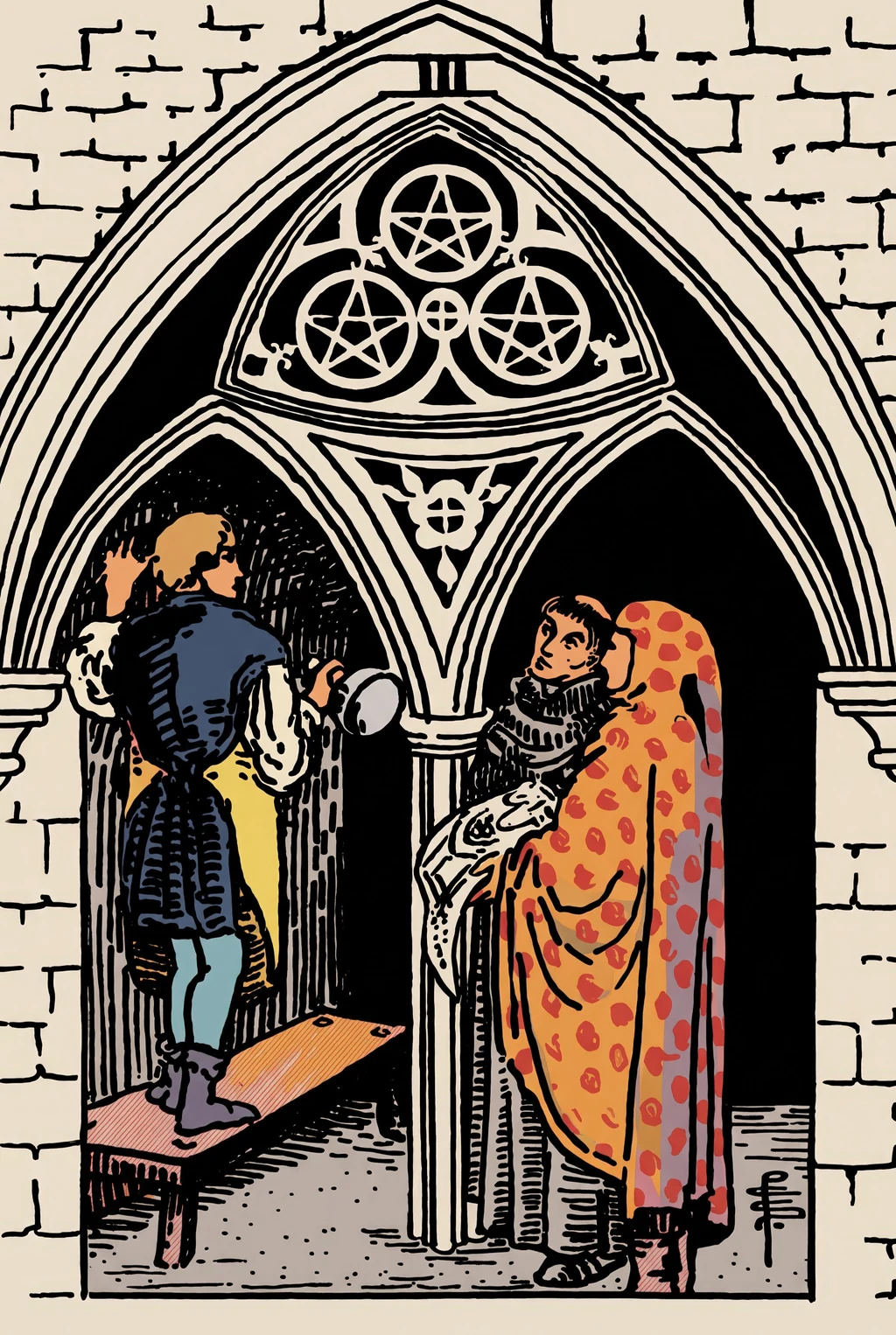
Beneath a monastery arch, a craftsperson discusses the work with two others; one holds an open set of plans. Waite connects the craftsperson to the apprentice or amateur on the Eight of Pentacles: that figure has received a reward and is now working in earnest. The comparison helps us see how a learned skill becomes part of a larger undertaking.
The craftsperson stands on a bench with tools in hand, turned toward the others as if something needs to be clarified. The lines on the page must be reconciled with the carving in the stone. The person holding the tool knows how the material resists and may notice what the drawing does not yet show. Vision and experience meet beside the column. The conversation is part of the work, too.
Core meaning
Skill becomes visible through shared work. The Three of Pentacles connects quality craftsmanship with recognition, learning, and the ability to bring different contributions together.
- Key meanings:Craftsmanship
- Collaboration
- Recognition
- Learning
- Shared plan
- Quality
- Key meanings:Lack of coordination
- Undervalued contributions
- Flaws
- Delays
- Rivalry
- Independent work
Image and symbols
Card image
Three people stand beneath gray Gothic vaults. On the left, a craftsperson holding tools has stepped onto a wooden bench and turned toward two figures on the right. The craftsperson wears blue clothing with light-colored sleeves and a yellow apron. One of the others wears a long gray robe, while the other wears a patterned hooded garment; a sheet of architectural plans is held up between them.
Above the figures, three pentacles are set into the stone arch. Beneath them is a carved floral pattern within a small triangular frame. Pale columns and vaults stand out against the dark background.
Traditional context
Waite describes a sculptor at work in a monastery and compares this figure with the Eight of Pentacles: the apprentice or amateur has already received a reward and is working in earnest. What matters is mastery of a craft and recognition.
In his divinatory list, occupation and skilled labor appear alongside nobility, aristocracy, renown, and glory. Waite’s reversed meanings include mediocrity, immaturity, pettiness, and weakness.
Modern RWS readings place greater emphasis on collaboration. For Theresa Reed, the card also speaks to apprenticeship: skills are still being honed with a mentor. The reversed card is not limited to poor workmanship; it may suggest undervalued expertise or choosing to work alone instead of persisting in an unsuccessful collaboration.
A craftsperson with tools before a stone arch
Practical skill and work that demonstrates a person’s craftsmanship.
A figure in a robe with a tonsure
In a modern reading, the monk represents the spiritual purpose and vision behind the shared work.
A figure in a patterned hooded garment
This figure is read as an architect or client, bringing requirements for the work and how the finished structure should take shape.
The craftsperson turns toward the others gathered around a drawing
The discussion brings different kinds of knowledge together. The craftsperson’s opinion carries weight, regardless of the others’ status.
A wooden bench beneath the craftsperson’s feet
The bench can be read as the accumulated knowledge on which the work rests.
A sheet of architectural plans
A shared plan makes the vision clear to everyone involved and helps them coordinate their work.
Gothic stone vaults and columns
The work belongs to a larger structure and must meet requirements beyond the craftsperson’s personal taste.
Three pentacles carved into the stone
Skill has taken visible form: the result of the work becomes part of the building itself.
Three pentacles arranged in an upward-pointing triangle
In an elemental reading, this triangle is associated with Fire, action, and creation.
A downward-pointing triangular frame beneath the pentacles
In the same elemental reading, it is associated with Water and the receptivity that complements action.
A carved floral rosette beneath the three pentacles
The floral ornament connects the practical value of craftsmanship with beauty and the spiritual meaning of the work.
Colors
- Yellow — the craftsperson’s apron
In a modern reading, the yellow apron may symbolize wisdom.
Meanings
Three of Pentacles — Upright
General
Overall meaning
Skill is put to practical use and becomes visible to others. The card describes quality work, recognition of each person’s contribution, and cooperation among people with different experience.
In modern readings, it often points to the early results of a shared vision: work is underway but still needs development. In a question about construction, the card may refer literally to building work; if the question concerns a ceremony, it can also be read literally as a shared celebration.
Possible support
People whose strengths complement yours can help, as can a willingness to draw on one another’s knowledge.
Possible difficulty
The idea may prove too complex to carry out alone. The difficulty then lies in asking for help and coordinating efforts.
Focus
Clarify the shared vision and how the work will be done before everyone starts following a separate plan.
Reflection questions
- Which parts of my vision have I already brought to life?
- Whose involvement could improve what I am doing?
Relationships
Overall meaning
For a couple, the card describes a relationship built through shared activities, mutual help, and a willingness to learn from each other. When getting to know someone, it may suggest growing closer through work, study, or a shared interest.
In family and friendships, its theme is just as practical: making plans together and recognizing what each person brings to the relationship.
Possible support
Mutual involvement and respect for what loved ones contribute can help.
Possible difficulty
One person cannot build a partnership for two. A relationship needs mutual participation, not just one person’s effort.
Focus
In a relationship, clarify shared responsibilities and listen to each other.
Reflection question
What shared activity helps me better understand someone close to me?
Work and study
Overall meaning
Professional skill, teamwork, and an assessment of quality come together here. The card speaks to projects involving different specialists, learning a craft, studying, and working with a mentor. Recognition is based on what someone can do, not just their job title.
Possible support
Reviewing your work with a mentor and exchanging skills with colleagues can help.
Possible difficulty
A complex task calls for dividing up the work rather than trying to take everyone’s place.
Focus
Show your work to people who can evaluate it. Thoughtful feedback can help you refine the quality of your work.
Reflection questions
- Which skill should I practice with a mentor?
- Which part of our shared work am I especially good at?
Money and resources
Overall meaning
The material side of this card concerns being paid for useful skills, working together, and understanding your finances. It can also point to learning: getting to grips with a budget or receiving a clear explanation of a money matter.
Possible support
Someone who can explain unfamiliar financial matters may be a source of support.
Possible difficulty
With shared expenses, individual choices may conflict with the plan everyone agreed on.
Focus
In a shared budget, it is worth clarifying expenses and each person’s responsibilities.
Reflection questions
- What about my finances do I still not understand?
- Which shared expenses do I need to discuss and agree on?
Wellbeing and self-care
Overall meaning
The card may reflect the satisfaction of making a useful contribution and feeling that your efforts are valued. When it comes to well-being, it points to support from others rather than a need to handle everything alone.
Possible support
You can seek help from an appropriate professional or a group where people support one another.
Possible difficulty
Poor coordination and unclear arrangements may make it harder to receive the support you need.
Focus
Notice how much space you make for self-care in your everyday life.
Reflection question
Who makes it easier for me to look after my well-being?
Personal growth
Overall meaning
Growth comes through learning and encountering other people’s experience. The card also connects personal development with work that puts your own interests and abilities to use.
Possible support
Learning something new can broaden your perspective and strengthen confidence in your abilities.
Possible difficulty
Choosing a course of study solely to meet family expectations can pull you away from what genuinely interests you.
Focus
When choosing a new pursuit, pay attention to your own interests, not just someone else’s idea of the right career.
Reflection question
What would I like to learn, regardless of others’ expectations?
Three of Pentacles — Reversed
General
Overall meaning
Mistakes, flawed plans, and disagreements hinder a shared effort. Sometimes the work is done well but goes unnoticed, or people have no opportunity to use the skills they already possess.
Another reading involves a conscious choice to work independently instead of continuing an unsuccessful collaboration.
Possible support
Reconsidering how you collaborate may help. Sometimes working independently offers a better foundation.
Possible difficulty
Competing to take the lead and refusing to listen to others prevent people from working together.
Focus
Distinguish a lack of skills from a situation where existing abilities are poorly coordinated or undervalued.
Reflection questions
- What might be keeping us from working together?
- Would I genuinely be more comfortable working on my own?
Relationships
Overall meaning
In a romantic relationship, feelings may not be matched by participation in everyday responsibilities. Unequal contributions can also lead to resentment and tension in families and friendships.
When the question is about being single, the card allows another reading: right now, someone may prefer an independent life to looking for a relationship.
Possible support
Speaking openly about expectations and being willing to hear each other can help you find a more mutual way of relating.
Possible difficulty
In a couple, household tasks, money concerns, or the work of keeping in touch may fall mostly on one person.
Focus
It helps to clarify what loved ones expect from each other and what they have yet to agree on.
Reflection questions
- Am I comfortable with how we divide shared responsibilities?
- What could I talk about openly instead of waiting for the other person to guess?
Work and study
Overall meaning
The card may describe unfinished details, insufficient preparation, a breakdown in coordinated work, or the need to redo someone else’s mistakes. But the quality of the work is not always the problem: sometimes a skilled person is undervalued, or the job offers no room to grow.
Possible support
If you need to build your skills, learning and practicing alongside someone experienced can help.
Possible difficulty
Two opposing extremes are possible: carelessness undermines quality, while perfectionism prevents the work from being finished.
Focus
Look closely at your working conditions. Is there room to use your skills and continue learning?
Reflection questions
- Which part of my work might call for more training?
- Which revisions improve the result, and which only delay completion?
Money and resources
Overall meaning
Managing shared money becomes difficult when people have different priorities and fail to coordinate decisions. The card may also suggest being underpaid for your work or avoiding financial matters rather than trying to understand them.
Possible support
Clear agreements about money and an explanation from a knowledgeable professional may help.
Possible difficulty
Different ideas about how to spend shared funds can turn financial decisions into arguments.
Focus
Notice which financial topic you have been putting off learning about because it seems difficult or uncomfortable.
Reflection questions
- Which money matter do I need someone to explain?
- Which rule about shared expenses do we understand differently?
Wellbeing and self-care
Overall meaning
When your efforts go unappreciated, disappointment and emotional strain may follow. In matters of well-being, the card draws attention to a lack of support or help that is not well coordinated.
Possible support
You do not have to handle every concern alone. You can seek the kind of support you need.
Possible difficulty
When the people helping you do not share information effectively, it becomes harder to coordinate your care.
Focus
If the activities you usually do for your well-being no longer hold your interest, it may be worth reconsidering your approach.
Reflection questions
- Can I reach out for the support I need?
- What is making it hard to continue the activities I chose for my well-being?
Personal growth
Overall meaning
The card may point to a tendency to undervalue your own abilities. Another theme is independent growth: sometimes focusing on your own learning is more useful than continuing a collaboration that is no longer helping you grow.
Possible support
Developing your skills and reflecting on what working with others has taught you can help.
Possible difficulty
Growth is held back by repeating old mistakes and persisting with a course of study chosen under pressure from others.
Focus
Distinguish independence you have chosen from isolation that leaves you without enough connection and support.
Reflection questions
- Am I undervaluing what I already know how to do?
- What past experience should I consider before trying again?
Roles in a spread
Position examples
A position gives the card a question, such as what helps or what gets in the way. That question shapes how you read its meaning.
Three of Pentacles — Upright
Situation
The idea is already being tested in practice: people are combining their skills and evaluating the first results.
Influence
Support comes from people who recognize the value of the skills you have already demonstrated.
Motivation
You may be driven by a desire to learn your craft thoroughly, earn recognition, and create something lasting.
Support
Your strength lies in combining your skills with what others do best.
Obstacle
Trying to handle everything alone becomes a limitation when the task calls for other kinds of knowledge and coordinated effort.
Focus of attention
Check whether the vision, execution, and quality standards are aligned, rather than relying on everyone’s good intentions alone.
Next step
Offer your contribution and invite others into the conversation. Listen to what they can do and how they see the shared work.
Possible development
With continued care and collaboration, what you have started can take on a stable, lasting form.
Three of Pentacles — Reversed
Situation
Progress has stalled: work needs to be redone, plans diverge, and individual efforts are not adding up to a shared result.
Influence
The situation is shaped by an environment where people’s contributions go unnoticed or are not taken seriously.
Motivation
Choosing to work alone may reflect a desire for independence or weariness from waiting for others to take part.
Support
More open, honest communication may help. If working together is not the right fit, working independently is also an option.
Obstacle
Conflicting goals and the struggle to come out on top draw attention away from the reason people came together.
Focus of attention
Notice where your contribution truly goes unappreciated and where you may be underestimating your own skills.
Next step
Return to the shared goal and revisit agreements about contributions, workflow, and deadlines.
Possible development
If disagreements and planning mistakes persist, the work may continue to face delays and revisions.
Combination examples
Card combinations are in development. For now, here are a few examples.
Three of Pentacles + The Magician
Three of Pentacles ( upright) + The Magician ( upright)
- Example question:
- How can I put my skills to use in a shared effort?
- Example interpretation:
The Magician’s initiative and skill find an outlet through collaboration. The pairing invites you to show what you can do and align it with the plans of the others involved.
Three of Pentacles + Temperance
Three of Pentacles ( upright) + Temperance ( upright)
- Example question:
- What helps bring different contributions together?
- Example interpretation:
The cards reinforce the theme of combining efforts: different people and ways of working can complement one another.
Three of Pentacles + Five of Wands
Three of Pentacles ( upright) + Five of Wands ( upright)
- Example question:
- What prevents people from working together?
- Example interpretation:
The theme of collaboration meets division and rivalry. This pairing highlights the tension between a shared undertaking and competition among its participants.
Three of Pentacles + Nine of Pentacles
Three of Pentacles ( upright) + Nine of Pentacles ( upright)
- Example question:
- How do independence and teamwork relate to each other?
- Example interpretation:
The pairing contrasts two ways of approaching a task: relying on your own abilities or drawing on the involvement of others.
Reading example
An imagined one-card reading shows how the meanings above can apply to a question. This is one possible interpretation.
Three of Pentacles — Upright
Situation:
You have been invited to join an amateur theater production. You like the idea, but the others have more experience, and you are unsure whether to say yes.
Question:
What will help me decide whether to take part?
-
Card drawn:
Imagine drawing a card for the position «What will help» and getting Three of Pentacles (upright).
Interpretation:
The Three of Pentacles connects shared work with different skills and the chance to learn from one another. Here, it invites you to look beyond the difference in experience and consider what you could contribute.
You could discuss your prospective role and ask who you might learn from along the way. That gives your decision a concrete basis: a clear role and an opportunity to develop your skills.
Three of Pentacles — Reversed
Situation:
You have been invited to join an amateur theater production. You like the idea, but the others have more experience, and you are unsure whether to say yes.
Question:
What will help me decide whether to take part?
-
Card drawn:
Imagine drawing a card for the position «What will help» and getting Three of Pentacles (reversed).
Interpretation:
The reversed Three of Pentacles draws attention to undervaluing your abilities and the difficulties of working with others. In this situation, it invites you to distinguish your own uncertainty from the conditions under which you would participate.
You could clarify what would be expected of you and how less experienced participants are supported. Consider those arrangements when making your decision, rather than simply comparing your skills with everyone else’s.
Yes / No
Three of Pentacles — Upright
Why this answer
The card connects a positive answer with skill and collective effort. This “yes” is especially fitting for questions about collaboration, learning from others, and recognition for good work.
A clarification
Consider both how well people work together and how prepared they are. Wanting to join forces is not enough without the necessary skills.
A question to consider
Whose skills could complement mine in this work?
Three of Pentacles — Reversed
Why this answer
Poor coordination, inadequate preparation, or a lack of mutual participation stand in the way of progress. In this approach to the situation, the card points to “no.”
A clarification
Distinguish between two possibilities: people have the skills but cannot agree on how to work together, or they get along but do not yet have the preparation the task requires.
A question to consider
What is missing right now: the necessary skills or coordinated effort?
Correspondences
Connections with numbers, elements and other symbols add depth to the card’s imagery. They can differ between traditions.
Number — III (3)
The number three is associated with bringing different participants together and with a vision beginning to take shape.
Element — Earth
Earth connects the suit with the material side of life: the body, work, money, and tangible results.
Astrology — Mars in Capricorn; second decan of Capricorn
This correspondence accompanies the image of the “Lord of Material Works”: creation and the beginning of an undertaking that has yet to become firmly established.
Tree of Life — Binah, the third sephirah
In this system, the threes are associated with action beginning to take form. For the Three of Pentacles specifically, the text names an undertaking, paid work, and commercial exchange.