
Four of Pentacles
Descriptions and symbolism are based on the card’s classic illustration in the Rider–Waite–Smith deck. Details of the artwork may differ in other editions of the deck.
This guide brings together traditional and modern readings. Interpretations and answers may differ between authors and schools.
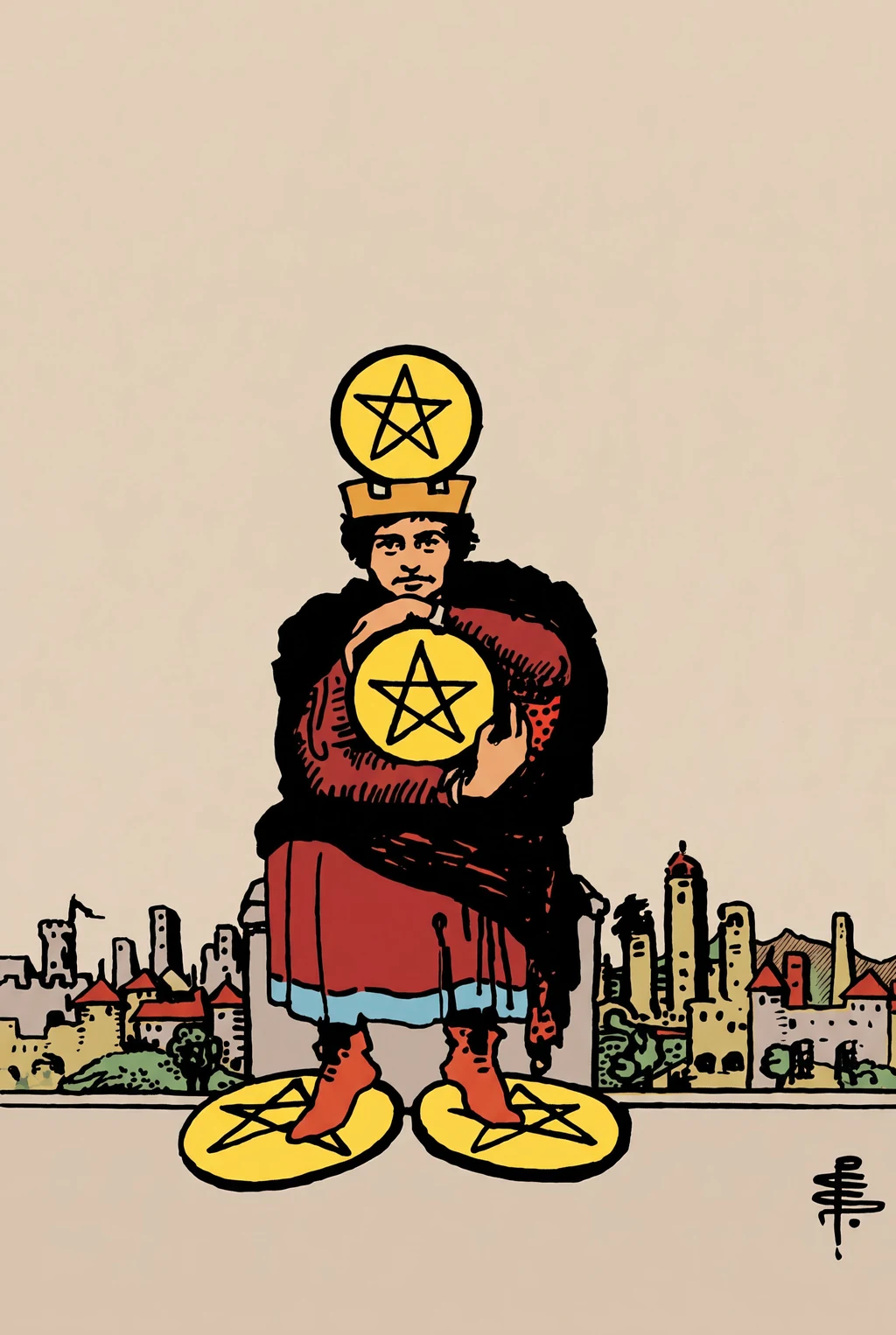
A person has arranged their body around four pentacles. One is pressed against the chest, two are held beneath the feet, and another rises above the head. It is a secure arrangement, but a difficult one to rise from without disturbing something. The city remains behind them, while their immediate world is limited to what they can directly control.
To stand up, they would have to disturb at least one disk. To reach out a hand, they would have to loosen their embrace. Every movement begins with a small act of letting go, which makes it so easy to put off. Everything is still in its place—except the person, who seems to have settled in as a guard over their own possessions.
Core meaning
The Four of Pentacles is associated with holding on to what you have built, stability, and control. It shows how sensible protection of your boundaries and possessions can turn into fear of loss and resistance to change.
- Key meanings:Savings
- Stability
- Control
- Personal boundaries
- Fear of loss
- Possessiveness
- Key meanings:Release
- Generosity
- Overspending
- Greed
- Insecurity
- Delay
Image and symbols
Card image
A crowned figure sits facing the viewer on a gray stone seat. The figure wears red clothing with blue trim, a black cloak, and red shoes.
Both hands clasp a pentacle against the chest. Another pentacle sits above the crown, while two more lie beneath the figure’s feet. City buildings and towers are visible in the background; the foreground and sky are gray.
Traditional context
In Waite’s account, the main emphasis is on safeguarding possessions and holding on to what one has. His list of divinatory meanings also includes a gift, a legacy, and an inheritance, so reducing the card to miserliness alone would be misleading.
For Waite, the reversed card is associated with uncertain anticipation, delay, and opposition. An additional list includes observation and obstacles. These meanings differ from the modern interpretation of releasing attachments.
In the Golden Dawn system, the card is called the “Lord of Earthly Power”: an acquired position has been secured, but further development may stall. Modern RWS interpretations consider not only possessions but also control in interactions, fear of loss, and personal boundaries. Reversed readings distinguish between loosening one’s grip, excessive spending, and, conversely, intensified greed.
Hands clasping a pentacle against the chest
Holding on to what belongs to you and protecting it from loss. When the grip becomes too tight, possession turns into a constant need to guard what you have.
Pentacle above the crown
In a modern symbolic reading, material concerns overshadow spiritual interests.
Two pentacles beneath the feet
The desire to keep everything under control restricts movement. Here, holding everything in place and moving freely are at odds.
The city behind the solitary figure
Community life, family, and friends are left behind. The distance from the city emphasizes the isolation that can accompany a focus solely on possessions.
Rectangular stone seat
A firm, stable foundation.
Colors
- Red — the figure’s main garment
Passion and strong personal investment.
- Blue — the trim along the lower edge of the garment
Introspection and a focus on one’s own thoughts.
- Gray — the sky behind the figure
Neutrality and ambiguity: the background sets neither an overtly favorable nor an overtly troubling tone.
Meanings
Four of Pentacles — Upright
General
Overall meaning
The Four of Pentacles describes preserving what you have achieved: holding on to possessions, status, or familiar routines. There is thrift, foresight, and a desire to feel secure here.
The other side of this stability appears when any change feels threatening. Protection then becomes rigid control, and holding on to what is yours leaves no room for exchange or growth.
Possible support
The ability to safeguard what matters and set clear boundaries. Caution is useful when something you have built genuinely needs protecting.
Possible difficulty
Fear of loss becomes an obstacle when it makes you hold on to a situation longer than is reasonable.
Focus
It is worth distinguishing what still holds value from what you are keeping only because it is familiar.
Reflection questions
- What do I want to preserve in this situation?
- Does my familiar routine help me feel freer?
Relationships
Overall meaning
In romantic relationships, the card can describe possessiveness, jealousy, and emotional guardedness rooted in fear of losing closeness. After a breakup, resentment or hope of restoring the former relationship may linger.
In family life and friendships, another theme is how attention to possessions and earnings can crowd out attention to loved ones.
Possible support
In a relationship, personal space supports closeness: being together without directing each other’s lives.
Possible difficulty
Trying to hold on to a partner through control can gradually undermine the relationship itself.
Focus
When meeting someone new, it may be worth noticing whether a past relationship is taking up all the space that new intimacy might need.
Reflection questions
- Is there room for personal space in my relationships?
- How does my past experience affect my openness to meeting someone new?
Work and study
Overall meaning
At work, the Four of Pentacles can represent an established position and a desire to keep it. Sometimes the cost is a loss of interest: you stay in a familiar job primarily for the income.
In collaborative work, the card also relates to protecting your territory: reluctance to share ideas with colleagues and a preference for keeping responsibilities under your own control.
Possible support
A predictable income can remain a practical source of stability, even when the work itself is not fulfilling for now.
Possible difficulty
Guarding ideas too closely and continually interfering with others’ work can make collaboration difficult.
Focus
Address a specific concern about authorship or credit without turning the fear of having your ideas taken into a constant expectation of threats.
Reflection questions
- What matters most to me when choosing a job: security, interest, or room to grow?
- How freely do I share ideas when working with others?
Money and resources
Overall meaning
The central theme is protecting money and possessions. This may mean saving for a particular goal, keeping spending in check, and building up reserves.
Traditional interpretations also include property received as a gift or inheritance. A more strained expression of the card is holding on to every dollar out of fear of running out of money.
Possible support
A clear budget and the habit of not wasting your savings help maintain a material foundation.
Possible difficulty
Saving becomes an imbalance when affordable pleasures, gatherings, and gifts are sacrificed solely for the sake of accumulating more.
Focus
What matters is the line between thoughtful spending habits and fear of spending anything at all.
Reflection questions
- What am I saving money for right now?
- Does my budget leave room for the things I earn money to enjoy?
Wellbeing and self-care
Overall meaning
In matters of emotional well-being, the card relates to the tension of trying to preserve a familiar sense of safety. Another meaning concerns old resentments that are difficult to let go of.
Possible support
Relaxation and quiet contemplative practice can help ease the need for constant control.
Possible difficulty
The difficulty may involve someone else’s attempts to control your emotional state and everyday self-care.
Focus
Not everything is within conscious control. Notice where the expectation of managing everything keeps you from relaxing.
Reflection question
What helps me relax without needing to control everything?
Personal growth
Overall meaning
The card touches on your sense of self-worth when you begin to measure it by income, possessions, or outward signs of wealth. Another meaning involves rigid beliefs and a familiar way of life defended against any change.
Possible support
An inner sense of having enough can offer support: security rests on more than what you own.
Possible difficulty
A belief that no longer serves you may remain in place simply because it once made you feel safe.
Focus
Notice whether your view of yourself comes down to what you own and how much you earn.
Reflection questions
- How do I judge my own worth?
- Which familiar beliefs do I find hard to reconsider?
Four of Pentacles — Reversed
General
Overall meaning
The reversed Four of Pentacles changes the theme of holding on. In one reading, the grip loosens: sharing, opening up, and letting go of what is no longer needed become easier. In another, the sense of proportion is lost: generosity becomes wastefulness, while the desire for protection hardens into greed and mistrust.
In Waite’s historical interpretation, the card also signifies waiting, delay, and opposition. A reversed card, then, does not always indicate release or forward movement.
Possible support
Openness and a willingness to share can make room for new experiences instead of the familiar habit of keeping everything to yourself.
Possible difficulty
The extremes of control: either refusing to let anything go or abandoning necessary protection before you are ready.
Focus
Distinguish between letting go of what you do not need and losing useful boundaries. These are two different ways of loosening control.
Reflection questions
- What do I genuinely no longer need to hold on to?
- What would change if I loosened my grip?
Relationships
Overall meaning
In a romantic relationship, the card can show jealousy easing and a gradual readiness to open up after past disappointments. As advice, it can also suggest releasing a relationship that is being held together through possessiveness.
With family and friends, the theme may be expressing thoughts and feelings more freely. Yet the pursuit of ever-higher earnings can, conversely, leave loved ones without enough attention.
Possible support
Open, trusting conversations where you can share what you feel rather than keeping everything inside.
Possible difficulty
When the desire to earn more crowds out time with loved ones, material support no longer makes up for the lack of presence.
Focus
In a relationship that takes constant effort to hold together, notice possessive demands and the need to ease them.
Reflection questions
- What could I share with someone close to me whom I trust?
- Which expectations in my relationships could I ease?
Work and study
Overall meaning
At work, the card can describe more open collaboration: helping colleagues and acknowledging their contributions. Another reading concerns risky decisions, when the desire to take on the most high-profile project obscures the consequences.
In business matters, the opposite extreme is also possible: pursuing profit at any cost while pushing clients’ interests aside.
Possible support
A willingness to help and give colleagues credit can become a strength in collaborative work.
Possible difficulty
Ambition without regard for consequences: an impressive idea takes priority over what can realistically be achieved.
Focus
When making a business decision, weigh the additional profit against its cost to the people the work is meant to serve.
Reflection questions
- How can I support my colleagues’ contributions to our shared work?
- What am I overlooking because I am drawn to the scale of the project?
Money and resources
Overall meaning
Reversed, the card can suggest a shift from saving to spending: generosity, gifts, and a willingness to use your money. The risky side involves going too far, managing it poorly, and depleting your reserves.
There is also an opposite interpretation: fear of poverty grows, there never seems to be enough money, and thrift turns into greed.
Possible support
Giving within your means lets money serve not only as a reserve but also as a way to help others.
Possible difficulty
Carelessness with money and a refusal to consider the consequences of using up savings.
Focus
Notice habits that cause money to go out faster than you can save it.
Reflection questions
- What kind of help can I afford to offer others right now?
- Do I know where my savings are going?
Wellbeing and self-care
Overall meaning
The card can reflect a need for security amid uncertainty in the outside world. Managing your immediate surroundings can then help restore a sense of order.
Another meaning concerns trying to lift your mood through shopping: purchases may bring more anxiety instead of satisfaction.
Possible support
Bringing order to your home and belongings can feel calming.
Possible difficulty
Spending to drown out dissatisfaction may increase stress rather than bring relief.
Focus
Consider whether acquiring more things brings the satisfaction you expect.
Reflection questions
- Does having order around me help me feel calmer?
- How do I feel after shopping to improve my mood?
Personal growth
Overall meaning
The card can describe a reassessment of values: possessions and income stop being the main measures of a good life. You may become ready to part with what you no longer need and let go of beliefs that restrict your choices too much.
Reconsidering your values is not the same as giving up your self-worth. In an alternative reading, a person gives too much or undervalues themselves.
Possible support
Flexibility helps you welcome new experiences without holding on to every old belief.
Possible difficulty
Giving too much can go hand in hand with undervaluing yourself: in letting go of what is unnecessary, you may also discard what matters to your own well-being.
Focus
Reconsider the place of possessions in your life: what truly matters beyond owning things?
Reflection questions
- What, beyond acquiring things, gives my life meaning?
- Which old beliefs can I release without undervaluing myself?
Roles in a spread
Position examples
A position gives the card a question, such as what helps or what gets in the way. That question shapes how you read its meaning.
Four of Pentacles — Upright
Situation
The situation centers on holding on to what is already there. Maintaining your position takes priority over expanding your possibilities.
Influence
Someone else’s desire to hold on to a person or relationship, without allowing enough freedom, may be influencing the situation.
Motivation
The driving need is to feel secure and avoid losing what your familiar way of life rests on.
Support
Strength lies in protecting what truly matters without squandering what you have built.
Obstacle
Trying to keep everything unchanged makes it harder to act or welcome something new.
Focus of attention
The central question is the cost of control: what does it protect, and what is it already preventing from growing?
Next step
Bring more order to the situation and set a boundary that protects what matters.
Possible development
If more and more effort goes into protecting possessions, freedom of action may shrink while dependence on what has been accumulated grows.
Four of Pentacles — Reversed
Situation
Your old way of holding on to what is yours is shifting. Release and exchange are possible, but so are overspending and a renewed urge to cling.
Influence
Uncertainty in the outside world may intensify the urge to protect yourself and establish at least a small area of stability around you.
Motivation
The underlying impulse may be a desire to feel secure when your former sense of certainty is no longer enough.
Support
Flexibility and a willingness to open up help make room for new experiences.
Obstacle
Going to extremes may be the obstacle: holding on too tightly or abandoning protection without being ready for the consequences. In Waite’s historical reading, the reversed card also involves delay and opposition.
Focus of attention
Notice where the change is leading: does loosening your grip bring freedom, or does it become excessive giving and a tendency to undervalue yourself?
Next step
Make space by letting go of things you no longer use, and consider what generosity you can comfortably afford instead of keeping everything to yourself.
Possible development
If loosening control comes with flexibility and openness, it creates more room for new experiences and connection.
Combination examples
Card combinations are in development. For now, here are a few examples.
Four of Pentacles + The Emperor
Four of Pentacles ( upright) + The Emperor ( upright)
- Example question:
- What role do order and control play in this situation?
- Example interpretation:
Both cards strengthen the theme of control: holding on to what is yours joins with structure and established order.
Four of Pentacles + The Hanged Man
Four of Pentacles ( upright) + The Hanged Man ( upright)
- Example question:
- What am I trying to hold on to, and what can I let go of?
- Example interpretation:
Holding on meets letting go. The urge to preserve everything contrasts with releasing the effort to control everything that happens.
Four of Pentacles + Two of Swords
Four of Pentacles ( upright) + Two of Swords ( upright)
- Example question:
- What is keeping this situation in place?
- Example interpretation:
This pair emphasizes a standstill: staying in place meets an impasse that prevents progress.
Reading example
An imagined one-card reading shows how the meanings above can apply to a question. This is one possible interpretation.
Four of Pentacles — Upright
Situation:
You are thinking about changing jobs. Your current position provides a familiar income, but you have almost completely lost interest in the work. Another opportunity appeals to you, though it is still hard to know whether it is worth leaving a familiar routine behind.
Question:
What should I consider before changing jobs?
-
Card drawn:
Imagine drawing a card for the position «What to Notice» and getting Four of Pentacles (upright).
Interpretation:
The Four of Pentacles highlights the need to preserve a reliable foundation. In this situation, steady income matters, but fear of change may also be keeping you in place.
You can name what your current job provides and what no longer works for you. Then identify which details of a possible move you need to clarify, so you can distinguish reasonable caution from reluctance to leave what is familiar.
Four of Pentacles — Reversed
Situation:
You are thinking about changing jobs. Your current position provides a familiar income, but you have almost completely lost interest in the work. Another opportunity appeals to you, though it is still hard to know whether it is worth leaving a familiar routine behind.
Question:
What should I consider before changing jobs?
-
Card drawn:
Imagine drawing a card for the position «What to Notice» and getting Four of Pentacles (reversed).
Interpretation:
The reversed Four of Pentacles invites you to distinguish between readiness to let go of what is familiar and excitement about a risky opportunity. The desire to leave shows an openness to change, but the appeal of the new position does not yet make the consequences of moving clear.
In this reading, it is worth finding out what the new job would actually involve and which terms are still unknown. That allows you to consider change without either rejecting it out of fear or accepting it simply because it is new.
Yes / No
Four of Pentacles — Upright
Why this answer
A protective stance leaves little room for the proposed development. The desire to hold on to the familiar and prevent loss makes it difficult to accept an opportunity or change course.
A clarification
Consider whether fear of loss is driving your choice. This can help you distinguish reasonable caution from saying no simply to preserve what is familiar.
A question to consider
Is fear of loss keeping me from considering the offer itself?
Four of Pentacles — Reversed
Why this answer
The card connects the answer with emerging opportunities and a readiness to move forward after difficulties. This reading emphasizes welcoming something new rather than continuing to hold on to what was.
A question to consider
What opportunity can I consider now?
Correspondences
Connections with numbers, elements and other symbols add depth to the card’s imagery. They can differ between traditions.
Number — IV (4)
Stability and the consolidation of what has been achieved. In Pentacles, this Four also shows how preserving a structure can become immobility.
Element — Earth
Possessions, material circumstances, and their preservation. The card’s earth element focuses on securing what is already held.
Astrology — Sun in Capricorn, 20°–30°
The correspondence for the “Lord of Earthly Power”: a material position has been attained and is being maintained, but this alone does not lead to further growth.
Letter — Final He (ה)
The letter component of the formula “Chesed of the Final He,” which links the card to the material realm. This is a suit correspondence, not a separate letter assigned to a Major Arcana path.
Tree of Life — Chesed
In this system, Chesed in the Four of Pentacles is associated with acquiring money or influence, as well as receiving a gift.