
Five of Pentacles
Descriptions and symbolism are based on the card’s classic illustration in the Rider–Waite–Smith deck. Details of the artwork may differ in other editions of the deck.
This guide brings together traditional and modern readings. Interpretations and answers may differ between authors and schools.
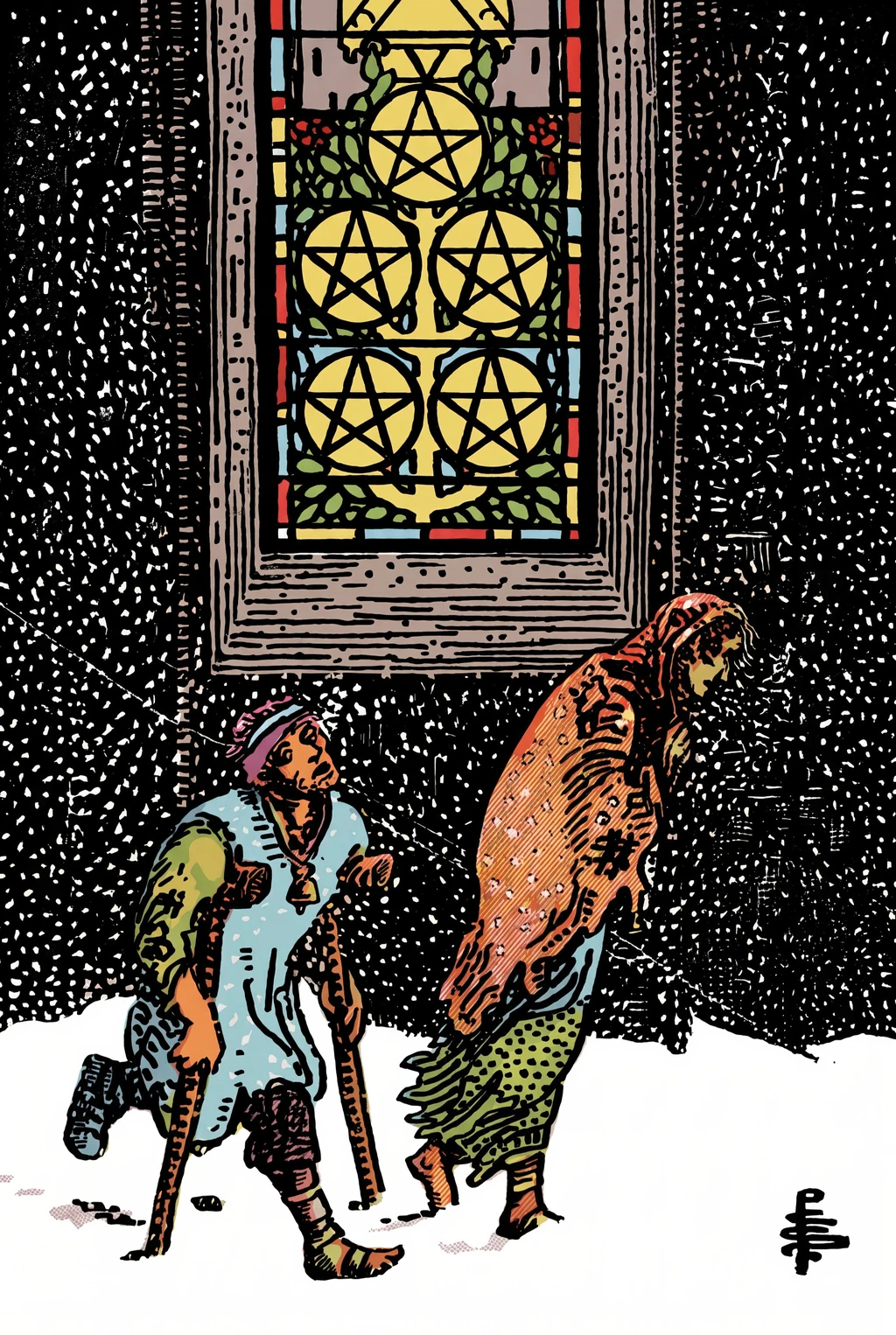
Two figures make their way through a snowstorm. One walks on crutches; the other is barefoot, wrapped in a worn cloak. To keep going, they must spend their strength on things that barely demand attention in more comfortable times: warmth, support, the next step.
Directly above them glows a stained-glass window with five pentacles. Beside this bright window, the cold feels sharper: a sheltered life seems so close, yet the travelers remain outside. Symbols of abundance are enclosed in colored glass, while bare feet and crutches touch the snow. The two continue side by side, each carrying their own burden.
Core meaning
A shortage of money, strength, or support; the feeling that the life you knew is on the other side of a lit window. The card also touches on mutual aid and the difficulty of accepting it.
- Key meanings:Hardship
- Material loss
- Isolation
- Rejection
- Vulnerability
- Mutual support
- Key meanings:Recovery
- Accepting help
- Reconnection
- Inner sense of lack
- Discord
- Wastefulness
Image and symbols
Card image
Two figures walk through the snow toward the viewer's right. In front is a person with bare feet, their head and shoulders wrapped in a torn cloak. Behind them moves a person on two crutches; one leg is bandaged, and a small bell is visible near the neck.
Behind them are a dark wall and a tall stained-glass window. Five yellow pentacles are surrounded by a leafy pattern; two small towers are visible in the upper part of the window. Snow covers the ground and falls in front of the figures.
Traditional context
Waite primarily associates the card with material hardship, even extreme deprivation. He also offers another divinatory list: love, close companions, harmony, and affinity. Waite himself regards these as incompatible alternatives rather than combining them into one meaning.
A supplementary list in the same book offers yet another reading: attaining prosperity through intelligence. For the reversed card, it gives difficulties in love. Waite separately warns that these additions may differ from the main text and the image.
In the Golden Dawn system, the card is called the 'Lord of Material Trouble.' Its meanings include loss, hard work, and concern for one's livelihood, but also kindness and the possibility of regaining what was lost through persistent effort.
Modern RWS interpretations develop themes of loneliness, mutual support, and self-worth. The reversed orientation has changed especially noticeably: modern reference works offer a recovery-focused reading, while the primary meanings given by Waite include chaos, ruin, discord, and wastefulness.
Two figures walking side by side
Shared hardship and vulnerability. Their closeness also suggests companionship: losing material security does not necessarily mean losing every human connection.
Crutches and a bandaged leg
Physical vulnerability and difficulty moving forward. In a modern symbolic reading, the crutches can also represent a burden that someone must carry with them.
A small bell around the neck
In a symbolic reading, it emphasizes illness and physical suffering.
A torn cloak and bare feet
Inadequate protection from the cold makes deprivation visible: even the most basic necessities are lacking.
Snow on the ground and falling snowflakes
Harsh external conditions, isolation, and exposure without shelter. The hardship here is not solely a matter of someone's inner state.
An illuminated stained-glass window
Possible refuge, hope, and spiritual support. Seen another way, the window separates those inside from those left outside: the presence of light does not necessarily mean help is within reach.
Five pentacles in the window's leafy pattern
An image of abundance and stability on the other side of the wall. The pentacles, resembling fruit on a sturdy tree, contrast with the hardship of those passing by.
Two small towers at the top of the window
They may symbolize shelter and protection.
Colors
- Black — the wall around the stained glass
A color accent suggesting anxiety and unease.
- Yellow — the pentacles in the window
In a symbolic reading of the reversed card, the bright pentacles are associated with hope of emerging from a difficult period.
Meanings
Five of Pentacles — Upright
General
Overall meaning
The Five of Pentacles describes a situation in which essentials are lacking: money, security, strength, or human support. A familiar way of life becomes inaccessible, and hardship may be accompanied by shame and a sense of separation from one's usual circle.
The card can also speak to the fear of a future loss, when deprivation has not yet occurred. It therefore distinguishes actual scarcity from anxiety about it. Alongside hardship remains the theme of human connection: a difficult period does not diminish the value of helping one another.
Possible support
A sense of community with people who can share the burden. Support may remain available even after the loss of money or social standing.
Possible difficulty
Shame or fear of rejection can make it difficult to speak about a need. Isolation then adds to the original hardship.
Focus
Notice what has remained, too. Focusing only on losses can obscure forms of care and support that are still available.
Reflection questions
- What am I truly lacking right now?
- Is there support I have not yet noticed?
Relationships
Overall meaning
In close relationships, the card can suggest loneliness, rejection, or a lack of care. For a couple, this may involve emotional distance and financial strain; for someone seeking a relationship, disappointment and a feeling of being unwanted.
In friendships and family ties, both estrangement and mutual support during hardship are possible. Another distinct reading concerns a connection disapproved of by others: two people remain close but find themselves outside their familiar circle.
There is also a separate traditional interpretation involving love, harmony, and close bonds, which Waite gives alongside material hardship.
Possible support
The willingness of loved ones to stay close during a difficult period. You can accept help from family or friends without having to hide your circumstances.
Possible difficulty
Financial pressure and difficulty talking about feelings can increase the distance between partners.
Focus
In a partnership, consider whether both people are offering enough care and effort.
Reflection questions
- Can I tell someone close to me that I'm having a hard time?
- Am I receiving enough care in return in this relationship?
Work and study
Overall meaning
In work, the card can reflect job loss, difficulty finding employment, or alienation within a team. Someone may feel they have no support from coworkers or management. For a business owner, it can also suggest a period of serious difficulties.
Possible support
Looking for another job may offer a way forward if the current conditions provide neither stability nor a sense of support.
Possible difficulty
Feeling excluded from the team and unsupported by coworkers makes communication at work more difficult and deepens isolation.
Focus
Consider whether your pay reflects your contribution and whether your current circumstances have led you to undervalue your skills.
Reflection questions
- What exactly makes me feel isolated at work?
- Does my pay reflect the work I do?
Money and resources
Overall meaning
Not having enough money for regular or essential expenses, debts, and material losses. The scale can vary, from having to cut back to a serious threat to financial stability. This reading centers on limitations that cannot be ignored.
Possible support
Available financial assistance, including charitable support. You do not have to resolve your difficulties on your own before asking for help.
Possible difficulty
Old debts and unpaid obligations may continue to burden the budget and make it harder to move beyond scarcity.
Focus
The fear of running out of money again can persist after a period of hardship. It is worth distinguishing that fear from the size of today's expenses and obligations.
Reflection questions
- Which essential expenses can I not cover right now?
- What help is available to me with my current financial difficulties?
Wellbeing and self-care
Overall meaning
Low energy, anxiety, and the feeling of carrying responsibilities without enough support. The card can reflect exhaustion that causes a person's everyday needs to go neglected.
Possible support
Returning attention to basic physical needs, especially food and rest.
Possible difficulty
Continuing to give your energy when you no longer have enough for yourself.
Focus
Notice which everyday needs you keep postponing because of other concerns.
Reflection questions
- Am I getting enough food and rest right now?
- Am I still helping others when my own energy is running out?
Personal growth
Overall meaning
Material difficulties can affect a person's sense of self-worth. The card asks what remains important after losing money, status, or the approval of others, and offers a chance to reconsider familiar measures of success.
Possible support
Respect for your own worth and boundaries. Helping others should not mean neglecting yourself entirely.
Possible difficulty
Treating the loss of material security or social recognition as proof of personal inadequacy.
Focus
Reconsider your usual measures of success and notice which human connections endure through hardship.
Reflection questions
- What do I value about myself apart from my income?
- Whose regard for me does not depend on my circumstances?
Five of Pentacles — Reversed
General
Overall meaning
In a modern recovery-focused reading, a gradual emergence from hardship and isolation begins. Connection, hope, and the possibility of rebuilding stability return; this is a process, not an instant end to difficulties.
Another interpretation concerns an inner sense of lack: external circumstances may be fairly stable, yet feelings of emptiness or insignificance remain.
There is also a more difficult reading. For Waite, the reversed card signifies discord, chaos, and ruin; another possible interpretation points to the absence of even the help one would normally count on. These meanings differ from the modern emphasis on recovery.
Possible support
Reconnecting with people and available support systems. Help becomes something to lean on when you are able to reach out for it.
Possible difficulty
Fear of another loss or rejection can make it difficult to accept help even when an opportunity for improvement appears.
Focus
Notice where your time and effort continue to go without improving the situation. This exhaustion may hide behind the habit of telling yourself to endure just a little longer.
Reflection questions
- Where can I already see improvement?
- Where do I keep investing energy without seeing any change?
Relationships
Overall meaning
In a modern reading, the card concerns reconnecting after loneliness or estrangement. For a couple, it may reflect renewed closeness and work on past difficulties; for someone seeking a relationship, openness to meeting new people returns.
In family and friendships, the card can suggest a softening of old estrangement and renewed contact. But recovery does not always mean preserving an existing bond: it may also involve leaving a relationship in which needs consistently go unmet. The supplementary list by Waite, by contrast, retains romantic difficulties as a reversed meaning.
Possible support
In a couple, mutual effort and a conversation about what has been missing can offer support. Rebuilding a bond involves both people.
Possible difficulty
After rejection, it can be hard to trust again and let a partner come closer. Expecting another rejection may keep the distance in place.
Focus
In a romantic relationship, consider the balance of care: are your needs going unanswered while you continue to care for the other person?
Reflection questions
- What kind of care am I missing in my relationship?
- Are there signs of closeness returning in my relationships?
Work and study
Overall meaning
A gradual return to employment after a difficult search, or improving conditions in a current job. A person may feel ready to look for suitable work again and develop new skills.
Recovery is not yet the same as stability. In a more difficult reading, problems in a business or job continue, so an improving outlook is not the only interpretation.
Possible support
Professional advice and mentorship can help rebuild confidence and reveal further opportunities at work.
Possible difficulty
Fear of another setback after past rejections can stand in the way of trying again. Another imbalance arises when someone tries to prove their worth through overwork.
Focus
Pay attention to whether your new work routine is sustainable. A period of improvement calls for patience, not an attempt to make up for everything at once.
Reflection questions
- What helps me try again after being turned down?
- Am I trying to prove my worth by overworking?
Money and resources
Overall meaning
In a modern reading, financial pressure gradually eases: there is an opportunity to address debts and rebuild savings. This is a move toward greater stability, not necessarily wealth.
There is also an unfavorable interpretation in which deprivation grows worse. The primary list given by Waite also retains themes of ruin and wastefulness.
Possible support
Careful planning helps sustain financial recovery and avoid returning to earlier difficulties.
Possible difficulty
Even when there is enough money, a fear of spending anything may persist. The opposite imbalance is spending on small things until there is not enough left for what truly matters.
Focus
As things improve, it is worth remembering which financial decisions previously made matters worse, so you do not repeat them out of habit.
Reflection questions
- Which old money habits should I avoid returning to?
- What am I spending money on that was meant for something important?
Wellbeing and self-care
Overall meaning
A gradual return of strength and more attentive self-care. Relief may coexist with lingering anxiety, while a slow pace of recovery can bring impatience.
Possible support
Consistent everyday self-care and contact with people you can ask for support.
Possible difficulty
Returning to self-care only occasionally and becoming discouraged when energy does not return at once.
Focus
Notice your own needs that become easy to postpone again as soon as you start to feel a little better.
Reflection questions
- What kind of self-care helps me feel more grounded?
- Am I expecting myself to recover too quickly?
Personal growth
Overall meaning
Reconsidering the connection between material security and self-worth. An inner sense of lack may remain even when life looks comfortable from the outside, if success is measured only in money and status.
The card also invites reflection on the habit of giving time and energy to something that changes nothing and leaves you feeling depleted.
Possible support
Recognizing your own worth without constantly needing to prove it by giving more. Boundaries help you avoid exhausting yourself in relationships and pursuits that only drain you.
Possible difficulty
The belief that a person is not good enough without material security can sustain a sense of inner poverty even after circumstances improve.
Focus
Distinguish what is truly missing from your life from what only seems necessary according to familiar standards of success.
Reflection questions
- Do I measure my worth by how much I have?
- Where am I spending my energy trying to earn the right to feel good about myself?
Roles in a spread
Position examples
A position gives the card a question, such as what helps or what gets in the way. That question shapes how you read its meaning.
Five of Pentacles — Upright
Situation
A situation in which essentials are lacking and a familiar sense of security has been disrupted. The need itself comes to the foreground.
Influence
Social norms and disapproval from others can deepen estrangement. In this reading, distance arises not only from personal fear but also from the group's response.
Motivation
To get through hardship without losing dignity. This reading explores the tension between needing help and wanting to avoid a humiliating position.
Support
Mutual support between people facing hardship. A connection that endures can offer something to lean on even when material security has been lost.
Obstacle
Shame and the expectation of rejection make it hard to ask for help. As a result, difficulties may be experienced in even greater isolation.
Focus of attention
Distinguish a loss that has already happened from the fear that it might happen. The card can draw attention to fear of deprivation before circumstances have actually worsened.
Next step
Tell someone who can offer practical or personal support about the difficulty. Do not leave the need itself unspoken.
Possible development
The direction points toward material difficulties. If unfavorable conditions persist, securing the essentials remains the central concern.
Five of Pentacles — Reversed
Situation
A transition from scarcity toward recovery, or a lingering inner sense of lack despite more stable external circumstances.
Influence
Past hardships can continue to shape how new opportunities are perceived. A change in circumstances does not always ease old insecurities right away.
Motivation
Actions may be driven by the wish to regain stability after losses and feel supported by others again. A person seeks support in an effort to emerge from isolation, although the fear of renewed scarcity may remain.
Support
Renewed contact with others and a willingness to accept available support help ease isolation.
Obstacle
Unresolved fears of scarcity and rejection keep the situation as it is, even though the possibility of change is already being considered.
Focus of attention
Pay particular attention to efforts that leave you feeling only depleted. It helps to recognize the repeated drain before giving more.
Next step
Stop pouring energy into what only drains you, and turn your attention back to supportive relationships and activities.
Possible development
In a modern recovery-focused reading, circumstances gradually grow more secure. This direction concerns continuing a recovery already underway, not a sudden leap into abundance.
Combination examples
Card combinations are in development. For now, here are a few examples.
Five of Pentacles + The Magician
Five of Pentacles ( upright) + The Magician ( upright)
- Example question:
- What can I rely on after losing a familiar sense of stability?
- Example interpretation:
The Five of Pentacles reflects a loss of support, while The Magician points to the ability to act that remains. In this pairing, losing a familiar position does not diminish the skills already gained.
Five of Pentacles + The Tower
Five of Pentacles ( upright) + The Tower ( upright)
- Example question:
- What is the nature of this difficult period?
- Example interpretation:
These cards reinforce the shared theme of difficult circumstances. Together, they place hardship at the center of the reading without identifying a specific event on their own.
Five of Pentacles + Three of Swords
Five of Pentacles ( upright) + Three of Swords ( upright)
- Example question:
- What stands out in the experience of a separation?
- Example interpretation:
The shared emphasis falls on rejection, separation, and a lack of support. The Three of Swords heightens the sense of being left behind already present in the Five of Pentacles.
Five of Pentacles + Strength
Five of Pentacles ( upright) + Strength ( upright)
- Example question:
- What can help counter exhaustion?
- Example interpretation:
Strength contrasts the exhaustion of the Five of Pentacles with endurance and resilience. Attention shifts from scarcity alone to the ability to withstand hardship.
Reading example
An imagined one-card reading shows how the meanings above can apply to a question. This is one possible interpretation.
Five of Pentacles — Upright
Situation:
Your income has dropped, and your usual outings with friends have become too expensive. Your friends keep inviting you, but you turn them down more and more often, even though you don't want to lose touch.
Question:
How can I stay connected in this situation?
-
Card drawn:
Imagine drawing a card for the position «What can help» and getting Five of Pentacles (upright).
Interpretation:
The Five of Pentacles draws attention to how financial hardship can turn into isolation. Here, the difficulty is not just the cost of getting together: declining invitations without explanation leaves the need for connection unspoken.
You could tell your friends that your usual plans are beyond your budget right now and suggest meeting in a less expensive way. That makes your wish for their support easier to understand.
Five of Pentacles — Reversed
Situation:
Your income has dropped, and your usual outings with friends have become too expensive. Your friends keep inviting you, but you turn them down more and more often, even though you don't want to lose touch.
Question:
How can I stay connected in this situation?
-
Card drawn:
Imagine drawing a card for the position «What can help» and getting Five of Pentacles (reversed).
Interpretation:
In a recovery-focused reading, the reversed Five of Pentacles highlights the possibility of reconnecting. The invitations that keep coming already offer a point of contact; you do not have to wait until your income fully recovers before responding to your friends.
You could accept an invitation and talk about a way of getting together that fits your budget. Here, moving forward begins with accepting the care being offered, rather than first trying to regain your former material security.
Yes / No
Five of Pentacles — Upright
Why this answer
No. Hardship, loss, and a lack of support make the hoped-for outcome harder to reach. The card does not favor an affirmative answer.
A clarification
This negative answer comes with permission not to rush ahead. When facing difficulties, you can give yourself time instead of immediately pushing for the outcome you want.
A question to consider
Can I give myself time before moving forward?
Five of Pentacles — Reversed
Why this answer
Yes. The answer relates to emerging from a difficult period and moving forward again. Reversed, the card is read as recovery after loss.
A clarification
This 'yes' is especially fitting for a question about recovery when circumstances are beginning to improve. The positive answer refers to moving beyond hardship, not to all its effects having already disappeared.
A question to consider
What signs of improvement can I already see?
Correspondences
Connections with numbers, elements and other symbols add depth to the card’s imagery. They can differ between traditions.
Number — V (5)
The Fives represent resistance, struggle, and obstacles to the work at hand. The number alone does not determine ultimate success or failure.
Number — V (5)
Instability, a sense of loss, and a search for balance. In this interpretation, the Fives unsettle familiar confidence.
Element — Earth
The material side of life: livelihood, work, and possessions. For the Five, these themes are connected with difficulties.
Astrology — Mercury in Taurus
A correspondence of the card known as the 'Lord of Material Trouble.' In this system, it also connects concern for one's livelihood with practical resourcefulness in material matters.
Letter — Final He (ה)
He in this position connects the suit with the earthly, material plane. This is a general correspondence for Pentacles, not a separate path letter assigned to the Five.
Tree of Life — Geburah
In combination with the suit of Pentacles, Geburah expresses material trials: loss of work or money, and worry about making a living.