
Strength
Descriptions and symbolism are based on the card’s classic illustration in the Rider–Waite–Smith deck. Details of the artwork may differ in other editions of the deck.
This guide brings together traditional and modern readings. Interpretations and answers may differ between authors and schools.
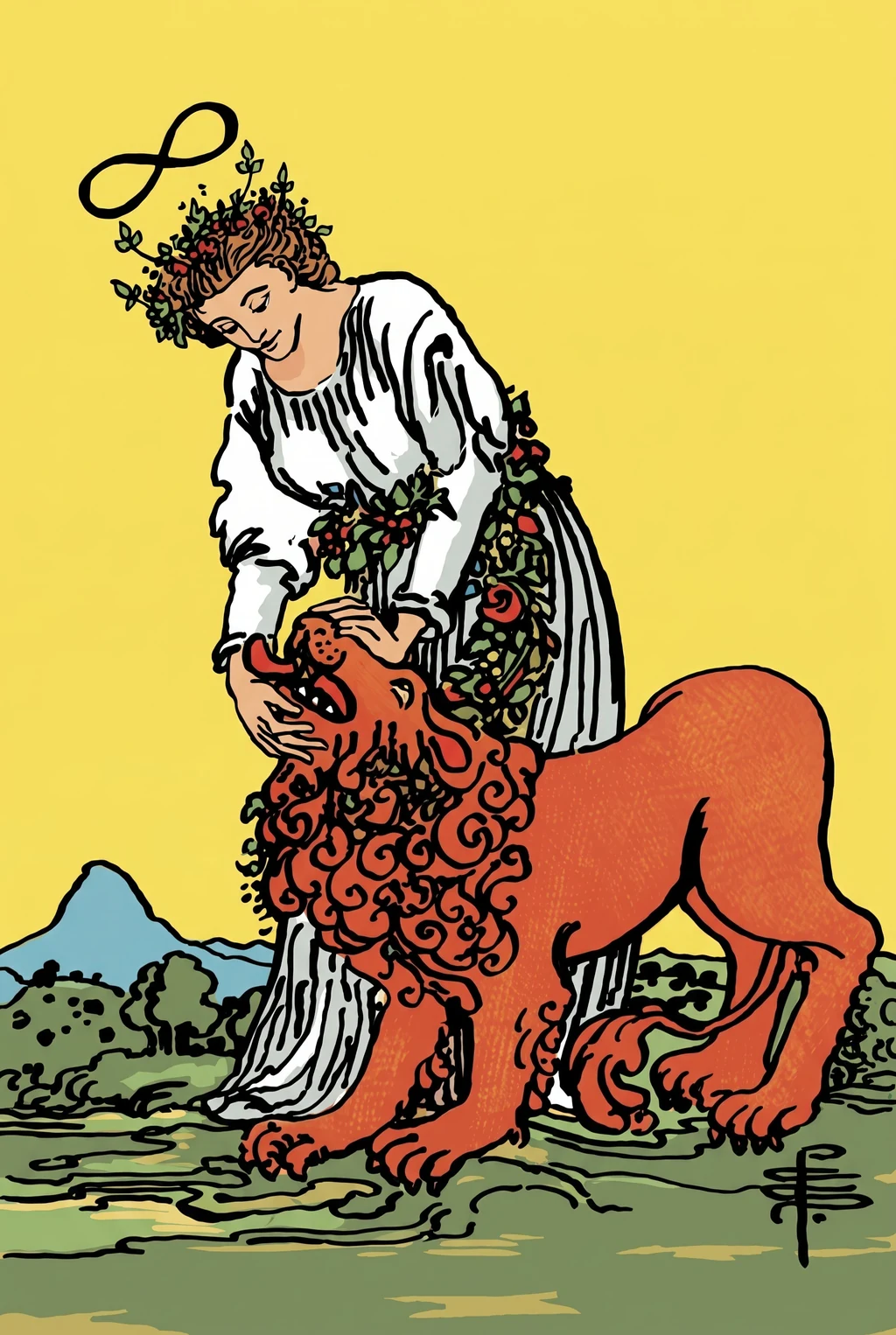
The woman stands so close to the lion that her hands rest directly on its mouth. She gently closes its jaws as the animal raises its head toward her hands. Waite emphasized that the lion has already been tamed. In his symbolic reading, human passions have encountered a higher nature that has freed itself from their power.
The lion still has its teeth, its weight, and its living strength. The woman remains beside it without weapons or armor. Her calm touch bears no resemblance to an attempt to overpower the animal. Between them runs a floral garland. Too fragile to withstand a struggle, it is nevertheless enough to guide a lion that no longer resists.
Core meaning
Inner resilience expressed through patience, compassion, and self-control rather than force. Reversed, Strength draws attention to self-doubt, exhaustion, or excessive control.
- Key meanings:Patience
- Self-control
- Inner resilience
- Courage
- Compassion
- Gentle influence
- Key meanings:Self-doubt
- Exhaustion
- Suppressed anger
- Impulsiveness
- Excessive control
- Regaining stability
Image and symbols
Card image
In the foreground, a woman in a long white dress bends toward a large lion. Both her hands are near its open mouth. The animal stands sideways, its tail curling behind its back. The woman's expression is calm, and her posture does not suggest a physical struggle. Above her head is a horizontal figure eight.
A wreath of flowers is visible in her hair, while another floral garland hangs from her waist. The lion is rendered in reddish-orange tones, with green ground and shrubs stretching behind the figures. Bluish mountains appear in the distance on the left, beneath a yellow sky.
Traditional context
For Arthur Edward Waite, Strength (Fortitude) primarily represents spiritual fortitude. The woman has already calmed the lion rather than engaging it in a violent struggle. For Waite, the lion may represent the passions, while the woman embodies the higher nature capable of handling them. The chain of flowers is associated with the light burden of an accepted inner law. Waite explicitly distinguished this meaning from ordinary self-confidence. His explanation is rooted in a religious understanding of strength that should not be quietly replaced with the language of modern psychology.
In his list of divinatory meanings, Waite separately included courage, action, magnanimity, recognition, and success. For the reversed card, he listed weakness, abuse of power, despotism, and discord. These are divinatory formulas, not identical to his interpretation of the symbolic scene.
Modern guides more often describe the card through patience, the management of strong emotions, gentle influence, and the ability to remain true to yourself in a difficult situation. Reversed Strength can suggest suppression and exhaustion as well as forceful pressure or an uncontrolled reaction. In the Waite–Smith deck, the card is numbered VIII: Waite exchanged its position with Justice, which is numbered eight in other widely used arrangements.
A calm woman beside a lion
In Waite's explanation, the woman represents the higher nature, capable of guiding the passions without violence.
Both of the woman's hands at the lion's open mouth
Her gentle touch, rather than a weapon, invites us to understand strength as self-mastery without force.
A large lion at the woman's feet
The lion represents powerful emotions, desires, and instincts that can be given a conscious direction.
A horizontal figure eight above the woman's head
This symbol of life connects Strength with The Magician. In modern interpretations, it also suggests boundless potential and wisdom.
A floral garland around the waist and near the lion
For Waite, the chain of flowers speaks of an inner law accepted without force. In modern symbolism, the flowers express harmony with natural impulses.
A wreath of flowers in her hair
In modern readings, the wreath emphasizes the woman's connection to nature: her composure does not suppress what is alive.
Distant bluish mountains
The distant horizon lends a sense of calm perspective to the lion's intense presence. Modern interpretations associate the mountain backdrop with clarity and a broader view.
Colors
- White — the woman's long dress
Modern interpretations associate the white clothing with purity of intention, emphasizing the character of her actions rather than weakness.
- Reddish-orange — the lion's body
The rich, warm color strengthens the image of passion and powerful desire, which need to be guided rather than denied.
- Yellow — the sky behind the figures
One detailed analysis of the card's palette associates the yellow background with the role of reason in working with instincts.
- Red — some of the flowers in the wreath and garland
In the botanical symbolism of the Rider–Waite–Smith deck, red flowers are associated with desire, earthly life, and passion.
Meanings
Strength — Upright
General
Overall meaning
In a difficult situation, Strength points to the ability to keep your first impulse from taking control. Fear, anger, or a powerful desire may still be present, but you can choose how to express them. Here, resilience is made up of patience, courage, and awareness of the consequences of your actions.
The card does not ask you to endure everything indefinitely. Its gentleness does not mean inaction: you can act decisively without resorting to pressure or domination.
Possible support
A calm presence, the ability to respond to aggression without becoming aggressive yourself, and the patience to return to a difficult issue can all help.
Possible difficulty
The test may come in a situation where you want immediate compliance or wish to speed up someone else's decision. In the obstacle position, Strength specifically highlights a lack of patience and the need to withstand tension.
Focus
Notice the difference between a strong emotion and an action. Feeling irritated does not, by itself, determine what you will say or do.
Reflection questions
- Where do I need patience right now rather than a hasty response?
- How can I express a strong feeling without escalating the situation?
Relationships
Overall meaning
In a romantic relationship, Strength may represent powerful attraction that calls for care. When emotions run high, it is easy to confuse intimacy with the desire to control a partner. Calm conversation and a willingness to hear each other can keep a disagreement from becoming a struggle.
In friendship, the meaning takes on a different shade: the willingness to stay close, offer support, and not turn away from someone during a difficult period.
Possible support
Compassion, patient listening, and a dependable presence without demanding that someone immediately open up or agree can provide support.
Possible difficulty
Strong attraction can be accompanied by jealousy, flashes of anger, or attempts to settle disagreements through force. Even upright, this is an important aspect of the card, not merely a sign of harmony.
Focus
Consider whether both people's needs are receiving attention in conversation, especially when you feel the urge to prove you are right.
Reflection questions
- Can we make room for a calm conversation when we disagree?
- What support can I offer someone close to me without making every decision for them?
Work and study
Overall meaning
At work, Strength is associated with persistence and the ability to channel tension into productive effort. A long-term project does not necessarily move faster when pressure increases. Sometimes a steady pace and the ability to continue after setbacks matter more.
In a career context, the card also speaks to the courage to show the skills you already have, make yourself heard, or take on a new challenge. Patience alone, without action, may not be enough.
Possible support
Your accumulated skills, perseverance through a difficult process, and ability to maintain professional relationships without unnecessary conflict can all provide support.
Possible difficulty
Fear of speaking up about your abilities and the desire to accelerate teamwork through forceful pressure can hold progress back. In the obstacle position, the card particularly emphasizes a test of patience.
Focus
Consider whether your focus on results is turning into an attempt to rush other people. At the same time, don't let quiet endurance keep your own contributions hidden.
Reflection questions
- Where would consistency serve my work better than a sudden push?
- Is there a skill I should speak about more openly?
Money and resources
Overall meaning
In financial matters, Strength relates to moderation and the habit of avoiding decisions made on impulse. Stability can grow from regularly monitoring expenses and practicing patience. But being careful with money does not rule out a well-considered major purchase if it is genuinely needed and affordable.
Possible support
The ability to pause before spending and follow a thoughtful spending plan without making decisions out of panic provides a foundation.
Possible difficulty
Difficulty arises when you want to make a purchase solely for immediate relief or, conversely, keep waiting for the perfect moment to make a justified expense.
Focus
Before a major expense, it helps to distinguish a lasting need from a sudden desire. Not every expensive purchase is impulsive, but rushing can affect your judgment.
Reflection question
Which purchase am I genuinely considering carefully, and which would be a decision made in the heat of the moment?
Wellbeing and self-care
Overall meaning
In questions of everyday well-being, the card draws attention to how you move through demanding circumstances and strong emotions. It describes composure and the ability not to be swept away by every emotional wave. This is about habits, responses to fatigue, and caring for yourself, not the condition of your organs or predictions about treatment.
Possible support
A calm pace, patience with your own feelings, and the ability to avoid adding to tension through further inner conflict can help.
Possible difficulty
Even familiar resilience can become a reason to ignore fatigue. If the demands never let up, the habit of simply pushing through without a break deserves reconsideration.
Focus
Notice what happens just before a sharp reaction. You can acknowledge irritation without treating it as a command to act.
Reflection questions
- How do I usually notice that tension is building?
- When does a brief pause before responding help me?
Personal growth
Overall meaning
In personal growth, Strength speaks to developing the ability to live with conflicting emotions. Anger and fear do not need to be erased from your inner life. What matters more is learning to listen to them and guide your actions consciously. This approach takes repeated practice, not a single victory over yourself.
Possible support
The courage to face uncomfortable feelings and the ability to treat yourself without cruelty, even after a mistake, can sustain you.
Possible difficulty
The belief that a strong person should never feel anger or fear can become an obstacle. Suppressing impulses is different from learning to work with them.
Focus
Notice a recurring reaction you most often want to hide. It may show where you need a new way of relating to yourself rather than another prohibition.
Reflection questions
- Which feeling is hardest for me to acknowledge?
- What changes when I don't criticize myself for my initial reaction?
Strength — Reversed
General
Overall meaning
Reversed Strength points to an imbalance between inner impulses and the ability to manage them. Sometimes there is too little strength available: a person doubts themselves, feels exhausted, or is afraid to act. At other times, the opposite extreme appears: accumulated tension erupts as irritation or becomes a desire to control everything.
This reversal does not always mean “you won't be able to handle it.” It may be an invitation to reconsider the cost of your usual endurance, allow yourself a break, and let go of the expectation that you must carry everything alone.
Possible support
Rebuilding your foundation begins with recognizing your actual capacity: remembering difficulties you have already overcome, resting, or asking for support when your own resources are not enough.
Possible difficulty
Self-criticism and accumulated irritation can operate together. The harder someone tries to appear unshakable, the more difficult an unexpected emotional outburst may become to manage.
Focus
It is worth distinguishing fatigue, fear of making a mistake, and the desire to dominate. Each calls for a different response, so reversed Strength cannot be reduced to the single word “weakness.”
Reflection questions
- Where am I placing too much importance on enduring everything?
- Is fatigue holding me back right now, or the urge to take immediate control of the situation?
Relationships
Overall meaning
In romantic relationships, reversed Strength may represent insecurity, emotional dependence, or a struggle for power. One person may set aside their own needs to preserve the relationship, while another may try to control their partner instead of talking. These are distinct patterns and should not automatically be attributed to any particular couple.
In friendships and family relationships, the card may concern difficulty asking for support, acknowledging vulnerability, or speaking without letting accumulated resentment take over.
Possible support
An honest conversation about your own needs and a willingness to hear the response can help, without turning differences of opinion into tests of loyalty.
Possible difficulty
The central difficulty may not be the intensity of feelings but an imbalance of power: excessive control, jealousy, fear of losing the other person, or an inability to express disagreement.
Focus
Consider who gives way during a difficult conversation, and why. Willing care is different from staying silent out of fear of conflict.
Reflection questions
- Is there something I stay silent about just to keep the peace?
- Can I express my needs without putting pressure on the other person?
Work and study
Overall meaning
In a professional context, reversed Strength points to two different challenges. You may already have the necessary skills but doubt them, hesitating to suggest an idea or take responsibility. Another possibility is prolonged overload, where everything depends on your personal effort, delegation feels difficult, and irritation builds.
The card does not suggest that your work is bound to end in failure. The question is more about how effort is distributed and whether your usual endurance has become an obstacle.
Possible support
A possible source of support is recognizing the skills you have already developed without feeling compelled to prove them immediately through excessive work.
Possible difficulty
The risk lies in self-doubt before an important step and the habit of refusing to pass tasks to others, even when your workload becomes excessive.
Focus
It helps to distinguish patience that allows you to finish a task from accepting a constant workload at your limit. Containing irritation and discussing working conditions are not the same thing.
Reflection questions
- Am I doubting my skills, or have I simply been working too long without a break?
- Which task do I find difficult to hand over to someone else?
Money and resources
Overall meaning
In financial matters, reversed Strength may appear in two opposing ways. The first is spending or taking financial risks under the influence of strong emotions. The second is becoming so afraid of spending that you avoid even useful, affordable purchases.
A feeling of scarcity does not necessarily reflect your actual circumstances. The card therefore invites you to examine your behavior rather than treat anxiety as proof of a financial threat.
Possible support
Calmly rebuilding trust in your financial decisions may help: name the specific fear, examine what supports it, and separate insecurity from the actual terms of a purchase or investment. This creates room to act neither out of panic nor in defiance of it.
Possible difficulty
Emotional extremes can become the challenge: spontaneous spending for relief or refusing every purchase without examining its necessity and your ability to afford it.
Focus
Compare the actual affordability of an important purchase with your sense of danger. Fear of running out of money may be stronger than the real constraints.
Reflection questions
- What expense am I putting off out of fear, even though I may be able to afford it?
- Do I sometimes spend money simply to relieve tension?
Wellbeing and self-care
Overall meaning
In the context of everyday demands, reversed Strength may describe a time when it has become harder to keep going and rest is continually postponed. If someone has spent a long time directing their energy toward others or a single goal, irritation and fatigue may build. This describes a pattern of behavior, not a medical conclusion.
Possible support
Taking a genuine break, restoring a regular rhythm of rest, and allowing yourself to temporarily step back from unnecessary obligations can help.
Possible difficulty
The expectation that you must always be composed and useful to others can become an obstacle. Such rigidity may make it difficult to acknowledge that your energy is running low.
Focus
Notice early signs of fatigue and where you keep going to meet other people's expectations. Not every obligation needs to be fulfilled immediately.
Reflection questions
- What has exhausted me most lately?
- What can I postpone without creating additional difficulties for myself?
Personal growth
Overall meaning
In questions of your relationship with yourself, reversed Strength may suggest a habit of dismissing what you have already achieved or demanding complete control over your emotions. Doubting your ability to act can sometimes go hand in hand with a strict refusal to allow yourself mistakes.
Change begins with a more accurate view of your experience: recognizing where courage is needed, where your limits need acceptance, and where rest matters.
Possible support
Remembering specific situations where you have already overcome difficulties, along with a gentler inner dialogue instead of dismissing your own worth, can provide support.
Possible difficulty
The belief that “either I control everything or I'm weak” may get in the way. It makes it difficult to calmly acknowledge fear, mistakes, or the need for support.
Focus
Consider whether your inner critic becomes harsher during the very periods when you have the least energy. An emotional outburst need not be treated as a final judgment of your character.
Reflection questions
- Which of my achievements do I still consider insignificant?
- Where do I need to acknowledge a limit instead of accusing myself of weakness?
Roles in a spread
Position examples
A position gives the card a question, such as what helps or what gets in the way. That question shapes how you read its meaning.
Strength — Upright
Situation
The situation calls for quiet courage. There is considerable tension, but progress is possible through composure rather than a battle of wills.
Influence
Patient people may offer support from the outside. Someone who leads by example can help you maintain your balance without telling you what to do.
Motivation
The driving force is an inner determination to face difficulty calmly, without suppressing yourself or others.
Support
Your inner composure is a source of support: you can navigate a difficult conversation or stage of work without imposing your will on others.
Obstacle
The challenge may lie in how the situation tests your patience and ability to manage your initial reaction. Wanting a particular outcome is not enough.
Focus of attention
Notice when a strong feeling becomes an urge to react immediately. A pause preserves your ability to choose.
Next step
Act with persistence, but without pressure. Begin by keeping a calm tone, then clearly express what you need and allow the situation to unfold without force.
Possible development
If you continue with your current approach, progress may come through calmly overcoming difficulties and gradually building confidence. The card does not specify a particular outcome.
Strength — Reversed
Situation
At the heart of the situation may be a loss of inner stability: doubt about your decisions, fatigue, or an attempt to compensate for insecurity through control.
Influence
External pressure or an environment where your abilities are constantly questioned may deepen insecurity. This is a possible dynamic, not a conclusion about any particular person.
Motivation
The desire to control everything may be an attempt to hide insecurity and conceal how frightening it feels to make a mistake. Alternatively, someone may be driven by the need to prove their worth quickly, placing excessive demands on themselves.
Support
In a supporting position, reversed Strength may encourage you to rebuild trust in yourself by remembering difficulties you have already overcome and allowing yourself needed rest.
Obstacle
Self-doubt, haste, or difficulty containing irritation may get in the way, especially when you are tired.
Focus of attention
Notice what feels strongest right now: fear of not being able to cope, exhaustion from constant effort, or accumulated anger. Each may point to a different need.
Next step
First, acknowledge the limits of your energy or the fear holding you back. Restore your ability to choose calmly: a break, support, or a gentler approach may help more than another attempt to force yourself forward.
Possible development
If self-doubt and overload go unaddressed, progress may slow because of a fear of speaking up or a loss of self-control. The direction can change when you reconsider your workload and sources of support.
Combination examples
Card combinations are in development. For now, here are a few examples.
Strength + The Chariot
Strength ( upright) + The Chariot ( upright)
- Example question:
- What will help me stay committed to my chosen course without rushing?
- Example interpretation:
The Chariot brings direction and determination to the task, while Strength clarifies how to proceed: stay the course without turning willpower into pressure on yourself or others.
Strength + The Devil
Strength ( upright) + The Devil ( upright)
- Example question:
- How can I work with a habit that is difficult to change?
- Example interpretation:
The Devil raises the theme of powerful attachment or temptation, while Strength points to the possibility of facing that desire consciously without allowing it to take control.
Strength + Temperance
Strength ( upright) + Temperance ( upright)
- Example question:
- What will help me navigate a difficult conversation without going to extremes?
- Example interpretation:
Temperance softens the intensity of Strength. Perseverance is balanced with moderation, awareness of limits, and the ability to resolve tension without aggression.
Strength + The Moon
Strength ( upright) + The Moon ( upright)
- Example question:
- How can I keep anxiety from making decisions for me when I have too little information?
- Example interpretation:
The Moon adds uncertainty and fear of the unknown. Together with Strength, it suggests not yielding to anxious assumptions, but tolerating uncertainty and observing your own reactions.
Strength + The Hermit
Strength ( upright) + The Hermit ( upright)
- Example question:
- What will help me understand what I'm feeling without rushing to respond?
- Example interpretation:
The Hermit turns attention inward, while Strength helps you remain present with the feelings you discover. This combination lends itself to quiet, solitary reflection on a difficult experience.
Reading example
An imagined one-card reading shows how the meanings above can apply to a question. This is one possible interpretation.
Strength — Upright
Situation:
After a heated conversation, something remains unresolved between you and someone close to you. You want to talk about what happened, but you're unsure how to keep the meeting from turning into another argument.
Question:
How should I approach this conversation?
-
Card drawn:
Imagine drawing a card for the position «First Step» and getting Strength (upright).
Interpretation:
Upright Strength invites you to stay calm without avoiding the conversation. In the card, the woman does not fight the lion. Her confidence shows in an action that is gentle yet firm. Here, this can suggest a willingness to name what hurt you without trying to force the other person to agree immediately.
A first step could be a brief, clear invitation to talk, leaving room both for what you need to say and for the other person's response.
Strength — Reversed
Situation:
After a heated conversation, something remains unresolved between you and someone close to you. You want to talk about what happened, but you're unsure how to keep the meeting from turning into another argument.
Question:
How should I approach this conversation?
-
Card drawn:
Imagine drawing a card for the position «First Step» and getting Strength (reversed).
Interpretation:
Reversed Strength invites you to notice first whether your patience has run out and whether you feel compelled to prove you are right at any cost. If tension is already too high, starting another conversation immediately may simply repeat the previous argument.
Your first step could be to take a break and honestly identify what you need to communicate and where a boundary is necessary. This can help you return to the conversation without trying to control the other person's response.
Yes / No
Strength — Upright
Why this answer
Yes. In a practical reading, upright Strength connects this answer with perseverance, courage, and the ability to work through difficulties gradually without overpowering others.
A clarification
This “yes” does not mean “quickly and easily.” It applies most strongly to questions that call for sustained, patient effort. For relationship questions, one reference guide offers the more cautious answer “probably yes.”
A question to consider
- Am I prepared to keep going steadily if things don't resolve right away?
- How can I stay determined without becoming forceful?
Strength — Reversed
Why this answer
No. Reversed Strength points to a lack of stability in the current approach: self-doubt, exhaustion, or irritation is making it harder to move forward with intention.
A clarification
This “no” applies to your present state and way of acting. Both reference guides associate it with the need to restore strength or confidence before expecting circumstances to unfold differently.
A question to consider
- What is making it difficult for me to stay grounded right now?
- Where do I need to regain my strength before returning to a decision?
Correspondences
Connections with numbers, elements and other symbols add depth to the card’s imagery. They can differ between traditions.
Number — VIII (8)
The number of the eighth Major Arcana card in the Waite–Smith system. Here, it places Strength before The Hermit. The exchange of positions with Justice was Waite's choice.
Element — Fire
Here, Fire expresses the heat of passion, courage, and the impulse of life, all given a calm direction.
Astrology — Leo
This fixed Fire sign emphasizes courage, vitality, and the theme of mastering powerful impulses.
Letter — Teth (ט)
The letter Teth is associated with the image of a serpent and hidden life force. This correspondence belongs to an occult system rather than directly to the card's imagery.
Tree of Life — 19th Path: Chesed — Geburah
The connection between mercy and severity serves as an image of balance between compassion and discipline.