
The Chariot
Descriptions and symbolism are based on the card’s classic illustration in the Rider–Waite–Smith deck. Details of the artwork may differ in other editions of the deck.
This guide brings together traditional and modern readings. Interpretations and answers may differ between authors and schools.
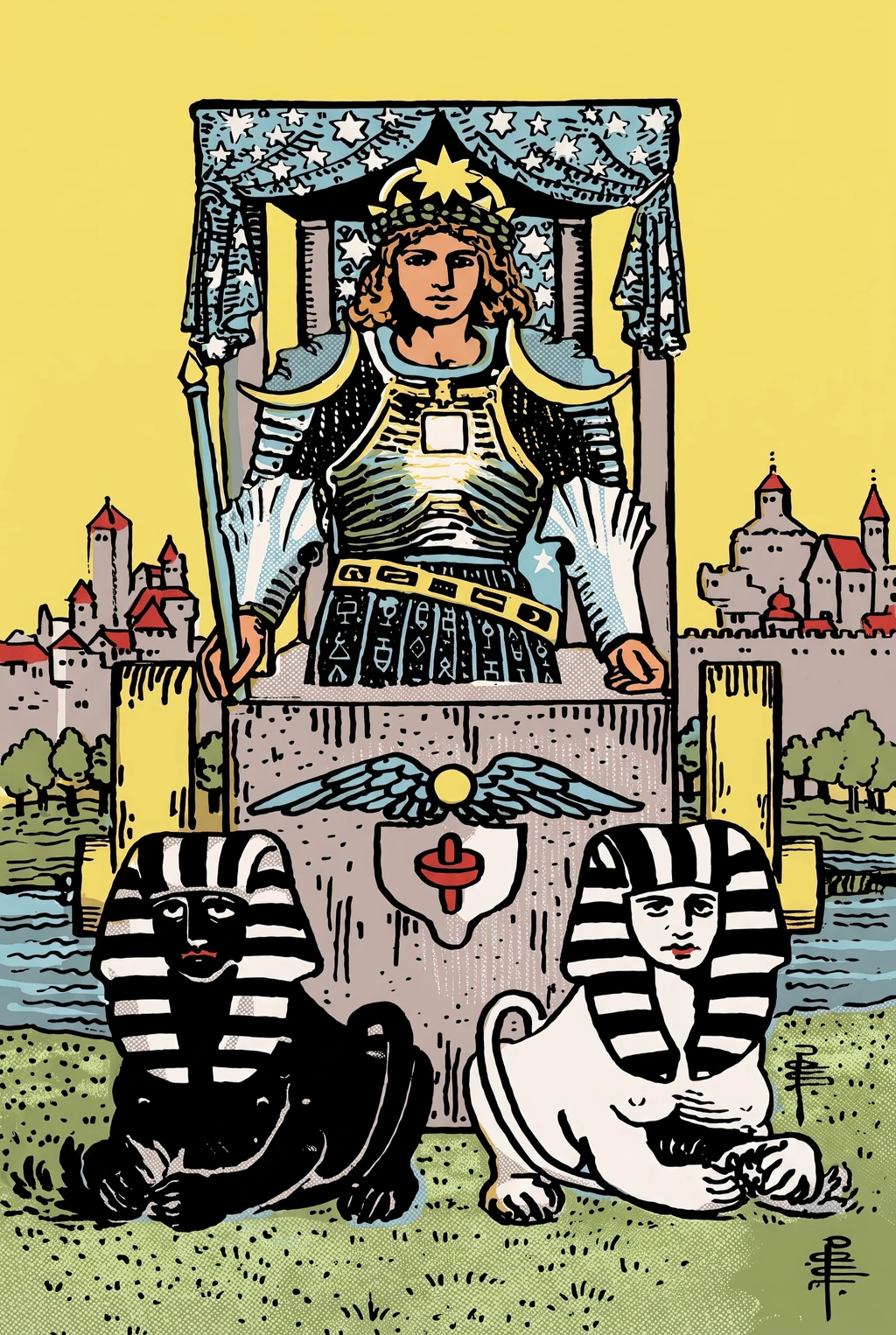
The charioteer holds himself with the confidence of a victor. City towers rise behind him; a black sphinx and a white sphinx lie before the chariot. There are no reins. He stands upright beneath a starry canopy, as though his composure alone must hold the direction steady. Two different forces have been brought before him, but the journey has not yet begun.
Waite saw this figure above all as a conqueror of outward trials and an embodiment of reason. He has solved the riddle of the Sphinx, yet that victory does not open every door. In a hypothetical encounter described by Waite, the charioteer would stand before the temple of The High Priestess—and be unable to open her scroll. Here, the familiar skill of finding an answer reaches its limit. The victor stands before knowledge that cannot be mastered in the same way.
Core meaning
The Chariot speaks of moving toward a chosen goal with resolve, endurance, and the ability to bring conflicting impulses into alignment. Its difficult side emerges when persistence turns into pressure or movement loses its direction.
- Key meanings:Willpower
- Self-control
- Victory
- Decisive action
- Independence
- Travel
- Key meanings:Loss of direction
- Excessive control
- Conflicting desires
- Delay
- Conflict
- Inner discipline
Image and symbols
Card image
At the center is an armored figure wearing a wreath and a crown with an eight-pointed star. Crescent moons with faces rest on the shoulders, a light-colored square sits on the chest, and pale markings cover the lower garment. In the figure’s right hand, on the viewer’s left, is a wand with a pointed tip; the other hand rests on the edge of the chariot.
Above the figure, a blue starry canopy stretches between supports, while the gray rectangular body stands between yellow wheels. A winged disk and a small shield with a red emblem appear on the front. Two sphinxes lie before the chariot: black on the viewer’s left and white on the right. No reins are visible.
A band of water runs behind the chariot, with city walls, towers, and other buildings beyond it. Greenery grows around the scene; the sky is yellow.
Traditional context
Waite associates The Chariot with the triumph of reason and outward achievement: conquest, knowledge, and progress. Yet the figure’s power has limits. Solving the riddle and earning recognition do not in themselves bring inner spiritual understanding.
Waite’s list of divinatory meanings is not uniformly favorable, either. For the upright card he names aid and providence, but also war, presumption, vengeance, and trouble. For the reversed card he lists disorder, quarrels, dispute, litigation, and defeat.
Modern readings link the card to willpower, independence, and the alignment of opposing impulses. Reversed, it can suggest either a lack of control or excessive control. Brigit Esselmont also offers another reading: inner discipline and preparation that have not yet taken the form of outward movement.
An armored figure facing the viewer
For Waite, this is a conqueror whose strength is tied to reason and outward success. In modern readings, the armor emphasizes protection and emotional self-command.
A wand in the right hand; no reins
Control comes from directed will rather than physically restraining the team. For Case, the wand also echoes the tool of The Magician.
Two sphinxes before the chariot
The sphinxes bring together the motif of the riddle and that of opposing forces. In Waite’s account, the figure answers the Sphinx’s riddle; a modern reading sees the task of bringing different impulses into alignment.
A wreath around the head
The laurel wreath is a sign of victory and attained status.
An eight-pointed star on the crown
In Case’s Hermetic explanation, the star is a solar symbol. A modern reading associates the star-crowned figure with success and spiritual development.
Crescent moons with faces on the shoulders
Waite calls these shoulder emblems Urim and Thummim. Case explains the lunar motif through Cancer and its ruling Moon; this is a distinct Hermetic reading.
A light-colored square on the breastplate
The square may represent the stable material world and the four quarters of the earth. In the modern interpretation of Brigit Esselmont, it expresses willpower.
Light-colored markings on the lower garment
The alchemical patterns may signify spiritual transformation.
A starry canopy above the figure
The canopy represents the celestial order under which the charioteer acts. In modern readings, it connects personal will with a higher sense of direction.
Four supports holding up the canopy
In Peter Oddi’s Hermetic analysis, the supports represent the four elements that make up an ordered world.
The rectangular body of the chariot
For Case, this is the material form through which the spiritual principle acts.
A winged disk on the front panel
The winged sun is read as a sign of consciousness, the spiritual principle, and royal authority.
A red emblem on the shield beneath the winged disk
Symbolically, this represents the union of lingam and yoni, the masculine and feminine principles. It continues the theme of bringing opposites together.
Water behind the chariot
In a modern reading, the water recalls the movement of life, with which personal will must find its balance. Case links the river to the water motif of The Empress.
City walls and buildings in the background
In Peter Oddi’s Hermetic explanation, the city represents the charioteer’s already established authority in the outer world.
Colors
- Black and white — the colors of the sphinxes
The contrast makes duality visible: opposing principles share the same scene and call for coordination.
- Yellow — the sky background
In modern symbolic interpretation, the yellow background emphasizes clarity of mind and awareness of what is happening.
- Golden yellow — the wheels
In Peter Oddi’s Hermetic reading, the color of the wheels signifies spiritual activity.
Meanings
The Chariot — Upright
General
Overall meaning
The Chariot describes focused movement toward a goal. Different desires and circumstances do not disappear, but they can be directed toward the same end. Victory here comes through endurance, self-command, and a readiness to act, rather than a lucky turn of events.
The card can suggest striving for a result, independence, or entering a new chapter. In a literal question about travel, it can also refer to a trip or a move. Strong determination has a difficult side: the desire to win can become arrogance, aggression, or a wish for revenge.
Possible support
Perseverance and the ability to hold your chosen course when circumstances or other people’s actions distract you help.
Possible difficulty
Competition becomes a hindrance when winning at any cost matters more than using your strength wisely.
Focus
Distinguish your own goal from the directions other people’s demands are pulling you toward.
Reflection questions
- Where do I want to direct my efforts?
- What helps me stay focused on my chosen goal?
Relationships
Overall meaning
In a romantic question, The Chariot suggests initiative and moving a relationship forward: expressing interest more clearly, agreeing on a shared direction, or taking on a change together. In an established relationship, aligned goals and both partners’ involvement are important.
In family and friendships, the card may point to cooperation, shared values, and reliability. Yet a strong focus on one direction can create an imbalance: personal achievement pushes closeness aside, or maintaining the connection comes at the cost of your independence.
Possible support
A shared goal and the willingness to contribute without leaving all responsibility to one person support the connection.
Possible difficulty
In romance, competition for the leading role and conflicting plans can turn shared progress into a struggle over who is in control.
Focus
Notice the balance between your personal plans and the needs of loved ones; neither should be left out of consideration.
Reflection questions
- Do we share a goal we both want to work toward?
- Is there room for my loved ones in my plans?
Work and study
Overall meaning
At work, The Chariot speaks to ambition, initiative, and focused effort: advancing a project, moving into a role with greater responsibility, or choosing your next professional step for yourself. Staying focused and being prepared to work through resistance matter.
This is also a card of competitive environments. Competition can strengthen resolve, but others’ maneuvering and struggles for position can distract from the work itself.
In a question about education, the card may point to passing a difficult exam.
Possible support
A clear professional direction and the discipline to keep working without constantly comparing your progress with others’ achievements help.
Possible difficulty
Office politics and the urge to answer every slight become obstacles when they draw your attention away from the result.
Focus
Keep your long-term professional goal in view, rather than focusing only on immediate recognition or a chance to get ahead of a competitor.
Reflection question
What work goal do I want to stay focused on despite distractions?
Money and resources
Overall meaning
In money matters, The Chariot concerns active progress toward a material goal and managing expenses. Its meaning centers on discipline, a clear plan, and a willingness to address obstacles rather than wait for circumstances to change on their own.
Possible support
A clear financial goal and consistent budgeting provide a foundation.
Possible difficulty
A short-term temptation to spend or abruptly change plans may pull attention away from a more important financial goal.
Focus
Before making a money decision, be clear about the purpose it serves.
Reflection question
What financial goal are my current decisions serving?
Wellbeing and self-care
Overall meaning
In matters of everyday well-being, The Chariot is associated with vitality, composure, and the ability to maintain a chosen routine. Effort gains direction when caring for yourself becomes consistent.
Emotional resilience matters as much as activity here: even a highly focused person has needs that are easy to overlook while pursuing the next goal.
Possible support
A steady routine and familiar self-care practices that do not require a fresh burst of effort each time offer support.
Possible difficulty
Constantly chasing the next goal crowds out rest and places excessive demands on you.
Focus
Notice the emotional needs that remain beneath an outwardly composed appearance.
Reflection questions
- What regular act of self-care helps me maintain a steady routine?
- Which of my feelings might I be overlooking in pursuit of a goal?
Personal growth
Overall meaning
The Chariot connects independence with action: choosing a direction rooted in your values and taking responsibility for how you follow it. Inner growth shows in the ability to bring desire, decision, and perseverance together.
It also involves working with your own impulses. Different desires do not have to disappear, but you can learn to guide them without abandoning your sense of what matters.
Possible support
Consciously chosen values help you measure your actions against what matters and remain true to your decision.
Possible difficulty
Other people’s expectations and attempts to set your course can distract you from what matters to you.
Focus
Consider whether your daily actions express your beliefs and chosen values.
Reflection question
Which of my decisions expresses what I believe in?
The Chariot — Reversed
General
Overall meaning
The reversed Chariot highlights a gap between effort and direction. Two extremes are possible: movement stalls through indecision and conflicting desires, or it becomes overly forceful and difficult to control. Conflict, delay, or defeat may mark the limits of an old approach.
There is a quieter reading as well: discipline takes shape within before becoming visible in action. Such a pause is different from losing your will. The question is whether it helps clarify your goal or simply leaves everything at a standstill.
In a literal question about travel, the card may also suggest difficulties with a trip or transportation.
Possible support
Another person’s help may provide support. Sometimes sharing responsibility or letting someone else take the lead is more useful than trying to manage everything yourself.
Possible difficulty
Incompatible goals, bursts of aggression, and attempts to control every detail deepen the feeling that the situation is unmanageable.
Focus
Consider what truly depends on your decisions and what you are trying to force to fit your plan.
Reflection questions
- Where am I trying harder without making progress?
- Which decisions in this situation are mine to make?
Relationships
Overall meaning
In a relationship, the reversed Chariot may describe different directions or paces: agreeing on what comes next is difficult, and trying to get your own way increases tension. When looking for a relationship, this can appear as rushing and pressing too hard for closeness, or as hesitation that makes meeting someone difficult.
In friendships and family, this reading concerns arguments, struggles for influence, and strained communication. Another possible imbalance arises when devotion to one part of life leaves other relationships neglected.
Possible support
A conversation that makes room for different expectations and a willingness to listen can help. In family and friendships, it offers a way to look for common ground again rather than decide who wins the argument.
Possible difficulty
Trying to force a relationship into one plan or rush intimacy gets in the way of reciprocity. At the other extreme, passivity makes it difficult to voice your own needs.
Focus
In a romantic question, consider whether the desired direction and pace of growing closer are shared. Strong desire alone does not create a mutual decision.
Reflection questions
- What conversation could help us understand our different expectations?
- Am I rushing closeness because I want more certainty?
Work and study
Overall meaning
Progress at work may stall because the goal is unclear, motivation has faded, or efforts are spread too thin. What has been started needs coordination that is not yet in place.
The opposite pattern involves too much force: pushing ahead at any cost causes clashes with colleagues or leadership. Both passive waiting and aggressive pursuit can get in the way of professional growth.
Possible support
Revisiting your professional goal and being willing to discuss disagreements without a power struggle can help.
Possible difficulty
Too little initiative leaves decisions to others, while excessive assertiveness undermines cooperation. Both extremes make progress harder.
Focus
Consider what you want from your next stage at work and whether conflict with others has displaced the professional task itself.
Reflection questions
- Do I know what I want from my next stage at work?
- Am I spending more energy on arguments than on the work itself?
Money and resources
Overall meaning
The reversed Chariot may suggest a loss of control over spending and financial decisions. One pattern involves hasty purchases without enough consideration; another involves indecision that makes choosing a direction difficult.
Scattered efforts and unclear financial goals may also undermine material stability. These readings are different: slowing down before an impulsive purchase is not the same as endlessly postponing every decision.
Possible support
Returning to your financial goals and reviewing spending habits before continuing with the same approach can help.
Possible difficulty
Impulsive spending and prolonged hesitation disrupt consistency in financial decisions in different ways.
Focus
Notice what information you still need for a purchase or another financial decision, and whether impulse alone is driving it.
Reflection question
What gets in the way of my financial decisions more often: impulse or prolonged hesitation?
Wellbeing and self-care
Overall meaning
Here, the reversed Chariot may describe exhaustion from excessive effort, irritation, or the feeling of being pulled in too many directions. A familiar routine falls out of place, and trying to pull yourself together through willpower alone does not bring stability.
Another expression is rigid self-control: the need for a pause feels like an obstacle, and self-care becomes one more demand to meet.
Possible support
Rest, a more manageable routine, and support from people you trust may help.
Possible difficulty
A rigid demand to keep going at any cost makes it harder to recognize overload and adjust your workload.
Focus
Look at which self-care habits no longer work and where a gentler pace is needed.
Reflection questions
- Where do I need a more manageable pace?
- Whose support can I rely on when I am tired?
Personal growth
Overall meaning
The reversed Chariot may point to an inner conflict: it can be hard to know what you want, or different goals may demand incompatible actions. Other people’s opinions can pull you even further off course.
But a standstill can also be a time of inner preparation. Self-discipline, reexamining your motives, and reconnecting with your values can happen without visible outward progress. This reading leaves room to reconsider the goal rather than simply demand greater effort.
Possible support
Honest inner work on motivation and discipline provides a foundation, even when its results are not yet visible to others.
Possible difficulty
Unclear goals and conflicting desires make choosing difficult, while the desire for complete control can make reconsideration harder.
Focus
Distinguish your goal from the way you are pursuing it: perhaps the direction needs to change, or perhaps only your old way of acting.
Reflection questions
- Which of my desires are pulling me in different directions?
- What am I learning inwardly, even without a visible result?
Roles in a spread
Position examples
A position gives the card a question, such as what helps or what gets in the way. That question shapes how you read its meaning.
The Chariot — Upright
Situation
The situation calls for purposeful movement: a goal is clear or coming into focus, and success depends on coordinating your efforts.
Influence
Active leadership, the example of a determined person, or a competitive environment that encourages a faster pace may be at work.
Motivation
The motivation may be a desire to achieve a result and determine your own direction from here.
Support
Self-command provides support: it helps you withstand resistance and keep distractions from displacing your goal.
Obstacle
The drive to win at any cost becomes an obstacle. Aggression and excessive force make it harder to direct your own efforts.
Focus of attention
Consider where your will is directed and whether other people’s demands are obscuring your own goal.
Next step
Choose your direction and take the initiative. From there, consistency and self-control serve you better than trying to respond to everything at once.
Possible development
With a clear goal and steady resolve, the path may lead past an obstacle and toward a more confident position.
The Chariot — Reversed
Situation
Effort and direction are out of step: there may be a standstill, conflicting impulses, or movement that is difficult to control.
Influence
Conflicting outside demands, unclear leadership, or a lack of shared direction among those around you may be getting in the way.
Motivation
Behind the effort may be a desire to keep complete control, even when circumstances no longer follow the old plan.
Support
Support may come from rebuilding discipline within yourself or from someone you trust to take on some of the responsibility.
Obstacle
Scattered goals and attempts to make up for uncertainty by applying more and more pressure create an obstacle.
Focus of attention
Distinguish losing direction from needing a change of approach. Pay particular attention to the line between your own decisions and circumstances beyond your control.
Next step
Stop pushing where the effort is going nowhere and reconsider your approach. A blocked path may call for a different way forward, not more force.
Possible development
If the lack of alignment continues, progress may be delayed and repeatedly meet obstacles.
Combination examples
Card combinations are in development. For now, here are a few examples.
The Chariot + The Magician
The Chariot ( upright) + The Magician ( upright)
- Example question:
- What helps direct the effort?
- Example interpretation:
The Magician reinforces The Chariot’s themes of willpower and concentration. Together, the cards emphasize focused, purposeful action.
The Chariot + Strength
The Chariot ( upright) + Strength ( upright)
- Example question:
- What kind of control is appropriate here?
- Example interpretation:
Strength balances The Chariot’s forcefulness: alongside determination comes a gentler way of influencing events, without having to bring everything under control through force.
The Chariot + Six of Wands
The Chariot ( upright) + Six of Wands ( upright)
- Example question:
- How can the theme of achievement be read?
- Example interpretation:
The Six of Wands strengthens The Chariot’s motif of victory and confidence. The combination emphasizes achievement, not just the struggle to reach it.
The Chariot + The Hanged Man
The Chariot ( upright) + The Hanged Man ( upright)
- Example question:
- What should I consider when I want to move faster?
- Example interpretation:
The Hanged Man introduces the need to pause and reconsider direction. The Chariot’s momentum meets the task of not simply pressing onward.
The Chariot + The Devil
The Chariot ( upright) + The Devil ( upright)
- Example question:
- When does striving toward a goal become excessive?
- Example interpretation:
The Devil intensifies The Chariot’s difficult side: a goal can become an obsession, and persistence can become dependence on achievement.
Reading example
An imagined one-card reading shows how the meanings above can apply to a question. This is one possible interpretation.
The Chariot — Upright
Situation:
There is an opportunity to move, and the idea has appealed to you for a long time. But each conversation with loved ones changes your mind: you want to try a new life and preserve the familiar one at the same time.
Question:
How should I approach the decision to move?
-
Card drawn:
Imagine drawing a card for the position «Next Step» and getting The Chariot (upright).
Interpretation:
The Chariot draws attention to your own direction. In this situation, it is important to understand why you want to move, so that every new piece of advice does not become a new decision.
One possible step is to put into words exactly what you want to change in your life. You can then discuss a concrete choice with your loved ones while retaining responsibility for it.
The Chariot — Reversed
Situation:
There is an opportunity to move, and the idea has appealed to you for a long time. But each conversation with loved ones changes your mind: you want to try a new life and preserve the familiar one at the same time.
Question:
How should I approach the decision to move?
-
Card drawn:
Imagine drawing a card for the position «Next Step» and getting The Chariot (reversed).
Interpretation:
The reversed Chariot highlights conflicting desires that make movement difficult. Here, the wish to leave and the wish to preserve familiar life each deserve attention; pushing harder will not automatically reconcile them.
You do not have to rush the decision. Instead, consider what you hope to gain from the change and what matters to you to keep. Then you can revisit the plan itself rather than keep forcing yourself to decide.
Yes / No
The Chariot — Upright
Why this answer
Leaning yes. The Chariot links a positive answer to determination and coordinated movement toward a goal. It favors taking action when you know what you want to achieve.
A clarification
Your desires and needs should point in the same direction. For reconciliation, both people also need to be willing to work toward a shared goal.
A question to consider
Do I know what I want my actions to achieve?
The Chariot — Reversed
Why this answer
No. The reversed Chariot links a negative answer to losing direction and conflicting desires: the current course does not come together as coordinated action.
A clarification
The question is what has brought movement to a halt: your own desires may conflict, or a struggle for control may persist in a relationship. Pushing harder does not resolve that conflict.
A question to consider
Which of my desires are working against each other here?
Correspondences
Connections with numbers, elements and other symbols add depth to the card’s imagery. They can differ between traditions.
Number — VII (7)
Case reads seven as a union of three and four: the spiritual principle and material form. In the image, this corresponds to the triangle of the figure above the square of the chariot’s body.
Number — VII (7)
The Chariot completes the first group of seven Major Arcana cards, associated with the formation of the self and the development of personal will.
Element — Water
The connection runs through the sign of Cancer. Water emphasizes the card’s emotional and receptive side, which needs to be brought into alignment with will.
Element — Fire
In this separate arrangement, Case connects The Chariot with Netzach and Fire. The fiery triangle above the square expresses spirit acting in matter; this does not replace the astrological connection with Water.
Astrology — Cancer; ruling planet — the Moon
The Moon’s rulership connects Cancer to the crescents on the charioteer’s shoulders. In this reading, directed will works together with receptivity rather than apart from it.
Letter — Cheth (ח, Cheth)
The letter, whose meaning is a fence or enclosed field, emphasizes protection and the boundaries of form: a defined space in which action can take place.
Tree of Life — 18th path: Binah — Geburah
The path connects Binah, understanding and form, with Geburah, strength and severity. The Chariot expresses action given definite boundaries.
Tree of Life — Netzach, the seventh sephirah
In Case’s teaching arrangement, The Chariot occupies Netzach, “Victory.” This places the card on a sephirah, which is not the same type of correspondence as the 18th path between sephiroth.