
The Magician
Descriptions and symbolism are based on the card’s classic illustration in the Rider–Waite–Smith deck. Details of the artwork may differ in other editions of the deck.
This guide brings together traditional and modern readings. Interpretations and answers may differ between authors and schools.
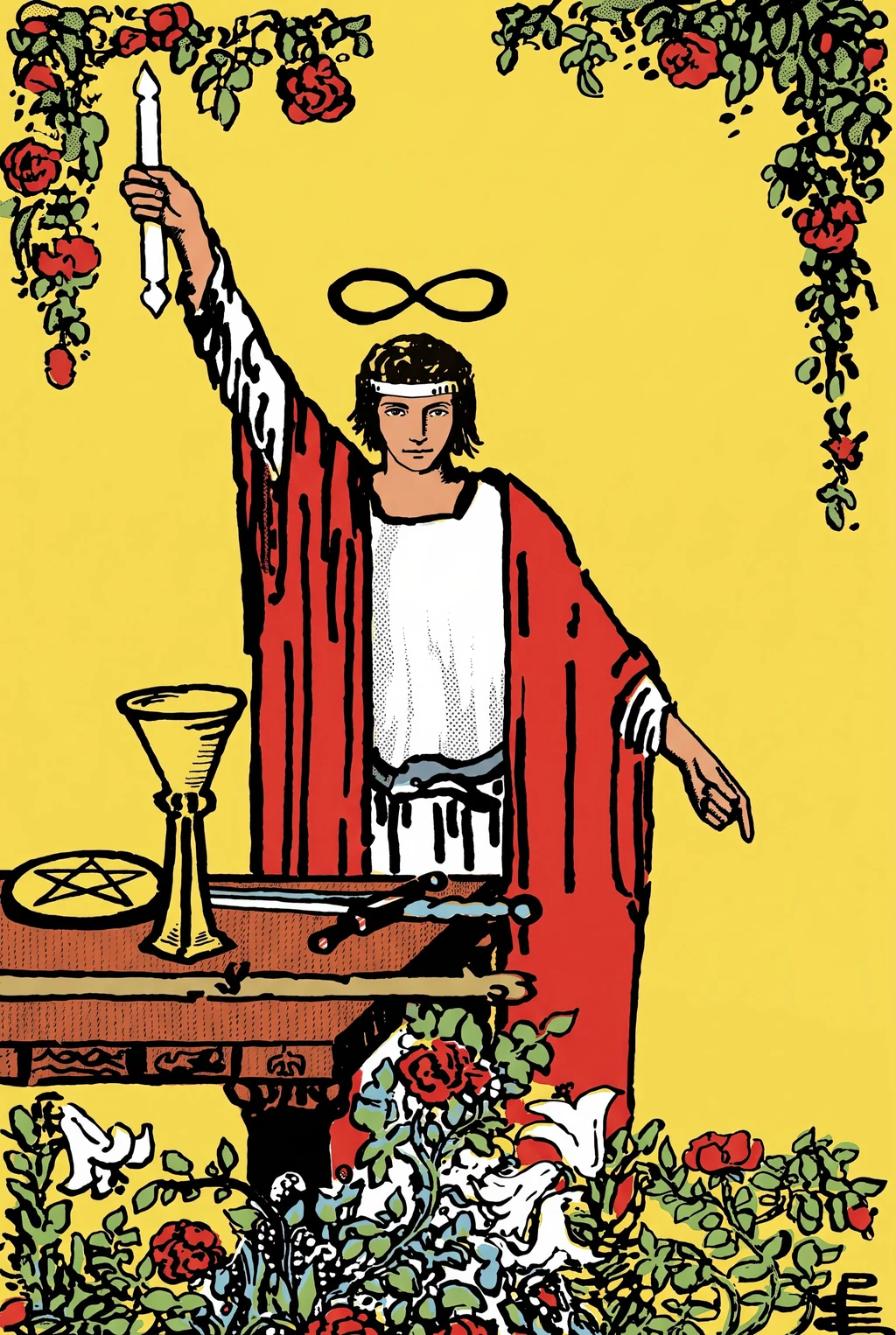
The Magician stands at his table with the confidence of someone who knows how to use his tools. Before him are the symbols of all four suits of the deck. A cup, sword, wand, and pentacle rest within reach, as though each object has already found its place in a larger plan. Among the blooming roses and lilies, everything is ready for work.
With his right hand, The Magician raises a wand toward the sky; with his left, he points to the earth. Waite saw this double gesture as receiving the gifts of spirit and conveying them into earthly life. The skilled practitioner becomes an intermediary: through his attention and will, inspiration takes form. The objects on the table have yet to move, but the gesture of his hands already sets a direction — from intention to action.
Core meaning
The Magician connects clear intention with the ability to act: knowledge, words, and available resources gain meaning when put to work toward a specific purpose. The card also reminds us that the ability to influence a situation calls for precision and honesty.
- Key meanings:Conscious intention
- Practical skill
- Focus
- Initiative
- Persuasiveness
- Key meanings:Scattered effort
- Untapped skill
- Manipulation
- Poorly considered plans
- Illusion of control
Image and symbols
Card image
A figure in white clothing and a red cloak stands behind a table. In one raised hand, the figure holds a light-colored wand, while the other hand points downward toward the earth.
On the table are a cup, sword, wand, and pentacle. Above the figure's head is a horizontal figure-eight symbol, and a snake coils around the waist.
Branches bearing red roses frame the scene from above, while roses, white lilies, and green leaves grow in front of the table.
Traditional context
In the symbolic account of Arthur Edward Waite, The Magician connects spiritual intention with its expression in the earthly world. The central themes are directed will and focused thought.
Waite's list of divinatory meanings is broader than the familiar theme of mastery: alongside skill, diplomacy, and confidence, it includes loss and misfortune. For the reversed card, he mentions a physician, a magician, and adverse conditions. These are historical divinatory meanings, not medical conclusions about a person.
Modern interpretations more often associate the upright Magician with initiative and the skillful use of available resources. The reversed Magician is linked to unused abilities, poorly considered actions, or manipulation. These approaches build on the themes of will and mastery, but do not reproduce Waite's meanings word for word: the power of persuasion can support cooperation or create an impressive appearance without genuine substance.
One hand raised, the other pointing downward
For Waite, this gesture connects the higher and earthly realms: what is received from above must find expression through action. In a modern reading, it highlights the connection between an idea and its practical realization.
A light-colored wand in the raised hand
The wand is part of the image of someone consciously directing their will. It emphasizes the difference between possessing an ability and choosing how to use it.
A cup, sword, wand, and pentacle on the table
The four objects represent the Tarot suits; Waite associated them with the elements of natural life. In a practical reading, they point to different ways of approaching a task: feelings, thought, initiative, and material circumstances.
A horizontal figure eight above the head
Waite calls this the sign of life and associates it with spiritual continuity. Its common modern interpretation as a symbol of infinity develops this theme, but does not in itself promise limitless possibilities.
A snake encircling the waist and biting its own tail
This is the ouroboros, a traditional symbol of a closed cycle and continuity. Waite specifically associated it with the enduring nature of spiritual attainment.
Red roses and white lilies surrounding the figure
Waite connected the garden flowers with the cultivation of aspirations: growth here requires care rather than happening on its own. Modern interpretations often associate the roses with desire and the lilies with clarity and purity of intention.
Colors
- White clothing and a red cloak
In a common interpretation, white represents clarity and purity of intention, while red suggests will and action. This contrast helps illustrate the union of intention and action, though it does not encompass the card's full meaning.
Meanings
The Magician — Upright
General
Overall meaning
The Magician represents a moment when an idea can be matched with concrete possibilities and you can begin to shape what happens next. Focus, the ability to choose suitable tools, and an understanding of the consequences of your decisions come to the forefront.
This card does not guarantee that every condition is already ideal. Instead, it highlights the value of working carefully with what you know and have available. What matters is not the strength of desire alone, but the connection between intention and action.
Possible support
The ability to notice different options and choose the one that fits, rather than simply relying on habit, can be a valuable strength. A clearly defined goal helps keep your efforts focused.
Possible difficulty
Confidence can become the belief that a well-developed idea is enough to achieve any result. Having considerable influence over a situation does not mean controlling everyone or everything involved.
Focus
It is worth distinguishing between what you can genuinely influence and what depends on other people or external events.
Reflection question
What skills do I already have that I can use in this situation?
Relationships
Overall meaning
In relationships, The Magician highlights the importance of taking initiative and expressing your intentions clearly. This could mean discussing boundaries, suggesting something to do together, or finding a way to understand each other better. It does not necessarily involve a romantic gesture.
Finding the right words can help establish a connection, but it cannot replace a willingness to hear the response. Mutual understanding grows where influence does not become pressure.
Possible support
Open communication and the ability to explain what you want create a foundation for reaching agreements. The other person still retains the right to make their own choices.
Possible difficulty
Eloquence and charm can create a sense of closeness faster than trust develops. Even a well-intentioned initiative can feel intrusive if boundaries are overlooked.
Focus
Tone, concrete actions, and the other person's response can help you distinguish between a sincere invitation to talk and an attempt to produce a particular reaction.
Reflection questions
- What is important for me to discuss with someone close to me?
- How can I show someone that I want to connect with them?
- What could help me better understand the other person's response?
Work and study
Overall meaning
In work and education, The Magician is about applying skills to a specific task. Knowledge alone does not amount to a completed project: you also need a suitable approach, a clear sequence of steps, and the ability to explain the results to others.
The card is especially relevant when preparation must be combined with independent initiative, whether in research, a presentation, or collaborative development. It emphasizes the quality of execution rather than promising recognition.
Possible support
Experience, the ability to learn a tool quickly, and a clearly defined task can provide the foundation for convincing work. It also helps to translate a complex idea into language everyone involved in the project can understand.
Possible difficulty
The desire to demonstrate competence can sometimes lead to promises that exceed the available time or level of preparation. Focusing too heavily on your own solution may also obscure your colleagues' contributions.
Focus
Distinguishing between skills you have mastered, areas where you still need to learn, and other people's responsibilities makes it easier to assess the task accurately.
Reflection question
Which of my skills could help me with this task?
Money and resources
Overall meaning
In financial matters, The Magician draws attention to how skills and existing material resources are used. Financial initiative here involves careful calculation, clear terms, and the ability to distinguish an idea from what it will cost to carry out.
The card concerns actions within your control, but does not predict how much you will earn.
Possible support
Practical resourcefulness and transparent recordkeeping can help clarify what resources are available and how they might reasonably be used.
Possible difficulty
A compelling presentation of an opportunity can distract from costs, limitations, and obligations. Confidence in your skills is no substitute for careful calculation.
Focus
The focus is on actual amounts, deadlines for obligations, and confirmed terms rather than expectations built around an appealing idea.
Reflection question
What expenses do I need to account for before spending money on this idea?
Wellbeing and self-care
Overall meaning
When it comes to well-being, The Magician shifts the focus toward managing everyday demands with awareness. This is not about controlling your condition through willpower or thought alone, but about recognizing your needs and finding manageable ways to care for yourself.
Staying focused is helpful when your plans still leave room for rest and adjustment.
Possible support
Paying attention to your natural rhythm and choosing sustainable habits can make self-care more practical and grounded.
Possible difficulty
Trying to control everything can turn recovery into yet another performance goal. Willpower does not erase fatigue or the body's limitations.
Focus
Notice which ways of organizing your day genuinely support your energy and which simply add more demands.
Reflection question
What habit helps me feel better?
Personal growth
Overall meaning
In personal growth, The Magician represents the transition from thinking about yourself to testing your chosen beliefs and skills in everyday life. A conscious intention helps clarify why you want to change, while regular practice reveals whether your chosen approach works for you.
This might involve learning a language, becoming better at maintaining boundaries, or changing how you usually make decisions. The card leaves room to reconsider your goal when experience differs from your original expectations.
Possible support
The ability to learn, recognize your own choices, and try new ways of behaving makes personal development more tangible.
Possible difficulty
You may become attached to the image of yourself as a capable person and avoid situations where you would have to admit that you do not know something. When that happens, maintaining an image begins to interfere with learning.
Focus
It is worth distinguishing between the value you want to move toward and the method you are using to bring it into your life.
Reflection question
What do I want to spend more time on because it matters to me?
The Magician — Reversed
General
Overall meaning
The reversed Magician draws attention to a gap between intention, available resources, and what is actually happening. Abilities may go unused, efforts may scatter in different directions, and a confident presentation may run ahead of what is truly there.
Another aspect of the card concerns using cleverness and persuasion to apply pressure or create a false impression. This does not prove that anyone is being deceptive. The invitation here is not to abandon your initiative, but to examine its foundation and direction.
Possible support
Reconsidering your goal or approach can reveal a skill that has been overlooked amid hasty decisions. Acknowledging uncertainty is sometimes more useful than projecting perfect confidence.
Possible difficulty
When words begin to replace actions that can be verified, it becomes easy to lose your bearings. Trying to control everything may make the situation harder to understand.
Focus
Pay attention to gaps between what was promised and what was done, as well as between the resources available and the scale of the intention.
Reflection question
Which parts of my plan am I already putting into action, and which am I still only thinking about?
Relationships
Overall meaning
In relationships, the reversed Magician draws attention to how words and charm align with actions. Sometimes a person finds it difficult to state their intentions directly, relying instead on hints or attempts to create a particular impression.
In another interpretation, influence becomes too forceful: conversation turns into persuasion, and securing agreement becomes the goal at any cost. The card invites you to consider the quality of the interaction without assigning blame or attributing hidden motives to the other person.
Possible support
Calm clarity and the freedom to speak without rehearsing a perfect response can help bring honesty back into communication.
Possible difficulty
Leaving things unspoken creates too much room for assumptions. Persuasive speech without a willingness to consider the other person can undermine mutual understanding.
Focus
Notice whether words match actions and how freely each person can agree or decline.
Reflection questions
- Can I speak honestly when I want someone to like me?
- Do my promises match what I actually do?
Work and study
Overall meaning
In work and education, this orientation points to a situation where ability and results are poorly aligned. A task may sound convincing on paper while the method for completing it remains unclear. Sometimes the knowledge is there, but disorganized work prevents it from being applied effectively.
Another possibility is the desire to appear knowledgeable without sufficient preparation. The reversed Magician invites you to distinguish a skills gap from a planning problem or an overly ambitious promise.
Possible support
Reviewing requirements and honestly assessing the tools you have mastered can help you reorganize your work without dismissing what you already know.
Possible difficulty
Unclear roles, performative confidence, or too many simultaneous tasks can obscure who is responsible for what.
Focus
It helps to compare the promised outcome with clear criteria for completion and identify which skills will actually be required.
Reflection question
Do I lack the knowledge for this task, or do I need a clearer plan?
Money and resources
Overall meaning
In financial matters, the reversed Magician highlights the risk of mistaking a persuasive story for a proven financial opportunity. This also applies to your own plans, when expected income or savings sound convincing but are not supported by calculations.
The card can also suggest an undervalued skill that has yet to find a practical use. On its own, it indicates neither fraud nor future losses.
Possible support
The ability to calmly examine offers in terms of numbers and conditions helps you make judgments independently of the confidence of the person presenting them.
Possible difficulty
Overly complicated explanations, incomplete information about expenses, or hope for a quick solution can interfere with a clear-eyed assessment.
Focus
What matters here is confirmed obligations, the potential cost of a mistake, and the difference between what is expected and what is actually available.
Reflection question
What evidence supports the income promises I'm counting on?
Wellbeing and self-care
Overall meaning
In self-care, the reversed Magician can suggest a mismatch between your plans and your everyday capacity. An elaborate system of habits may look well thought out but leave little time for recovery. The opposite is also possible: you want to change your routine but have not found a workable approach.
Trying to control every reaction can add to the strain when the unpredictable nature of how you feel is overlooked. This is about your approach to daily life, not a diagnosis.
Possible support
Flexibility and the freedom to adjust your plans help align self-care with your actual circumstances rather than an idealized routine.
Possible difficulty
Overly strict expectations create additional fatigue. A lack of noticeable results does not necessarily mean you have not tried hard enough.
Focus
You can compare the rules that structure your day with how much rest and energy you actually have.
Reflection question
How can I tell whether my approach to self-care is right for me?
Personal growth
Overall meaning
In personal growth, the reversed Magician concerns the difference between imagining the changes you want and experiencing the process of making them. Sometimes a person collects methods, plans, and explanations but rarely puts them to the test.
In another reading, a well-developed skill serves more to maintain a certain self-image than to move toward personal values. The card also leaves room for simple doubts about your ability to learn, without treating those doubts as evidence that you lack talent.
Possible support
A willingness to recognize your own knowledge gaps without rushing to judge yourself provides a more honest foundation for learning.
Possible difficulty
Self-reflection can become endless preparation if every action is postponed until you feel completely certain. Comparing yourself with an idealized image makes it harder to recognize what your actual experience has taught you.
Focus
Consider which beliefs are supported by your everyday choices and which exist mainly in the way you describe yourself.
Reflection question
What could I try before deciding that I won't succeed?
Roles in a spread
Position examples
A position gives the card a question, such as what helps or what gets in the way. That question shapes how you read its meaning.
The Magician — Upright
Situation
The situation offers an opportunity to consciously influence how things unfold. There is room to choose an approach, clarify your intention, and put your abilities to use. Your actual degree of influence depends on real circumstances, not confidence alone.
Influence
Available skills, resources, and opportunities to take initiative are shaping the situation.
Support
Support comes from combining knowledge, focus, and the ability to communicate clearly and directly. In this position, The Magician helps you recognize what you can already put to use without needing to demonstrate your power.
Obstacle
An obstacle may be excessive faith in your own control or an urge to persuade others before the facts are clear. Even skillful action loses its value when it disregards boundaries and consequences.
Next step
It may help to compare your goal with the resources available and choose an approach you can test in practice. What you say you intend to do should align with what you actually do.
Possible development
The situation is moving toward a more active use of skills and opportunities.
The Magician — Reversed
Situation
The situation may reveal a disconnect between intentions, available resources, and how those resources are being used. A confident presentation does not necessarily mean that actions are backed by sufficient knowledge and ability.
Support
A useful aspect of the reversed Magician is the ability to recognize exaggeration or untapped talent before either shapes a decision. Reconsidering your approach can be a sign of precision rather than weakness.
Obstacle
Distraction, poorly considered promises, or attempts to replace cooperation with influence can become obstacles. Moving forward is especially difficult when the gap between words and actions goes unacknowledged.
Next step
One direction to explore is separating what can be verified from what merely sounds impressive, then clarifying which resources are truly needed. If the goal still matters, you can reconsider how to reach it.
Possible development
Unclear communication and a mismatch between intentions and actions may complicate further progress.
Combination examples
Card combinations are in development. For now, here are a few examples.
The Magician + Eight of Pentacles
The Magician ( upright) + Eight of Pentacles ( upright)
- Example question:
- How can I learn the software I need for work?
- Example interpretation:
The Magician brings clear intention and a choice of tools, while the Eight of Pentacles reminds us that skill develops through repeated practice. Together, the cards describe a transition from a confident idea to practical work where quality can be assessed and improved over time.
The Magician + Two of Swords
The Magician ( upright) + Two of Swords ( upright)
- Example question:
- How can I choose between two job offers?
- Example interpretation:
The Magician emphasizes the ability to act and explain your position, while the Two of Swords highlights the difficulty of making the choice itself. Together, they suggest not mistaking persuasive reasoning for certainty: first, it is important to examine what your decision is based on.
The Magician + Seven of Cups
The Magician ( reversed) + Seven of Cups ( upright)
- Example question:
- How can I choose between several ideas for earning extra income?
- Example interpretation:
The reversed Magician emphasizes the possible gap between a promising opportunity and the resources actually available, while the Seven of Cups introduces a range of tempting possibilities. This combination can be read as an invitation to distinguish a workable option from a fantasy, without assuming that every idea is deceptive.
The Magician + Justice
The Magician ( reversed) + Justice ( upright)
- Example question:
- How can we agree on who is responsible for what in a collaborative project?
- Example interpretation:
The reversed Magician draws attention to a possible gap between convincing words and actual action; Justice introduces criteria, justification, and proportionality. Together, the cards suggest examining verifiable terms and consequences rather than guessing at hidden intentions.
Reading example
An imagined one-card reading shows how the meanings above can apply to a question. This is one possible interpretation.
The Magician — Upright
Situation:
Something remains unspoken between you and someone close to you. You want to talk, but you're concerned that trying to explain yourself could lead to another argument.
Question:
What will help me start this conversation?
-
Card drawn:
Imagine drawing a card for the position «What Will Help» and getting The Magician (upright).
Interpretation:
The Magician is about initiative and the ability to express what matters. Here, the card can be read as an invitation not to wait for the other person to figure out how you feel on their own.
You can begin with what you're feeling and what you want to discuss. Your part is to express it clearly and give the other person room to respond.
The Magician — Reversed
Situation:
Something remains unspoken between you and someone close to you. You want to talk, but you're concerned that trying to explain yourself could lead to another argument.
Question:
What will help me start this conversation?
-
Card drawn:
Imagine drawing a card for the position «What Will Help» and getting The Magician (reversed).
Interpretation:
The reversed Magician draws attention to how words are used. In this situation, the card invites you to notice whether you want to explain yourself or find arguments that will make the other person agree with you.
Instead of preparing for a debate, you can first clarify what you truly want to communicate. That leaves room in the conversation for both your feelings and the other person's response.
Yes / No
The Magician — Upright
Why this answer
The Magician supports initiative: its "yes" is connected to the ability to act and make use of what is already available. This interpretation is especially clear when the question concerns taking your own first step.
A clarification
What matters here is your readiness to act. Wanting something or waiting for someone else to take the initiative is not enough.
A question to consider
What is within my control in this situation?
The Magician — Reversed
Why this answer
The reversed Magician can be read in different ways: as "no" when efforts are misdirected, or as a cautious "yes" if the obstacles can be addressed. Without knowing the question, it is not possible to choose between these answers.
A clarification
Notice what is preventing action: self-doubt, unclear intentions, or an approach that is not producing results. Whether you can change these conditions matters more than simply wanting a "yes."
A question to consider
What is preventing me from acting, and can I do anything about it?
Correspondences
Connections with numbers, elements and other symbols add depth to the card’s imagery. They can differ between traditions.
Number — I (1)
The number one emphasizes initiative and bringing attention together around a single intention. This is a symbolic interpretation of the card's number, not independent proof of how a situation will turn out.
Element — Air
Air emphasizes clarity of thought, the ability to distinguish between options, and communication. This is a later reference-book simplification and should not be presented as the single official element assigned to The Magician in the Golden Dawn system: the table before him holds symbols of all four suits.
Astrology — Mercury
Mercury is associated with thought, speech, dexterity, and the transmission of knowledge. This correspondence supports an interpretation of The Magician through the ability to choose the right word or tool.
Letter — Beth (ב)
The Hebrew letter Beth, whose name means "house," is assigned to The Magician in this school. In Hermetic symbolic interpretation, it represents the ability to give intention a definite form.
Tree of Life — 12th Path: Kether — Binah
This path connects the "Crown" and "Understanding" in the school's arrangement of the Tree of Life. For The Magician, it emphasizes the transition from the source of an idea to its conscious formation. This is a correspondence within Western esotericism, not a universal property of Tarot.