
Eight of Pentacles
Descriptions and symbolism are based on the card’s classic illustration in the Rider–Waite–Smith deck. Details of the artwork may differ in other editions of the deck.
This guide brings together traditional and modern readings. Interpretations and answers may differ between authors and schools.
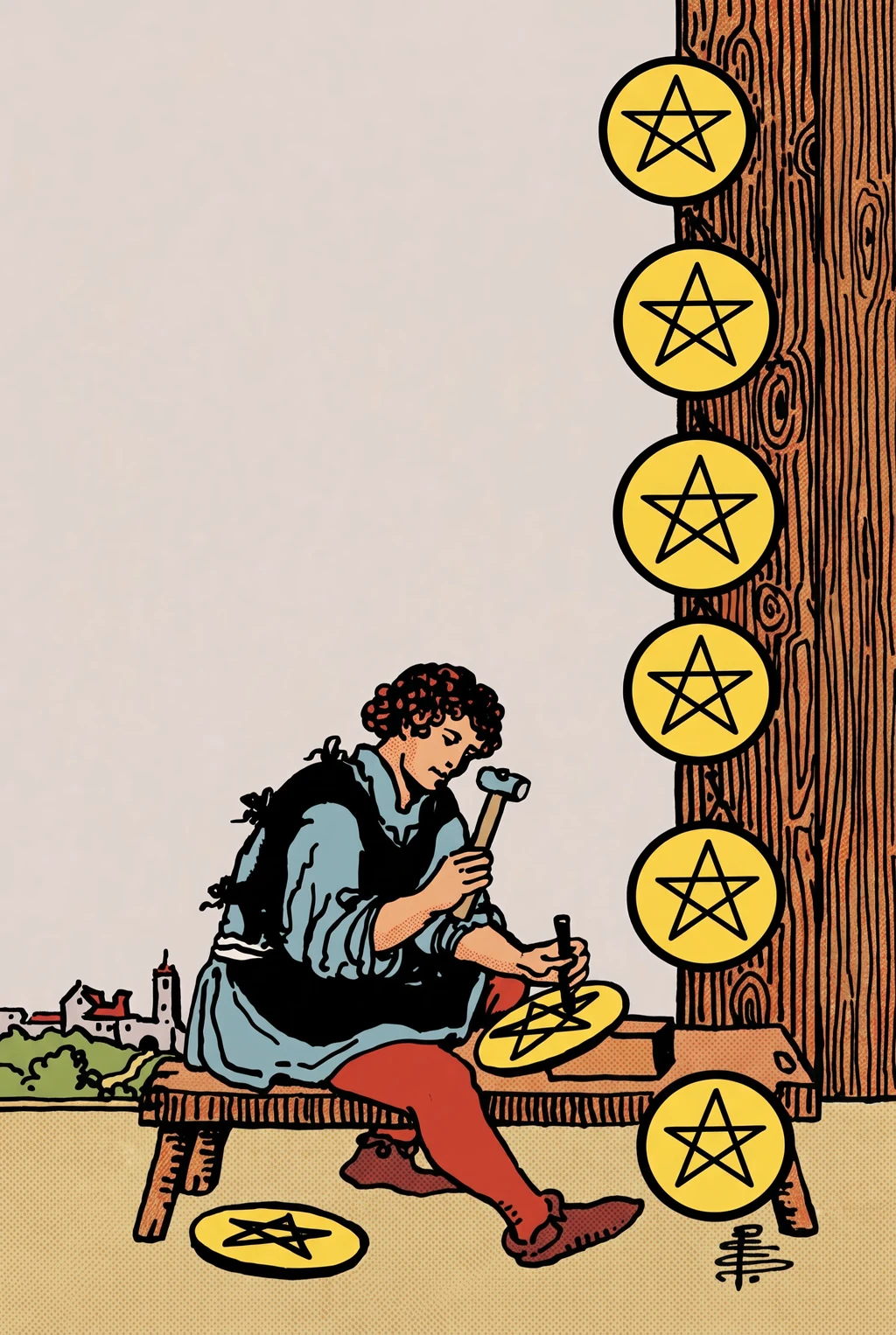
The craftsperson already has work to show, yet remains occupied with the next pentacle. Finished pieces are displayed nearby; beneath the chisel, another star is still taking shape. A town lies in the distance, while all of the figure’s attention rests on the small space between their hands.
As a familiar pattern is repeated, the hand learns how much force to use, and the eye learns to catch an uneven edge and stop in time. Gradually, skill becomes part of the movement itself. From the outside, we see a row of similar pieces, but each presents the same simple task anew: where to set the chisel and how to guide the next strike. The last successful piece cannot do that for its maker.
Core meaning
Mastery takes shape through attentive practice. The Eight of Pentacles connects learning and conscientious work with a level of quality that gradually becomes consistent.
- Key meanings:Mastery
- Apprenticeship
- Diligence
- Attention to detail
- Practice
- Work you love
- Key meanings:Perfectionism
- Carelessness
- Loss of interest
- Misdirected effort
- Inner work
- Misuse of skill
Image and symbols
Card image
A craftsperson sits on a wooden bench, head bent toward the pentacle in front of them. They work with a hammer and chisel and wear a blue shirt, a dark work apron, and red pants.
To the viewer’s right, six pentacles are fixed to a tall wooden post. One is beneath the craftsperson’s tools, and another lies on the ground at the lower left. In the distance on the left is a small town with a tower and red roofs, surrounded by green hills. A pale grayish sky fills most of the background.
Traditional context
Waite connects the card with work and craftsmanship: employment, commissions, skill in a trade, and a possible preparatory stage. Apprenticeship here does not rule out experience already gained. In the modern interpretation of Sergey Savchenko, a different emphasis stands out: the pleasure a skilled craftsperson takes in a beloved pursuit, including a hobby.
For the reversed card, Waite emphasizes unfulfilled ambition, vanity, greed, excessive demands for money, and usury. Skill may remain intact but be put to use in cunning and intrigue. His supplementary list also mentions questionable involvement in a monetary loan.
Modern readings add loss of interest, carelessness, and perfectionism that prevents the work from being finished. There is also a nonnegative interpretation: skill is directed inward, toward one’s own beliefs and habits.
In the Golden Dawn system, the card is called the “Lord of Prudence.” Book T combines diligence and careful calculation with the risk of getting lost in details and losing sight of what matters most.
Craftsperson at work
An image of practical skill: the person makes something rather than merely owning it.
Head bent toward the pentacle
Focused attention on a specific task and its smallest details.
Hammer and chisel in hand
Craft as action: skill becomes visible through working with the material.
Six pentacles on a post
Completed work on display. The repeated pieces show experience gained over time.
Pentacle beneath the tools
The present task, which holds the craftsperson’s attention. Finished pieces cannot replace the work still in progress.
A separate pentacle on the ground
May represent the next piece of work, still waiting its turn.
Work apron
Protection for manual work and readiness to engage in a hands-on task.
Wooden bench
A steady place to work and commitment to a chosen craft.
Town in the distance
A temporary retreat from everyday bustle to concentrate on the work.
Colors
- Blue — the craftsperson’s shirt
In a modern symbolic reading, emphasizes clarity of thought and an orderly approach.
- Red — pants and shoes
In a modern reading, represents enthusiasm channeled into concrete action.
- Golden yellow — the pentacles
Emphasizes the material value of what is being created and the visible results of the work.
Meanings
Eight of Pentacles — Upright
General
Overall meaning
The Eight of Pentacles describes work that takes time, concentration, and repetition. Skill develops through practice: you try, notice the details, and gradually become more precise.
The card can point to learning or a preparatory stage, but not necessarily to starting from scratch. It can also depict an experienced craftsperson absorbed in work, for whom doing the job well matters in itself.
Possible support
Patience helps you continue when the result does not yet match your vision. A willingness to learn and notice gradual improvements can become a source of support.
Possible difficulty
You may be facing too many demanding tasks at once. Even a conscientious approach to each one cannot eliminate overload.
Focus
Notice the particular area that needs refinement. A mistake may show you what there is still to learn.
Reflection questions
- What would I like to get better at?
- What changes tell me that my practice is paying off?
Relationships
Overall meaning
In a partnership, the card points to attention sustained in everyday life: interest in each other, patience, and a willingness to understand rather than simply expect to be understood. Closeness grows through ongoing involvement.
In family and friendships, this means making time to talk and caring for the bond itself. A pragmatic reading also emphasizes mutual respect and agreements about what each person contributes to the relationship.
Possible support
A willingness to keep getting to know each other supports a partnership, even when so much feels familiar. Curiosity and patience help keep the relationship from becoming a set of fixed roles.
Possible difficulty
Being absorbed in work may leave relationships with only the time and attention left over.
Focus
Check whether you still make time to talk with family and friends, including about difficulties that have come up.
Reflection questions
- How do I show the people close to me that I care in everyday life?
- What am I still curious to learn about my partner?
Work and study
Overall meaning
The card speaks to learning a profession, developing your expertise, and working carefully on a project. This may involve study, a new level of responsibility, or going deeper into a craft you already know.
What matters here is the quality of the work and the satisfaction of doing it well. The work may be paid, or it may be a beloved pursuit in which you want to become more skilled.
Possible support
Collaboration and timely help from colleagues can offer support. Greater responsibility does not mean you have to master every new task on your own.
Possible difficulty
A narrow specialization becomes a limitation when circumstances change and familiar methods no longer fit.
Focus
Look at the quality of what you have done, not only how much. Constructive feedback may reveal a skill that still needs practice.
Reflection questions
- Which skill matters most for me to develop in my work right now?
- Whose feedback could help me see what needs improvement?
Money and resources
Overall meaning
Money here is connected to the ability to create value and receive payment for work done. Material stability is understood as the result of skill and careful handling of what you earn, rather than a stroke of luck.
Possible support
A sought-after skill that earns payment when applied well can provide a foundation. In this reading, income rests on specific work.
Possible difficulty
A narrow specialization may limit earnings when changing circumstances call for different skills.
Focus
Pay attention to how you handle your earnings. Care matters not only in your work but also in everyday spending.
Reflection questions
- Which of my skills helps sustain my income?
- How carefully do I manage what I earn?
Wellbeing and self-care
Overall meaning
In questions of well-being, the card draws attention to regular, everyday self-care. A sustainable rhythm matters more than a single effort.
Possible support
Patience with gradual change can help you maintain a regular practice of caring for yourself.
Possible difficulty
Long periods of sedentary work may leave too little room for movement.
Focus
Consider whether you are overlooking fatigue or your need for a break when fully absorbed in your work.
Reflection question
Do I notice when I get tired while absorbed in what I am doing?
Personal growth
Overall meaning
Growth comes through practice, not just understanding what you would like to change. The card connects personal development with staying true to your values and working on yourself consistently.
Dissatisfaction with your current circumstances may motivate you to learn and gradually make changes in your life.
Possible support
Patience with gradual change and knowing why it matters to you personally can help.
Possible difficulty
Progress is not always visible right away. Repetition and the gradual refinement of a skill take patience.
Focus
Consider what you want to learn or create to support your development and change your present circumstances.
Reflection questions
- What habit do I want to change through practice?
- Why does continuing this work on myself matter to me?
Eight of Pentacles — Reversed
General
Overall meaning
Effort may stop producing the quality you need. Sometimes the work lacks attention or skill; at other times, the pursuit of perfection leads to endless adjustments and prevents completion. Boredom and loss of interest are also possible.
Another interpretation retains the card’s discipline but turns it inward: a person examines their beliefs and behavior. The reversed Eight of Pentacles therefore does not always mean the work is going badly.
Waite’s traditional list includes another meaning: skill used for cunning, intrigue, or self-serving ends.
Possible support
Returning to the reason you chose this work in the first place can offer direction. It helps distinguish necessary work from habitual busyness.
Possible difficulty
Demanding a flawless result can bring work to a complete halt. The higher the unattainable standard, the harder it becomes to consider anything finished.
Focus
Consider whether your current efforts serve the larger goal. An abundance of small tasks does not necessarily mean you are moving toward what prompted you to begin.
Reflection questions
- What is holding the work back more: a lack of practice or the demand to make it perfect?
- How much of my effort is genuinely connected to the goal?
Relationships
Overall meaning
In a relationship, the card may describe involvement that has become inconsistent or one-sided. Taking care of practical matters does not always come with attentiveness and warmth; conversations left unfinished may deepen the distance.
In friendships and family, it can also point to a bond taken for granted, with less and less time set aside for it.
Possible support
In family and friendships, small but repeated gestures of care can help restore connection: checking in with someone close to you and making time for a meaningful conversation.
Possible difficulty
Trying to sustain a partnership through one person’s efforts alone creates an imbalance. Constant busyness can also crowd out communication.
Focus
Notice whether your partnership has room both for practical help and for expressions of affection. Taking care of tasks cannot replace every other way of being there for each other.
Reflection questions
- Am I putting off talking with loved ones until a free moment that never comes?
- How do practical help and expressions of warmth come together in my relationship?
Work and study
Overall meaning
Work and study may bring different difficulties: inadequate preparation, careless execution, or a loss of interest in the activity itself. Sometimes you may have to correct other people’s mistakes.
Perfectionism creates a different imbalance: one detail absorbs all your attention, and the work remains unfinished. If considerable effort is not leading to the progress you need, the card invites you to consider both the quality of your preparation and whether the work you have chosen aligns with your goals.
Possible support
When skills are lacking, suitable guidance can help. Working through a difficult point with someone more experienced may be more useful than repeating an unsuccessful attempt alone.
Possible difficulty
Careless execution can undermine confidence in the result. Moving forward is equally difficult when a new task requires a skill you have yet to develop.
Focus
Distinguish a lack of preparation from a lack of interest in the work you have chosen. More training and reconsidering your career direction address different difficulties.
Reflection questions
- Am I lacking the necessary skills or the interest in the work itself?
- What is keeping me from finishing the work instead of revising it endlessly?
Money and resources
Overall meaning
The material return may not match the effort invested. In this reading, insufficient preparation or poor-quality work can make earning money harder; inattentiveness to finances and excessive spending create an additional imbalance.
Waite also associates the reversed card with self-interest and excessive demands for money.
Possible support
Paying attention to income and expenses can help you notice carelessness before it becomes a serious problem.
Possible difficulty
Ignoring expenses and financial difficulties allows problems to accumulate. Hoping for luck is no substitute for paying attention to what is happening with your money.
Focus
Look at precisely what has been neglected: current expenses and financial difficulties that have already arisen. Putting off a closer look may make things worse.
Reflection questions
- Am I accounting for all my current expenses?
- Is there a money issue I keep putting off?
Wellbeing and self-care
Overall meaning
In caring for yourself, two extremes are possible: everyday needs go unattended, or managing them becomes excessive. Trying to do everything perfectly can itself create strain.
The card may also point to a need to step away from constant work and make room for rest again.
Possible support
A break from work may provide support. It frees up attention for how you are feeling, something easily missed amid constant busyness.
Possible difficulty
A rigid demand to follow every self-care rule perfectly can turn self-care into another source of stress.
Focus
Notice both sides of the imbalance: what aspects of self-care have been neglected, and what is taking a disproportionate amount of attention and energy.
Reflection questions
- Is caring for myself helping me recover, or has it become another burden?
- Do I still make time to step away from work?
Personal growth
Overall meaning
Mastery can be directed inward: toward understanding your beliefs, noticing habitual behaviors, and consciously changing them. This reading is not simply about a lack of discipline.
Another possibility involves effort that has lost its personal meaning. A person keeps refining what they think they ought to do but feels less and less connected to why it matters to them.
Possible support
Returning to your own values can help you see which efforts toward personal growth are truly worth continuing.
Possible difficulty
Personal growth may be replaced by constant busyness with things that supposedly need improvement. The effort continues, but the connection with yourself fades.
Focus
Your beliefs and recurring patterns of behavior become the focus of attention.
Reflection questions
- Which of my beliefs do I want to understand better?
- Does what I am trying to improve truly matter to me?
Roles in a spread
Position examples
A position gives the card a question, such as what helps or what gets in the way. That question shapes how you read its meaning.
Eight of Pentacles — Upright
Situation
You are learning or refining a craft. The situation calls for engagement with the process itself, not just anticipation of the result.
Influence
The situation may be shaped by an environment where colleagues, mentors, or experienced craftspeople take their work seriously. Their example sets a standard of quality and shows how regular practice can refine a skill.
Motivation
You may be motivated by a desire to grow more skillful and to find satisfaction in the quality of the work itself.
Support
Patiently continuing to practice becomes a source of support, even when improvements are still small.
Obstacle
Your attention may be divided among too many tasks. The difficulty may lie in the number of demands, not necessarily in a lack of effort.
Focus of attention
The quality of your current work deserves attention: what is already going well, and where mistakes can still teach you something.
Next step
Choose one detail genuinely worth improving and return to attentive practice. A mistake can point to the next thing to learn.
Possible development
With continued attentive practice, your skills may become more reliable and the quality of your work may improve.
Eight of Pentacles — Reversed
Situation
Your efforts may not be producing the quality you need because of gaps in skill, waning interest, or endless adjustments to details. In another reading, the work continues but turns toward inner development.
Influence
Prolonged monotony may be affecting the situation: repetition without rest or renewed interest gradually drains your engagement.
Motivation
In Waite’s historical reading, vanity or an excessive desire for profit may be at work: skill is used to impress or gain an advantage, rather than for the quality of the work itself.
Support
Support may come from reconnecting the work with what it means to you. This leaves room to consider either continuing or taking a needed pause, without assuming you must take on more.
Obstacle
The obstacle is a standard by which no result is ever good enough. The drive to improve stops helping you finish.
Focus of attention
Distinguish useful care from endless refinement that obscures the goal. The possibility of changing your usual approach also deserves attention.
Next step
Step back from the small tasks and reconsider where your effort is going. Identify what moves you toward the larger goal and what merely keeps you busy.
Possible development
If the standard of perfection remains unattainable, the work may stay unfinished for longer and longer, despite the time invested.
Combination examples
Card combinations are in development. For now, here are a few examples.
Eight of Pentacles + The Magician
Eight of Pentacles ( upright) + The Magician ( upright)
- Example question:
- What will help me focus on the work I have chosen?
- Example interpretation:
The Magician reinforces the Eight of Pentacles’ sense of concentration. Together, the cards especially highlight the ability to focus attention on the task at hand.
Eight of Pentacles + The Hierophant
Eight of Pentacles ( upright) + The Hierophant ( upright)
- Example question:
- What should I focus on in my studies?
- Example interpretation:
The Hierophant reinforces the learning aspect of the Eight of Pentacles. This pairing highlights the pursuit of knowledge and the careful study of a subject.
Eight of Pentacles + Four of Cups
Eight of Pentacles ( upright) + Four of Cups ( upright)
- Example question:
- How do my level of involvement and my interest in the work relate?
- Example interpretation:
This pairing highlights the tension between focused involvement and a lack of interest. The discipline of the Eight of Pentacles meets the detachment of the Four of Cups.
Eight of Pentacles + Seven of Pentacles
Eight of Pentacles ( upright) + Seven of Pentacles ( upright)
- Example question:
- Does the result reflect the attention I have invested?
- Example interpretation:
The Eight of Pentacles emphasizes practice, while the Seven of Pentacles invites you to assess its return. Together, they help you consider whether continued work is bringing proportionate progress.
Reading example
An imagined one-card reading shows how the meanings above can apply to a question. This is one possible interpretation.
Eight of Pentacles — Upright
Situation:
You are learning something new that you have wanted to master for a long time. Progress feels slow, and you begin to wonder whether to continue learning or choose a different path.
Question:
What should I consider before deciding whether to continue studying?
-
Card drawn:
Imagine drawing a card for the position «What to pay attention to» and getting Eight of Pentacles (upright).
Interpretation:
The Eight of Pentacles draws attention to the gradual development of a skill. In this situation, slow progress does not necessarily mean you have chosen the wrong path: the very things you find difficult may be what require more practice.
Before deciding, you can look at what has already improved and where feedback would help. This allows you to assess the learning process itself, rather than only the gap between your current results and the mastery you hope to achieve.
Eight of Pentacles — Reversed
Situation:
You are learning something new that you have wanted to master for a long time. Progress feels slow, and you begin to wonder whether to continue learning or choose a different path.
Question:
What should I consider before deciding whether to continue studying?
-
Card drawn:
Imagine drawing a card for the position «What to pay attention to» and getting Eight of Pentacles (reversed).
Interpretation:
The reversed Eight of Pentacles invites you to examine the quality of your approach. Gaps in your preparation or a demand for immediate perfection may be holding back progress; losing interest in the subject raises a different question.
You can separate what you have yet to learn from what you no longer want to learn. In the first case, consider a different kind of learning support; in the second, a change of direction.
Yes / No
Eight of Pentacles — Upright
Why this answer
The card connects a positive answer with diligence, developing the necessary skills, and following through with care.
A clarification
The answer depends on continued effort. Consider the time and attention that further work will require.
A question to consider
What can I do regularly to work toward this goal?
Eight of Pentacles — Reversed
Why this answer
The negative answer is associated with effort directed the wrong way or effort that drains you without sufficient return.
A clarification
If you are depleted, consider rest before adding to your workload. If your efforts are misdirected, the approach itself needs attention.
A question to consider
Do I need to regain my strength or rethink my approach right now?
Correspondences
Connections with numbers, elements and other symbols add depth to the card’s imagery. They can differ between traditions.
Number — VIII (8)
A skill developed through repetition and the visible results of sustained practice.
Number — VIII (8)
In Book T, the eights signify an independent achievement in a particular pursuit that does not necessarily change the rest of one’s life.
Element — Earth
The practical side of mastery: working with materials and skill made visible in the result.
Astrology — Sun in Virgo, first decan of Virgo
The correspondence of the “Lord of Prudence” in Book T. A modern Hermetic reading associates it with creativity, precision, and attention to quality.
Tree of Life — Hod in Assiah
Analytical understanding applied to material work. In Book T, the association with Hod involves skill, prudence, and cunning.