
The Hierophant
Descriptions and symbolism are based on the card’s classic illustration in the Rider–Waite–Smith deck. Details of the artwork may differ in other editions of the deck.
This guide brings together traditional and modern readings. Interpretations and answers may differ between authors and schools.
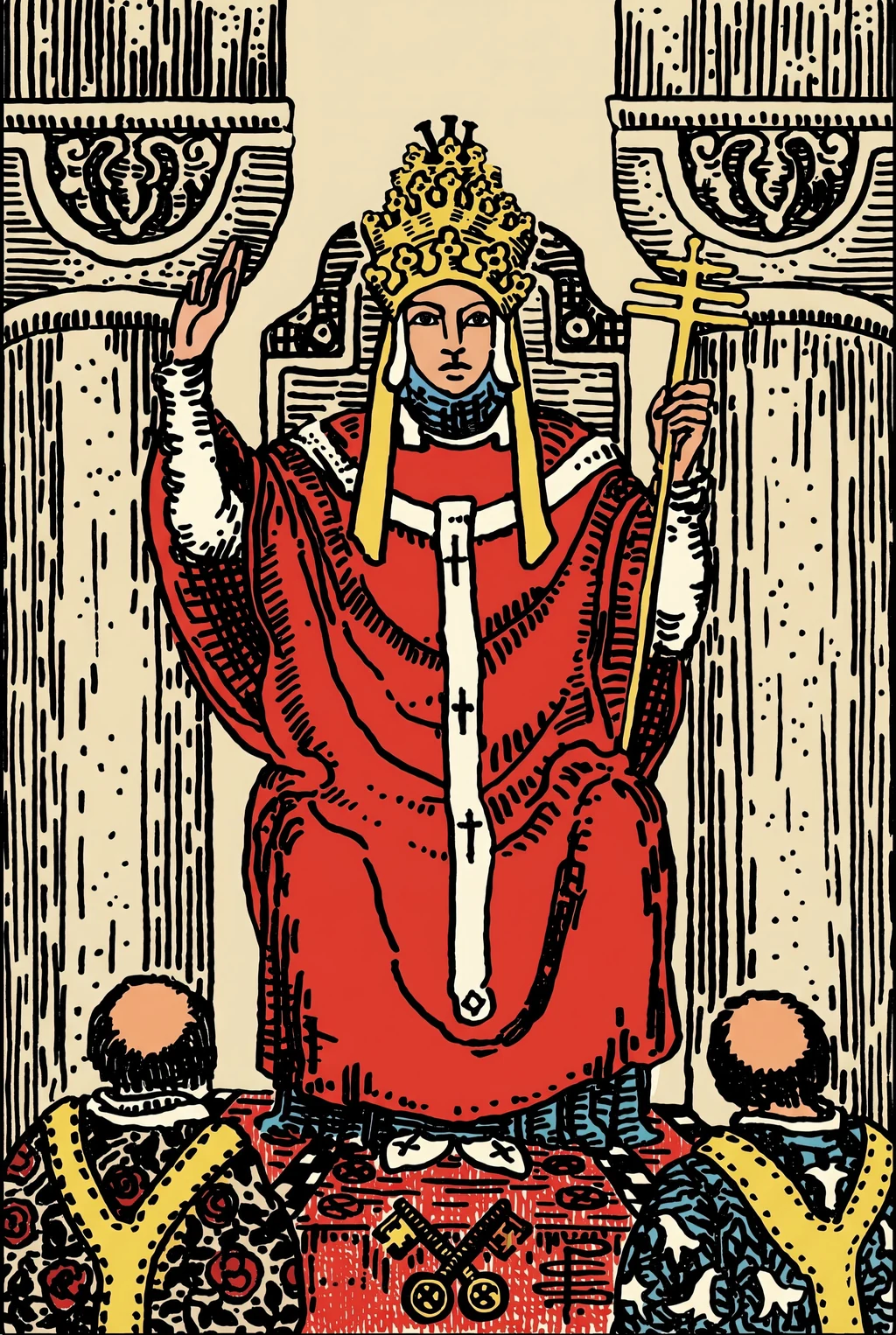
Two attendants receive The Hierophant's blessing. Kneeling before a spiritual leader, they take part in a ritual that existed before this meeting and may be passed on to others. The familiar gesture carries the experience of many people; each attendant has something to draw on beyond their own understanding.
Waite distinguished The Hierophant from the silent High Priestess: here, the sacred takes an open, shared form — teaching, ritual, and recognized service. The raised hand is turned toward the people; the keys lie at his feet. Before them sits a keeper of tradition through whom it becomes accessible to others.
Yet the keeper cannot encompass everything entrusted to him. Waite left this danger in the image: the spiritual leader may forget that he represents something greater than himself. For those kneeling before him, fidelity to the teaching then becomes difficult to separate from obedience to one person.
Core meaning
The Hierophant is associated with tradition, learning, and shared beliefs. The card invites you to consider whose knowledge you can rely on and where following rules becomes submission.
- Key meanings:Tradition
- Mentorship
- Shared beliefs
- Belonging
- Commitments
- Obedience
- Key meanings:Reassessing beliefs
- Independence
- Dogmatism
- Rebellion
- Crisis of authority
- Excessive kindness
Image and symbols
Card image
At the center, a figure sits in red vestments and a three-tiered golden tiara. Blue clothing is visible beneath the red fabric, and a white band with three black crosses runs across the chest. The right hand, on the viewer's left, is raised, with the index and middle fingers pointing upward. The left hand holds a golden staff with three crossbars.
Two carved gray pillars stand on either side, with the back of the throne visible between them. Two crossed golden keys lie at the figure's feet. Below, two figures with shaved crowns kneel with their backs to the viewer. The figure on the left wears roses, the one on the right lilies; golden ribbons cross their backs.
Traditional context
For Waite, The Hierophant represents the outward, organized side of religion: an established hierarchy, teachings, and ritual. Unlike The High Priestess, he is associated with the public transmission of religious knowledge. His authority comes not only from the individual but also from the office he holds.
Waite's divinatory list is broader and more ambiguous than this image. Upright, marriage and union appear alongside obedience and constraint, as well as mercy, kindness, and a person one turns to for help. Inspiration is also included, although Waite rejects it as a definition of the card itself in his symbolic explanation. His reversed list includes society, mutual understanding, agreement, excessive kindness, and weakness.
Modern readings extend the theme to education, mentorship, and family and cultural heritage. The reversed card is often associated with questioning learned rules: this might mean liberation from dogma or rejection of useful guidance. This reading differs from Waite's brief list for the reversed card.
The Hierophant on his throne
An image of recognized religious authority and teachings passed down through an established hierarchy.
Raised right hand with two fingers extended
In Waite's interpretation, the gesture of blessing distinguishes the open and hidden aspects of the teaching.
Three-tiered tiara
A sign of high religious rank. In modern esoteric interpretations, its three tiers correspond to the conscious, subconscious, and superconscious levels.
Staff with three crossbars in the left hand
The papal cross emphasizes the figure's religious standing and authority.
Two crossed keys at his feet
Access to knowledge through teaching and initiation. Modern interpretations also link the keys to the conscious and subconscious minds.
Two kneeling figures
Receiving and passing on teachings, entering a shared tradition. In Peter Oddy's Kabbalistic reading, the figures also represent the intellect and emotional nature.
Shaved crowns of the kneeling figures
The tonsures mark membership in a religious order and submission to its authority.
Roses and lilies on the figures' clothing
For Case, these patterns refer to The Magician: its number appears in the sum 1 + 4, through which he explains The Hierophant's number five.
White band with crosses over the red vestment
Case reads the shape of this vestment, the pallium, as a variation on the symbol of Venus, linking The Hierophant to The Empress.
Equal-armed crosses on white shoes
In A. Pearson's Hermetic reading, the cross unites opposites and symbolically corresponds to the four elements.
Two pillars flanking the throne
In a Kabbalistic reading, the figure between the pillars maintains balance. These pillars should not automatically be equated with those of The High Priestess.
Colors
- Gray — pillars and throne
A. Pearson associates this color with wisdom and the balance of opposites.
- Red — outer vestment
In Michelle Piper's Kabbalistic reading, the red vestment is associated with love, sacrifice, and purification.
- Blue — clothing beneath the red vestment
In Case's system, blue links The Hierophant to The High Priestess.
- White — lighter parts of the vestment
In modern symbolic interpretations, white emphasizes purity and spiritual understanding.
Meanings
The Hierophant — Upright
General
Overall meaning
The Hierophant describes a situation where accepted rules and knowledge passed down through others matter. Answers may be found through learning, a mentor's experience, established practices, or a group's shared sense of what is right. There are two possible roles: learning from someone else or passing on what you already know.
The card also speaks to belonging, union, and commitments. This structure has more than one side: it offers support and clear guidance, but may also demand obedience. Traditional interpretations also include kindness, mercy, and help.
Possible support
An established body of teaching or someone who can explain how to apply it may offer support. Good mentorship helps you understand rather than making every decision for you.
Possible difficulty
Rules become obstacles when they cannot be discussed and the old order must be maintained regardless of circumstances.
Focus
Distinguish well-founded authority from habitual agreement with someone simply because they hold a senior position.
Reflection questions
- Who can give me a meaningful explanation?
- Which rule in this situation do I understand, and which do I merely follow?
Relationships
Overall meaning
In a partnership, The Hierophant is associated with faithfulness, shared beliefs, and recognized commitments, including marriage. Intimacy is viewed through what two people have agreed upon and what they consider important.
In families, inherited rules may come to the forefront; in friendships, shared principles and belonging to the same circle may matter most. Common values can strengthen a bond, but the expectation of following a single model can limit those involved.
Possible support
Support comes from principles both people genuinely share and mutual respect for their commitments.
Possible difficulty
Rigid ideas about what a relationship "should" look like can hinder mutual understanding. This includes both pressure from family expectations and a couple's inability to reconsider familiar roles.
Focus
In conversation, it helps to separate mutual agreements from the demands of family or community. A shared tradition means something different when both people choose it.
Reflection questions
- Which rule that matters to us have we actually agreed on?
- How do the expectations of those close to me shape my views on relationships?
Work and study
Overall meaning
In work and education, the card points to mentorship, steadily learning the fundamentals, and finding a place within an existing system. This might mean taking a course, learning from an experienced colleague, or following shared professional standards.
The Hierophant emphasizes teamwork and passing on knowledge. Once you've mastered a subject, your role may shift from student to teacher or mentor.
Possible support
An experienced mentor and a clear learning plan offer support when knowledge is still developing. Shared rules help the team work in coordination.
Possible difficulty
Bureaucracy and mandatory adherence to old methods can slow work, especially when improvements are rejected simply because they're unfamiliar.
Focus
When joining a new team, learn its procedures and from your colleagues rather than guessing at unspoken expectations.
Reflection questions
- What knowledge am I missing right now, and who can help me learn it?
- Which workplace rule helps us work together effectively?
Money and resources
Overall meaning
In money matters, The Hierophant is associated with a familiar, methodical approach: clear rules, long-term planning, and drawing on accumulated experience. The emphasis is on stability rather than finding an unusual way to make money quickly.
Possible support
A consistent financial plan and an explanation from a qualified professional can offer support in understanding an established approach.
Possible difficulty
Promises of easy money can distract from a stable plan and encourage unwarranted risks.
Focus
When considering a job change, the card highlights the practical financial aspects: regular income, familiar working conditions, and how they fit long-term plans.
Reflection questions
- What clear system helps me manage my money?
- What do I want to clarify with a professional before making a financial decision?
Wellbeing and self-care
Overall meaning
In matters of everyday well-being, The Hierophant is associated with seeking support and a familiar routine that provides a sense of stability. What matters here is having someone to discuss difficulties with and belonging to a circle of understanding.
Emotionally, this can reflect a feeling of safety and trust grounded in a clear structure and lasting beliefs.
Possible support
A conversation with a suitable counselor or mentor may help. You don't have to work through everything alone.
Possible difficulty
Habitual beliefs and the pressure of others' expectations can make it harder to recognize your own needs.
Focus
Consider carefully whom you turn to for support. The person or source you choose should have earned your trust.
Reflection question
Who can I turn to for support with what I'm facing?
Personal growth
Overall meaning
The Hierophant invites you to examine where your beliefs came from. Education, family traditions, or a community may provide a meaningful foundation for your own views.
But belonging doesn't require you to keep every rule you've learned. Understanding where a rule came from allows you to choose consciously what to carry forward and what no longer aligns with your views.
Possible support
Exploring the origins of your beliefs helps you preserve what's valuable in tradition without automatically submitting to it.
Possible difficulty
Fear of judgment and the desire for approval can keep old beliefs in place even when you no longer agree with them.
Focus
It helps to distinguish between a rule you believe is right and one you follow out of fear of stepping outside accepted boundaries.
Reflection questions
- Which family tradition do I want to continue by choice?
- Why do I follow a rule that matters to me now?
The Hierophant — Reversed
General
Overall meaning
The reversed Hierophant shifts attention to your relationship with authority. Familiar teachings may stop answering your questions, rules may become ends in themselves, and outside approval may lose its former importance. The card then speaks to reassessing beliefs and seeking your own approach.
Another imbalance emerges when independence turns into rejecting all advice. Protest alone doesn't establish what to rely on in place of the system you've rejected.
Waite offers a different reversed interpretation: society, agreement, and mutual understanding, but also excessive kindness and weakness. So this orientation is not limited to conflict or rebellion.
Possible support
Support comes from your ability to evaluate teachings for yourself and choose what aligns with your experience and beliefs.
Possible difficulty
Both rigid dogma and its opposite can get in the way: rejecting useful guidance simply because it comes from an authority.
Focus
Examine why you disagree: does the approach genuinely no longer fit, or is the very idea of following someone else's advice uncomfortable?
Reflection questions
- Which rule do I disagree with on its merits?
- What useful advice can I accept while keeping the decision my own?
Relationships
Overall meaning
In a partnership, the reversed Hierophant may reflect differing beliefs, restrictive familiar roles, or a desire to shape a relationship outside the accepted model. Sometimes the difficulty is that one person constantly instructs while the other is expected to comply.
In families and friendships, the card allows for disagreements about traditions and ways of life. Rejecting a shared rule doesn't necessarily mean rejecting the relationship itself. Respect for differences and the ability to discuss how you relate to each other are essential.
Possible support
An open conversation about differences can support the relationship. The form you share doesn't have to follow a family model, but it needs to work for both people.
Possible difficulty
Trying to make one person the keeper of truth and the other a perpetual student deepens routine and disagreement. Arguing over rules then replaces a conversation between equals.
Focus
Notice whether the relationship continues through genuine mutual agreement or mainly because "that's how it's done." This distinction deserves discussion without assuming you know the other person's answer.
Reflection questions
- Which familiar rule in our relationship is worth discussing again?
- Is there room for me to disagree in our conversations?
Work and study
Overall meaning
At work, the card can reflect a conflict between established procedures and the way a person works best. Rigid processes may stifle initiative, and a once-familiar professional environment may no longer be a good fit.
Another approach may be possible: changing practices within the organization or exploring a different workplace. But rejecting every rule can also create difficulties when useful experience is discarded along with unnecessary formalities.
Possible support
It may help to have the freedom to suggest another way of working and find an environment where independent ideas don't require constant self-denial.
Possible difficulty
Tension arises when hierarchy suppresses initiative. The opposite problem emerges when every procedure is rejected without considering its purpose.
Focus
When considering a job change, distinguish between wanting work that suits you and wanting to escape any restriction. A new environment also needs to be understood.
Reflection questions
- Which rule at work is getting in the way, and why?
- What matters most to me in a different workplace?
Money and resources
Overall meaning
The reversed Hierophant is associated with reconsidering familiar money habits and conventional financial advice. An approach accepted by family or community may not suit a particular situation.
Another reading concerns rejecting sensible rules or entering unclear financial arrangements. Independence here is different from guessing or dismissing every piece of advice.
Possible support
A fresh perspective may reveal that your familiar financial approach isn't the only option. The aim is to find something suited to your circumstances, not simply the opposite of someone else's advice.
Possible difficulty
Unclear terms in financial arrangements and rejection of all rules can leave financial decisions without the clarity they need.
Focus
Consider whether you understand the risks and possible losses of a new approach. Being unconventional doesn't, by itself, make it suitable.
Reflection questions
- Which familiar piece of financial advice doesn't account for my circumstances?
- Which terms of a financial arrangement are still unclear to me?
Wellbeing and self-care
Overall meaning
In matters of self-care, the card may point to a difficult relationship with receiving help: handing every decision over to an outside authority or, conversely, rejecting all support in the name of independence. The focus is on retaining your own judgment without facing everything alone.
Emotionally, this orientation can describe feeling constrained, inwardly conflicted, or uncertain when personal beliefs clash with expectations.
Possible support
Support can come from combining your own judgment with help from others. Accepting support doesn't mean handing over every decision.
Possible difficulty
The difficulty lies in either extreme: unquestioning obedience to an adviser or refusing to seek help at all.
Focus
Notice whether a critical attitude toward advice is isolating you from available support.
Reflection question
What help can I accept while keeping the right to decide for myself?
Personal growth
Overall meaning
The reversed Hierophant is associated with developing your own beliefs instead of automatically accepting a ready-made answer. You may reconsider inherited ideas, question former teachings, and look for something that fits better.
This doesn't necessarily mean rejecting your entire past. The task is to notice both blind obedience and the habit of arguing regardless of what's actually being said.
Possible support
Trust in your own judgment offers support: changing your beliefs thoughtfully doesn't require permission from a former authority.
Possible difficulty
Rejecting everything you've learned may leave you within the same rigid boundaries, only reversed. Your choices would still be defined by someone else's position.
Focus
Look closely at familiar actions: which reflect your own agreement, and which continue only to preserve your place in a group?
Reflection questions
- Which belief do I want to reconsider on my own terms?
- What do I still agree with only to gain approval?
Roles in a spread
Position examples
A position gives the card a question, such as what helps or what gets in the way. That question shapes how you read its meaning.
The Hierophant — Upright
Situation
Shared rules, learning, or participation in an established system define the situation. How knowledge is acquired and commitments are made matters.
Influence
Mentors, social norms, and community expectations may be influencing what happens.
Motivation
The motivation may be a desire to belong to a familiar community, find guidance, and act in keeping with accepted principles.
Support
A mentor's experience and knowledge tested by tradition can provide support.
Obstacle
An inflexible rule or an authority who refuses discussion becomes an obstacle.
Focus of attention
Consider what the authority you've chosen teaches and how closely its demands align with your beliefs.
Next step
Consult someone knowledgeable and learn the basics before changing an established approach.
Possible development
If this approach continues, progress comes through steady learning within the existing system and reinforcing what has been learned.
The Hierophant — Reversed
Situation
Familiar rules are being challenged or no longer provide clear answers. Independent exploration and conflict with a former authority are both possible.
Influence
People around you or new ideas may encourage you to question old norms and try an unfamiliar approach.
Motivation
The motivation may be a desire to define your own beliefs, even at the cost of disapproval from your usual circle.
Support
Independent judgment that doesn't require constant outside approval can be a source of support.
Obstacle
Dogma, or rebellion that also rejects useful help, becomes an obstacle.
Focus of attention
Examine what's behind your refusal: the advice itself or resistance to the authority giving it.
Next step
Reconsider a rule you don't truly agree with and choose a course of action grounded in your own ethics.
Possible development
If this reassessment continues, the path ahead involves setting your own rules and making decisions outside the old system of approval.
Combination examples
Card combinations are in development. For now, here are a few examples.
The Hierophant + The Emperor
The Hierophant ( upright) + The Emperor ( upright)
- Example question:
- How do shared rules relate to the structure of authority?
- Example interpretation:
The cards reinforce the theme of established order and rules. The question is how organized authority and accepted norms work together.
The Hierophant + The Lovers
The Hierophant ( upright) + The Lovers ( upright)
- Example question:
- Where does my choice differ from the expectations of those around me?
- Example interpretation:
This pairing highlights the difference between personal beliefs and those accepted by a group. It invites you to explore where your own choice diverges from a shared rule.
The Hierophant + Eight of Pentacles
The Hierophant ( upright) + Eight of Pentacles ( upright)
- Example question:
- What part of this situation involves learning?
- Example interpretation:
The shared theme of learning becomes stronger, drawing attention to study and the acquisition of knowledge.
The Hierophant + Two of Swords
The Hierophant ( upright) + Two of Swords ( upright)
- Example question:
- Which belief might be preventing action?
- Example interpretation:
In Sergey Savchenko's reading, beliefs may hold a person back from acting. The combination highlights an inner prohibition that keeps the matter from moving forward.
Reading example
An imagined one-card reading shows how the meanings above can apply to a question. This is one possible interpretation.
The Hierophant — Upright
Situation:
Your family has a tradition you've long taken part in. Now you'd like to spend that day differently, but stepping away feels like devaluing something your loved ones hold dear.
Question:
What can I rely on when deciding whether to continue this tradition?
-
Card drawn:
Imagine drawing a card for the position «What to rely on» and getting The Hierophant (upright).
Interpretation:
The Hierophant is associated with passing down tradition and its meaning. In this situation, the card invites you to explore what the familiar practice actually preserves. Perhaps what matters to you isn't the entire form of the tradition, but the way it brings people together.
You could ask your loved ones what this tradition means to them and decide which parts you want to continue by choice.
The Hierophant — Reversed
Situation:
Your family has a tradition you've long taken part in. Now you'd like to spend that day differently, but stepping away feels like devaluing something your loved ones hold dear.
Question:
What can I rely on when deciding whether to continue this tradition?
-
Card drawn:
Imagine drawing a card for the position «What to rely on» and getting The Hierophant (reversed).
Interpretation:
The reversed Hierophant helps distinguish your own agreement from the need for approval. Here the question isn't whether changing traditions is right or wrong in general, but whether this particular form still reflects what matters to you.
You could first put into words why you want a change, then tell your loved ones what you'd like to do differently. Their disagreement doesn't have to be the sole basis for your decision.
Yes / No
The Hierophant — Upright
Why this answer
Yes. The Hierophant favors learning, making commitments, and following a well-established path. This answer is especially relevant when asking whether to seek guidance or work within an established process.
A clarification
This answer assumes a willingness to learn and understand the established process. If the question is specifically about breaking with the rules, the card's favor toward tradition should not be taken as approval of that break.
A question to consider
What do I need to understand about this system before following it?
The Hierophant — Reversed
Why this answer
It depends on the question. If it's about thoughtfully leaving restrictive rules behind, the reading leans toward "yes." If it means rejecting useful help simply to assert independence, it leans toward "no." The distinction lies in what is being rejected and why.
A clarification
Identify the specific rule that no longer fits. A reasoned reassessment is different from rejecting something out of irritation with the person offering advice. That distinction helps clarify the answer.
A question to consider
Why do I want to reject this particular rule?
Correspondences
Connections with numbers, elements and other symbols add depth to the card’s imagery. They can differ between traditions.
Number — V (5)
Case interprets 5 as 1 + 4 and 2 + 3. Through these sums, he links The Hierophant to The Magician, The Emperor, The High Priestess, and The Empress, and explains recurring details in the imagery.
Element — Earth
Earth emphasizes stability and giving knowledge a definite form.
Astrology — Taurus
This fixed earth sign is associated with preserving a stable form and continuity. The connection to Venus here comes through its rulership of Taurus.
Letter — Vav (ו), "nail"
The letter is read as a connection: something that joins and binds.
Tree of Life — Path 16: Chokmah — Chesed
The connection between the wisdom of Chokmah and the mercy of Chesed. Teaching passes on and gives form to knowledge received.
Tree of Life — Geburah
In his own table, Case also places The Hierophant in Geburah, associating it with strength or severity. This is a different arrangement of the arcana, not a replacement for the path of Vav between Chokmah and Chesed.