
The Emperor
Descriptions and symbolism are based on the card’s classic illustration in the Rider–Waite–Smith deck. Details of the artwork may differ in other editions of the deck.
This guide brings together traditional and modern readings. Interpretations and answers may differ between authors and schools.
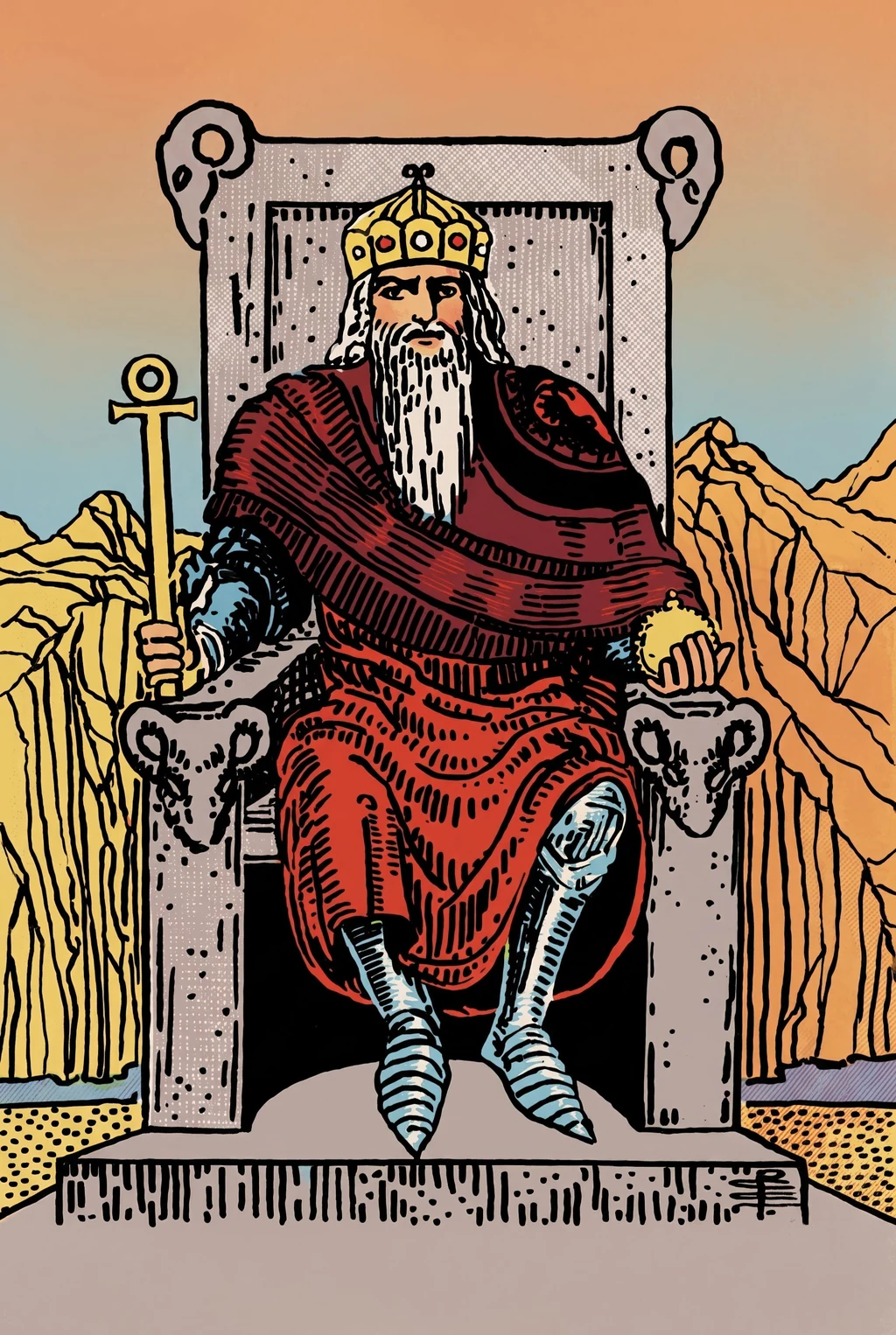
The Emperor remains in armor even on his throne. It is as though he is still on duty at an hour when someone else might already have set their weapons aside. In one hand is a scepter; in the other, a golden orb—a small world he can hold in his palm. Before the stark mountains, the ruler sits as though the final word belongs to him.
Waite associated his authority with bringing an idea into being. Here, a decision must take a form that can endure after the words have been spoken. The stone throne and armor lend weight to this role: to govern is to remain present for what you are responsible for. The Emperor's stillness holds a readiness to act. His red robes fall loosely over his knees, but the metal beneath remains visible.
Core meaning
The Emperor is associated with authority, order, and responsibility for what needs to be protected or built. He shows both the support that comes from dependable rules and the point where leadership becomes pressure.
- Key meanings:Authority
- Order
- Responsibility
- Protection
- Stability
- Self-discipline
- Key meanings:Excessive control
- Inflexibility
- Avoiding responsibility
- Weak leadership
- Resistance to rules
- Delegating authority
Image and symbols
Card image
A ruler with a long white beard sits on a gray stone throne. He faces the viewer. On his head is a golden crown with red accents; over his armor he wears red robes and a dark red cloak. His armored legs stand apart on the platform in front of the throne.
In his right hand, on the viewer's left, he holds a scepter with a loop and crossbar; in his left, on the viewer's right, a golden orb. Four ram heads adorn the upper corners of the throne's back and the front of its armrests.
Bare, rocky mountains rise behind the throne. A thin blue strip of water is visible at their base. The sky is orange.
Traditional context
For Waite, The Emperor embodies executive authority and the realization of an idea. His domain includes reason, will, and the governance of earthly affairs. Waite also speaks of the power of thought: reducing the card to a powerful boss or family patriarch would be too narrow.
Waite's divinatory list includes stability, protection, aid, reason, and conviction. His reversed meanings differ noticeably from common modern interpretations: alongside obstruction and immaturity are benevolence and compassion. This is a distinct historical interpretation, not another way of describing tyranny.
In contemporary RWS readings, structure and responsibility are especially important. The reversal often reveals two extremes: authority that suppresses others, or an absence of necessary leadership. A quieter meaning is possible, too: someone reconsiders their role and hands over authority. The Emperor and The Empress may represent different ways of caring and acting; their appearance together does not, by itself, establish a marriage.
Ruler seated on a throne
The father figure is associated with protection, responsibility, and setting rules.
Forward-facing posture and squared shoulders
A readiness to face a challenge directly and take a clear position.
Massive stone throne
Its solid, austere form emphasizes practical governance, where structure matters more than comfort or decoration.
Four ram heads on the throne
The ram refers to Aries and emphasizes drive, decisiveness, and a desire to lead.
Ankh-shaped scepter
The ankh is read as a symbol of life; in the ruler's hand, it is joined with the image of authority.
Orb in the left hand
The world under his rule: the earthly realm of authority and responsibility.
Crown
A sign of recognized authority and a position of leadership.
Armor beneath the robes
Readiness to defend one's position. In a modern reading, the armor can also suggest protection against emotional vulnerability.
Long white beard
Mature judgment and knowledge gained through experience.
Bare, rocky mountains
Firmness and resolve; their stillness also allows for a suggestion of resistance to change.
Narrow strip of water behind the throne
The emotional dimension remains part of the scene, though it does not define the ruler's outward appearance.
Colors
- Red — robes and cloak
Authority, passion, and forceful action. Here, red reinforces the figure's fiery character.
- Orange-red — sky and background
Reinforces the card's fire correspondence and its active, assertive character.
Meanings
The Emperor — Upright
General
Overall meaning
The Emperor describes a situation in which authority, order, and carrying out decisions matter. An idea takes shape: rules emerge, responsibilities are assigned, and someone takes responsibility for what happens.
The card is also associated with protecting what has already been built, capable assistance, and stability. It may represent your own ability to lead or the involvement of someone whose position and experience influence decisions.
Possible support
Experienced advice, clear rules, and the ability to follow through on a decision can help.
Possible difficulty
Rigidity can make it harder to hear objections and change an ineffective system. In an obstacle position, the card also allows another reading: the necessary rules or responsible leadership are not yet in place.
Focus
Check which facts support the decision and who is responsible for carrying it out. A confident tone is no substitute for knowing the work.
Reflection questions
- Where do I need clearer structure right now?
- Whose experience can I draw on without giving them the right to decide for me?
Relationships
Overall meaning
In a partnership, The Emperor is associated with serious commitments, reliability, and care expressed through actions. Shared plans and a division of household responsibilities may matter more than beautiful promises.
In family life, he represents protection and responsibility toward loved ones. In friendship, the card may point to an experienced adviser. Yet reliability does not remove the need for warmth: relationships grow restrictive when one person constantly decides for everyone else.
Possible support
Reliable participation in shared responsibilities and clear agreements support the connection. In friendship, thoughtful advice from someone familiar with the situation can offer grounding.
Possible difficulty
In a romantic relationship, the urge to organize everything can displace conversations about feelings. Difficulty arises when one person's sense of what is reasonable becomes a right to decide how both people live.
Focus
In a relationship, notice whether rules can be discussed as equals and whether there is room for emotional closeness.
Reflection questions
- What agreement would make our shared life clearer?
- How do I show care beyond solving practical problems?
Work and study
Overall meaning
At work, The Emperor represents competent leadership: a clear goal, workable rules, and responsibility for getting things done. It is also a card of professional authority and mastering a field well enough to make decisions and help others.
In professional training, the emphasis is on discipline and accumulated experience. In a project, the card may describe a manager, a mentor, or the need to bring scattered efforts into order.
Possible support
Mentorship and coordinated work provide support. When responsibilities are clear, people find it easier to work together.
Possible difficulty
A leadership role may demand more time and responsibility than it appears to from the outside. Another risk arises when authority is used for status rather than the shared work.
Focus
Before taking on a new responsibility, clarify its scope and assess your preparation. It helps to distinguish an interest in the work itself from a desire for the title.
Reflection questions
- Do I understand what I would be responsible for in this new role?
- Who can help me learn what I still need to know for this task?
Money and resources
Overall meaning
In money matters, The Emperor is associated with a clear budget, keeping track of obligations, and saving consistently. He may also describe material stability that has already been established. The main emphasis is on managing money and maintaining order.
Possible support
The habit of tracking expenses and sticking to a chosen financial plan provides support.
Possible difficulty
In an obstacle position, the upright Emperor may point to a lack of clear strategy: there is a financial goal, but no defined path to reach it.
Focus
Review income, expenses, and existing commitments. A plan needs to reflect the resources you actually manage.
Reflection question
Which recurring expenses have I not yet accounted for in my plan?
Wellbeing and self-care
Overall meaning
In everyday self-care, The Emperor is associated with consistency: routines and habits that have a place in your day. Structure helps make that care sustainable.
Possible support
A clear routine with time set aside for self-care can provide support.
Possible difficulty
When work carries significant responsibility, duties can take up time intended for personal life and rest. This particular nuance concerns the demands of a leadership role.
Focus
Consider whether the workload you have taken on leaves time outside your responsibilities.
Reflection questions
- What routine helps me care for myself consistently?
- Do I have time when I am not responsible for work matters?
Personal growth
Overall meaning
The Emperor is associated with the right to set your own rules and take responsibility for your choices. Inner stability grows from experience, judgment, and the ability to follow through on a decision, not only from an authority figure's approval.
Possible support
Acknowledging what your own experience has already taught you can provide support. Not every new decision requires you to prove yourself all over again.
Possible difficulty
Confidence becomes inflexibility when someone stops revisiting their judgments and recognizing other people's independence.
Focus
Consider why you want authority over your own life: to carry out your decisions, or to keep proving your worth to others.
Reflection questions
- What personal rule do I want to follow consciously?
- Where has my experience already given me reason to trust my judgment?
The Emperor — Reversed
General
Overall meaning
With the reversed Emperor, authority and responsibility fall out of balance. In one case, there is too much control: decisions are imposed, rules go unchallenged, and others' independence is restricted. In another, necessary leadership is missing: responsibility is passed around, agreements are not honored, and order never takes shape.
The card may also describe resistance to someone else's authority or a reassessment of your own role. One possible reading involves voluntarily handing over authority after completing the work, rather than suffering a defeat.
Waite's divinatory list also offers a benevolent nuance: the reversed card is associated with benevolence and compassion.
Possible support
It can help to reclaim the right to decide where you have given it up. At the opposite extreme, support comes from a willingness to share leadership with others.
Possible difficulty
An inflexible hierarchy, a struggle for control, or a lack of discipline can impede progress. These are different causes: increasing control will not solve a situation where pressure itself is the problem.
Focus
Distinguish what is missing now: the freedom to decide, a willingness to take responsibility, or the ability to stop managing everyone and everything.
Reflection questions
- Where do I need structure, and where am I trying to control too much?
- What responsibility can I genuinely take on?
Relationships
Overall meaning
In a relationship, the reversed Emperor may describe unequal power: one partner sets every rule, while the other loses independence. There may also be a lack of reliable involvement, with shared responsibilities left unattended.
In a family context, the card concerns control and fulfilling obligations to loved ones. In friendship, it may carry a narrower nuance: promised support may prove unreliable.
Possible support
In a relationship, openly discussing responsibilities and boundaries can help. In family life, support comes from actively attending to needs that have previously been neglected.
Possible difficulty
Closeness is hindered by struggles to have the final say, inflexible demands, and relationships where one person gives up their right to choose.
Focus
In a partnership, consider whose decisions are treated as binding and whether disagreements can be discussed without trying to dominate each other.
Reflection questions
- Can we discuss disagreements as equals?
- Which shared responsibility needs a clearer division?
Work and study
Overall meaning
At work, the reversal may suggest micromanagement and an inflexible hierarchy, or the opposite problem: poor organization, a lack of discipline, and unclear leadership. Sometimes a task requires experience you have not yet gained, or a position of responsibility has been accepted without sufficient preparation.
Another possibility is choosing to step down from leadership or hand over authority. In this context, the card does not call for reclaiming the former position at any cost.
Possible support
If the difficulty involves a new leadership role, training and support from more experienced colleagues can help. A lack of preparation does not need to be hidden behind rigidity.
Possible difficulty
Excessive approvals and oversight can deprive work of flexibility. With too little organization, on the other hand, plans stall for lack of discipline and direction.
Focus
Compare the expected responsibilities with your preparation and the actual workload. Also consider whether the way work is organized can change before assuming all forms of control are inevitable.
Reflection questions
- What do I need to learn to feel more capable in this role?
- Which approvals genuinely help the work, and which only delay it?
Money and resources
Overall meaning
In money matters, there may be two extremes: a lack of tracking and uncontrolled spending, or excessive frugality and one-sided control over finances. Another possibility is spending to maintain status.
Possible support
Comparing income with expenses and seeking knowledgeable help when the financial picture is difficult to understand can bring clarity.
Possible difficulty
Financial decisions lose coherence without records and a clear plan. The other extreme is rigid control, where frugality becomes an end in itself.
Focus
Check exactly where the imbalance lies: is money not being tracked, or have restrictions become excessive? Different extremes call for different considerations.
Reflection questions
- Do I understand where my money goes?
- Is there an expense I restrict so severely that I should reconsider the rule itself?
Wellbeing and self-care
Overall meaning
In matters of well-being, the reversed Emperor may reflect the strain of constant control and difficulty relaxing. Even outside work, your attention stays occupied with responsibilities.
Another reading concerns a disrupted routine: daily self-care gives way to other demands, leaving no room for familiar activities.
Possible support
If you are overloaded, a pause and a reassessment of your work rhythm may help. If your routine has fallen apart, returning to familiar forms of self-care can provide support.
Possible difficulty
Trying to anticipate everything can take over your time for rest as well. In this reading, tension is sustained not only by the volume of work but also by the inability to stop overseeing it.
Focus
Distinguish two situations: rest is repeatedly interrupted by thoughts of obligations, or there is no room for self-care in your routine at all. These are different aspects of a disrupted routine.
Reflection questions
- What keeps me from setting work thoughts aside when I rest?
- Is there a familiar form of self-care that no longer has a place in my day?
Personal growth
Overall meaning
The reversed Emperor may describe dependence on someone else's approval or demands you continue to obey out of habit. In another version, every rule is rejected, even those needed to pursue your own goals.
Inner change involves distinguishing these situations: reclaiming your independence is not the same as rejecting responsibility. A separate interpretive nuance concerns an internalized harsh voice that continues to surface in self-criticism.
Possible support
Reconsidering outdated beliefs and reclaiming the right to make your own decisions can help. This does not require rejecting every form of help or every rule.
Possible difficulty
Independence is limited when someone else's approval becomes a prerequisite for choosing. Another imbalance arises when personal goals are left without consistent action.
Focus
Consider which rule genuinely serves your goals and which remains only because someone once demanded that you follow it.
Reflection questions
- Whose approval am I waiting for before making my own decision?
- Which rule do I follow out of habit without knowing why I still need it?
Roles in a spread
Position examples
A position gives the card a question, such as what helps or what gets in the way. That question shapes how you read its meaning.
The Emperor — Upright
Situation
The situation centers on leadership, rules, and implementing decisions. What matters is how authority is structured and what gives it legitimacy.
Influence
An authority figure, mentor, or established order may be influencing the situation. Their influence comes from experience, rules, and the right to make decisions.
Motivation
The motivation may be a desire to create a stable order, take on a leadership position, or gain recognition for your competence.
Support
Support may come from a capable ally or your own considered judgment. The Emperor connects help with experience and the ability to stand by a decision.
Obstacle
Overly rigid management may be the obstacle. In another positional reading, the card shows a lack of necessary structure: decisions are left without rules or someone accountable.
Focus of attention
The focus is on facts, competence, and responsibility for a decision. It is worth checking what lies behind a confident assertion.
Next step
Set out a course of action and take responsibility for the part of the work you can genuinely lead.
Possible development
If decisions are carried out consistently, the situation may move toward greater organization and the lasting realization of a plan.
The Emperor — Reversed
Situation
Leadership has become unstable: authority is either held too tightly or no one is performing the necessary leadership role.
Influence
External pressure may come from a controlling figure or an inflexible hierarchy. In another reading, poor advice may be complicating matters.
Motivation
The motivation may be fear of losing control: wanting to keep the right to decide even when the old structure no longer works.
Support
Reclaiming your independence and being willing to share authority rather than keeping all control in one person's hands may help.
Obstacle
The obstacle involves leadership that is not working: pressure, disorder, inflexible rules, or a refusal to take responsibility for results.
Focus of attention
Distinguish authority from responsibility: who makes decisions, who fulfills obligations, and how well do the two match?
Next step
Reconsider the approach to leadership. Where everything depends on pressure, share decisions; where efforts are scattered, establish a clear structure.
Possible development
If excessive pressure continues, authority may weaken to the point of losing a leadership position. This trajectory applies to the rigid-control scenario, not every reversed reading.
Combination examples
Card combinations are in development. For now, here are a few examples.
The Emperor + The Empress
The Emperor ( upright) + The Empress ( upright)
- Example question:
- How can care for a shared undertaking be combined with organizing it?
- Example interpretation:
Care and growth meet rules and follow-through. The pair invites reflection on how to support a living process without leaving it without structure.
The Emperor + The Magician
The Emperor ( upright) + The Magician ( upright)
- Example question:
- What matters when moving from an idea to making it real?
- Example interpretation:
Initiative and practical ability gain organizational support. This combination centers on turning an idea into manageable action.
The Emperor + The Hierophant
The Emperor ( upright) + The Hierophant ( upright)
- Example question:
- What role do established rules play in the situation?
- Example interpretation:
Authority and order are reinforced by adherence to norms. The pair highlights institutional rules and an accepted code of conduct.
The Emperor + Three of Wands
The Emperor ( upright) + Three of Wands ( upright)
- Example question:
- How does leadership appear in a shared undertaking?
- Example interpretation:
The pair strengthens the theme of leadership: what matters is the ability to set direction and take responsibility for organizing the work.
The Emperor + Four of Pentacles
The Emperor ( upright) + Four of Pentacles ( upright)
- Example question:
- What is being kept under control in this situation?
- Example interpretation:
The combination heightens control and a desire to preserve the existing order. In a more rigid reading, holding on becomes excessive and is linked to fear of loss.
Reading example
An imagined one-card reading shows how the meanings above can apply to a question. This is one possible interpretation.
The Emperor — Upright
Situation:
You have been offered the chance to lead a team. The opportunity appeals to you, but until now you and your colleagues have interacted as equals, and it is not yet clear how expectations and responsibilities will change.
Question:
What should I consider before accepting?
-
Card drawn:
Imagine drawing a card for the position «What to Pay Attention To» and getting The Emperor (upright).
Interpretation:
The Emperor connects leadership with clear responsibility and knowing your work. Here, he invites you to look beyond the appeal of the title to the decisions you would have to make and what you would be accountable for to the team.
Before accepting, you could discuss the responsibilities, authority, and expected workload. That would help you see whether the work itself suits you, not just the title.
The Emperor — Reversed
Situation:
You have been offered the chance to lead a team. The opportunity appeals to you, but until now you and your colleagues have interacted as equals, and it is not yet clear how expectations and responsibilities will change.
Question:
What should I consider before accepting?
-
Card drawn:
Imagine drawing a card for the position «What to Pay Attention To» and getting The Emperor (reversed).
Interpretation:
The reversed Emperor invites you to consider the difference between having a title and being ready to lead. In this situation, uncertainty does not necessarily mean turning down the opportunity: it may point to responsibilities for which you still lack experience or support.
It helps to find out what training and assistance will be available. It is also worth discussing whether one person is expected to carry more responsibility than they can reasonably handle.
Yes / No
The Emperor — Upright
Why this answer
Yes. The Emperor connects a positive answer with a stable foundation, clear leadership, and the ability to put a decision into practice. This practical reading is especially relevant to questions about building, organizing, and strengthening something.
A clarification
The qualification concerns your own involvement: this 'yes' assumes a willingness to make decisions and follow a plan. It does not extend to the question, 'Will everything work out on its own?'
A question to consider
What responsibility would this 'yes' require of me?
The Emperor — Reversed
Why this answer
Probably not. In this practical reading, the reversed Emperor points to a course of action hindered by too much control or too little leadership. The necessary coordination has not yet come together.
A clarification
Do not rush to turn this answer into a decision. First, reconsider your chosen approach and the available options, especially if the steps ahead are unclear.
A question to consider
What should I reconsider about my chosen approach before deciding?
Correspondences
Connections with numbers, elements and other symbols add depth to the card’s imagery. They can differ between traditions.
Number — IV (4)
Four is associated with structure, consolidation, and stability. Its limiting side appears as inflexibility and confinement.
Element — Fire
The fire correspondence is connected with Aries, emphasizing active will, decisiveness, and drive.
Astrology — Aries
Decisiveness, initiative, and a readiness to lead. The ram heads provide a visible reference to the sign.
Letter — Heh (ה), 'window'
The image of a window is associated with clarity and understanding.
Letter — Tzaddi (צ)
Crowley assigns this letter to The Emperor in his revised arrangement of correspondences between The Emperor and The Star. The Emperor's link with Aries remains.
Tree of Life — Path 15: Chokmah — Tiphareth
The path connects Wisdom and Beauty, also understood as balance. The Emperor represents the stabilizing principle in this symbolic connection.