
The Fool
Descriptions and symbolism are based on the card’s classic illustration in the Rider–Waite–Smith deck. Details of the artwork may differ in other editions of the deck.
This guide brings together traditional and modern readings. Interpretations and answers may differ between authors and schools.
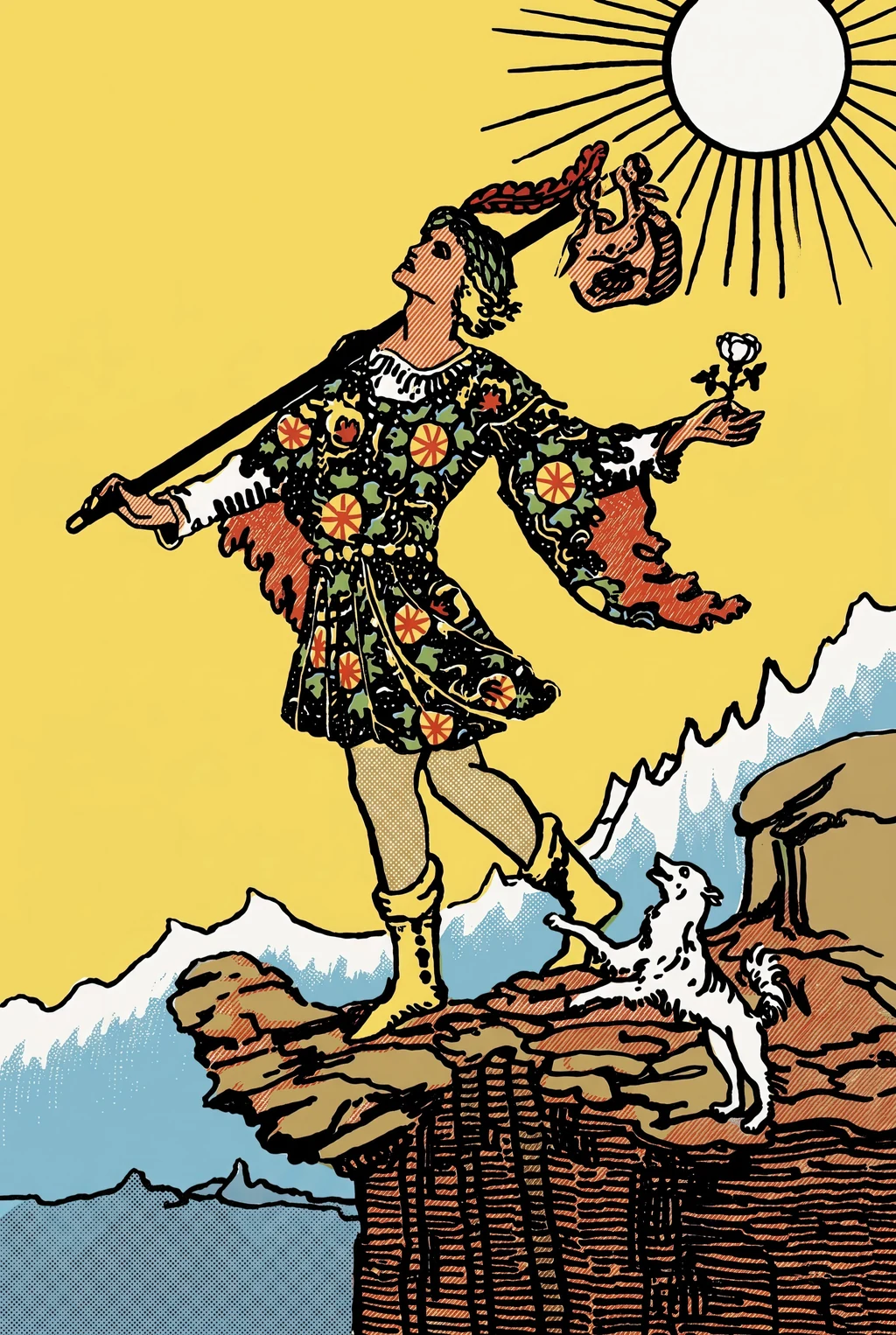
Waite portrayed the Fool as a wanderer from another world—a spirit who has come here in search of experience. He travels light: a small bag hangs over his shoulder, and he carries a white rose in his hand. His upturned face holds the anticipation of encountering things he has yet to discover. Everything around him could be a first.
At the cliff's edge, he pauses, his step still light, while the dog beside him continues to leap. Sunlight falls on this brief moment of stillness. The young man looks outward and upward, as though the unfamiliar world interests him more than the difficulties he may meet along the road. While his eyes are on the sky, solid ground ends almost at his toes.
Core meaning
The Fool is associated with beginnings, curiosity, and stepping into the unknown. The card reminds us that the freedom to try something new comes with a need to recognize real risks.
- Key meanings:New beginnings
- Freedom
- Spontaneity
- Curiosity
- Inexperience
- Courage
- Key meanings:Carelessness
- Unjustified risk
- Fear of change
- Delayed start
- Fear of mistakes
Image and symbols
Card image
At the edge of a cliff stands a young man in patterned clothing and a cap with a red feather. His face is turned to the viewer's left, chin raised, eyes looking upward.
In his left hand, on the viewer's right, is a white rose; his right hand holds a staff with a small bag slung over his shoulder. A white dog leaps at his feet.
Mountain peaks rise behind him, while in the upper right corner, against a yellow background, shines a white sun.
Traditional context
For Arthur Edward Waite, the Fool is a spirit in search of experience. He is not simply someone oblivious to danger: Waite describes an inwardly free wanderer turned toward the unknown. His fearlessness belongs to the symbolic image, not to a promise of protection in real life.
Yet Waite's list of divinatory meanings is markedly harsher: for the upright card, he gives recklessness and extravagance; for the reversed card, negligence, carelessness, apathy, and vanity. Even his own account resists the simple formula of “upright is good, reversed is bad.”
Modern authors often bring new beginnings, spontaneity, and freedom to the foreground. Their emphasis differs, though: Theresa Reed highlights the courage to embrace change, while Sergey Savchenko retains the images of a naive beginner and a trickster—a rule-breaker for whom play may matter more than responsibility.
A young man in ornate, patterned clothing
Waite sees him as a spirit still seeking life experience, rather than a portrait of a particular kind of person.
An upturned face and a gaze directed beyond the cliff's edge
For Waite, this gesture expresses anticipation of the unknown and an absence of fear toward it.
A white rose in his left hand
In a modern symbolic reading, the rose represents innocence and purity of intention.
A white dog leaping beside his feet
Two common readings: a warning of danger, or a loyal companion encouraging him onward.
A small patterned bag at the end of a staff
Waite associates its indistinct markings with memories held deep within the soul.
A staff carried over his shoulder
In one modern reading, the staff is a wand: a connection to magical power the traveler has not yet learned to use consciously.
The precipice ahead of the figure
The boundary between the familiar and the unknown; new experience requires moving beyond familiar limits.
Mountain peaks in the background
In a modern reading, the mountains represent challenges still to be encountered.
The sun in the background
In a modern reading, the sun is linked to a love of life, vitality, and openness to the new. Waite connects it with the traveler's origins and the road ahead.
Colors
- White — the rose in his hand
Purity of intention and innocence: the traveler is open to experiences that have not yet changed his view of the world.
- Red — the feather in his cap
Vitality, inspiration, and a readiness to follow an inner impulse.
Meanings
The Fool — Upright
General
Overall meaning
The beginning of a new chapter, a change of direction, or a journey whose outcome is not yet known. The Fool combines courage and spontaneity with inexperience: there is still much to learn firsthand.
Possible support
Curiosity and a willingness to learn help you find your footing where past experience is not enough.
Possible difficulty
Not knowing the dangers can be mistaken for self-confidence, leading you to begin without the preparation you need.
Focus
Gaps in your knowledge: what only seems clear so far, and where someone else's experience could help.
Reflection questions
- What new possibility sparks my curiosity right now?
- What don't I know yet about what I'm planning?
Relationships
Overall meaning
When getting to know someone romantically, the Fool suggests ease and an open-ended connection: interest may already be there, while serious commitments have yet to be defined.
In friendships and family relationships, another reading concerns the influence of loved ones: their bold decision may prompt you to reconsider your own plans.
Possible support
In an established relationship, a new shared interest or experiences together can bring you closer.
Possible difficulty
A lighthearted approach becomes difficult when it masks avoidance of agreements and shared responsibility in a relationship.
Focus
With someone new, whether fear of rejection is leading you to withdraw before you've even tried to connect.
Reflection questions
- What do I want from a new connection beyond enjoyable conversation?
- What would we like to try together?
Work and study
Overall meaning
A new job, career, or project where much has to be learned for the first time. Sometimes the change happens within familiar work: a fresh idea emerges, along with a desire to try another approach.
Possible support
Flexibility, creativity, and a willingness to experiment are useful when there is no established way of working yet.
Possible difficulty
Enthusiasm for an opportunity can run ahead of an understanding of its complexity and practical consequences at work.
Focus
New possibilities in your current work: you don't necessarily have to change everything to make a different start.
Reflection questions
- What would I like to learn to do for the first time at work?
- What new idea would I like to put into practice?
Money and resources
Overall meaning
Money may be seen primarily as a way to have a new experience: traveling somewhere or learning something new. Another reading is earning money for the first time in an unfamiliar field, where income is still unpredictable.
Possible support
A willingness to change your approach can help, as long as you remain aware of the risks you can accept.
Possible difficulty
It's easy to mistake optimism for careful planning and underestimate future expenses.
Focus
Not only the appeal of a new venture, but also the financial obligations that follow from it.
Reflection questions
- What expenses will follow the initial purchase or payment?
- What do I know about the income this new venture could bring?
Wellbeing and self-care
Overall meaning
The Fool is associated with lightness, curiosity, and a break from constant seriousness. This reading makes room for play and for enjoying an activity simply for its own sake.
Possible support
Humor and the ability to let yourself be less than perfectly composed in every situation.
Possible difficulty
Fear of the new and self-doubt.
Focus
Whether everyday life still has room for play, laughter, and activities done purely for pleasure.
Reflection question
What activity brings me joy in itself?
Personal growth
Overall meaning
New experiences help you get to know yourself without reducing your life to a familiar role. You don't have to prove in advance that an activity fits your image of yourself.
Possible support
Giving yourself permission to choose your own direction, even when it looks unusual to others.
Possible difficulty
Wanting to always appear knowledgeable makes it harder to learn something you have no experience with yet.
Focus
How much your choice reflects your own interests rather than a desire to look right in other people's eyes.
Reflection questions
- What would I like to try, even though I don't know how to do it yet?
- What am I turning down only because someone might laugh at me?
The Fool — Reversed
General
Overall meaning
The Fool reversed can describe two different extremes: taking a hasty step without considering the consequences, or standing still out of fear of the unknown. In the first, freedom becomes carelessness; in the second, the desire to control everything prevents a beginning.
There is also a quieter modern reading: a new idea remains private for now and is not yet ready to be shared with others.
Possible support
Taking time to gain knowledge and experience before entering a situation you don't yet understand well enough.
Possible difficulty
The desire to preserve familiar stability can block even changes that genuinely interest you.
Focus
Which is stronger: underestimating the risks or fearing any unfamiliar outcome.
Reflection questions
- What consequences am I not considering yet?
- What's holding me back: a lack of knowledge or fear of beginning itself?
Relationships
Overall meaning
In a relationship, the Fool can point to inconsistency and avoidance of serious agreements. Another possibility is excessive caution that makes it hard to open up to someone else.
In friendships and family relationships, a separate reading concerns a loved one's repeated carelessness, which creates tension, especially when past mistakes go unheeded.
Possible support
When fear of opening up gets in the way, a conversation in which both people can express their feelings may help.
Possible difficulty
Avoiding practical matters leaves one person carrying more of the shared responsibility.
Focus
Which shared responsibilities and conversations about the future keep getting postponed.
Reflection questions
- Is there an agreement between us that I find difficult to keep?
- What would I like to talk about but feel afraid to open up about?
Work and study
Overall meaning
A rushed start, disorganized decisions, and an underestimation of how demanding the work will be. The opposite scenario is also possible: your work has stopped developing, but trying something different feels frightening.
Elliot Adam also associates this card with the fear of revealing what you don't know, whether at work or in a subject you're studying.
Possible support
Identify what you actually need to learn instead of trying to conceal every gap in your knowledge.
Possible difficulty
Lack of preparation and chaotic decisions make it difficult to honor commitments at work.
Focus
How hasty decisions affect colleagues and the work you do together.
Reflection questions
- What do I need to learn to complete this task?
- How will my decision affect the people I work with?
Money and resources
Overall meaning
Unplanned spending, errors in calculations, and expectations unsupported by preparation. Another possibility is that earnings have stagnated because fear of change makes it difficult to consider a different approach.
Possible support
Revisit your financial plans based on what's realistically possible, not just what you hope for.
Possible difficulty
Impulse purchases can add up to more than you planned to spend.
Focus
The terms of a new financial decision that are still unclear but matter when assessing the risk.
Reflection questions
- Which recent purchases were unplanned?
- What is my estimate of future income based on?
Wellbeing and self-care
Overall meaning
For Elliot Adam, the Fool reversed is linked to feeling lost in the unknown and overwhelmed by everything happening around you. This describes an experience, not a conclusion about health.
Possible support
In one modern reading, a source of support is playing on your own, without feeling the need to perform for others.
Possible difficulty
Fear of making mistakes and constant self-judgment create tension before you've even tried.
Focus
Making room for play in an ordinary day, even when you're by yourself.
Reflection question
What do I enjoy doing on my own, free from others' judgment?
Personal growth
Overall meaning
Familiar beliefs can keep you in place even when a new direction already appeals to you. Fear of appearing inexperienced turns the beginning into a test of your worth.
Possible support
Learning from mistakes without treating each one as proof that you're incapable.
Possible difficulty
Refusing to change until you're completely certain leaves little room for new experience.
Focus
Whether a sudden desire aligns with your goals and beliefs, or rests only on your initial excitement.
Reflection questions
- What belief is keeping me from trying something new?
- What did a recent mistake teach me?
Roles in a spread
Position examples
A position gives the card a question, such as what helps or what gets in the way. That question shapes how you read its meaning.
The Fool — Upright
Situation
The old order is giving way to a new beginning. The direction is not yet settled, and much will become clear along the way.
Influence
An unexpected offer or the example of someone unafraid of change opens up an unfamiliar possibility.
Motivation
A desire for freedom, fresh experiences, and a chance to discover something not yet part of your life.
Support
A willingness to ask questions and learn, without pretending to know everything already, can help.
Obstacle
A lack of preparation becomes an obstacle; sometimes the very prospect of entering the unknown brings hesitation.
Focus of attention
Whether the desire to avoid others’ disapproval is taking the place of your own choice.
Next step
Try a new direction with a willingness to learn, without expecting to know the entire future in advance.
Possible development
The situation may develop into a new chapter rather than a final resolution; its eventual shape is still undefined.
The Fool — Reversed
Situation
A beginning is delayed by fear, or it happens too hastily, without an understanding of the consequences.
Influence
Other people's poorly considered decisions or the carelessness of those around you may disrupt plans and create more uncertainty.
Motivation
A refusal to begin may come from wanting to control the entire outcome in advance.
Support
Having the option to step back and prepare can help, without clinging to an earlier decision at any cost.
Obstacle
A need for things to remain unchanged makes it hard to accept the uncertainty that comes with any new beginning.
Focus of attention
Whether you're ignoring warnings for the sake of feeling free—or whether fear has already begun to limit your freedom.
Next step
If you're underprepared, pause and find out what you've missed rather than repeating a hasty step.
Possible development
If haste continues, the transition into something new may become chaotic. If fear of making a mistake dominates, progress may stop before the first attempt.
Combination examples
Card combinations are in development. For now, here are a few examples.
The Fool + The Magician
The Fool ( upright) + The Magician ( upright)
- Example question:
- What will help give a new beginning a clear shape?
- Example interpretation:
In this reading, the Fool's courage meets the Magician's skills and resources: wanting to begin is not enough without putting them to use consciously.
The Fool + Temperance
The Fool ( upright) + Temperance ( upright)
- Example question:
- How can a new connection develop without rushing?
- Example interpretation:
In this reading, the pair suggests a gradual deepening of the connection: the Fool's openness is balanced by Temperance's patience and unhurried pace.
The Fool + The Star
The Fool ( upright) + The Star ( upright)
- Example question:
- What inner source of support deserves attention?
- Example interpretation:
For Joan Bunning, the Fool and the Star reinforce their shared themes of innocence, faith, and trust. This pairing emphasizes openness.
The Fool + The Hierophant
The Fool ( upright) + The Hierophant ( upright)
- Example question:
- How does the desire to try something new relate to established rules?
- Example interpretation:
Joan Bunning places the Hierophant among the cards that oppose the Fool: spontaneity meets accepted rules and established ways of doing things.
Reading example
An imagined one-card reading shows how the meanings above can apply to a question. This is one possible interpretation.
The Fool — Upright
Situation:
I want to change careers. The new field interests me, but it's hard to face being a beginner again.
Question:
How should I approach this change?
-
Card drawn:
Imagine drawing a card for the position «Approach to change» and getting The Fool (upright).
Interpretation:
The Fool connects this change with a willingness to be a beginner. Here, the card offers a way to see a lack of experience as part of starting something new, rather than a reason to rule it out before trying.
You can explore the work firsthand and find out what you would need to learn before making a final decision.
The Fool — Reversed
Situation:
I want to change careers. The new field interests me, but it's hard to face being a beginner again.
Question:
How should I approach this change?
-
Card drawn:
Imagine drawing a card for the position «Approach to change» and getting The Fool (reversed).
Interpretation:
The Fool reversed highlights the fear of showing what you don't know. In this situation, it's important to distinguish a genuine lack of preparation from the expectation that you should understand everything right away.
You can find out what knowledge the new job requires and begin building it. Then your decision can rest on more than a fear of looking inexperienced.
Yes / No
The Fool — Upright
Why this answer
The Fool upright suggests “Yes.” Its meaning centers on openness, trust, and a willingness to embrace a new opportunity, tilting the answer toward the positive.
A clarification
This “Yes” does not mean acting blindly. The Fool is also associated with inexperience. If the question concerns a choice you’re making, consider what you know about the possible consequences before agreeing.
A question to consider
What do I need to learn before I decide?
The Fool — Reversed
Why this answer
The Fool reversed suggests “No.” Here, openness to the new gives way to carelessness or fear: haste and lack of preparation, or fear of change, stand in the way of progress.
A clarification
If your question concerns an action you’re considering, this “No” can be read as “not now, or not this way.” Consider what’s holding you back: a lack of preparation or fear. That may help you reconsider your decision, but it does not mean the answer will automatically become “Yes.”
A question to consider
Am I unprepared, or am I afraid to try?
Correspondences
Connections with numbers, elements and other symbols add depth to the card’s imagery. They can differ between traditions.
Number — 0
Zero represents potential that has not yet taken shape: experience and clarity are still to come.
Element — Air
Air is associated with spirit and the breath of life. This is a correspondence within a symbolic system, not a description of the personality of everyone who draws the card.
Astrology — Uranus
This association emphasizes unconventional choices and moving beyond familiar boundaries; it does not establish the timing of an event or someone's zodiac sign.
Letter — Aleph — א, “ox”
The first letter of the alphabet corresponds here to Air. Its numerical value, one, does not replace the zero on the card itself.
Tree of Life — 11th path: Kether — Chokmah
The connection between original, undivided potential and the first impulse toward its expression. Kether and Chokmah are names for two spheres within this symbolic framework.