
Justice
Descriptions and symbolism are based on the card’s classic illustration in the Rider–Waite–Smith deck. Details of the artwork may differ in other editions of the deck.
This guide brings together traditional and modern readings. Interpretations and answers may differ between authors and schools.
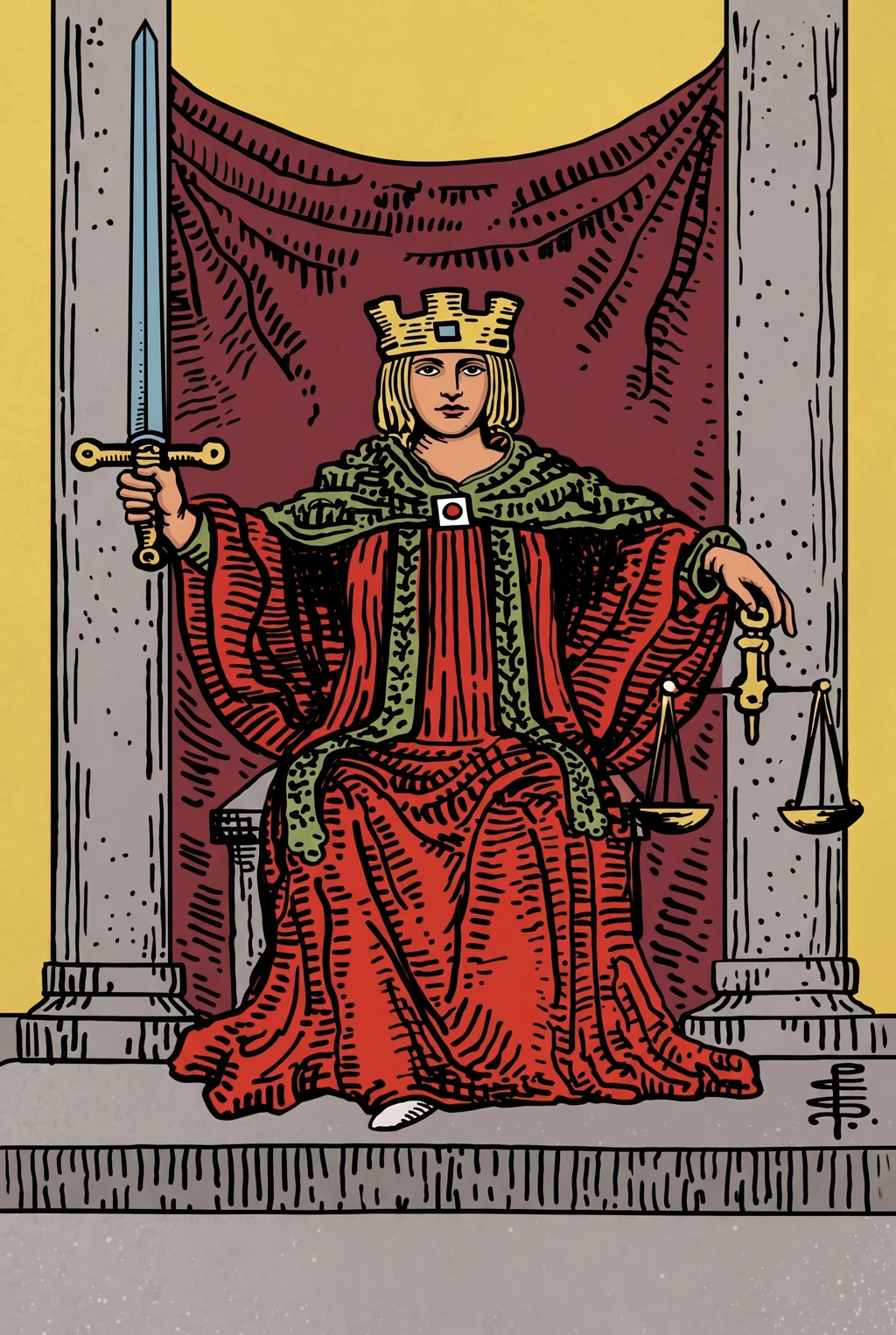
Justice receives a person along with all they have done. She sits upright, her gaze open; the scales in her hand still leave room for careful consideration. Before this throne, a story of good intentions must stand up to comparison with actual deeds. Waite associated the card with a moral measure by which each person receives what their actions warrant.
A sword is raised in her other hand. It is not poised to strike, but neither has it been set aside: a decision must carry weight. The same figure who weighs the evidence is ready to carry out the verdict. This makes her composure particularly demanding: before lowering the sword, she must carefully consider what rests on the scales.
Core meaning
Justice connects choices with their consequences. It draws attention to honesty, equal treatment, and responsibility: what happened, how should it be assessed, and what decision can be justified?
- Key meanings:Justice
- Honesty
- Responsibility
- Cause and effect
- Well-founded decision
- Law
- Key meanings:Bias
- Injustice
- Avoiding responsibility
- Dishonesty
- Excessive severity
- Legal complications
Image and symbols
Card image
A crowned figure sits on a stone throne between two gray pillars. The face is turned toward the viewer, with eyes open. A green cloak covers a red robe; a white shoe is visible beneath the hem.
In the figure’s right hand, on the viewer’s left, a sword points upward. The left hand, on the viewer’s right, holds a two-pan balance. A square ornament is visible on the crown, and a clasp on the chest.
A purple curtain hangs behind the figure, with a strip of yellow background above it. The throne rests on a gray stepped base.
Traditional context
Waite understands Justice as the moral measure of our actions: each person is judged according to what they have done. He distinguishes this principle from spiritual grace, which cannot be calculated as a deserved reward.
In his list of divinatory meanings, the upright card represents justice, fairness, integrity, and the execution of a decision. He also specifically mentions success for the deserving party in a legal case. His reversed meanings go beyond the familiar “dishonesty” to include legal matters, legal complications, prejudice, and excessive severity.
Modern readings add the need to examine our own judgments and accept responsibility. Personal agency, however, does not erase external circumstances or systemic injustice.
In RWS, Justice is numbered XI, while in the Tarot de Marseille it is usually VIII. In the Thoth Tarot, Crowley uses the title “Adjustment”: his emphasis is on the precise restoration of balance rather than a human moral verdict.
A figure holding a sword and scales
The personification of Justice: weighing actions and the authority to render a decision.
Scales in the figure’s left hand
Weighing both sides and judging impartially. In modern interpretations, the scales being held in the left hand are also associated with intuition balancing logic.
A sword in the right hand, point upward
Clarity of judgment and resolve after careful thought. The double-edged blade is also read as a reminder that actions have consequences.
Square ornament on the crown
Ordered thought, essential to sound judgment.
Two pillars flanking the throne
Measure, law, and stable order. Waite compares them to the pillars of the High Priestess, but places Justice in the realm of moral affairs and the High Priestess in a different realm of understanding.
Stone throne
In modern interpretations, it emphasizes restraint: a decision rests on examining the facts rather than an emotional impulse.
A shoe visible beneath the robe
In modern symbolic readings, it serves as a reminder that actions have moral and spiritual consequences as well.
Colors
- Red: the main robe
Red can suggest passion and determination to defend what is just.
- Green: cloak over the red robe
In modern readings, this color can represent love and compassion, tempering strictness with a sense of proportion.
- Purple: curtain behind the figure
In modern interpretations, it can represent compassion, or the wisdom and authority of the one passing judgment.
- Yellow: background above the curtain
This detail can be read as an image of the mental effort needed to reach a fair decision.
- White: shoe beneath the hem
In modern readings, it can emphasize purity of intention in passing judgment.
Meanings
Justice — Upright
General
Overall meaning
Justice describes a moment when actions are weighed against their consequences and a decision calls for clear grounds. Honesty, accountability, equal standards, and a willingness to acknowledge your part come to the forefront.
This may involve an agreement, a dispute, a review, or an important choice. A fair decision will not necessarily suit everyone: the card draws attention to whether the judgment is well founded, not just whether the outcome is desired.
Possible support
Impartiality and a willingness to acknowledge what truly depends on your actions can help. This opens the way to discussing how to put things right rather than simply looking for someone to blame.
Possible difficulty
The challenge may lie in facing the consequences of an earlier choice and making a difficult but proportionate decision.
Focus
The grounds for your judgment: what you know firsthand and what comes from rumors or assumptions.
Reflection questions
- What facts am I considering in my decision?
- What part of this situation am I responsible for?
Relationships
Overall meaning
In a relationship, this card concerns reciprocity and fair agreements. Both partners’ contributions, respect for each other’s feelings, and a willingness to take responsibility for their actions matter.
Another reading involves formal commitments, including a prenuptial agreement. Here the focus shifts to how the union is formalized and what obligations each person accepts.
Possible support
A willingness to discuss differences respectfully and seek compromise supports the relationship more than trying to prove you are right at any cost.
Possible difficulty
Defensiveness and resentment can displace a conversation about how responsibilities are actually shared. Even a discussion intended to be fair can then turn into an argument.
Focus
Reciprocity in actions and responsibility: are both parties held to the same standards?
Reflection questions
- How are our shared responsibilities divided?
- What in our agreements needs to be discussed openly?
Work and study
Overall meaning
At work, Justice concerns the evaluation of contributions, professional integrity, and the review of disputed decisions. It brings the connection between what someone does and what they are responsible for into focus.
Another theme is acknowledging your own mistakes. Correcting an error openly can help maintain colleagues’ trust; appearing flawless is not the same as being reliable.
Possible support
Being willing to acknowledge a mistake at work and take steps to correct it helps preserve trust.
Possible difficulty
Unfair workplace practices and unequal terms of collaboration can stand in the way of progress, even when the question concerns the upright card.
Focus
The integrity of your professional conduct and how responsibility is shared in a dispute.
Reflection questions
- How is my contribution evaluated within our shared work?
- What mistake at work can I correct openly?
Money and resources
Overall meaning
In financial matters, Justice concerns fair exchange. Terms of a deal, payments, and the distribution of funds are considered in light of everyone’s interests, not just personal gain.
The card can also relate to reconciling accounts and keeping track of financial obligations.
Possible support
Transparent and fair accounting can support financial stability.
Possible difficulty
Unequal financial terms or dishonest ways of seeking profit complicate the situation.
Focus
The balance between what you receive and what you give, as well as the other party’s interests in financial agreements.
Reflection question
Am I considering both parties’ interests in this financial agreement?
Wellbeing and self-care
Overall meaning
In everyday self-care, this card relates to an honest assessment of your habits. Sleep, nutrition, and how you handle stress come into focus: how thoughtfully do you treat your own body?
Possible support
An honest look at your habits and an understanding of what helps you maintain balance can provide support.
Possible difficulty
Focusing on one area of life can leave little room for rest and other needs.
Focus
Whether you get enough sleep, your approach to nutrition, and how you manage stress.
Reflection question
How do I make room for sleep and rest in an ordinary day?
Personal growth
Overall meaning
The card concerns clarifying your beliefs about truth and justice. Familiar certainties may need reconsideration: being honest with yourself includes recognizing where your view has been too simple.
Growth here means making more conscious choices and accepting their consequences, not trying to appear incapable of mistakes.
Possible support
Your inner ethical compass can help you make a decision for which you are willing to take responsibility.
Possible difficulty
Your ideas about what is right may be less clear-cut than you thought. This calls for reconsidering a belief rather than simply finding convenient evidence to support it.
Focus
Whether your everyday actions align with the principles you consider your own.
Reflection questions
- Which of my beliefs am I testing in practice right now?
- Do my actions align with what I consider fair?
Justice — Reversed
General
Overall meaning
Reversed Justice points to an imbalance in judgment. This may involve dishonesty, refusing responsibility for your actions, or making a decision with incomplete information. Another possibility is that someone is being treated unfairly and the rules in place do not provide equal conditions.
The card also relates to prejudice and excessive severity. Sometimes the harsh judgment is turned inward: a single mistake becomes grounds for relentless self-blame. These are distinct readings; injustice from outside does not, in itself, imply personal fault.
Possible support
Being able to acknowledge and correct a specific mistake can help. Self-compassion makes this possible without passing a merciless judgment on yourself.
Possible difficulty
Dishonesty and an unequal distribution of responsibility make the situation harder to understand. Unfair treatment, not just your own behavior, may be the obstacle.
Focus
Bias in the assessment and missing information needed for a decision that affects others.
Reflection questions
- What part of my judgment still needs to be checked?
- Where does my responsibility end and someone else’s begin?
Relationships
Overall meaning
A relationship may involve unequal responsibilities, dishonesty, or a habit of blaming the other person for all the tension. The conversation then centers on accusations, while each partner’s part in the relationship goes unexamined.
In Florence Saul’s interpretation of family life, the card may also suggest reconsidering an established order when making your own choice requires discussing uncomfortable questions. This is a separate reading concerned with independence within the family.
Possible support
Speaking openly about where reciprocity has broken down can help you look for a solution. In a relationship, this means acknowledging your share of responsibility without taking the blame for everything.
Possible difficulty
Unresolved disagreements and dishonest treatment sustain the rift. Wanting to repair the relationship does not, by itself, remove unequal conditions.
Focus
Your own part in a recurring argument: what can you acknowledge, and what is easier to attribute entirely to your partner’s behavior?
Reflection questions
- What do we keep arguing about without changing the underlying conditions?
- Am I placing all the responsibility for this argument on one person?
Work and study
Overall meaning
The reversed card can point to unfair treatment at work: someone else’s mistake is blamed on you, your contribution is judged with bias, or a working relationship rests on dishonest terms.
Another possibility concerns your own mistake, which you may be trying to hide or shift onto colleagues. These situations should not be confused: one calls for addressing someone else’s unfairness, the other for taking responsibility for your own actions.
Possible support
Explaining your position calmly and directly helps avoid escalating a conflict. If the mistake was yours, learning from it and changing your approach is more useful than continuing to hide it.
Possible difficulty
Concealing mistakes erodes trust and makes it harder to learn from experience. Reacting angrily to an unfair conflict can also make matters worse.
Focus
The difference between what you are accused of and what you are actually responsible for at work.
Reflection questions
- What part of this mistake at work am I responsible for?
- How can I explain my position without making accusations in return?
Money and resources
Overall meaning
In financial matters, the card can point to misleading information, unfair accounting, or an imbalance in an exchange. It is important to distinguish your own dishonesty from unequal terms offered by someone else.
Possible support
Complete, verified information helps you consider a financial offer without placing trust in it too quickly.
Possible difficulty
Dishonest transactions and unequal financial terms can undermine financial stability.
Focus
The accuracy of financial information provided and your own honesty in handling money.
Reflection question
Do I know all the terms of this financial offer?
Wellbeing and self-care
Overall meaning
In emotional life, the card may appear as harsh self-judgment: attention keeps returning to mistakes, guilt, or shame. This differs from calmly acknowledging a specific error.
Possible support
Self-compassion and permission to make mistakes can soften harsh self-criticism.
Possible difficulty
Constantly judging your every move can turn a small misstep into another reason for self-blame.
Focus
The tone of your inner judgment: how harshly do you treat yourself after a mistake?
Reflection question
How do I speak to myself after making a mistake?
Personal growth
Overall meaning
Reversed Justice can point to a gap between beliefs and actions. Sometimes an uncomfortable mistake is already clear, but acknowledging it is delayed to preserve a familiar self-image.
There is room to reconsider: responsibility becomes useful when it leads to making amends, rather than endlessly defending your position.
Possible support
Acknowledging and correcting a mistake allows you to learn from experience and make more conscious decisions.
Possible difficulty
Fear and the need to defend your position can make it harder to see what an unpleasant experience has to teach.
Focus
Your reason for revisiting the situation: to understand it or to preserve the sense that you were right.
Reflection questions
- What can I put right by acknowledging my mistake?
- What matters more to me right now: understanding what happened or being right?
Roles in a spread
Position examples
A position gives the card a question, such as what helps or what gets in the way. That question shapes how you read its meaning.
Justice — Upright
Situation
The situation calls for evaluating actions, determining responsibility, or making a well-founded decision.
Influence
Past decisions continue to shape the present. Their consequences become part of the circumstances you now face.
Motivation
A desire to find the truth and understand what decision would truly be fair may be at work.
Support
Impartiality and acknowledging your responsibility can help restore fairness where it has been lost.
Obstacle
The difficulty lies in the consequences of an earlier choice that must be acknowledged before moving forward.
Focus of attention
The facts behind the judgment: an unverified account should not quietly become the basis for a decision.
Next step
Consider how your choice will affect everyone involved, and make a decision you can take responsibility for.
Possible development
In a position pointing toward what lies ahead, the card can suggest clarifying a dispute and moving toward a decision grounded in the parties’ actual actions and obligations.
Justice — Reversed
Situation
The balance of judgment is disturbed: facts may be weighed unequally, responsibility is contested, or a decision is made without enough clarity.
Influence
Other people’s biases or unfair rules beyond your control may be influencing the situation.
Motivation
The desire to avoid admitting a mistake or to be right at all costs may overshadow the search for truth.
Support
Correcting a specific mistake and treating yourself more fairly may help you regain the ability to act with awareness.
Obstacle
Dishonesty, unequal responsibility, or unfair treatment is blocking progress. The source of the imbalance may be external.
Focus of attention
Biases hidden in your own assessment and missing information that could change the decision.
Next step
If the grounds for a decision are unclear, do not rush it. Return to the options and examine them more carefully.
Possible development
If bias persists, a decision may be delayed or remain unfair. New information can complicate the review rather than resolve the dispute immediately.
Combination examples
Card combinations are in development. For now, here are a few examples.
Justice + The Emperor
Justice ( upright) + The Emperor ( upright)
- Example question:
- How do rules affect the resolution of our dispute?
- Example interpretation:
The pairing strengthens the themes of rules and responsibility. The Emperor establishes structure and authority; Justice connects actions with how they are judged.
Justice + Judgement
Justice ( upright) + Judgement ( upright)
- Example question:
- What matters when reviewing an earlier decision?
- Example interpretation:
Together, these cards highlight looking back at the past, acknowledging mistakes, and the need to make a decision.
Justice + Seven of Pentacles
Justice ( upright) + Seven of Pentacles ( upright)
- Example question:
- What should I reconsider about the direction I have chosen?
- Example interpretation:
The combination links fair assessment with reviewing how far you have come: where you have arrived and whether a change of direction is called for.
Justice + The High Priestess
Justice ( upright) + The High Priestess ( upright)
- Example question:
- How can I bring careful thought and inner understanding together before deciding?
- Example interpretation:
The pair brings reasoning together with inner understanding. When looking for a fair decision, you can consider both verifiable arguments and what becomes clearer through attentive self-reflection.
Reading example
An imagined one-card reading shows how the meanings above can apply to a question. This is one possible interpretation.
Justice — Upright
Situation:
A couple keeps arguing about household chores. Responsibilities have been divided by habit, and now it is unclear how to agree on a new arrangement without blaming each other.
Question:
How can we fairly revisit our agreements?
-
Card drawn:
Imagine drawing a card for the position «What will help us reach an agreement» and getting Justice (upright).
Interpretation:
Justice invites you to look at how responsibilities are actually divided. Here, an argument over who does more can become a conversation about specific tasks and what each person sees as an equal contribution.
One possible step is to calmly explain what no longer works, listen to the other person, and discuss new terms both can understand.
Justice — Reversed
Situation:
A couple keeps arguing about household chores. Responsibilities have been divided by habit, and now it is unclear how to agree on a new arrangement without blaming each other.
Question:
How can we fairly revisit our agreements?
-
Card drawn:
Imagine drawing a card for the position «What will help us reach an agreement» and getting Justice (reversed).
Interpretation:
Reversed Justice draws attention to blame and unequal responsibility. It is worth noticing whether a discussion about household chores is becoming an attempt to hold one person responsible for everything.
You can begin by acknowledging your part in the disagreement and naming the specific imbalance you want to change. This leaves room to talk about responsibilities rather than passing a sweeping judgment on each other.
Yes / No
Justice — Upright
Why this answer
“Yes” is associated with honest and fair actions; “no” with dishonest conduct. Justice connects the answer to what led to the question, so wanting a particular outcome is not enough on its own.
A clarification
The condition behind the answer concerns actions taken in the situation at hand. Consider how honest and fair the actions that gave rise to the question have been.
A question to consider
Which of my actions support the answer I hope for?
Justice — Reversed
Why this answer
“No.” Reversed Justice associates the negative answer with unfair conditions, dishonesty, or responsibility that has not been acknowledged.
A clarification
Unfair conditions need to be examined before moving forward. This may concern your own actions or dishonest treatment by someone else.
A question to consider
What unfair conditions are standing in the way of the outcome I want?
Correspondences
Connections with numbers, elements and other symbols add depth to the card’s imagery. They can differ between traditions.
Number — XI (11)
In RWS, this is Justice’s number. Modern numerological readings associate 11 with intuition and compare the symmetry of the two ones to the pair of pillars.
Element — Air
Emphasizes reason, discernment, and clarity of judgment. The association comes through the sign of Libra and the image of the sword.
Astrology — Libra
This correspondence emphasizes weighing both sides, proportion, and the search for balance.
Letter — ל — Lamed
The letter’s name translates as “ox goad,” a tool used to guide an ox. In correspondence tables, Lamed and Justice occupy the same row.
Tree of Life — Path 22: Geburah — Tiphareth
Connects Geburah, associated with strength, and Tiphareth, associated with beauty. The path is called “Faithful Intelligence” in the table.