
Wheel of Fortune
Descriptions and symbolism are based on the card’s classic illustration in the Rider–Waite–Smith deck. Details of the artwork may differ in other editions of the deck.
This guide brings together traditional and modern readings. Interpretations and answers may differ between authors and schools.
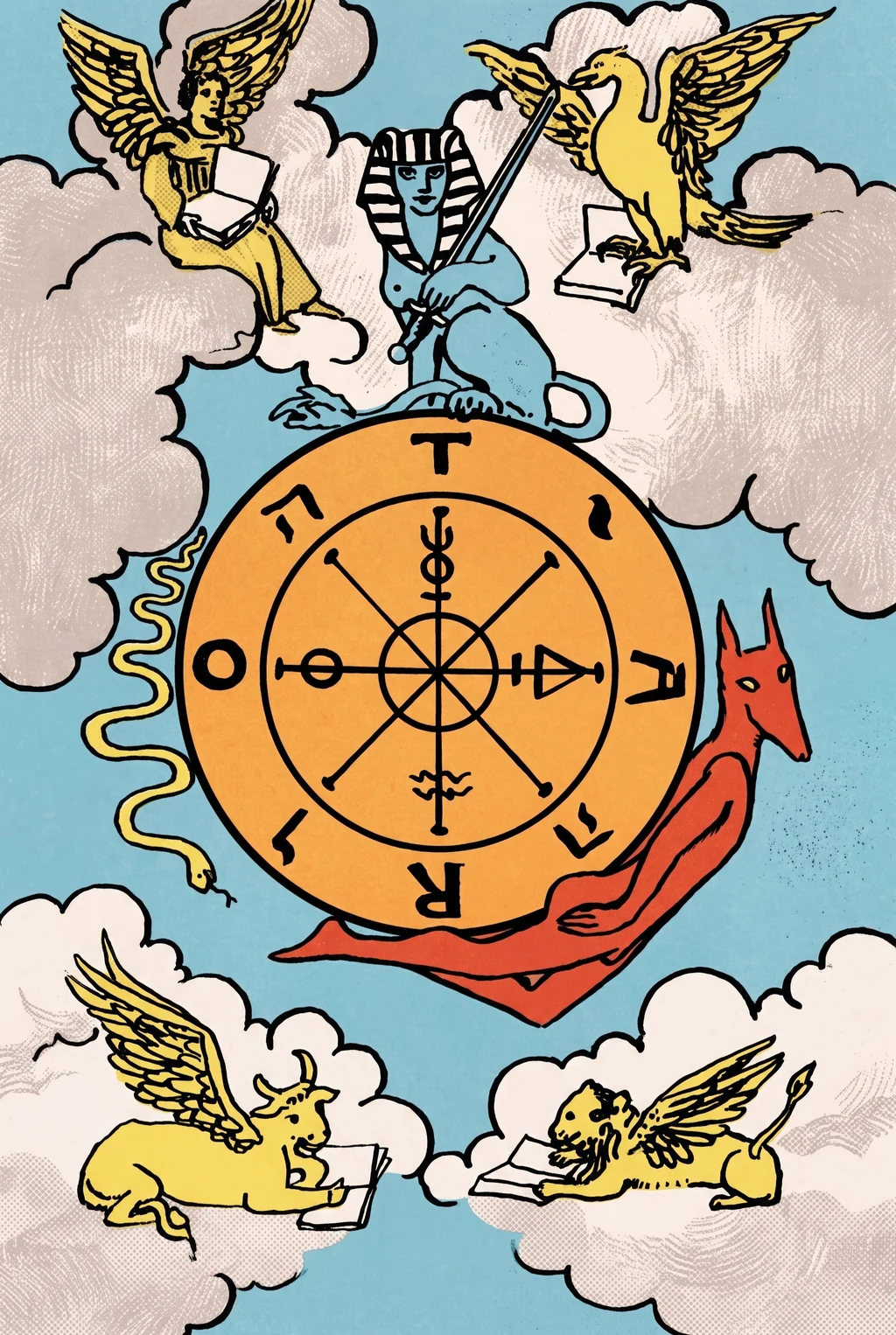
The Wheel of Fortune carries the scene beyond any single human story. As one figure rises along its rim, another descends; at the top, the sphinx remains. Waite connects this arrangement with the world’s ceaseless motion and the balance within it. No one figure can reach the highest point and stop the turning simply because it feels good to be there.
To the one rising, the highest point may seem like the end of the road. The one descending still remembers it as their own. Each sees only their stretch of the rim, while the sphinx remains above them. The rotation brings together positions from which it is so easy to mistake one’s own moment for the way the entire world works.
Core meaning
The Wheel of Fortune speaks to changing circumstances, cycles of highs and lows, and opportunities that cannot always be planned. What matters is distinguishing between what changes beyond your control and how you choose to respond.
- Key meanings:Change
- Turning point
- Lucky opportunity
- Cycles
- External influences
- Flexibility
- Key meanings:Delays
- Resistance to change
- Recurring patterns
- Instability
- Breaking a cycle
- Excess
Image and symbols
Card image
Against a blue sky, a large orange wheel with several rims and spokes floats among the clouds. Latin and Hebrew letters appear around the outer circle, and four alchemical symbols are inscribed inside.
On top of the wheel sits a blue sphinx wearing a striped headdress and holding a sword. On the left, a yellow serpent coils downward along the rim; on the right, a red jackal-headed figure clings to the wheel. Four winged figures with open books occupy the corners: a human (angel), an eagle, a bull, and a lion. The Roman numeral X appears at the top.
Traditional context
Waite connects the image of the Wheel to the work of French occultist Éliphas Lévi. He interprets its rotation as an image of the world’s ceaseless movement and the changing nature of human life, with the sphinx at the top representing balance amid change. Waite compares the four creatures in the corners to the vision of the prophet Ezekiel. He uses Egyptian imagery symbolically, without claiming that Tarot originated in Egypt.
In Waite’s list of divinatory meanings, the upright card signifies destiny, fortune, success, and elevation. His reversed Wheel is associated with increase, abundance, and excess. It does not automatically mean “bad luck,” as is common in modern guides.
Modern tradition often reads the upright card as an unexpected turn or opportunity, and the reversed card as delays, recurring difficulties, or resistance to change. Brigit Esselmont also offers another important interpretation of the reversed card: breaking free from an unfavorable recurring pattern. These are different approaches to the same card, and its meaning is best considered in the context of the question.
A large wheel with concentric rims and spokes
Its rotation represents shifting states and the uncertainty of a person's place within larger circumstances.
The Latin letters T, A, R, O on the outer rim
The letters can be read as ROTA ("wheel"), linking the name Tarot to circular motion.
Four Hebrew letters between the Latin letters
These are the letters of the divine name YHWH; in Waite’s system, they connect the turning of the world with the idea of providence.
Alchemical symbols on the inner circle
In modern interpretations, the symbols for mercury, sulfur, salt, and water represent the constituent principles of the material world and transformation.
The sphinx at the top of the wheel
Waite explicitly associates the sphinx with balance amid movement; modern readings also emphasize knowledge and steadiness.
The sword held by the sphinx
In contemporary symbolic readings, the sword highlights discernment and the ability to stay clear-headed amid change.
A yellow serpent descending the wheel on the left
Waite calls it Typhon in serpent form. Modern interpretations associate its descent with losing a former position and moving into a new phase.
A red jackal-headed figure on the lower right
Modern interpretations call this figure Anubis; its movement along the rising side of the wheel is associated with renewed ascent and transition.
Four winged creatures in the corners: an angel, eagle, bull, and lion
Waite refers to the beings in Ezekiel’s vision. Modern RWS symbolism also connects them to the four fixed signs of the zodiac and to stability.
Open books held by the four winged creatures
In modern readings, they emphasize knowledge that endures even as external circumstances change.
Clouds surrounding the wheel, with no earthly landscape
The wheel is placed outside an everyday setting, emphasizing forces that cannot be seen as ordinary human activity.
Colors
- Blue — the sphinx’s body
In one modern reading, the blue emphasizes its wisdom and clarity in contrast to the wheel’s motion.
- Orange-gold — the wheel
In modern symbolic tradition, the golden color can strengthen the wheel’s association with good fortune and a favorable turn; the color alone promises nothing.
Meanings
Wheel of Fortune — Upright
General
Overall meaning
Events are taking another turn. Not everything follows the plan, but change can open a door. The Wheel is a reminder of the limits of control: make use of a fortunate period without assuming a difficult one will last forever.
Possible support
Staying open to unexpected opportunities can help you make the most of the moment. Involvement and support from others may also be useful.
Possible difficulty
The difficulty with the Wheel upright is that familiar routines can change even when things are going well. Trying to hold every detail in place adds tension.
Focus
It helps to distinguish a change in circumstances from your own actions: what is happening regardless of your wishes, and where can you already respond differently?
Reflection questions
- What is changing in my situation without my involvement?
- What opportunity has come with this change?
Relationships
Overall meaning
In romantic relationships, the card may suggest a new chapter or unexpected circumstances that partners will need to navigate together. In friendship, it can point to new connections, renewed contact, or a change in the usual degree of closeness.
In family life, the Wheel may accompany a shift in familiar routines: a move, a new rhythm of household responsibilities, or the need to revisit earlier agreements.
Possible support
A willingness to communicate and adjust together to changing conditions can sustain a connection. In friendship, openness to new ways of staying in touch can help.
Possible difficulty
Even a welcome turn can require changes to plans and habits. For couples, transitions sometimes test their willingness to reach agreements and consider each other’s needs.
Focus
Pay attention to changes in the rhythm of your connection. What circumstances have changed, and what agreements might you revisit to make things work for both of you?
Reflection questions
- What has changed in the way we communicate recently?
- Where do we need to make a new agreement?
Work and study
Overall meaning
At work, the Wheel of Fortune is associated with a turning point: a new project, a shift in responsibilities, an unexpected opportunity, or a change in career direction. Even a difficult restructuring may offer a reason to develop new skills.
Possible support
It helps to notice genuine opportunities and respond to offers at the right time, rather than expecting things to fall into place on their own.
Possible difficulty
Old plans may no longer fit the new working environment. Even a promising change of direction requires learning and adjusted expectations.
Focus
Notice what has already changed at work and which offers actually serve your goals rather than merely looking promising.
Reflection questions
- What new opportunity has appeared at work?
- What could these changes teach me?
Money and resources
Overall meaning
Financial circumstances can shift in either direction. The card reminds you that comfortable periods do not last forever, but difficulties need not last indefinitely either. Thoughtful flexibility matters more than expecting constant growth.
Possible support
A reserve for unexpected expenses, built during more prosperous periods, can provide stability.
Possible difficulty
The risk is treating a temporary rise in income as permanent and taking on commitments as though a downturn were impossible.
Focus
Consider how well your budget could withstand a change in income and where new circumstances call for a review of familiar expenses.
Reflection questions
- How do I manage my money during more stable periods?
- What would change in my budget if my income became less stable?
Wellbeing and self-care
Overall meaning
In everyday well-being, the card may reflect shifts in workload, mood, and routine. Work, travel, and changing seasons can sometimes affect how much rest and attention you need.
Possible support
Noticing recurring periods of effort and recovery is more useful than demanding the same productivity from yourself every day.
Possible difficulty
Changes in routine can bring emotional ups and downs, especially if you expect yourself to maintain the same pace in every circumstance.
Focus
Look for connections between rest, daily activities, and changes in your surroundings. When does the week feel easier, and when does strain begin to build?
Reflection questions
- On which days do I need more rest?
- What changes in my routine affect how I feel?
Personal growth
Overall meaning
In personal growth, the Wheel of Fortune speaks to recognizing life’s alternating phases and seeing change as a chance to reconsider familiar perspectives. New experience may offer a direction that was not part of the original plan.
Possible support
Noticing recurring situations and being willing to learn from experience can help you stay grounded through an unexpected turn.
Possible difficulty
Growth is difficult when your peace of mind depends entirely on circumstances and your familiar self-image staying the same.
Focus
What change is making you revisit your previous expectations, and what have you already learned about your response to it?
Reflection questions
- What new experience has changed my perspective on the situation?
- What have I learned about myself after an unexpected change?
Wheel of Fortune — Reversed
General
Overall meaning
In common modern interpretations, the Wheel reversed represents delays, an unfavorable turn, repeated difficulties, or resistance to unavoidable change. Sometimes it points to the beginning of a way out of an unfavorable cycle.
Waite places the emphasis elsewhere: on increase, abundance, and also excess that no longer serves a purpose.
Possible support
It may help to recognize a recurring pattern and stop using an approach that keeps leading to a dead end. Some readings associate this orientation with breaking an old cycle.
Possible difficulty
Being unable to predict what will happen can lead to rigid control or a return to familiar solutions. In either case, resistance makes change harder.
Focus
Look at what keeps repeating, and whether the feeling of being stuck comes from circumstances or from how you respond to them. If something has become excessive, that imbalance is worth noticing too.
Reflection questions
- What keeps repeating in this situation?
- Has something become excessive?
Relationships
Overall meaning
In romantic relationships, external obstacles, a disrupted rhythm of closeness, or attempts to keep everything as it was may come to the fore. In friendship, this orientation is often read as recurring misunderstandings, growing distance, or resistance to a natural shift in the relationship.
In family life, the Wheel reversed may point to the same grievances and arguments returning even though circumstances have already changed.
Possible support
Patience and open conversation may help you navigate a period when plans do not align. In friendship, it helps to give the relationship room to change without pressure.
Possible difficulty
Familiar arguments may go around in circles, while insisting on old ways of connecting can create additional strain.
Focus
Consider what exactly keeps recurring in your interactions and what has changed in each person’s life. A change in closeness does not necessarily mean the relationship is ending.
Reflection questions
- What conversation or conflict keeps recurring between us?
- Where am I trying to restore the way we used to communicate?
Work and study
Overall meaning
Work requirements may change quickly, and your old approach to tasks may no longer help. The card is also associated with delays and frustration when trying to keep a project on its familiar course.
Possible support
Revisiting your workflow may help: keep the goal, but change how you pursue it in light of new requirements.
Possible difficulty
The main trap is stubbornly applying an old solution to a changed task, or taking every update to the requirements as a personal failure.
Focus
Check which requirements have actually changed and where you need to renegotiate the plan instead of repeating the same actions to no effect.
Reflection questions
- Which familiar approach has stopped helping?
- What exactly has changed in what is expected of me?
Money and resources
Overall meaning
In financial matters, the Wheel reversed is associated with unexpected, unwelcome changes. This is a reason to pay closer attention to your financial cushion, not a prediction of a specific loss.
Possible support
A modest reserve and avoiding impulsive risks may reduce your vulnerability to unexpected expenses.
Possible difficulty
A series of new expenses or sudden changes may tempt you into hasty decisions when you want to restore your previous position immediately.
Focus
Review upcoming obligations and the reserves available to you rather than trying to guess when circumstances will improve.
Reflection questions
- What unexpected expenses do I need to account for right now?
- Do I have a reserve for changing circumstances?
Wellbeing and self-care
Overall meaning
In everyday well-being, the card describes feeling stuck or moving through recurring difficult periods. The frustration can be especially noticeable when circumstances change quickly and your usual routine cannot keep up.
Possible support
Paying attention to recurring demands and being willing to ask for help when your usual resources are not enough may be useful.
Possible difficulty
Trying to handle everything the old way without noticing accumulated strain can deepen the feeling of going in circles.
Focus
Look at which actions or situations tend to recur before you feel overwhelmed, and where you can change your daily rhythm.
Reflection questions
- What most often comes before I feel overwhelmed?
- Where am I still acting out of habit despite being tired?
Personal growth
Overall meaning
The card may highlight a recurring life pattern: everything appears to change on the outside, but a familiar response leads to a similar outcome. Another reading is becoming aware of the pattern and beginning to move beyond it.
Possible support
Looking closely at your habits and past decisions that did not work may help you change a recurring pattern.
Possible difficulty
A rigid attachment to the old order makes you fight change even when carrying on as before no longer makes sense.
Focus
Notice where it is not the event itself that repeats, but your way of responding to it. That distinction can help you choose what you can truly change.
Reflection questions
- Which of my reactions to change have I repeated before?
- What could I do differently in a similar situation?
Roles in a spread
Position examples
A position gives the card a question, such as what helps or what gets in the way. That question shapes how you read its meaning.
Wheel of Fortune — Upright
Situation
A turn of events is changing the starting conditions: one phase gives way to another, and the direction does not depend entirely on personal choice.
Influence
Circumstances and coincidences play a role that you could not fully arrange or prevent.
Motivation
You may deeply want the usual course of events to finally change and create room for something new. The hope of a turn for the better can keep you open to an unexpected offer, even when the outcome remains unknown.
Support
Flexibility, support from others, and the ability to recognize an opening can help you find your footing.
Obstacle
The obstacle is insisting on complete control over a process largely shaped by outside forces.
Focus of attention
Notice how events are turning, and distinguish your own actions from what lies beyond your control.
Next step
Look at the opportunities that have emerged, choose one that fits, and adapt your original plan to the new conditions.
Possible development
If current conditions hold, the situation may enter a new phase. Whether it proves favorable depends not only on a lucky break but also on your ability to adapt.
Wheel of Fortune — Reversed
Situation
External events may disrupt plans, and the old way of doing things no longer works. Sometimes a way out of a long-standing cycle is beginning to emerge.
Influence
Unexpected external circumstances or a series of similar events complicate the situation.
Motivation
The inner drive may be a desire to regain familiar certainty and escape the helplessness that change can bring.
Support
Recognizing a recurring pattern and being willing to change your response to it can provide support.
Obstacle
Trying to restore the old order despite changed conditions only makes the situation more tense.
Focus of attention
Notice repeated choices, fear of uncertainty, and the areas where you still have some control.
Next step
Reconsider your usual response and let go of trying to force events back to how they were.
Possible development
If you continue resisting change, the tension may persist. Recognizing a recurring pattern leaves room to change direction.
Combination examples
Card combinations are in development. For now, here are a few examples.
Wheel of Fortune + The Magician
Wheel of Fortune ( upright) + The Magician ( upright)
- Example question:
- How should I approach the start of a new endeavor?
- Example interpretation:
A turn in circumstances creates an opportunity, while The Magician adds personal initiative and the ability to use the skills you already have.
Wheel of Fortune + The Chariot
Wheel of Fortune ( upright) + The Chariot ( upright)
- Example question:
- How can I stay on course as events speed up?
- Example interpretation:
The Wheel highlights a change in the moment, while The Chariot adds movement and purposeful action.
Wheel of Fortune + The Hermit
Wheel of Fortune ( upright) + The Hermit ( upright)
- Example question:
- How can I make sense of a change that has occurred?
- Example interpretation:
The Wheel reminds you that conditions are shifting, while The Hermit suggests pausing to reflect rather than reacting hastily.
Wheel of Fortune + The World
Wheel of Fortune ( upright) + The World ( upright)
- Example question:
- What does the end of a major chapter mean?
- Example interpretation:
The Wheel shows the repetition and succession of phases, while The World gives the story a sense of a completed cycle.
Wheel of Fortune + Death
Wheel of Fortune ( upright) + Death ( upright)
- Example question:
- How can I understand a change that closes an earlier chapter?
- Example interpretation:
The Wheel points to the inevitability of a turn, while Death marks the end of an old form and makes space for what comes next.
Reading example
An imagined one-card reading shows how the meanings above can apply to a question. This is one possible interpretation.
Wheel of Fortune — Upright
Situation:
You have been offered a move to a new team at work. Your current responsibilities are familiar, and the new role is appealing, but some of its conditions still depend on a broader department restructuring.
Question:
How should I approach the possibility of moving to a new role?
-
Card drawn:
Imagine drawing a card for the position «Advice» and getting Wheel of Fortune (upright).
Interpretation:
The Wheel of Fortune upright highlights a shift in circumstances and an emerging opportunity. The new role has not arisen solely from your own plans: the structure of the whole team is changing.
The card invites you to consider the offer seriously, find out what the actual terms are, and decide which aspects of the change you can make use of. Flexibility is more useful here than waiting for complete certainty.
Wheel of Fortune — Reversed
Situation:
You have been offered a move to a new team at work. Your current responsibilities are familiar, and the new role is appealing, but some of its conditions still depend on a broader department restructuring.
Question:
How should I approach the possibility of moving to a new role?
-
Card drawn:
Imagine drawing a card for the position «Advice» and getting Wheel of Fortune (reversed).
Interpretation:
In a modern reading, the Wheel of Fortune reversed points to plans being disrupted and resistance to change. Unclear conditions may create anxiety, while the familiar choice to “leave everything as it is” may no longer fit the new situation.
It helps to find out which requirements are still changing, what can be agreed on in advance, and which decisions are better left until you know more. What matters here is not blindly betting on luck, but understanding what you can adapt to now.
Yes / No
Wheel of Fortune — Upright
Why this answer
Yes. The Wheel of Fortune upright connects this answer with a favorable turn, good timing, and an emerging opportunity.
A clarification
Timing matters: the card highlights a favorable window of circumstances, but you still need to recognize the opportunity and act on it.
A question to consider
- What opportunity is available to me right now?
- What should I prepare to make use of it?
Wheel of Fortune — Reversed
Why this answer
No. The Wheel of Fortune reversed connects this answer with current obstacles or unfavorable timing. You can revisit the question when circumstances change.
A clarification
The limitation concerns timing and conditions. Before proceeding in the same way, look at what is not working now and what needs to change in the circumstances.
A question to consider
- What is standing in the way of my plan right now?
- What circumstances need to change before I return to this question?
Correspondences
Connections with numbers, elements and other symbols add depth to the card’s imagery. They can differ between traditions.
Number — X (10)
The number ten identifies the Wheel of Fortune. In modern symbolic readings, a cycle of ten is associated with the end of one phase and the start of another.
Element — Fire
Connects the turning of the Wheel with movement and momentum; this correspondence should not be attributed directly to Waite or treated as universal across traditions.
Astrology — Jupiter
Jupiter links the card with expansion, favorable opportunities, and changeable fortune.
Letter — Kaph (כ)
The letter’s name means “palm”; an open palm symbolizes accepting change and what cannot be held onto by force.
Tree of Life — 21st Path: Chesed — Netzach
The path connects Chesed and Netzach. This is a symbolic correspondence within a later Western occult system, not a universal fact of Tarot history.