
Judgement
Descriptions and symbolism are based on the card’s classic illustration in the Rider–Waite–Smith deck. Details of the artwork may differ in other editions of the deck.
This guide brings together traditional and modern readings. Interpretations and answers may differ between authors and schools.
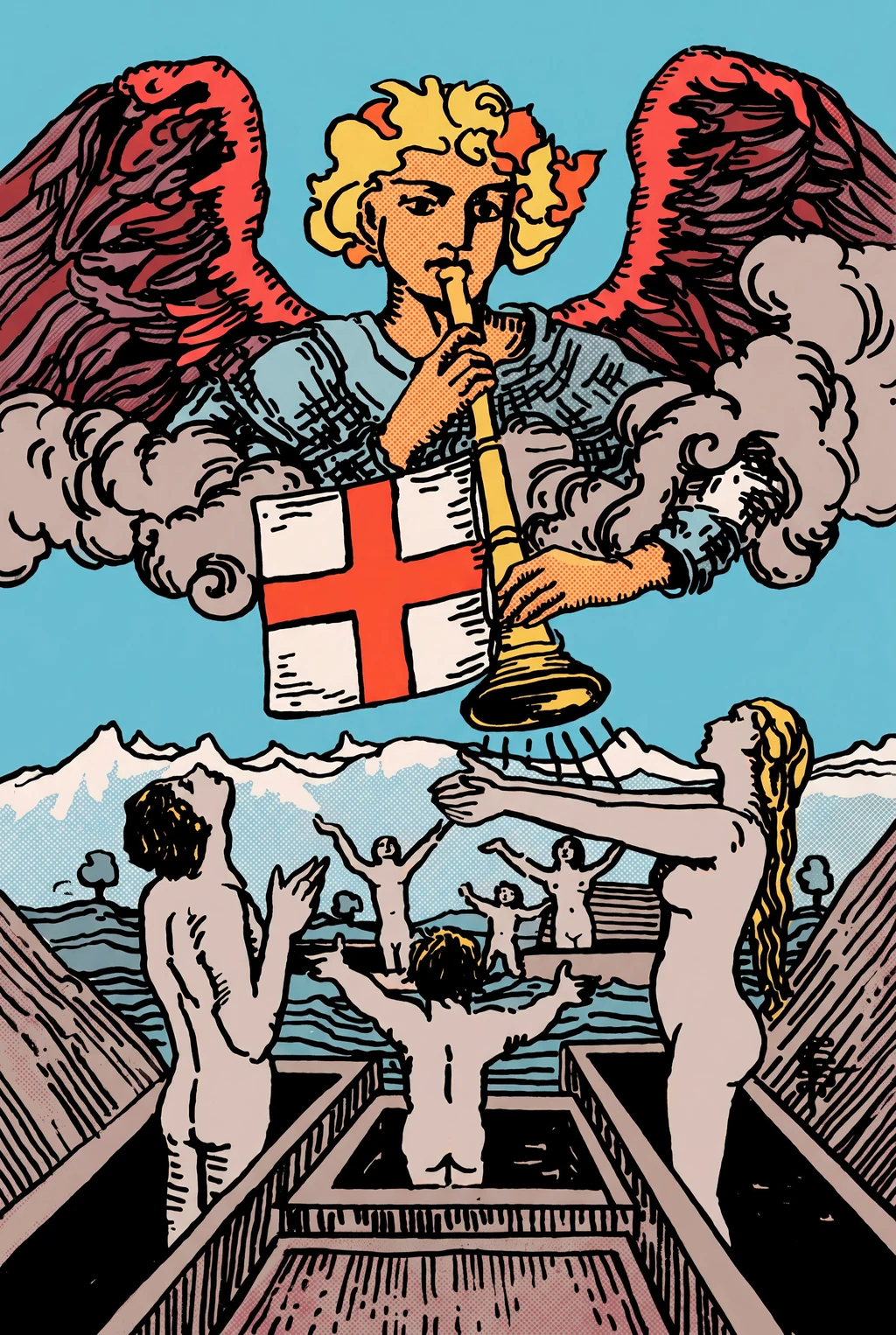
The trumpet's call reaches those whose earthly lives have ended. People rise from open coffins and turn toward the angel. The man clasps his hands, the woman opens her arms, and the child stretches upward between them. Each responds differently, yet their gestures share wonder and reverence.
Waite also read the resurrection at the Last Judgment as a response to a higher call heard within. Here awakening immediately becomes action: the bodies are still inside their narrow coffins, but their gestures already reach beyond them. The call continues over the water; in the distance, other people answer with raised arms.
Core meaning
Judgement connects taking stock of the past with renewal: what you have lived through becomes the foundation for an important decision. Its themes are an inner calling, a second chance, and release from old guilt.
- Key meanings:Awakening
- Taking stock
- Calling
- Renewal
- Second chance
- Forgiveness
- Key meanings:Self-doubt
- Self-judgment
- Delayed decision
- Repeating mistakes
- Unanswered calling
- Reassessment
Image and symbols
Card image
At the top of the card, an angel with red wings and yellow hair appears among the clouds. The angel wears a pale blue robe and holds a golden trumpet to their lips. A white banner bearing a red cross hangs from the trumpet. Fine black lines radiate downward from its bell.
Below, nude blue-gray figures rise from open rectangular coffins. In the left foreground stands a man with clasped hands; on the right, a woman raises her arms. Between them, a child faces away from the viewer with arms outstretched. Three more figures appear behind them. Water surrounds the coffins, and pale mountains rise in the distance beneath a blue sky.
Traditional context
For Waite, the Last Judgment scene also has an inner meaning. The figures answer the angel's call not only as resurrected bodies: transformation begins with a response arising within. Their gestures express wonder, adoration, and ecstasy.
Waite's brief list of divinatory meanings goes beyond this imagery. For the upright card, he names a change of position, renewal, and the outcome of a matter; he also gives the possibility of total loss in a lawsuit. For the reversed card, he lists weakness, cowardice, and simplicity, but also deliberation, decision, and a sentence. These historical meanings cannot be reduced to the modern formula “upright Judgement is good, reversed Judgement is bad.”
Modern readings place more emphasis on calling, an honest assessment of one's life, second chances, and forgiveness. The reversed card often suggests a delayed response to needed change or an overly harsh view of oneself. Theresa Reed offers another application: before a major change, a pause may be worthwhile when there is not yet enough information to decide.
An angel above the rising figures
For Waite, this is an image of a higher call answered from within. In a modern reading, it can represent the recognition of one's calling.
The trumpet at the angel's lips
The trumpet's sound announces an awakening. For Case, it also depicts the expression of creative Fire through sound.
Seven fine lines radiating from the trumpet's bell
In Case's system, the seven lines represent the sevenfold expression of the creative breath. He associates them with the seven spirits of God and the seven double letters of the Hebrew alphabet.
A red cross on a white banner
Case connects the cross with the fourfold structure of the world: the four elements, the worlds of Kabbalah, and the rivers of Eden. Another association is the Tetragrammaton, the four-letter name of God.
Three figures in the foreground and three in the distance
The resurrection scene includes several people rather than a single central figure. Waite emphasizes that the distant figures were added deliberately; in a modern reading, the group can suggest a change affecting many people.
The raised arms of the resurrected figures
Waite reads these gestures as wonder, adoration, and ecstasy. The figures do not hide from the call; they respond to it.
The clasped hands of the man on the left
In Case's explanation, the clasped hands express a contemplative state: the active mind temporarily ceases to intervene.
The raised arms of the woman on the right
Case sees receptivity here: the inner, or subjective, mind receives the influence of the call. In this framework, the male and female figures represent principles, not traits assigned to people of a particular gender.
A child between the adults, facing away from the viewer
For Case, the child represents a renewed personality. He interprets the child's turned back as a return to the source of existence.
Open coffins
Those whose former state has ended rise from them. Case associates the coffin with the limitations of material existence; modern interpretations extend the image to roles and ideas about oneself that are being left behind.
Water surrounding the coffins
In a modern symbolic reading, the water emphasizes the passage from one state to another and the inner experience of change.
Mountains in the distance
In a modern reading, the mountains can convey the inescapable nature of the call to reevaluate one's life. They belong to the symbolism of the Last Judgment scene, rather than indicating a specific danger.
Colors
- Blue — the angel's robe
Case associates this color with Chokmah, the sephirah of Wisdom, which he calls the root of Fire in his system.
Meanings
Judgement — Upright
General
Overall meaning
Judgement marks a moment to look back on the path you have taken and make a decision that will shape what comes next. The consequences of past actions become clearer, and scattered experiences begin to form a more coherent understanding of yourself.
This is where the meanings of awakening, an inner calling, and a second chance arise. Renewal might involve returning to unfinished business, correcting an earlier choice, or releasing guilt that no longer helps you make anything right.
Possible support
The experience you have already learned from offers a foundation, helping you bring inner understanding together with a clear-eyed assessment of your decision.
Possible difficulty
The weight of an important choice and fear of others' judgment can leave you feeling paralyzed. Reflection then becomes a search for a decision that cannot go wrong.
Focus
Notice which past decisions still affect the present, and what conclusion you can no longer put off.
Reflection questions
- What lesson from the past helps me decide what to do next?
- What endeavor has become important to me again?
Relationships
Overall meaning
In romantic relationships, Judgement points to reassessing what is happening between partners. A conversation might bring shared goals back into focus, uncover difficulties that have gone unspoken, or raise the question of whether to continue the relationship.
A second chance here means being willing to learn from the past rather than simply repeat a familiar story. When reflecting on a relationship that has ended, the card helps you recognize both the mistakes and what the connection taught you.
Possible support
In a romantic relationship, support comes from both partners being willing to talk about their needs and work together to change what is no longer working.
Possible difficulty
In a romantic relationship, the need to decide what comes next can create pressure and bring unresolved disagreements back to the surface.
Focus
In a romantic relationship, pay attention to a conversation you have previously avoided: which parts concern your needs, and which call for a response from your partner?
Reflection questions
- What do I need to speak openly about in my relationship?
- What do I want to do differently based on my past relationship experience?
Work and study
Overall meaning
Judgement speaks to reassessing your professional life: what makes your work meaningful going forward becomes clearer, along with whether your current work fits that direction. Themes may include evaluating results, returning to an earlier project, or renewing your commitment to your profession. In an educational setting, it can refer to the outcome of an exam or selection process.
Another aspect of the card concerns responsibility in collaboration. It invites you to see how your choices and behavior affect colleagues and the work you share.
Possible support
A clear sense of purpose in your work can rekindle your interest and help you reconsider your role.
Possible difficulty
Fear of professional evaluation or making the wrong choice can make it hard to move forward, even when change is due.
Focus
Look at your contribution to the situation at work: promises you have kept, the quality of your interactions, and your own share of responsibility in disagreements.
Reflection questions
- What still feels meaningful to me in my work?
- Which part of our shared work is my responsibility?
Money and resources
Overall meaning
In money matters, Judgement invites you to assess the accumulated consequences of past decisions. The central theme is your relationship with spending and having enough: which habits support a more stable life, and which keep creating difficulties?
Another practical reading connects the card with reviewing your finances and settling old obligations.
Possible support
Reconsidering your usual view of money can be a source of support, helping you notice opportunities for improvement you previously overlooked.
Possible difficulty
An imbalance can show up as spending beyond your means or as a persistent sense of scarcity, even when your circumstances improve.
Focus
Compare your everyday money decisions with what matters to you over the long term.
Reflection questions
- Which regular expense is worth reconsidering?
- Where does my sense of scarcity reflect my actual circumstances, and where does it differ?
Wellbeing and self-care
Overall meaning
In emotional life, Judgement can reflect relief after acknowledging the past and letting go of long-held guilt or regret. It becomes possible to see yourself as more than a single mistake. The card also touches on reconsidering everyday self-care habits.
Possible support
Talking with people who have faced a similar difficulty can help you feel understood and less alone in what you are experiencing.
Possible difficulty
The prospect of being judged and the pressure of an important decision can sustain considerable inner tension.
Focus
Notice your usual rest routine and how you handle everyday stress.
Reflection questions
- Who can I talk to about something that has weighed on me for a long time?
- What is worth changing about the way I usually rest?
Personal growth
Overall meaning
Judgement concerns reevaluating who you believe yourself to be and what you want to devote your life to. Past events begin to form a meaningful body of experience, from which a personal decision can emerge rather than simply following a familiar role.
Forgiveness is an important theme: acknowledging what you have done and its consequences without reducing your whole identity to them. Releasing old guilt makes it possible to begin a new chapter with intention.
Possible support
The perspective of a trusted friend or mentor may help you notice what your usual self-reflection misses.
Possible difficulty
Trying to assess yourself honestly can turn into judging yourself or others. When that happens, individual mistakes can obscure the fuller picture of your experience.
Focus
Compare your current goals with what has genuinely become important through your experiences.
Reflection questions
- Which former goal no longer reflects what I want?
- What in my experience helps me understand myself better?
Judgement — Reversed
General
Overall meaning
Reversed Judgement often points to a gap between understanding and action: the need for change is visible, but the decision is delayed. This may come from self-doubt, a refusal to acknowledge past mistakes, or, conversely, self-judgment so harsh that the past obscures what could come next.
The past can also return through unfinished obligations: something that seemed settled requires your attention again.
There is a quieter reading as well: the decision may simply need more thought. Before a major change, a pause can be appropriate if it helps you gather missing information rather than circle endlessly around the same doubt.
The opposite imbalance is also possible: change made in haste. In this reading, it is worth checking whether you are discarding something that still supports you along with what has grown outdated.
Possible support
When your direction is unclear, it can help to talk with someone who will consider your doubts carefully and offer guidance.
Possible difficulty
Refusing to look at past actions prevents learning; continually blaming yourself prevents you from using what you have already learned.
Focus
Distinguish missing information from recurring fear. In the first case, the decision needs preparation; in the second, notice why you keep postponing an answer you already understand.
Reflection questions
- What information am I missing to make this decision?
- What am I putting off again, even though I already understand why change is needed?
Relationships
Overall meaning
In a romantic relationship, reversed Judgement can suggest being stuck in old grievances, unfair criticism, or an unwillingness to acknowledge dissatisfaction. Coming back together does not, by itself, change familiar ways of communicating.
In friendship, this reading relates to longstanding hurts that make reconnecting difficult. In family life, the emphasis may shift to avoiding conversations about unresolved issues and necessary change.
Possible support
In a relationship, more measured criticism and a willingness to compromise can help without leaving real disagreements unspoken.
Possible difficulty
In a romantic relationship, unspoken grievances and the habit of blaming one another can keep both partners caught in the same conflict.
Focus
Before rekindling a romantic connection, consider whether the reasons for the earlier breakup are changing, not just whether you want to be together again.
Reflection questions
- What complaint do I keep repeating without explaining what I want to change?
- What conversation with someone close to me am I putting off?
Work and study
Overall meaning
At work, reversed Judgement can show two different imbalances. One is persistent doubt about your abilities after a mistake; the other is refusing to acknowledge your part in a mistake and learn from it.
The card can also describe a prolonged professional reassessment: your old role no longer fits, yet a decision to change remains on hold.
Possible support
Correcting a specific mistake and learning from it can offer firmer ground than passing judgment on your abilities as a whole.
Possible difficulty
When reviewing work gives way to assigning blame, misunderstandings with colleagues and past mistakes remain unresolved.
Focus
Consider which feedback on your work calls for change and where the assessment of a single mistake has turned into a belief that “I can't do anything right.”
Reflection questions
- What mistake at work can I correct without dismissing everything else I have done?
- What work-related decision have I been putting off for a long time?
Money and resources
Overall meaning
Reversed Judgement can suggest a recurring financial pattern whose consequences are already familiar. Unresolved obligations draw attention back to the past, while a necessary reassessment keeps being postponed.
Another reading concerns excessive self-blame after a financial setback. This is different from refusing to acknowledge mistakes: the lesson has already been recognized, but the emotional weight of the experience still makes it difficult to move forward.
Possible support
Treating yourself with more kindness after a setback can help you stay willing to examine your finances and learn from experience.
Possible difficulty
A repeated approach to money decisions stands in the way of change when its past consequences go unexamined.
Focus
Distinguish between two situations: are you repeating a mistake without reassessing it, or have you already taken its consequences into account while self-criticism continues?
Reflection questions
- What money decision do I keep repeating even though I know its consequences?
- How has my approach to money changed since an earlier mistake?
Wellbeing and self-care
Overall meaning
In emotional life, reversed Judgement speaks to the weight of self-condemnation: thoughts keep returning to past decisions, guilt, or shame. You may find it hard to acknowledge a mistake without continually punishing yourself for it.
Possible support
Self-acceptance and easing relentless self-criticism can help you treat difficult feelings with greater care.
Possible difficulty
Repeated self-accusation can drown out other aspects of your experience and deepen self-doubt.
Focus
Notice which accusing thoughts recur and what fears lie behind them.
Reflection questions
- Which self-accusing thought comes back most often?
- What do I struggle to forgive myself for, even after trying to make amends?
Personal growth
Overall meaning
Reversed Judgement can reflect an inner call left unanswered: the desired direction is clear, but you hesitate to claim it as your own. Sometimes fear of change gets in the way; sometimes an established idea of who you are leaves no room for new experiences.
Another emphasis is on recurring themes in your life. What is needed here is not another round of self-blame, but a reassessment of your beliefs and your own definition of success.
Possible support
Kind feedback and the chance to redefine your goals support reflection without self-condemnation.
Possible difficulty
A persistent sense of inadequacy makes it hard to see the call to change as a real possibility.
Focus
Look at recurring situations in which you choose a familiar role over a direction that already feels true to you.
Reflection questions
- What desire am I not allowing myself to take seriously?
- What does success mean to me now, as opposed to before?
Roles in a spread
Position examples
A position gives the card a question, such as what helps or what gets in the way. That question shapes how you read its meaning.
Judgement — Upright
Situation
The situation has reached a point of reassessment: past experience and the consequences of decisions call for a clear conclusion.
Influence
The consequences of past decisions are shaping what happens now. An action that seemed complete becomes part of your present choice.
Motivation
The motivation may be a desire to answer your own calling and live in closer alignment with it.
Support
Sharing experiences with people who understand a similar difficulty and can help you see it in a broader light may offer support.
Obstacle
The weight of the decision itself becomes an obstacle: fear of making a mistake or being judged makes it harder to choose.
Focus of attention
Pay attention to a decision that calls for bringing together lessons from experience and an inner sense of your direction.
Next step
Take stock of your past decisions and choose what to change in keeping with what truly matters to you now.
Possible development
Thoughtful reflection may lead to the resolution of an earlier matter or a renewal made possible by what you have learned.
Judgement — Reversed
Situation
A necessary reassessment remains unfinished: the need for change is clear, but your response is delayed.
Influence
Your response may be shaped not only by doubt but also by circumstances beyond your control that limit your ability to follow your chosen calling.
Motivation
Resistance to change may reflect a wish to preserve familiar security and avoid stepping into a more visible role.
Support
When it is difficult to choose a direction, thoughtful advice from someone experienced can offer support.
Obstacle
Repeated delays, unacknowledged mistakes, or harsh self-judgment keep the situation from moving forward.
Focus of attention
Listen to your inner critic: what fears does it express, and are you treating its accusations as an accurate measure of your abilities?
Next step
Find out what is holding up your decision. If information is missing, take time to prepare; if you are repeating a familiar mistake, consider changing your approach.
Possible development
If a recognized need for change goes unanswered, the old pattern may continue and an opportunity may pass unused.
Combination examples
Card combinations are in development. For now, here are a few examples.
Judgement + The Fool
Judgement ( upright) + The Fool ( upright)
- Example question:
- How does the opportunity for a fresh start show up in this situation?
- Example interpretation:
Judgement and The Fool reinforce the themes of a new beginning and renewal.
Judgement + Justice
Judgement ( upright) + Justice ( upright)
- Example question:
- What is important to acknowledge when taking stock?
- Example interpretation:
This pairing emphasizes decision-making and acknowledging your past actions, including mistakes.
Judgement + Seven of Pentacles
Judgement ( upright) + Seven of Pentacles ( upright)
- Example question:
- At what point does the path forward require a decision?
- Example interpretation:
This combination highlights a moment when a decision needs to be made.
Reading example
An imagined one-card reading shows how the meanings above can apply to a question. This is one possible interpretation.
Judgement — Upright
Situation:
You have been invited to return to something you once enjoyed but had to leave behind after a setback. The interest is still there, along with a question: could things turn out differently now?
Question:
What would help me understand whether to return to this endeavor?
-
Card drawn:
Imagine drawing a card for the position «What to consider before deciding» and getting Judgement (upright).
Interpretation:
Judgement brings together a second chance and lessons from the past. What matters here is not the return itself, but the opportunity to use what you have learned in a different way.
Consider why you had to leave this endeavor behind and what has changed since then. You can then base your decision on your present interest and your understanding of past difficulties, rather than only on a wish to undo the setback.
Judgement — Reversed
Situation:
You have been invited to return to something you once enjoyed but had to leave behind after a setback. The interest is still there, along with a question: could things turn out differently now?
Question:
What would help me understand whether to return to this endeavor?
-
Card drawn:
Imagine drawing a card for the position «What to consider before deciding» and getting Judgement (reversed).
Interpretation:
Reversed Judgement helps you distinguish between a lesson not yet learned and an overly harsh conclusion about yourself. Perhaps the reasons for the earlier setback have not changed. But another possibility is that you understand them now, yet the thought “I won't succeed” is still stopping you from deciding.
It helps to separate a concrete difficulty you will need to address from a general doubt about your abilities. If it is not yet clear what has actually changed, begin by finding that out.
Yes / No
Judgement — Upright
Why this answer
Yes. Judgement connects this answer with a change that is coming due, renewal, and the possibility of moving from reflecting on the past to making a decision and taking action.
A clarification
In a question about reconciliation, a “yes” depends on both people being willing to acknowledge the reasons for the earlier separation and change what led to it. Wanting to get back together is not enough for this reading.
A question to consider
What lesson from the past do I want to carry into my next decision?
Judgement — Reversed
Why this answer
Probably not. Reversed Judgement connects this answer with stalled change: a decision is postponed, past mistakes remain unexamined, or doubt prevents you from taking an opportunity.
A clarification
If the question concerns renewing a relationship, the focus is on the reasons for the earlier breakup: are they still unresolved, and are both people willing to discuss them? Without that, reconnecting may repeat the same difficulty.
A question to consider
What is keeping me from making a decision and moving forward now?
Correspondences
Connections with numbers, elements and other symbols add depth to the card’s imagery. They can differ between traditions.
Number — XX (20)
Adding the digits of 20 gives 2, linking Judgement with The High Priestess. In this reading, the inner knowledge held by The High Priestess calls for a conscious response in Judgement.
Element — Fire
Fire represents purifying transformation and a creative call that breaks down a false image of oneself.
Astrology — Pluto
The association with Pluto emphasizes renewal after deep reassessment, evoking the death of a former state followed by rebirth.
Letter — Shin (ש)
Shin, meaning “tooth,” corresponds to Fire. Case connects its numerical value of 300 with the phrase “Spirit of God,” using this link to explain Judgement's transformative call.
Tree of Life — Hod — Malkuth
Judgement corresponds to the path of Shin between Hod and Malkuth. Case calls it the “Perpetual Intelligence” and associates the letter Shin with Fire.