
The Devil
Descriptions and symbolism are based on the card’s classic illustration in the Rider–Waite–Smith deck. Details of the artwork may differ in other editions of the deck.
This guide brings together traditional and modern readings. Interpretations and answers may differ between authors and schools.
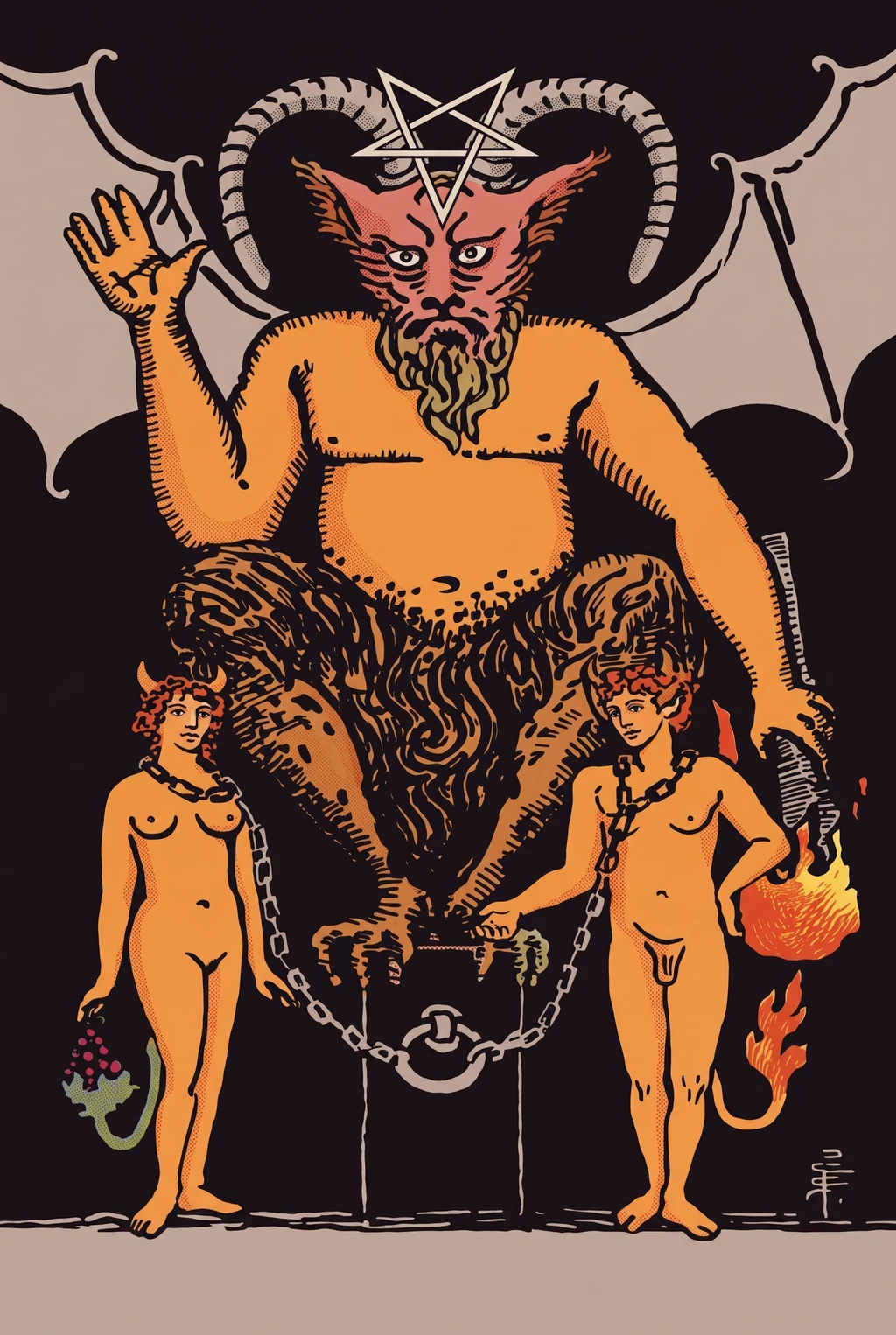
Two people share the same captivity, yet they remain human. The man and woman have small horns and tails, but their faces retain human expressions. Waite emphasized that their reason remained intact and wrote that the Devil's dominion would not last forever.
For now, both chains meet at a ring beneath his feet. The winged figure towers over the people, almost filling the dark space. The loops around their necks are wide, the links hang slack, and their hands are free. The image leaves room to imagine liberation but does not show how it would happen. Neither chain has been removed.
Core meaning
The Devil shows the power of desire and the cost of attachment. This card helps distinguish pleasure and free choice from a bond that increasingly takes control of a person's life.
- Key meanings:Attachment
- Temptation
- Dependency
- Control
- Materialism
- Sexuality
- Key meanings:Liberation
- Recognizing dependency
- Reclaiming independence
- Inner resistance
- Shame
- Denial
Image and symbols
Card image
A horned figure with a goat's head, beard, and outstretched bat wings towers over two naked people. Its legs are covered with fur and end in claws. A white inverted pentagram appears between its horns.
The figure's right hand, on the viewer's left, is raised with its palm facing forward. A dark mark appears on the palm. In its left hand, on the right, it holds a torch with the flame pointing downward. Beneath its feet is a black rectangular pedestal with a ring.
The woman stands on the left and the man on the right. Both have small horns, and loose chain loops around their necks connect to the ring on the pedestal. The woman's tail ends in a bunch of grapes; the man's ends in fire. The background is black, with no visible landscape.
Traditional context
Waite associates the chains with the bondage of material life and likens the human figures to Adam and Eve after the Fall. Their tails represent animal nature, but human reason endures. For Waite, the Devil's power is not final: even the dominant figure is not free.
Waite's list of divinatory meanings includes destruction, violence, vehemence, extraordinary effort, force, and a form of predestination that is not necessarily evil. The reversed card is associated with an unfavorable inevitability, weakness, pettiness, and blindness. This differs from today's common reading of the reversal as liberation.
Modern psychological interpretations focus on dependency, control, shame, and desires that are difficult to acknowledge. Strong attraction can be a pleasurable experience; its meaning changes when pleasure takes control of choice. The reversed card can suggest the weakening of dependency, a painful recognition of the problem, or an attempt to deny it.
Horned figure with a goat's head
An image of instincts and the desire to dominate, given a position of power.
Bat wings
In modern interpretations, they suggest desires that drain one's strength and take control.
Raised right hand
Waite contrasts this gesture with the Hierophant's blessing. It becomes an image of authority with an opposing, oppressive meaning.
Dark mark on the raised palm
In Hermetic interpretations, this is identified as the sign of Saturn: restriction and the difficult, gradual process of overcoming its power.
Inverted pentagram between the horns
Material desires take the place from which awareness and a broader understanding of life might otherwise guide us.
Downward-pointing torch
The fire of passion is directed toward earthly things. In modern interpretations, it represents an impulse that can take control if left unchecked.
Naked man and woman at the base
For Waite, they resemble Adam and Eve after the Fall. In a modern comparison with The Lovers, a freely chosen bond gives way to bondage.
Small horns and tails on the human figures
Their animal features show the power of instinct. Yet their human nature has not disappeared entirely.
Bunch of grapes on the woman's tail
Sensual pleasure and the desire for enjoyment.
Flame at the end of the man's tail
Lust and a powerful physical impulse.
Chains and loose loops around their necks
The bondage looks secure, yet the loose loops suggest the possibility of release. This image invites us to notice choices that remain available, not to assume that real coercion is ever voluntary.
Low rectangular pedestal, like half a cube
In Hermetic interpretations, this represents an incomplete understanding of the world: its visible, material aspect is mistaken for the whole of reality.
Colors
- Black background behind the figures
In symbolic interpretations, it emphasizes ignorance and fear, which can leave a person unaware of their own bondage.
Meanings
The Devil — Upright
General
Overall meaning
A desire, habit, or dependency has gained too much influence over decisions. Brief pleasure, a sense of security, or possession of something important can keep a person in a situation that has become costly.
The Devil also describes pressure and struggles for power. The feeling that there are 'no other options' becomes part of the situation, even though more choices may be available than it seems.
In a more affirmative reading, the card speaks to strong desire and ambition: excessive self-restraint can also stand in the way of action. What matters is distinguishing an honest acknowledgment of desire from letting it govern every decision.
Possible support
Support comes from being able to name what holds you back and recognize its influence. This gives you something concrete to work with instead of a general sense of helplessness.
Possible difficulty
Immediate rewards can outweigh an understanding of the consequences. Even clear signs of harm then become reasons for another justification rather than a change of course.
Focus
Notice where a familiar attachment narrows your sense of choice and makes dependency seem inevitable.
Reflection questions
- What is hard for me to give up, even when I can see the cost?
- Which options do I rule out in advance as impossible?
Relationships
Overall meaning
In a romantic relationship, the card may represent strong physical attraction and the pleasure of intimacy. Difficulties arise when desire turns into possessiveness, pressure, or dependence on a partner.
In friendship, The Devil can point to mutually reinforcing harmful habits. Within families, the focus shifts to control through guilt and forms of dependence that make it difficult to remain independent.
Possible support
Clear agreements about intimacy and boundaries help preserve freely given consent. Openly discussing expectations is especially useful when strong attraction develops faster than familiarity.
Possible difficulty
The desire to keep someone close can crowd out mutuality. In friendship, this may take the form of dependence on approval, jealousy, or control instead of support.
Focus
In romance, distinguish the strength of attraction from whether your expectations align. Within families, notice whether guilt has replaced the freedom to set a boundary calmly.
Reflection questions
- Can I decline intimacy or a meeting without being pressured?
- Is there a habit my friend and I reinforce in each other even though it harms us?
Work and study
Overall meaning
Work may feel like a place you cannot leave or change. The card also speaks to pressure, struggles for influence, and compromising professional principles for personal gain.
Another imbalance arises when status and achievement consume all your attention. In education, this may appear as a fixation on flawless performance that obscures the purpose of learning itself.
Possible support
Recognizing your own role in decisions at work can offer support. Even when you feel entirely dependent on a job, that does not rule out every possible action.
Possible difficulty
The desire to protect your income or position can keep you in work that conflicts with your principles and brings little satisfaction.
Focus
Consider whether other people's approval and financial compensation have become your only reasons for staying. The distinction here is between genuine interest in the work and a need to prove your worth.
Reflection questions
- What keeps me in this job beyond my interest in the work?
- Is the demand for a perfect result getting in the way of learning?
Money and resources
Overall meaning
Material desires can begin to outweigh control over spending. The Devil can symbolize repeated unnecessary purchases, a gambling-like attitude toward money, or dependence on immediate rewards.
The card also touches on the constraints of debt and the pursuit of profit at the expense of things that matter beyond money.
Possible support
Reconsidering financial priorities can reveal where the pursuit of gain is already creating dependency or demanding too great a sacrifice.
Possible difficulty
The brief satisfaction of a purchase or gain can reinforce behavior that makes your financial situation more difficult.
Focus
Notice recurring expenses that are hard to control and decisions in which an immediate reward obscures the later cost.
Reflection questions
- Which expense gives me only a moment of relief?
- What am I being tempted to sacrifice for the promise of a quick gain?
Wellbeing and self-care
Overall meaning
The card can describe stress and exhaustion when familiar ways of finding pleasure crowd out self-care. It is also associated with shame, helplessness, and emotional emptiness.
Possible support
Paying attention to your habits and treating yourself with greater care as you try to change them can help.
Possible difficulty
The pursuit of momentary satisfaction can keep pushing everyday self-care aside.
Focus
Notice a habit you have wanted to change for a long time and the feelings that accompany its repetition. Self-blame is no substitute for understanding what is happening.
Reflection questions
- Which habit gets in the way of taking care of myself?
- How do I speak to myself when I cannot change it right away?
Personal growth
Overall meaning
The Devil can point to beliefs about yourself that prevent you from trying things or making choices before you even begin. Fear, shame, or a habit of seeing yourself as incapable can sustain a lack of inner freedom.
Another theme is desires and impulses that are difficult to acknowledge. Denying them makes it harder to understand why your actions conflict with your convictions.
Possible support
Support comes from being willing to examine uncomfortable impulses without judging yourself and to seek help when needed.
Possible difficulty
An inner voice that declares you unworthy or incapable may be mistaken for an accurate account of who you are.
Focus
Consider which desire influences your actions but remains unnamed. The gap between what you consider important and what you repeatedly do can be especially revealing.
Reflection questions
- Which belief about myself do I accept as fact without questioning it?
- Which desire is difficult to acknowledge even to myself?
The Devil — Reversed
General
Overall meaning
The bonds become easier to see, and efforts to loosen their hold begin. This may mean giving up a harmful habit, leaving oppressive circumstances, or reclaiming the right to decide for yourself.
The Devil reversed does not always describe freedom already achieved. Familiar justifications may linger, while a clear understanding of the problem can coexist with anxiety and resistance to change.
In another interpretation, the reversal emphasizes denial or suppression of a problem: a difficult aspect of life is pushed aside rather than understood.
Possible support
Taking an honest view of changes already underway offers support: acknowledge the difficulty of the transition without treating it as proof that the effort is pointless, and seek support when needed.
Possible difficulty
Even a painful but familiar situation can feel safer than the unknown. A cynical 'nothing will change' can restore the hold of old beliefs.
Focus
Distinguish a dependency that is weakening from an attempt to declare the problem gone. Denial can hide behind the desire to feel free as soon as possible.
Reflection questions
- What has less control over my decisions now?
- Am I justifying a return to the familiar simply because change is uncomfortable?
Relationships
Overall meaning
It becomes possible to start changing a dependent relationship dynamic. In a couple, this might mean regaining independence and establishing more honest expectations, or sometimes leaving a relationship built on control. A weakening attachment does not necessarily mean indifference.
In friendship, the card allows for letting go of jealousy and mutual control. In a family, it can signify freedom from oppressive rules once treated as unquestionable.
Possible support
Respect for separate interests and the right to personal space can help. Supporting each other does not require constant dependence.
Possible difficulty
Recognizing an unhealthy dynamic is not the same as changing it. The difficulty may lie in having uncomfortable conversations and no longer excusing what you once found unacceptable.
Focus
In an existing relationship, notice which needs remain unspoken. Change calls for clear communication, not the expectation that your partner will somehow know everything without being told.
Reflection questions
- What change in communication gives me more freedom to be myself?
- Which of my needs have I not expressed directly?
Work and study
Overall meaning
There is an opportunity to reconsider dependence on work and status. This may mean leaving an oppressive environment, changing a strained relationship with a colleague, or no longer treating a job title as your only source of stability.
Change can also be less visible: a more suitable work schedule, fewer commitments made for approval. In education, the card can suggest that the pressure of perfectionism is easing.
Possible support
Relying on your own professional judgment, rather than only on a previous role, can help. Changing how you relate to others at work can also be a way to regain independence.
Possible difficulty
Old assumptions about your abilities may persist even after you decide to change something. They need to be reconsidered, or new possibilities may remain difficult to reach.
Focus
Notice which commitments you take on to gain others' approval and what work patterns sustain the old dependency.
Reflection questions
- What can I change about my current job without reducing my options to leaving?
- Which work commitment do I maintain mainly to earn approval?
Money and resources
Overall meaning
Financial habits and dependencies come under review. This may involve moving away from compulsive spending and material obsession toward greater independence in managing money.
In this area, the card can also suggest a reduction in financial dependence on a partner or family.
Possible support
A more mindful approach to spending helps: noticing old temptations and keeping your budget in view.
Possible difficulty
Old money habits and limiting beliefs may still stand in the way of change. Wanting to break free does not mean the process of reconsidering them is complete.
Focus
Check whether your approach to financial decisions is changing: what counts as a benefit, and which obligations sustain an unwanted dependency?
Reflection questions
- Which change in my spending gives me more independence?
- Which financial habit still needs my attention?
Wellbeing and self-care
Overall meaning
A reduction in compulsive behavior can bring relief, but the transition itself may be unsettling. Sometimes the external situation has already changed while difficult feelings remain.
This interpretation draws attention to your emotional state during change and a return to greater awareness of everyday habits.
Possible support
Support may come from someone close to you or a professional with whom you can discuss feelings that remain after a difficult change.
Possible difficulty
Anxiety about an unfamiliar situation can pull you back toward an old way of coping, even when you already understand its cost.
Focus
Look at the real changes in your habits, not just the discomfort that remains. Recognizing how far you have come matters, too.
Reflection questions
- What has become easier since the recent changes?
- Who can I talk to about what still worries me?
Personal growth
Overall meaning
You begin to free yourself from beliefs and habits that have limited your choices. There is a growing willingness to acknowledge fear, guilt, or previously rejected desires without defining yourself solely through them.
This acknowledgment may be uncomfortable. The aim is not to push everything unpleasant away but to understand it and develop a more conscious relationship with your impulses.
Possible support
Self-acceptance and attention to abilities once obscured by constant inner criticism provide support.
Possible difficulty
You may want to avoid everything that evokes shame instead of understanding what is happening. Denial then takes the place of inner change.
Focus
Notice what you hide out of shame. Being able to acknowledge it calmly to yourself or discuss it with someone you trust may ease inner tension.
Reflection questions
- Which old belief about myself am I beginning to reconsider?
- What can I acknowledge in myself without needing to justify every action?
Roles in a spread
Position examples
A position gives the card a question, such as what helps or what gets in the way. That question shapes how you read its meaning.
The Devil — Upright
Situation
A strong attachment or recurring pattern keeps the situation in place, making it hard to leave.
Influence
A desire for approval and material proof of your worth may influence your choices.
Motivation
The appeal lies in immediate pleasure, making it easy to put its later cost out of mind.
Support
Perseverance and a willingness to endure the difficult process of letting go of the familiar can offer support.
Obstacle
Dependency, pressure, or self-imposed limits that narrow your choices become obstacles.
Focus of attention
Notice the justifications that make a binding situation seem impossible to change.
Next step
Begin by clearly acknowledging what holds you back and what it costs you.
Possible development
If you continue to choose immediate gratification despite the consequences, a painful cycle may persist: the relief is brief, while the cost lasts much longer.
The Devil — Reversed
Situation
A former dependency is being recognized or is losing its hold; the transition toward independence may still be underway.
Influence
A familiar fear of the unknown can make old negative beliefs seem convincing again.
Motivation
Weariness with a repeating cycle and a desire for change become the motivation.
Support
The ability to recognize your strengths apart from habitual self-devaluation offers support.
Obstacle
The difficult transition itself may be an obstacle: the need to change your behavior becomes clear before you are able to do so.
Focus of attention
Consider whether you are still justifying an old pattern under the guise of newfound freedom.
Next step
Consider letting go of a bond, habit, or belief whose limiting influence you have already recognized.
Possible development
If you continue to examine familiar limitations honestly, their influence may gradually weaken.
Combination examples
Card combinations are in development. For now, here are a few examples.
The Devil + Seven of Cups
The Devil ( upright) + Seven of Cups ( upright)
- Example question:
- Where does the pursuit of pleasure become excessive?
- Example interpretation:
Together, these cards emphasize excess and extravagance when the desire for pleasure is difficult to restrain.
The Devil + Eight of Swords
The Devil ( upright) + Eight of Swords ( upright)
- Example question:
- Why do my available choices seem so limited?
- Example interpretation:
The themes of restriction and confusion become stronger: attachment is paired with difficulty seeing a way out.
The Devil + The Star
The Devil ( upright) + The Star ( upright)
- Example question:
- What counters the feeling that there is no way out?
- Example interpretation:
The Star offers hope and faith in the future in contrast with The Devil's dark sense of bondage. Together, the cards present two different perspectives on the possibility of change.
The Devil + Queen of Swords
The Devil ( upright) + Queen of Swords ( upright)
- Example question:
- How do an appealing desire and my principles relate to each other?
- Example interpretation:
The pairing may show a conflict between temptation and moral judgment: desire meets the need to distinguish what is acceptable from what is not.
The Devil + Six of Pentacles
The Devil ( upright) + Six of Pentacles ( upright)
- Example question:
- How does the desire to feel important influence the help I give?
- Example interpretation:
Helping others may become a way to reinforce a sense of self-importance. This reading invites reflection on the role the desire to matter plays in offering help.
Reading example
An imagined one-card reading shows how the meanings above can apply to a question. This is one possible interpretation.
The Devil — Upright
Situation:
This job has not felt fulfilling for a long time, yet the thought of leaving brings anxiety. Work increasingly fills the evenings, and attempts to discuss the workload keep getting postponed: losing a familiar source of stability feels frightening.
Question:
What do I need to recognize about my relationship with this job?
-
Card drawn:
Imagine drawing a card for the position «What to Pay Attention To» and getting The Devil (upright).
Interpretation:
The Devil helps bring the hold this job has on you into focus, especially when staying begins to seem like the only option. It may help to separate what genuinely keeps you there from anxious assumptions about change.
Begin with an honest answer: what does this job give you, and what does it cost to maintain that familiar stability? This perspective leaves room to discuss your workload, rather than seeing only the frightening choice between enduring things as they are and leaving immediately.
The Devil — Reversed
Situation:
This job has not felt fulfilling for a long time, yet the thought of leaving brings anxiety. Work increasingly fills the evenings, and attempts to discuss the workload keep getting postponed: losing a familiar source of stability feels frightening.
Question:
What do I need to recognize about my relationship with this job?
-
Card drawn:
Imagine drawing a card for the position «What to Pay Attention To» and getting The Devil (reversed).
Interpretation:
The Devil reversed shifts the focus toward reclaiming your independence. Change here does not have to begin with quitting your job: you could stop taking on new tasks to gain approval and discuss your work schedule.
Lingering anxiety does not make this reassessment pointless. One possible step is to name the workload you no longer want to accept in silence and bring it into a conversation.
Yes / No
The Devil — Upright
Why this answer
No. The Devil connects the decision at hand with dependency, excessive desire, or restricted choice. In this practical framework, it therefore does not support continuing on the same terms.
A clarification
What matters most is whether desire is becoming excessive. If pursuing it requires you to surrender more and more independence, the goal's appeal does not change the answer from no.
A question to consider
Am I giving up my freedom to choose in pursuit of something I want?
The Devil — Reversed
Why this answer
Yes. In this practical framework, The Devil reversed supports breaking free from a limiting pattern and moving toward more independent choices. The answer rests on changing an existing dependency, not continuing it.
A clarification
If the question concerns rekindling a formerly dependent relationship, freedom may mean choosing not to return rather than reconciling. Changing a relationship and restoring the old dynamic are not the same thing.
A question to consider
Does my decision help me leave an old dependency behind, or bring me back into it?
Correspondences
Connections with numbers, elements and other symbols add depth to the card’s imagery. They can differ between traditions.
Number — XV (15)
Adding the digits 1 + 5 gives 6, inviting comparison with The Lovers: choice and connection can take the form of dependency.
Element — Earth
A link to physical life and the material world; in this card, attachment to possessions and tangible pleasures stands out.
Astrology — Capricorn
Emphasizes material goals, discipline, and restriction. Saturn, associated with Capricorn, adds the theme of structures that can provide order or impose constraints.
Letter — Ayin (ע), “eye”
This correspondence draws attention to sight and perception: what appears to be the whole of reality may be only its visible part.
Tree of Life — Path 26: Tiphareth — Hod
Connects Tiphareth, understood as a harmonizing center, with Hod, the sphere of analysis and rational explanation. For The Devil, the risk lies in mistaking a limited rational picture for the whole.