
Six of Pentacles
Descriptions and symbolism are based on the card’s classic illustration in the Rider–Waite–Smith deck. Details of the artwork may differ in other editions of the deck.
This guide brings together traditional and modern readings. Interpretations and answers may differ between authors and schools.
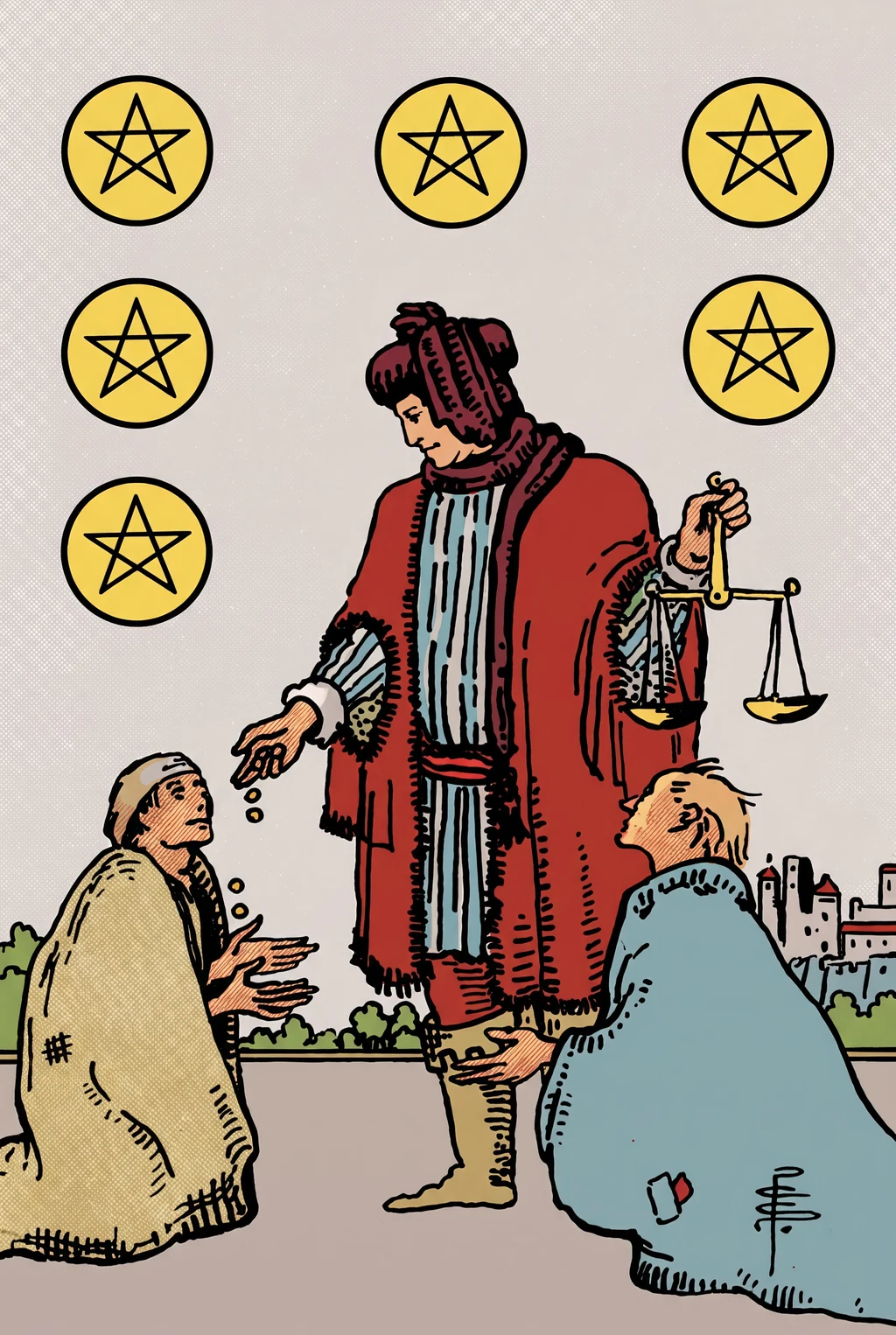
One person is already receiving coins; another still waits with an outstretched hand. For the giver, these are two gestures close together. For those on their knees, there is a meaningful divide between them. One has already received an answer. The other can only watch and wait to see whether the person holding the scales will turn toward them.
The measure of the help rests in one hand, the help itself in the other. The one waiting can speed up neither the weighing nor the decision. Coins move downward into open palms, and for a moment all attention gathers around this small sum. Its weight is different for each of them.
Core meaning
The Six of Pentacles speaks to generosity, mutual support, and the ability to accept help. It also draws attention to the terms of the exchange: who controls the assistance, and whether both sides retain their dignity.
- Key meanings:Generosity
- Accepting help
- Reciprocity
- Fair exchange
- Gifts
- Mentorship
- Key meanings:Unequal giving
- Help with strings attached
- Unpaid debt
- Excessive generosity
- Stinginess
- Self-care
Image and symbols
Card image
At the center stands a figure wearing a red headdress and a long red garment. Blue-and-white striped fabric is visible underneath. The figure's head is tilted and turned to the viewer's left.
In the left hand, on the right side of the image, the figure holds a set of scales. From the right hand, coins fall into the outstretched palms of the person kneeling on the left. On the other side, another kneeling figure in a blue cloak also reaches out a hand.
Above them are six golden disks bearing five-pointed stars. The background is gray; greenery and a distant building can be seen to the right behind the people.
Traditional context
For Waite, the person handing out coins represents worldly success and kindheartedness. The upright meanings include gifts, satisfaction, a favorable moment, and present prosperity; Waite also offers attention and vigilance as an alternative. The reversed list includes desire, greed, envy, jealousy, and illusion.
In an additional list in the same book, he cautions against relying on the present, while the reversed card is linked to limits on ambition. Waite himself notes inconsistencies between these lists: these are different divinatory interpretations, not one undisputed definition.
In the Golden Dawn system, the card is called the “Lord of Material Success.” Here, the emphasis falls more strongly on an established position and influence. An unfavorable combination with surrounding cards in that system should not automatically be equated with a reversed card.
A modern reading considers both sides of giving and receiving. For Joan Bunning, the card concerns having and lacking not only money but also knowledge or power. Generosity therefore sits alongside a question of inequality: the decision about who receives help remains with the person holding the scales.
A well-dressed figure standing
Prosperity and the means to share. According to Waite, the figure's actions express kindness and success already achieved.
Two kneeling figures
Need and a willingness to accept help. The difference in the figures' positions also reveals an imbalance of power between the giver and the recipients.
Scales in the left hand
Measure and fairness in distribution. Yet the decision about who receives how much remains with the person holding the scales.
Coins falling into open palms
Help becomes a concrete action: what one person has is passed to another. This is an image of giving, not accumulating.
Six disks bearing five-pointed stars
The material side of exchange: money and other tangible forms of support.
A distant building on the right
In a modern reading, it reinforces the contrast between prosperity and need that shapes the scene of giving.
Colors
- The giver's red outer garment
It may emphasize activity in material affairs, as well as the visibility and power of the person controlling the assistance.
- Blue stripes beneath the red garment
In a modern reading, they draw attention to the giver's inner life: their feelings and personal needs are also part of the exchange.
- Gray background
Neutrality: the moral significance of giving depends on the intentions and actions of those involved, rather than being determined by a single outward gesture.
- Green trees in the background
They may represent prosperity and abundance present alongside the scene of need.
Meanings
Six of Pentacles — Upright
General
Overall meaning
The card describes help you can offer or receive: money, time, knowledge, or personal involvement. One person has something to share, while support can help another cope with a shortage.
Fairness in the exchange is also central. A generous act does not erase differences in power: what matters is whether the person receiving help retains their dignity and freedom of choice.
Possible support
Support comes from being willing to accept manageable help without shame and to share what you can genuinely spare.
Possible difficulty
Even generous help can reinforce dependence if the recipient must obey the person controlling the support.
Focus
Consider what lies behind an offer to help: a wish to support someone's independence, or an opportunity to control their decisions.
Reflection questions
- What kind of help would be useful for me to accept right now?
- What can I share without harming my own well-being?
Relationships
Overall meaning
In a romantic relationship, the card speaks to mutual care, support for a partner's plans, and a willingness to respond to their needs. In family and friendship, it may represent practical help during a difficult period.
Reciprocity does not require equal financial contributions. Different divisions of responsibility can work for both people as long as neither person's worth is diminished by the arrangement.
Possible support
A relationship is supported when both people can care for each other and ask for care when they need it.
Possible difficulty
Difficulties arise when attention, time, or effort are shared unfairly and one partner is always the giver.
Focus
Helping someone close to you requires respect for their dignity and privacy. Don't turn the support you've given into a story for outsiders.
Reflection questions
- What kind of support is easier for me to give than to ask for?
- Am I comfortable with how we share care and responsibilities?
Work and study
Overall meaning
In work and study, the card is associated with mentorship, sharing skills, and support from someone more experienced. In a project, it may point to help with essential resources or knowledge.
Another theme is recognition of contributions: fair compensation, employee training, and a willingness to share expertise.
Possible support
A mentor who explains something difficult and helps you develop a missing skill can offer practical support.
Possible difficulty
In a challenge position, the card highlights a mismatch between the work someone puts in and what they receive in return.
Focus
Check whether recognition is reflected in concrete terms—pay, training, and support—not only in praise.
Reflection questions
- Who can I ask for help with something I don't yet know how to do?
- What part of my experience can I pass on to someone else?
Money and resources
Overall meaning
Here, the card encompasses gifts, loans, charity, and other forms of material support. You may be the one receiving or offering help; for a project, it can also point to raising funds from a community.
Another reading concerns keeping income and expenses in balance, allowing you to give without undermining your own stability.
Possible support
Temporary financial assistance may offer breathing room while you regain the ability to support yourself.
Possible difficulty
One-time assistance is not a substitute for a sustainable way to cover expenses. Ongoing reliance on it can become a vulnerability.
Focus
Look closely at how shared money and property are divided: is someone gaining an advantage at others' expense?
Reflection questions
- What temporary help could I accept so I can manage on my own afterward?
- How much money can I genuinely spare to help others after covering my essential expenses?
Wellbeing and self-care
Overall meaning
In everyday self-care, this card speaks to support from loved ones and the possibility of not having to handle everything alone. Caring also includes your own needs: rest and a manageable workload.
Possible support
Support may come from loved ones, rest, and a gentler attitude toward your own limits.
Possible difficulty
The habit of giving more than your energy allows, along with difficulty accepting help, can upset the balance.
Focus
Compare the time and energy you give to others with what remains for your own everyday needs.
Reflection questions
- Which everyday responsibility would be easier with help from people close to me?
- Do I leave time to rest when I help others?
Personal growth
Overall meaning
The card invites you to practice both generosity and openness to receiving help. Compassion becomes tangible action, and needing support does not determine a person's worth.
The roles of giver and receiver can change. A mature approach to mutual support means not basing self-worth solely on who is contributing more at the moment.
Possible support
Offering help within your means lets you express compassion through actions, rather than stopping at good intentions.
Possible difficulty
Receiving can be difficult when the very need for help feels like a loss of dignity.
Focus
Notice whether you see yourself as above or below someone else simply because you can offer help—or need it—right now.
Reflection questions
- Does the way I see myself change when I'm the one who needs help?
- How do I express compassion through my actions?
Six of Pentacles — Reversed
General
Overall meaning
The reversed card shows an exchange out of balance: help is not reciprocated, comes with demands, or costs the giver too much. Opposite extremes are also possible: unwillingness to share or refusal to accept needed support.
Its meaning is not limited to loss. Sometimes generosity needs to turn inward: acknowledging your own needs and reconsidering obligations that leave no room for them.
Possible support
Revisiting the agreement may help: reduce further assistance or agree on a contribution in return that is manageable.
Possible difficulty
Guilt, resentment, and constant scorekeeping turn help into an obligation that is hard to refuse.
Focus
Distinguish a lack of capacity from an unwillingness to respond. One calls for a boundary; the other calls for recognizing a lack of involvement.
Reflection questions
- What help am I agreeing to provide beyond my means?
- Which terms of an exchange do I need to discuss again?
Relationships
Overall meaning
In a relationship, the card may describe one-sided care: one person keeps giving way while the other takes more and more. The giver builds resentment; the recipient may feel dependent. Financial support can sometimes become a means of control.
In friendship, another pattern is a loan that has not been repaid or help that did not receive the response expected.
In a new relationship, the card may reflect concern that your efforts will not be reciprocated, especially after a painful breakup or conflict.
Possible support
An open conversation about needs and expectations, with both partners willing to reconsider their share of the effort, can help.
Possible difficulty
Dependence on a partner's money can limit independence: giving help begins to be seen as grounds for demanding obedience.
Focus
Consider whether continually agreeing to someone else's terms has become the unspoken price of their support.
Reflection questions
- Can I say no to a request without fearing I'll lose support?
- What imbalance in how we care for each other do I need to discuss?
Work and study
Overall meaning
In a workplace setting, the card is associated with unfair pay, unrecognized contributions, and a lack of support. Help from a mentor or supervisor may carry an expectation of special favors or loyalty.
Another side of the exchange is trying to gain an advantage by pleasing someone influential rather than through your own work.
Possible support
It may help to make your contributions clear and advocate for fairer working conditions.
Possible difficulty
Patronage with unspoken obligations ties professional support to a willingness to comply with someone else's demands.
Focus
Also look at cutbacks in necessary training or professional help: is the work being deprived of the support it needs?
Reflection questions
- What do I receive in return for my work?
- What favors are implied by the support I've been offered?
Money and resources
Overall meaning
The card may point to delayed or unreturned support, an unequal distribution of money, or dependence on someone else's terms. Another possibility is excessive generosity: money goes toward helping others even when there's not enough to cover your own obligations.
Loans and debts deserve separate attention here, especially when their terms deepen dependence instead of offering temporary relief.
Possible support
Reexamining expenses and obligations with your own financial stability in mind can provide a firmer footing.
Possible difficulty
Obligations may build faster than you can pay them off. Help offered on unequal terms narrows your choices further.
Focus
When giving money to help, check whether it will reach the intended recipient and whether the purpose of the collection is clear.
Reflection questions
- Am I using money needed for my own obligations to help others?
- Do I understand where my contribution will go?
Wellbeing and self-care
Overall meaning
Caring for others can take up all available time, leaving your own needs unattended. The reversed card invites you to notice this imbalance and redirect some of the care you usually give others toward yourself.
Possible support
Accepting help without guilt and making time for activities that support your well-being can provide relief.
Possible difficulty
Constantly giving beyond your capacity leaves your own needs unattended: there is no care left to give them.
Focus
Notice where you keep agreeing to new requests even though you have no time or energy left.
Reflection questions
- What part of my self-care keeps getting postponed because of other people's requests?
- What help do I find difficult to accept without feeling guilty?
Personal growth
Overall meaning
The card draws attention to the motives behind generosity. Constantly helping may be driven by a need to earn approval, feel indispensable, or maintain influence.
The opposite imbalance is refusing to receive: needing support feels like weakness. In both cases, it helps to separate your worth from your role in the exchange.
Possible support
Acknowledging your own efforts and caring for yourself after a long period of giving to others may help.
Possible difficulty
Always trying to be the rescuer can sustain someone else's dependence and tie your self-worth to how hard things would be without you.
Focus
Compare your real reasons for helping with what matters to you: compassion, reciprocity, or the wish to earn someone's good opinion.
Reflection questions
- What do I hope to gain when I agree to help?
- Am I tying my worth to how much others need me?
Roles in a spread
Position examples
A position gives the card a question, such as what helps or what gets in the way. That question shapes how you read its meaning.
Six of Pentacles — Upright
Situation
Someone offers help, while someone else decides how to accept it. The reading invites a closer look at how opportunities are distributed and at the terms of that exchange.
Influence
A person or community with the means to offer practical support may be influencing the situation.
Motivation
The impulse may be a sincere wish to help. Another possible motive is the satisfaction of feeling needed and influential.
Support
Support may come from another person's practical involvement: needed knowledge, time, or material help.
Obstacle
An unequal exchange becomes an obstacle when one side consistently gives more and the distribution of help depends on someone else's self-interest.
Focus of attention
Consider whether help remains freely given or quietly becomes a claim to make decisions for the person receiving it.
Next step
Consider a specific form of help you can reasonably offer: share your time, skills, or money, or support someone else's initiative.
Possible development
Support can be a step toward greater independence if temporary help does not become ongoing dependence.
Six of Pentacles — Reversed
Situation
Mutual support has fallen out of balance: efforts go unreciprocated, while offers of assistance turn out to have demands attached.
Influence
Obligation, guilt, or resentment may shape the exchange more than a freely chosen desire to help.
Motivation
Behind conspicuous generosity there may be a wish to earn approval, appear more virtuous, or keep another person dependent.
Support
You can find support in changing your part of the exchange: rather than automatically continuing to give as before, discuss a different contribution in return.
Obstacle
Unspoken debts, overgiving, and taking advantage of another person's generosity keep relationships from being reciprocal.
Focus of attention
Look at the unspoken terms: what does the giver expect, and what is the recipient actually agreeing to?
Next step
Set a limit on what you can give if you have nothing more to spare. If the issue isn't a lack of resources, consider what is keeping you from offering help.
Possible development
If the imbalance in giving continues, it may increasingly drain the giver and deepen the recipient's dependence.
Combination examples
Card combinations are in development. For now, here are a few examples.
Six of Pentacles + Five of Pentacles
Six of Pentacles ( upright) + Five of Pentacles ( upright)
- Example question:
- What material support is needed?
- Example interpretation:
The Five emphasizes a lack of resources. In this pairing, the Six is viewed primarily from the perspective of the person needing help, rather than the person with a surplus.
Six of Pentacles + Ten of Pentacles
Six of Pentacles ( upright) + Ten of Pentacles ( upright)
- Example question:
- Is there enough prosperity to share?
- Example interpretation:
The Ten emphasizes abundance. Beside it, the Six draws attention to available resources and the position of someone able to help.
Six of Pentacles + Justice
Six of Pentacles ( upright) + Justice ( upright)
- Example question:
- How fair are the terms of the help?
- Example interpretation:
Material exchange is considered alongside the fairness of its terms and their consequences. This pair emphasizes whether support is arranged justly, not only the generosity of the gesture itself.
Reading example
An imagined one-card reading shows how the meanings above can apply to a question. This is one possible interpretation.
Six of Pentacles — Upright
Situation:
Someone close to you offers to help cover your expenses while you're changing jobs. The support would be welcome, but accepting it feels awkward: you're not sure whether the money would come with new obligations.
Question:
What should I consider before agreeing?
-
Card drawn:
Imagine drawing a card for the position «What to Pay Attention To» and getting Six of Pentacles (upright).
Interpretation:
The Six of Pentacles points to the possibility of accepting support with dignity. In this situation, it invites you to see the offer as a temporary source of support: right now, one person has something to share, while the other has a greater need for that help.
You could discuss which expenses need covering and how much help the person close to you can comfortably offer. This allows you to consider the offer without rushing to turn it down simply because accepting feels uncomfortable.
Six of Pentacles — Reversed
Situation:
Someone close to you offers to help cover your expenses while you're changing jobs. The support would be welcome, but accepting it feels awkward: you're not sure whether the money would come with new obligations.
Question:
What should I consider before agreeing?
-
Card drawn:
Imagine drawing a card for the position «What to Pay Attention To» and getting Six of Pentacles (reversed).
Interpretation:
The reversed Six of Pentacles draws attention to the cost of accepting help and the freedom to choose. In this situation, it's still unclear what is expected in return. The card encourages you not to let a polite yes leave that question unasked.
You can ask directly about repayment and any other expectations. Before accepting the offer, it's worth considering whether the agreement leaves you free to decide what kind of work to pursue.
Yes / No
Six of Pentacles — Upright
Why this answer
Generosity, support, and fair exchange point toward yes. This reading is especially clear in questions about help, cooperation, and mutual involvement.
A clarification
A positive reading assumes an exchange within each person's means. Giving should not deprive the giver of what they need or require the recipient to give up their independence.
A question to consider
Can I take part in this exchange while keeping what I need for myself?
Six of Pentacles — Reversed
Why this answer
Unequal giving, dependence, and help that comes with demands point toward no. Continuing this kind of exchange deepens the imbalance rather than creating mutual support.
A clarification
For questions about support, consider the cost of agreeing: hidden obligations, demands for loyalty, or giving beyond your means. Terms like these call for revisiting the agreement itself.
A question to consider
What obligations am I taking on by accepting this help?
Correspondences
Connections with numbers, elements and other symbols add depth to the card’s imagery. They can differ between traditions.
Number — VI (6)
Six is associated with harmony and alignment. Here, that means seeking balance between giving and receiving.
Number — VI (6)
In Book T, the sixes signify fulfillment and achieved results. In Pentacles, that emphasis concerns material matters.
Element — Earth
Money, everyday necessities, and tangible help. Material resources are considered here through their transfer and distribution.
Astrology — Moon in Taurus; second decan, 10°–20°
In Book T, this is a correspondence of the “Lord of Material Success.” In a modern reading, it connects care with a need for material security.
Tree of Life — Tiphereth in the suit of Pentacles; final Heh
In Book T, this connection is expressed through success in material matters and the prosperity of an undertaking.