
Queen of Swords
Descriptions and symbolism are based on the card’s classic illustration in the Rider–Waite–Smith deck. Details of the artwork may differ in other editions of the deck.
This guide brings together traditional and modern readings. Interpretations and answers may differ between authors and schools.
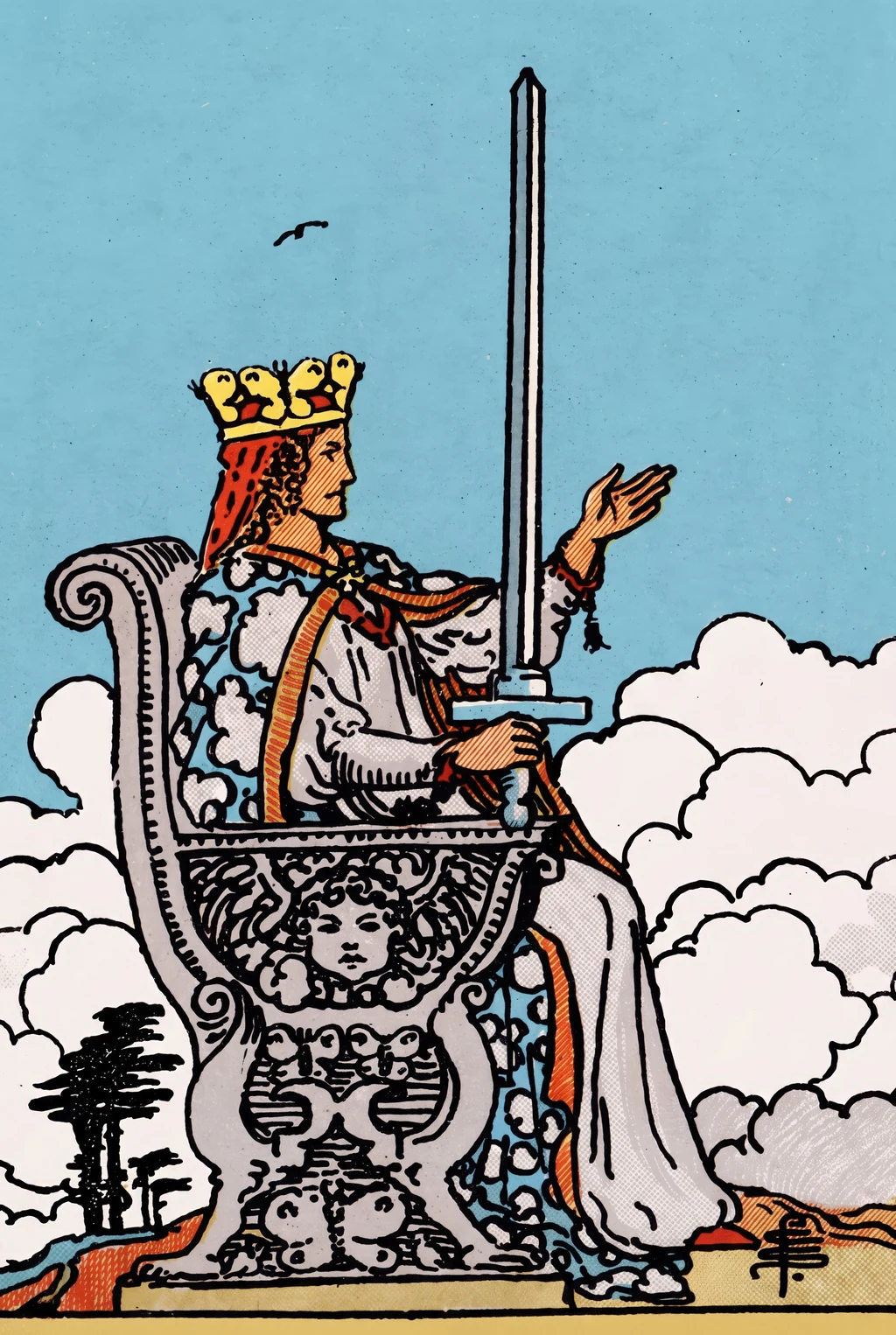
The Queen of Swords seems to let the other person finish speaking, even when she does not like what she hears. Her left palm is open and extended, while her right hand holds the sword upright. The gesture shows a willingness to listen without promising agreement in advance.
Waite saw a familiarity with sorrow in her stern face. Her severity takes on a human depth: she seems like someone for whom loss is more than an abstract word. Between the Queen and the person we imagine before her, there is room for clear words. The blade maintains a boundary, but the hand remains extended. Her reserve still leaves room for another person.
Core meaning
Clear judgment, independence, and honest conversation. The Queen of Swords knows how to protect boundaries and see what matters; her severity is often shaped by experiences of loss.
- Key meanings:Clarity
- Independence
- Honesty
- Insight
- Boundaries
- Life experience
- Key meanings:Harshness
- Bias
- Resentment
- Self-criticism
- Suppressed voice
- Outside influence
Image and symbols
Card image
The Queen sits on a gray stone throne, her head turned in profile to the viewer's right. In her right hand she holds a sword vertically, with its hilt near the armrest; her left hand extends forward with an open palm.
She wears a white dress and a blue cloak patterned with clouds. Butterflies adorn her crown, and red fabric hangs from beneath it. The side of the throne is carved with a winged child's head, a butterfly, and paired curved figures. A dark tassel hangs from her left wrist.
Above the bank of clouds, a blue sky remains, with a lone bird. At lower left, trees bend in the wind.
Traditional context
Waite emphasizes sorrow and loss already endured. The Queen's face is stern but familiar with grief; despite the sword, he does not regard her as an obvious symbol of power or mercy. His divinatory meanings for the upright card include widowhood, female sadness and embarrassment, absence, sterility, mourning, privation, and separation.
For the reversed card, Waite lists malice, bigotry, artifice, prudery, bale, and deceit. This is the historical vocabulary of his divinatory system, not a description of everyone who draws the card.
Modern interpretations broaden this image considerably: experience becomes insight, independence, and the ability to speak directly. Joan Bunning adds humor and freedom from self-deception to the Queen's severity. She can represent a quality of communication or a person of any gender, not necessarily a woman of a particular age or marital status.
The Queen's stern expression
Waite sees the restrained sorrow of someone familiar with loss.
Profile facing right
In Liz Dean's reading of the composition, this suggests looking toward the future.
Sword held vertically
Judgment and boundaries. In Liz Dean's interpretation, the sword also suggests that strictness can outweigh compassion.
Open left palm
A willingness to hear another perspective and take in new information.
Butterflies on the crown and throne
A changing view of oneself and the world, and freedom of thought.
Winged child's head on the throne
Gentleness and compassion that may remain behind an outwardly reserved manner.
Cloud pattern on the cloak
A connection to Air and the realm of thought. Liz Dean also reads the cloak as an image of freedom.
A lone bird high in the sky
High principles and the ability to view a difficulty from a greater distance.
Clouds below the Queen's head
The clouds can represent past pain and confusion that she has managed to rise above.
Trees bending in the wind
Changes around the Queen, who maintains her composure.
Paired sickle-shaped figures on the throne
Liz Dean interprets them as sickles of divine judgment; another reading sees crescent moons associated with intuition.
Tassel at the left wrist
This detail may echo the bindings in the Eight of Swords: a reminder of past restriction and release.
Colors
- White — dress
Purity of intention and an association with Air in Liz Dean's symbolic reading.
- Blue — upper sky
Truthfulness and clarity as guiding qualities for the Queen's words and decisions.
- Gray — bank of clouds
The lighter gray clouds can suggest new thoughts, while the darker area may suggest worry.
Meanings
Queen of Swords — Upright
General
Overall meaning
The Queen of Swords represents independent judgment: understanding what is happening, separating facts from impressions, and getting to the point without evasions. She may represent an insightful person to talk with or a way of approaching a situation.
Experience, precision, and personal boundaries matter here. Reserve does not rule out compassion: you can hear another person's reasoning without giving them the right to decide for you.
Possible support
A combination of clear-eyed assessment and compassion helps you make sense of a difficult situation without reducing people to their mistakes.
Possible difficulty
Even an accurate observation can hurt when directness turns harsh.
Focus
Examine your own honesty. Well-placed humor can also help you see a situation more clearly without mocking anyone.
Reflection questions
- What facts support my judgment?
- What do I need to say directly?
Relationships
Overall meaning
In a partnership, the card brings together loyalty and a need for independence. Closeness can grow from shared views and quiet trust without constant romantic gestures. It may also reflect a conscious choice to remain single.
In friendship, it suggests honest advice and respect for personal space. In family life, it may emphasize clear rules and encouraging independent thinking.
Possible support
An honest conversation about needs, with room for both clear boundaries and compassion for your partner.
Possible difficulty
Protective reserve can slow the growth of intimacy: it may be difficult to let someone closer.
Focus
In a romantic relationship, it is worth distinguishing between considering your partner's needs and abandoning your own to keep the relationship intact.
Reflection questions
- What personal space do I need to preserve in a close relationship?
- What do I want to discuss openly and agree on with my partner?
Work and study
Overall meaning
The card relates to professional independence, precise analysis, and fair treatment of colleagues. It can represent an experienced mentor who offers useful, if demanding, feedback.
In learning, it highlights an interest in continuing education and a willingness to develop intellectual skills.
Possible support
Your own work experience, including lessons from past mistakes. It helps you assess a task beyond theory alone.
Possible difficulty
A difficult workplace conversation may require attention to both the facts and other people's feelings.
Focus
Your own principles matter in a career decision. Compare the actual conditions in your current field and the one you hope to enter, rather than just its appealing image.
Reflection questions
- What past experience can help me assess this task?
- Which working conditions are essential to me?
Money and resources
Overall meaning
In money matters, the focus is on clear calculations and straightforward agreements. Helping someone close to you is considered in light of your own means and terms agreed upon in advance.
Possible support
Financial literacy and comparing different arguments help you form your own view rather than blindly following advice.
Possible difficulty
Personal affection or a strong desire for a particular outcome can make it harder to assess a financial decision impartially.
Focus
The terms of financial help deserve particular attention: what exactly is being provided, and how is the debt expected to be repaid?
Reflection questions
- Do I understand the terms of this financial agreement?
- How would helping someone else affect my expenses?
Wellbeing and self-care
Overall meaning
Composure can help you make sense of difficult experiences. Sometimes the card describes trying to stay strong for others and reason through pain while keeping feelings at a distance.
Possible support
The chance to share what you are going through with someone you trust instead of handling everything in silence.
Possible difficulty
Constantly holding back feelings can leave your own experiences unattended.
Focus
When talking about how you feel, it matters not to leave out what is troubling you or what support you need.
Reflection question
Which feelings have I only been trying to explain, without allowing myself to express them?
Personal growth
Overall meaning
Defining yourself through your own convictions and an honest view of who you are. The card speaks to a willingness to let go of pretense, stand by a considered position, and look at life without self-deception.
Possible support
Lived experience brings more realistic expectations and makes it possible to acknowledge human weaknesses without arrogance.
Possible difficulty
It can be hard to admit an uncomfortable truth about yourself, even when you already recognize it.
Focus
A past mistake can be useful experience: consider what you can take from it now so you do not repeat the same way of choosing.
Reflection questions
- What lesson from past experience can I use now?
- Which of my beliefs can I genuinely explain?
Queen of Swords — Reversed
General
Overall meaning
Clarity of judgment can falter in two different ways. In one, a critical attitude becomes cold, suspicious, and hurtful: someone notices flaws but stops listening to the response.
In the other, your own voice grows quieter. Strong feelings or another person's opinion overshadow your own decision; it becomes difficult to state your position for fear of disturbing a familiar sense of agreement. These two readings do not have to appear together.
Possible support
Calm advice from someone whose judgment you trust may help before your next step.
Possible difficulty
Misunderstandings and biased conclusions make it harder to see an obstacle for what it is.
Focus
The tone and effect of your words: what explains your position, and what only hurts the other person?
Reflection questions
- Where is someone else's opinion drowning out my own?
- What might be biased in my conclusion?
Relationships
Overall meaning
In a romantic relationship, this may be sharp criticism, mistrust, or carrying past hurt into a present conversation. At the other extreme, it can appear as difficulty standing by your own opinion with a partner.
In friendship, the card may describe gossip that sets people against each other; in family life, a cold, demanding manner that sometimes reflects an overwhelmed parent. A separate, less conflicted reading is the desire to remain single.
Possible support
A conversation in which both people can speak and the difficulty is addressed together, without trying to punish a partner with words.
Possible difficulty
Holding on to an old grievance can make it harder to resolve a past conflict and build new closeness.
Focus
When speaking with your partner, it is worth distinguishing the need to explain yourself from the wish to answer hurt with hurt.
Reflection questions
- What old conflict might I be bringing into this conversation?
- Can I express my own opinion with my partner?
Work and study
Overall meaning
The card may describe workplace communication in which discussing the task gives way to attacks and faultfinding. Sometimes it represents a demanding person who uses words to humiliate others; sometimes it points to your own harshness, which makes collaboration harder.
Another aspect is the feeling that work has reached a dead end: dissatisfaction obscures opportunities to discuss conditions and develop new skills.
Possible support
When considering a change of profession, a conversation with a mentor who knows the realities of the new field can help.
Possible difficulty
Unsolicited lectures and hasty reactions can increase colleagues' resistance and misunderstandings.
Focus
State the project's problem separately from accusations against a person; that makes it easier to discuss the reasoning itself.
Reflection questions
- How can I describe a work problem without blaming someone personally?
- What do I need to learn about the conditions in a new field before deciding to leave?
Money and resources
Overall meaning
Financial clarity may be lost when information is incomplete or agreements are unclear. Possible situations include difficulties getting money back from loved ones, and giving help or spending beyond your own means.
Possible support
When preparing to start a business, an independent review of calculations and assumptions can be useful: a second perspective may reveal overlooked details.
Possible difficulty
Overconfidence can obscure risks, while other people's interests may displace your own criteria for making a decision.
Focus
Check which information is incomplete or comes from an unreliable source. It is especially easy to misunderstand terms on that basis.
Reflection questions
- What part of this financial agreement is still unclear to me?
- What information am I basing this calculation on?
Wellbeing and self-care
Overall meaning
Emotional exhaustion may come with withdrawal and a desire to shut out support. In a gentler reading, the card can simply suggest a need for quiet and solitude.
Possible support
Being able to accept gentle support without expecting yourself to handle everything alone.
Possible difficulty
Self-protection can turn into isolation that cuts off both comfort and the connection you want.
Focus
Pay attention to the words you use to judge yourself: a constant accusatory tone also calls for care.
Reflection questions
- What kind of support would be easiest for me to accept?
- How do I speak to myself on a difficult day?
Personal growth
Overall meaning
Inner criticism can obscure the ability to learn: your mistakes become grounds for condemnation rather than opportunities for new understanding. It is also possible to repeat an old way of reacting despite the experience you have gained.
Possible support
A willingness to forgive yourself for a mistake and ease the demand for perfection.
Possible difficulty
Overconfidence can make it harder to learn, welcome new ideas, and acknowledge the limits of your knowledge.
Focus
Notice your habitual way of judging yourself and others: where does it leave room for fresh understanding, and where does it reach a verdict in advance?
Reflection questions
- What mistake do I still use as evidence against myself?
- Where do I find it hard to admit that I do not know everything yet?
Roles in a spread
Position examples
A position gives the card a question, such as what helps or what gets in the way. That question shapes how you read its meaning.
Queen of Swords — Upright
Situation
A setting where open discussion becomes possible: naming what is happening without pretense or leaving things unsaid.
Influence
The influence of experience and a clear-eyed perspective: the ability to step back from details and see the situation as a whole.
Motivation
A desire to understand what is happening and maintain independent, honest judgment.
Support
Insight and the ability to ease awkwardness with well-timed humor, without putting anyone down.
Obstacle
Directness that turns into a cutting remark and hurts the other person.
Focus of attention
First examine your own honesty, then look at what remains unsaid in the conversation.
Next step
State your position clearly and offer a well-considered idea rather than hiding it behind hints.
Possible development
The situation may lead to a choice that calls for experience. What becomes possible next is tied to speaking clearly and listening carefully.
Queen of Swords — Reversed
Situation
The discussion becomes tangled: misunderstandings and one-sided judgments make it hard to agree on what is happening.
Influence
Pressure from others may push aside your own judgment and shape which decisions seem possible.
Motivation
A wish to avoid disagreement or protect the relationship from tension, which leads you to put your own plans aside.
Support
Outside advice that helps you check your own perspective before taking action.
Obstacle
Biased judgments and confused communication can keep the situation stuck in an argument rather than moving toward a solution.
Focus of attention
Before replying, consider what your words will do: explain your position or deepen the hurt.
Next step
Soften a defensive stance and return to a connection that offers more than criticism.
Possible development
If cutting remarks continue and others are not heard, support may weaken and distance may grow.
Combination examples
Card combinations are in development. For now, here are a few examples.
Queen of Swords + The Magician
Queen of Swords ( upright) + The Magician ( upright)
- Example question:
- How can I present my idea in negotiations?
- Example interpretation:
The Magician's skill gains the precision of the Queen of Swords: you can present a plan through knowledge and reasoned arguments, without mistaking a desire to be liked for persuasiveness.
Queen of Swords + The Hermit
Queen of Swords ( upright) + The Hermit ( upright)
- Example question:
- What will help me examine my own decision honestly?
- Example interpretation:
The Hermit brings solitary reflection, and the Queen of Swords gives it precision. Together, they connect the search for your own answer with a readiness to face an uncomfortable truth.
Queen of Swords + The Fool
Queen of Swords ( upright) + The Fool ( upright)
- Example question:
- How can I consider a new path without making others' approval the deciding factor?
- Example interpretation:
This pair emphasizes choosing a new path independently: the Fool's openness joins the Queen of Swords' self-reliance.
Reading example
An imagined one-card reading shows how the meanings above can apply to a question. This is one possible interpretation.
Queen of Swords — Upright
Situation:
Your partner suggests spending almost all your free time together. You want to keep time for your own interests, too, but the conversation keeps getting postponed.
Question:
How can I say that I need time for my own interests?
-
Card drawn:
Imagine drawing a card for the position «How to approach a conversation» and getting Queen of Swords (upright).
Interpretation:
The Queen of Swords brings closeness together with clear boundaries. Here, she invites you to see your own interests as part of your life—something you do not have to hide or defend by attacking.
One possible step is to calmly explain what time you would like to keep for yourself, hear your partner's needs, and discuss an arrangement that works for both of you.
Queen of Swords — Reversed
Situation:
Your partner suggests spending almost all your free time together. You want to keep time for your own interests, too, but the conversation keeps getting postponed.
Question:
How can I say that I need time for my own interests?
-
Card drawn:
Imagine drawing a card for the position «How to approach a conversation» and getting Queen of Swords (reversed).
Interpretation:
The reversed Queen of Swords draws attention to the fear of voicing your needs and causing disagreement. If you keep putting off the conversation, your partner may never learn what you want.
You can begin by separating your need from the urge to avoid any disagreement. Then state it directly to your partner, without blame or making a decision for both of you in advance.
Yes / No
Queen of Swords — Upright
Why this answer
The card supports a thoughtful, independent decision. Its affirmative reading rests on clear thinking and the ability to weigh the options.
A clarification
If your question concerns a relationship, consider honesty and personal boundaries: this 'yes' does not suggest giving up your principles to grow closer.
A question to consider
What reasons support my choice?
Queen of Swords — Reversed
Why this answer
Biased conclusions and misunderstandings interfere with a clear decision. Under these conditions, the card leans toward not taking the step you are considering.
A clarification
It is worth looking separately at communication problems and other people's influence: these can distort the reasons a decision seems right.
A question to consider
Is a misunderstanding affecting my decision?
Correspondences
Connections with numbers, elements and other symbols add depth to the card’s imagery. They can differ between traditions.
Number — III (3)
The number of Binah, the sphere of Understanding associated with the rank of Queens. This is a Kabbalistic correspondence, not a number printed on the card.
Element — Air
Thought, speech, and the ability to distinguish truth from error.
Element — Water of Air
Water represents the receptive nature of the Queens, while Air belongs to the suit of Swords. This rank receives and develops an impulse rather than merely directing it outward.
Element — Water of Air
Crowley emphasizes flexibility and the ability to communicate ideas; the Queen is associated with clear awareness of an idea and freedom of mind.
Astrology — 20° Virgo to 20° Libra
This span includes the last ten degrees of Virgo and the first twenty degrees of Libra. For Liz Dean, these signs emphasize precision in details and weighing different sides of a decision.
Astrology — Gemini, Libra, and Aquarius
A broader association with the Air signs, without a precise section of the zodiac.
Letter — Heh (ה), the first Heh in the Tetragrammaton
The letter of the maternal, receptive principle in the four-letter name. It corresponds to the Queen rank, which develops the initial impulse.
Tree of Life — Binah — Understanding
The sphere of the maternal and receptive principle, associated with Queens. The emphasis here is on the ability to receive and give form to what is received.