
Knight of Swords
Descriptions and symbolism are based on the card’s classic illustration in the Rider–Waite–Smith deck. Details of the artwork may differ in other editions of the deck.
This guide brings together traditional and modern readings. Interpretations and answers may differ between authors and schools.
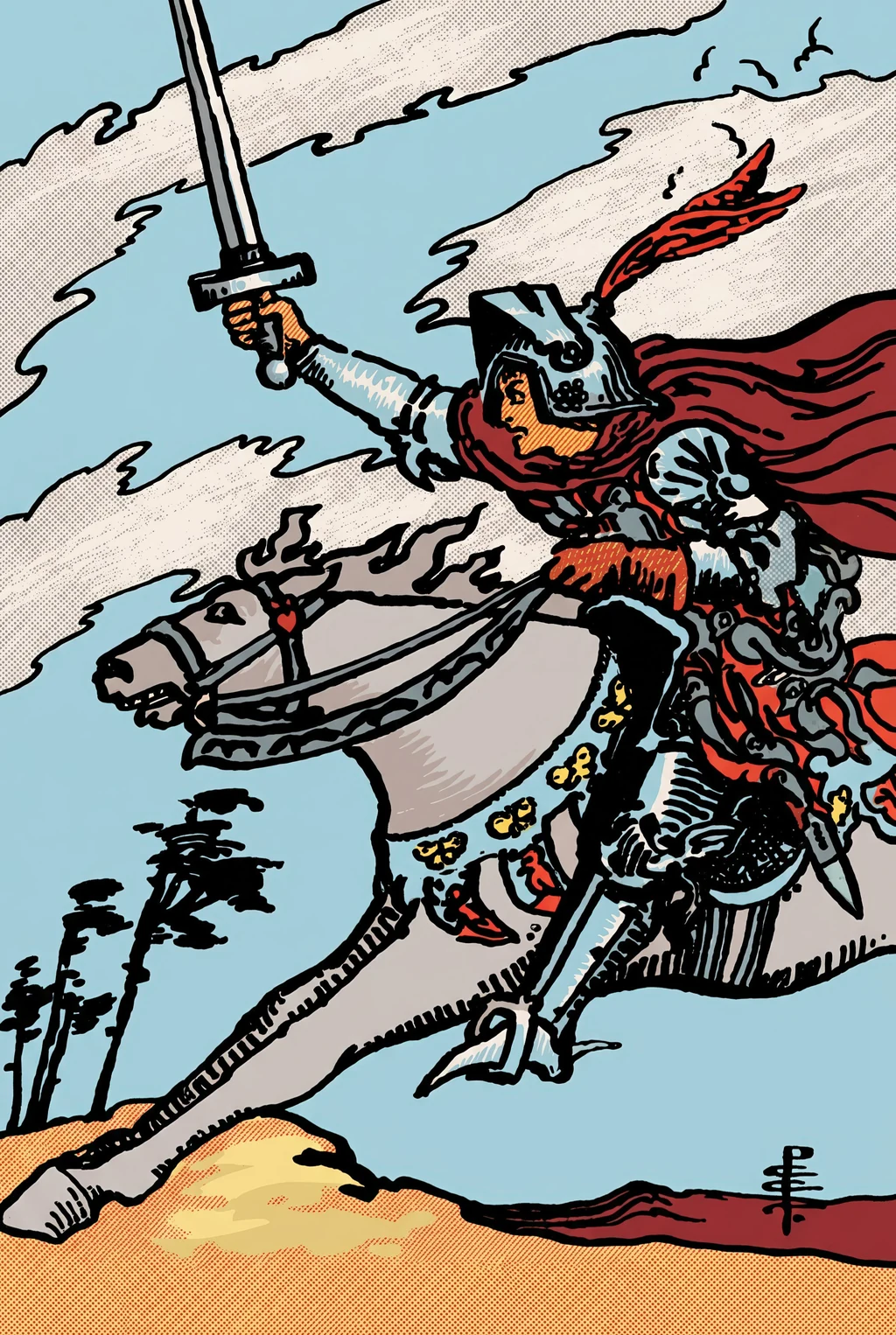
The Knight of Swords rushes to intervene, as though any delay would already be a retreat. Waite compares him to Galahad, the hero of Grail legend, linking the speed and faithfulness of his sword to purity of heart. In this reading, the rider is driven to defend what he believes is right.
He leans forward over the neck of his white horse. His sword is raised, his cloak streams behind him, and the slanting, ragged clouds seem to carry the motion onward. There is also a sense of fury in this urgency, capable of turning defense into attack. The rider is so poised for a charge that stopping to reassess what is happening seems harder than riding on.
Core meaning
The Knight of Swords brings together a quick mind, determination, and a readiness to argue. He can represent a bold advance toward a goal, but also haste, sharp words, and a conflict that becomes more important than its outcome.
- Key meanings:Determination
- Quick thinking
- Directness
- Bold action
- Protection
- Conflict
- Key meanings:Impatience
- Scattered focus
- Lack of preparation
- Harshness
- Exhaustion
- Retreat
Image and symbols
Card image
A knight in blue-gray armor rides a white horse toward the viewer's left. He leans forward: his right arm extends with a raised sword, while his left holds the reins. His red cloak and the feather on his helmet stream to the right.
Birds and butterflies decorate the horse's tack. The horse's front legs extend into a gallop, and part of its body passes beyond the right edge of the image.
Ragged white-gray clouds stretch across a blue sky; small birds fly in the upper right. At the lower left, trees bend to the right. Low hills rise beyond the ocher-colored ground.
Traditional context
Waite sees the Knight of Swords as a hero of chivalric romance and compares him to Galahad. This suggests courage, skill, and readiness to defend. In an additional list of meanings, he also retains the literal image of a military man.
But defense and attack are not separated by orientation in Waite's account: his upright meanings also include anger, enmity, opposition, and destruction. He qualifies the mention of death by linking it to the presence of other cards with fatal meanings. For the reversed card, he names imprudence, incapacity, and extravagance.
Modern readings examine speech, decisions, and the handling of ideas in more detail. In Joan Bunning's approach, directness sits beside tactlessness, logic beside insensitivity, and knowledge beside dogmatism. These are different sides of one style of behavior, not her table of upright and reversed meanings.
Armed rider
The knightly ideal of courage and protection; that same readiness for confrontation can turn into an attack.
Raised arm and open mouth
The pose of a battle cry: a readiness to make oneself heard and spring into action.
Raised sword
Intellect and conviction directed toward a specific goal. The sword represents not only thought but also the willingness to defend it.
Armor and helmet
Readiness for conflict and protection during a confrontation.
Horse at full gallop
Speed, force, and determination to keep moving despite resistance.
Winglike feather on the helmet
An image of flight that echoes the card's symbolism of air.
Birds on the horse's tack
The flight of thought and the possibility of seeing events from a broader perspective.
Butterflies on the horse's tack
Changes in beliefs and self-image. The butterfly is an image of transformation.
Torn clouds
Confusion and distracting circumstances that the rider is trying to break through.
Trees bent by a headwind
Resistance from circumstances. The rider moves into it rather than waiting for favorable conditions.
Small birds in the sky behind the rider
The birds left behind can be read as a warning about acting faster than you can think things through.
Colors
- White — the horse
White is associated with purity of thought, which drives the rider to act.
- Red — the cloak
Passionate commitment and the intensity of action.
Meanings
Knight of Swords — Upright
General
Overall meaning
The Knight of Swords shows a moment when thought quickly becomes action. There is determination here, a clear position, and a readiness to defend a cause or a person. A situation may suddenly accelerate and call for an immediate response.
With this card, forcefulness is not the same as being right. A sharp mind helps untangle complexity, but dedication to a goal can obscure the consequences. That is why the upright card encompasses not only courage and protection, but also argument, anger, resistance, and destructive conflict.
Possible support
Quick analysis and the ability to keep your bearings when facing a difficult task can help. Rather than remaining stuck in confusion, the Knight looks for a solution and acts.
Possible difficulty
Haste leaves little room for preparation or unintended consequences. Even a compelling idea can lead to unnecessary complications if you push ahead without looking around.
Focus
Consider where your efforts are headed: is this goal truly worth pursuing, and what might you be overlooking on the way?
Reflection questions
- What goal am I rushing toward right now?
- Which consequences of my decision have I yet to consider?
Relationships
Overall meaning
In a romantic relationship, the Knight of Swords can suggest intellectual attraction and a decisive move toward greater closeness: expressing your feelings, discussing commitments, or finally having an important conversation. Another reading emphasizes a need for constant stimulation and difficulty with emotional intimacy.
In friendship, the card can depict someone who quickly offers help, suggests a solution, and is ready to stand up for you.
Possible support
Practical help from a friend can be a source of support: not only empathy, but a willingness to work through the problem and take your side.
Possible difficulty
Engaging conversations do not necessarily mean readiness for intimacy. Romantic interest may fade when the novelty wears off and emotional involvement is needed.
Focus
At the start of a romantic relationship, compare the pace of growing closer with what both people are ready for. Initiative calls for sensitivity and patience, not only courage.
Reflection questions
- What conversation about our relationship have I been putting off?
- How comfortable am I with the pace at which we're growing closer?
Work and study
Overall meaning
At work, this card speaks to focus on a professional goal, quick decisions, and a drive to see a project through. It fits a stage when it's time to put an idea forward, pursue a more engaging assignment, or consider changing jobs.
This approach can move things ahead, but it may feel too forceful to others. Your enthusiasm does not automatically mean your colleagues share your views.
Possible support
The strength here is the ability to focus your attention on a task and persist until you reach a result.
Possible difficulty
An overly forceful approach can intimidate colleagues. Pursuing your own plans at others' expense makes collaboration harder.
Focus
When a professional opportunity arises, notice where initiative is needed from you: an application, a proposal, or a direct conversation about your next assignment.
Reflection questions
- What professional goal is it time for me to speak up about?
- How does the way I pursue results affect my colleagues?
Money and resources
Overall meaning
In money matters, the card is associated with actively pursuing a specific goal. That might mean saving for a major purchase or working to organize your savings more effectively.
Possible support
Your strength lies in keeping a chosen financial goal in focus and directing your efforts toward it.
Possible difficulty
A rushed decision can create financial commitments you haven't fully assessed, such as an investment made without checking the risks or a contract signed without understanding its terms. The difficulty comes when the desire to act quickly replaces a careful look at the numbers.
Focus
When unexpected money comes in, notice the urge to spend the entire amount in one place right away.
Reflection questions
- What am I hoping to save for right now?
- How thoughtfully do I spend money that comes unexpectedly?
Wellbeing and self-care
Overall meaning
The Knight of Swords can describe life at a relentless pace: urgent tasks, intense concentration, and the feeling that everything must get done at once. Even the excitement of welcome events can become tiring when there's no time to rest.
Possible support
A good night's sleep and a pause after a demanding period can offer support.
Possible difficulty
Rushing can become a habitual pace in which demands keep growing and stopping becomes harder.
Focus
Notice whether you can take a quiet break between urgent tasks, or whether even your free time immediately fills with more activity.
Reflection questions
- When do I manage to rest after a demanding day?
- What happens when I try not to rush anywhere?
Personal growth
Overall meaning
In personal growth, the card reflects a desire to understand the world, build your own arguments, and stand by your convictions. New ideas do not remain abstract theories here; they inspire you to act differently.
An important theme is the willingness to broaden your perspective through discussion, rather than only defending what you already believe.
Possible support
Conversations with people who can make a thoughtful case and offer a different perspective can help. Exchanging ideas supports the development of your own thinking.
Possible difficulty
A limiting belief may keep you from considering new possibilities.
Focus
Make room for a perspective different from your own and consider what it adds to your understanding of the situation.
Reflection questions
- What belief am I interested in reconsidering right now?
- What might I understand differently if I listen to someone else's reasoning?
Knight of Swords — Reversed
General
Overall meaning
The reversed Knight of Swords highlights a gap between speed and direction. Decisions are made before a plan takes shape; ideas keep changing and efforts are scattered. The opposite imbalance is also possible: the desire to act is there, but the right conditions or necessary skills are missing.
Harshness and certainty that you're right can strengthen other people's resistance. Instead of purposeful action, the result is frantic activity, poorly considered risks, or excess.
Another reading concerns retreat: ending a fruitless confrontation or stepping away briefly to regain your strength and reconsider your approach.
Possible support
Mental discipline helps: choose one idea and keep your attention on it without changing course at every new impulse.
Possible difficulty
Every new idea changes the previous plan. This inconsistency makes it harder for you to act and confuses the people involved.
Focus
Find out exactly what is delaying action: poor timing, missing resources, or another person's lack of readiness. Simply pushing harder will not resolve these circumstances.
Reflection questions
- What exactly is preventing me from acting right now?
- What plan do I want to stay with rather than immediately moving on to the next one?
Relationships
Overall meaning
In a couple, this card can suggest an argument where insisting on being right matters more than understanding each other. Sharp words and pressure take the place of discussion. Another reading concerns convincing promises that are not followed by action, leaving responsibility with one partner.
In friendship, another possible meaning involves gossip and sharing information given in confidence.
Possible support
In romantic communication, it helps to have room to speak without pressure and to hear the response. Growing closer can take time without demanding an immediate decision.
Possible difficulty
Tension grows when arguments are used to force a concession rather than reach an understanding. Poorly considered plans together can also pull a partner, friends, or family into someone else's rush.
Focus
In a relationship, compare promises with what actually gets done, and notice how responsibility is shared.
Reflection questions
- What do I need to talk about without demanding an immediate answer?
- Which of my promises can I back up with action?
Work and study
Overall meaning
At work, this card can suggest a poorly thought-out project, a rushed application, or an attempt to advance an idea without listening to colleagues. Effort goes into arguments and rework instead of progress.
Another possibility is a loss of direction: struggling to choose suitable work or to present your skills with confidence. Sometimes the tension comes from having abilities that you cannot find a way to use.
In education, it may point to choosing a course too quickly, then losing interest and abandoning your studies.
Possible support
The perspective of a mentor or trusted colleague can help. Together, it may be easier to reconsider professional goals and notice another option.
Possible difficulty
Dismissing other people's ideas without explanation and getting ahead at their expense can damage collaboration. Over time, you may lose the support of your team.
Focus
Review your preparation for an application or interview: how clearly are your skills presented, and how well have you researched the prospective job? In your current role, the tone you use when discussing other people's ideas also deserves attention.
Reflection questions
- What preparation do I need before my next professional step?
- How do I explain my disagreement with colleagues' suggestions?
Money and resources
Overall meaning
In financial matters, the card can point to the risk of overpaying and the influence of an overly persuasive seller or intermediary. The financial decision needs to be separated from someone else's pressure.
Possible support
It helps to assess an offer for yourself, regardless of how confidently someone promotes it.
Possible difficulty
The drive to make money at any cost can blur the line of what is acceptable. The desired gain then becomes more important than the means used to obtain it.
Focus
Look closely at the price of a purchase and consider the risk of overpaying. A persuasive sales pitch is no substitute for that assessment.
Reflection questions
- What is my agreement with this price based on?
- Where do I draw the line in how I earn money?
Wellbeing and self-care
Overall meaning
There may be plenty to do but little sense of progress. Scattered attention and attempts to be everywhere at once come with growing fatigue.
Another reading involves slowing down after a demanding period, as you begin to reassess your workload and priorities.
Possible support
Time away from the race to do everything at once can help: rest, gather your thoughts, and keep only what matters most in focus.
Possible difficulty
Trying to take part in everything at once divides your attention and uses up your energy, even when little of importance gets completed.
Focus
Compare how much energy constant busyness takes with what you actually manage to finish.
Reflection questions
- What can I put off so I can rest?
- Is trying to keep up with everything taking more energy than I have right now?
Personal growth
Overall meaning
The desire for freedom may run ahead of experience. Hasty decisions become an opportunity to reconsider your approach, while independence calls for more mature judgment.
Another emphasis is on slowing down: understanding your motives and weighing your present choices against what matters in the long term.
Possible support
Taking time to think through and write down your thoughts can make it easier to see what truly matters.
Possible difficulty
Impatience pushes you to decide before you have enough experience to make the choice well.
Focus
Consider what impulse lies behind the decision and whether it aligns with your more important goals.
Reflection questions
- Do I have enough experience for the decision I want to make quickly?
- What matters more to me than an immediate result?
Roles in a spread
Position examples
A position gives the card a question, such as what helps or what gets in the way. That question shapes how you read its meaning.
Knight of Swords — Upright
Situation
Events move quickly from discussion to action or an open clash of views. A new issue calls for a decision without much time to pause.
Influence
A sudden sense of urgency may be affecting how things unfold. A new issue changes the plan and calls for a faster response than expected.
Motivation
The driving force is a desire to reach a goal and defend what feels true. The idea matters enough to be worth arguing for.
Support
In a position of support, this is resourcefulness under pressure: quickly making sense of a problem and turning understanding into a plan of action.
Obstacle
Forcefulness without preparation becomes an obstacle. It narrows your view and can cause you to miss consequences that later complicate matters.
Focus of attention
Check whether obstacles and consequences have slipped out of view while your attention is fixed on a single goal.
Next step
State your position clearly and take action where it's time to stand up for something that matters to you.
Possible development
If you keep moving quickly without a strategy, the original task may grow more complicated. Determination needs precision if it is not to become a chaotic confrontation.
Knight of Swords — Reversed
Situation
There is plenty of effort but little sustained movement: decisions keep changing, preparation falls behind, or the desired action does not yet have the right conditions.
Influence
Someone who keeps changing their decisions and drawing others along may be influencing events. Instead of clear points of reference, there is confusion.
Motivation
The impulse may be to speed things up simply to feel that something is moving, even though the goal is no longer clear enough.
Support
Support may come from staying with one chosen plan rather than letting every new impulse take control.
Obstacle
Impatience makes it difficult to choose a direction and follow it consistently. New decisions disrupt the previous plan and may make it harder for others to act.
Focus of attention
Pay attention to conclusions reached before others have been heard: certainty that you're right may run ahead of understanding.
Next step
Hold back the first impulse and wait for the circumstances to become clearer. If a confrontation has become fruitless, consider leaving it or stepping back for a while.
Possible development
If every new impulse changes the decision, progress may slow and the people involved may lose sight of their shared direction.
Combination examples
Card combinations are in development. For now, here are a few examples.
Knight of Swords + Queen of Swords
Knight of Swords ( upright) + Queen of Swords ( upright)
- Example question:
- How can we discuss our differences while continuing to look for a solution?
- Example interpretation:
This combination allows conflicting ideas to be expressed directly while keeping the conversation focused on resolving the disagreement.
Knight of Swords + Knight of Wands
Knight of Swords ( upright) + Knight of Wands ( upright)
- Example question:
- What form could help me express my idea?
- Example interpretation:
An idea may find especially powerful expression through art or song. Here, thought is conveyed through more than ordinary conversation.
Knight of Swords + King of Swords
Knight of Swords ( upright) + King of Swords ( upright)
- Example question:
- What could change how I see a familiar situation?
- Example interpretation:
A new idea can change how everyday things are perceived.
Reading example
An imagined one-card reading shows how the meanings above can apply to a question. This is one possible interpretation.
Knight of Swords — Upright
Situation:
There is an opportunity to change jobs. The new responsibilities appeal to you, but leaving a familiar workplace is difficult. You want to make a decision without confusing genuine interest in change with the desire to end the uncertainty as quickly as possible.
Question:
How should I approach this change?
-
Card drawn:
Imagine drawing a card for the position «Next Step» and getting Knight of Swords (upright).
Interpretation:
The Knight of Swords highlights a readiness to act toward a professional goal. In this situation, he invites you to notice which new responsibilities genuinely appeal to you, rather than leaving your interest at the level of thought.
One possible step is to discuss the role directly and speak up about your skills. That conversation lets you take initiative without equating it with resigning immediately.
Knight of Swords — Reversed
Situation:
There is an opportunity to change jobs. The new responsibilities appeal to you, but leaving a familiar workplace is difficult. You want to make a decision without confusing genuine interest in change with the desire to end the uncertainty as quickly as possible.
Question:
How should I approach this change?
-
Card drawn:
Imagine drawing a card for the position «Next Step» and getting Knight of Swords (reversed).
Interpretation:
The reversed Knight of Swords draws attention to a decision being rushed before it's ready. Here, the desire to finally put an end to uncertainty may make it harder to evaluate the opportunity itself.
Instead of leaving abruptly, you could first clarify the responsibilities of the new role and prepare for a conversation about it. That way, you can consider the offer itself rather than only the urge to reach a decision quickly.
Yes / No
Knight of Swords — Upright
Why this answer
Yes. The Knight of Swords supports decisive progress: taking initiative, defining your goal clearly, and acting toward it.
A clarification
This answer points to considered determination, not haste for its own sake. Before picking up speed, consider the consequences of the decision and keep the goal itself in view.
A question to consider
What action would genuinely bring me closer to my goal?
Knight of Swords — Reversed
Why this answer
Probably not. The reversed Knight of Swords links a negative answer to acting without preparation, an unclear direction, and impatience. This is especially relevant when a decision is being rushed before important circumstances are understood.
A clarification
The question is whether the decision is ready: is there an unresolved disagreement, an unrealistic goal, or preparation that has been overlooked? This is a reason to reconsider the approach first, rather than push harder.
A question to consider
What part of my decision is still unprepared or unclear?
Correspondences
Connections with numbers, elements and other symbols add depth to the card’s imagery. They can differ between traditions.
Number — XII (12)
Twelve comes from continuing the count after Ten and Page. In this numerological interpretation, it can be associated with a willingness to set aside personal interests for something greater, while the sum of its digits, three, is linked to creation. Smith's illustration of the card has no number.
Element — Air
Thought, speech, beliefs, and the workings of the mind.
Element — Air of Air
The element of air is assigned to both the suit and the rank of Knight. The emphasis falls on the movement of ideas and the activity of the mind itself.
Element — Fire of Air
Fiery force is expressed through the airy suit: thought quickly becomes decisive, sometimes excessively sharp action.
Astrology — 20° Capricorn – 20° Aquarius
The zodiacal range of the Prince of Swords. In this system, it is assigned to the Knight because he takes the Prince's place.
Astrology — 20° Taurus – 20° Gemini
The range of the mounted Knight in Book T, whose description combines mental agility, dexterity, and decisive force.
Letter — Vav (ו)
The letter of the filial rank: the Prince receives impulses from the King and Queen and turns them into action.
Letter — Yod (י)
The letter of the original, paternal impulse. In the court-card system, it signifies swift and powerful action whose effects are relatively short-lived.
Tree of Life — Tiphareth in Yetzirah
Tiphareth is the sixth sephirah on the Tree of Life. Here the Knight takes the Prince's place, while Yetzirah names the world to which the suit of Swords is assigned.