
King of Swords
Descriptions and symbolism are based on the card’s classic illustration in the Rider–Waite–Smith deck. Details of the artwork may differ in other editions of the deck.
This guide brings together traditional and modern readings. Interpretations and answers may differ between authors and schools.
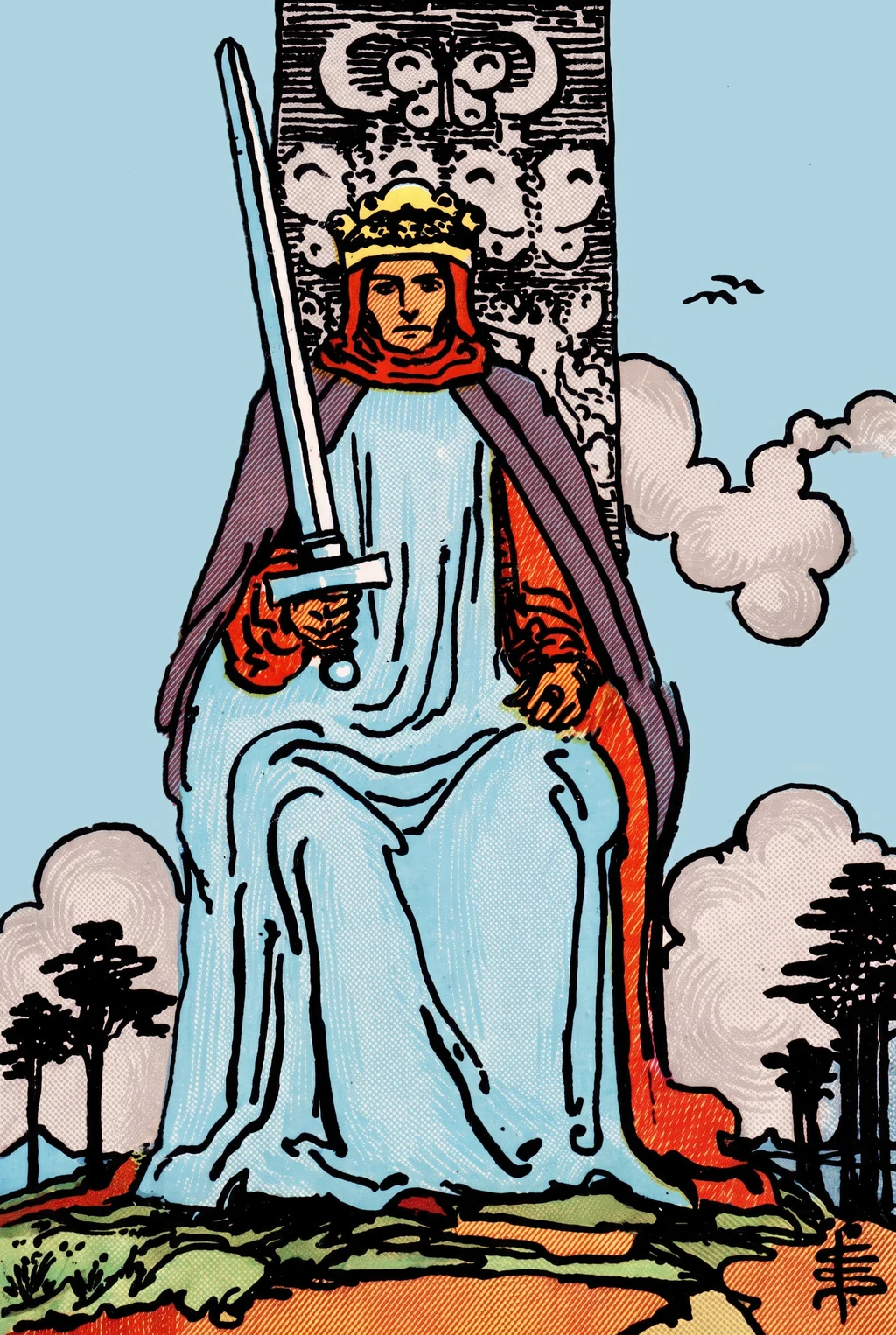
The King of Swords sits like a judge whose word can become a sentence. He looks straight ahead, holding an unsheathed blade with its point raised. Behind his decisions lies the power to enforce them.
Waite draws a parallel between the King and Justice, but sees him primarily as holding the power over life and death that comes with his office. Authority alone does not guarantee a just decision. A ruler’s mistake can become another person’s misfortune; the restraint of his posture can be read as responsibility for his judgment. The sword is already drawn, but his arm is not raised to strike.
Core meaning
The King of Swords speaks to sound judgment, principles, and responsibility for decisions. Its themes center on how knowledge and authority are used: to examine a situation fairly or to exert pressure.
- Key meanings:Clear judgment
- Competence
- Authority
- Principled thinking
- Direct communication
- Responsibility
- Key meanings:Abuse of power
- Manipulation
- Rigidity
- Indecision
- Self-doubt
- Inner confidence
Image and symbols
Card image
The King sits facing the viewer on a tall gray stone throne. He wears a golden crown, a red head covering, a light blue robe, and a lilac cloak with a red-orange lining.
In his right hand, to the viewer’s left, he holds an unsheathed sword. The blade points upward and leans slightly to the left. His left hand rests on his knee.
Butterflies, two crescents, and winged figures appear on the back of the throne. Trees grow on either side. Clouds dot the pale blue sky; two birds fly to the right of the throne, high in the background.
Traditional context
For Waite, the King of Swords personifies judicial authority. He resembles Justice, but the emphasis is on the powers of office, extending even to the authority over life and death. Waite’s divinatory list connects the card with command, law, government service, and militant intelligence.
For the reversed card, Waite gives cruelty, treachery, and malicious intent. In a supplementary list, the upright King may represent a lawyer, senator, or physician; the reversed card also carries a specific warning about ruinous litigation.
Modern interpretations explore competence, clear communication, and fair judgment in greater detail. Reversed, the card may suggest abuse of power, as well as a lack of clarity or confidence in one’s ability to make decisions. Biddy Tarot offers another interpretation: quiet inner strength that needs no public recognition.
When comparing the Thoth Tarot and Golden Dawn systems, court ranks are matched differently. For this reason, “Air of Air” and “Fire of Air” are presented below as two distinct systems of correspondences, not as a single attribution from Waite.
The king seated on a high throne
A figure of judicial authority: the right to make decisions and the power that comes with office.
The crown on the king’s head
In modern symbolism, it represents authority and command of intellectual abilities.
The raised, unsheathed sword
An instrument of judgment and decision. In modern readings, it emphasizes clarity, directness, and readiness to act.
The sword in his right hand, angled slightly to the viewer’s left
The tilt of the blade can be read as a balance of resolve and flexibility: a clear decision need not exclude intuitive understanding.
Butterflies carved into the throne’s back
Change and the growth of understanding. The butterflies suggest the mind’s capacity to transform.
Two crescents near the top of the throne’s back
In modern readings, they represent two ways of understanding: rational and intuitive, conscious and unconscious.
A winged figure on the throne’s back near the king’s left ear
It can be read as a quiet prompting from intuition, something a thoughtful person can still hear.
Trees and clouds in the background
The calm setting is associated with steadiness and clarity of thought. Attention remains focused without agitation.
Two birds in the sky to the right of the throne
The birds connect the card with the element of Air, the movement of thought, and the pursuit of knowledge.
Colors
- Blue — the king’s long robe
The pursuit of spiritual knowledge and understanding.
- Lilac — the outer side of the cloak
A combination of intellectual development and compassion.
- Red — the head covering beneath the crown
Activity and vitality.
- Red-orange — the lining of the cloak
The active side of character: a readiness to turn thought into action.
Meanings
King of Swords — Upright
General
Overall meaning
The King of Swords represents considered decisions, clear rules, and the authority to pass judgment. That authority may come from professional knowledge, experience, or an official position. In a reading, the card may point to a capable person, a role that carries responsibility, or a way to make sense of what is happening.
Precision in speech and impartiality matter here: separating facts from preferences, considering consequences, and stating the conclusion plainly. The card is also associated with law, official decisions, and expert evaluation. Its restraint allows for sober reasoning, but does not in itself imply emotional closeness.
Possible support
An independent perspective from someone knowledgeable may help: someone who can explain a complex issue without tailoring the conclusion to the answer you want.
Possible difficulty
A logically sound decision may overlook people’s feelings and the imperfections of a real situation. Excessive rationality can narrow your view even without any intention to exert pressure.
Focus
Check which facts support your conclusion and which consequences of the decision can already be considered. A confident tone is no substitute for that examination.
Reflection questions
- What is my judgment based on?
- What consequences of my decision might I be overlooking?
Relationships
Overall meaning
In a romantic relationship, the card highlights intellectual connection, respect, and high expectations for honesty. Feelings may be expressed with restraint; straightforward conversation matters more here than grand declarations.
In friendships and family relationships, the King of Swords may describe a levelheaded person others turn to for advice. The common theme is discussing disagreements on their merits, expressing expectations, and respecting one another’s boundaries.
Possible support
The relationship is supported by the ability to speak the truth and discuss it without humiliation. In friendship, honest advice that helps you see the situation more clearly can also provide support.
Possible difficulty
In a couple, restraint can make emotional intimacy difficult: a conversation may be proper in form yet leave little room for openness and vulnerability.
Focus
It is worth clarifying needs, expectations, and boundaries. The point is not only to state your own terms, but also to hear the other person’s.
Reflection questions
- What do I need to discuss and agree on directly?
- How do I show that I care beyond giving advice?
Work and study
Overall meaning
At work, the King of Swords is associated with expertise, strategy, and responsible leadership. This is a stage that calls for professional judgment, the ability to explain it, and a commitment to high standards.
The card may represent a demanding but fair mentor. It also highlights the ability to write and speak clearly and turn complex ideas into understandable decisions.
Possible support
Professional feedback and a reliable way of working can provide support. What makes a mentor valuable here is not leniency but precise expectations.
Possible difficulty
A demanding manager or the task itself may push you to raise the quality of your work substantially. The challenge is meeting a high professional standard.
Focus
It is worth checking whether your methods align with your professional principles. Making a decision also means taking responsibility for how it is carried out.
Reflection questions
- Whose professional assessment would be useful for me to hear?
- What conclusion about my work can I clearly justify?
Money and resources
Overall meaning
In money matters, the card represents a focused, deliberate approach: understanding your financial goal, aligning spending with it, and examining the reasoning behind major decisions. Keeping your finances organized comes to the fore.
Possible support
Thoughtful financial planning helps: decisions are made consistently rather than in response to every new desire.
Possible difficulty
A long-term goal may require passing up some purchases today. What is being tested is your willingness to stay with your chosen priority.
Focus
Before a major financial decision, it is worth examining the terms and the reasoning behind it rather than acting without looking into them.
Reflection question
What financial goal does my current spending support?
Wellbeing and self-care
Overall meaning
The card connects self-care with structure and self-control. At the same time, restraint should not become the suppression of feelings.
Possible support
A routine and limits on your workload may offer support.
Possible difficulty
Excessive control and perfectionism can be accompanied by mental strain.
Focus
Notice whether your self-control still leaves room for feelings.
Reflection questions
- What routine supports me?
- Am I confusing calm with suppressing my feelings?
Personal growth
Overall meaning
In personal growth, the King of Swords is associated with independent judgment. It invites you to examine your beliefs, distinguish evidence from habitual assumptions, and gain a clearer understanding of your motives.
In this reading, a mature mind does not have to dismiss intuition. It can weigh intuition alongside reason and speak confidently about its conclusions while remaining willing to revise them.
Possible support
The habit of questioning your own assumptions as carefully as other people’s can help. It gives you reasons for your views instead of simply adopting ready-made answers.
Possible difficulty
The difficulty arises when your principles are easier to articulate than to live by each day. It is not always easy to notice where habitual actions diverge from what you believe is right.
Focus
It is useful to notice beliefs you have accepted without examining them yourself. You can compare them with what you genuinely think and want.
Reflection questions
- Which belief can I explain in my own words?
- Which parts of my perspective have I examined, and which have I accepted out of habit?
King of Swords — Reversed
General
Overall meaning
The reversed King of Swords may point to power without impartiality: selective use of facts, verbal pressure, cruel judgment, or using knowledge for personal advantage. The ability to persuade becomes disconnected from honesty.
Another shift involves a lack of clarity. Thoughts become tangled and decisions are postponed; abrupt, impulsive reactions may replace composure. The card can also describe doubts about your ability to lead or fear of taking a position of authority.
Biddy Tarot’s inward-focused interpretation differs from these difficulties: it speaks of quiet confidence and trust in your own beliefs and values. In this approach, authority is not displayed but felt as the right to hold your own perspective.
Possible support
When clarity is hard to maintain or you are tempted to act against your principles, sensible outside advice can offer support.
Possible difficulty
Substituting pressure for sound arguments and abusing authority can obstruct understanding. In another reading, indecision becomes the obstacle: uncertainty delays a necessary choice.
Focus
Examine how influence is being used: to clarify an issue or to force agreement. This applies both to the way you argue and to pressure coming from others.
Reflection questions
- What would help me reach a clear judgment?
- Am I trying to understand or to secure agreement at any cost?
Relationships
Overall meaning
In relationships, the card may describe an imbalance of power: one voice drowns out another, criticism replaces conversation, and being right matters more than reciprocity. In family relationships and friendships, this reading touches on condescension, dishonesty, and a lack of compassion.
In a romantic relationship, it may point to avoiding difficult conversations or abrupt shifts from coldness to outbursts of anger. When looking for a partner, there are two distinct readings: expectations of mutual respect that are too low or, conversely, standards so high that there is no room to grow closer. The first highlights a lack of discernment; the second, inflexible expectations.
Possible support
Clear boundaries and conversations that leave room for both sides can help. In friendships and family relationships, a willingness to hear another perspective rather than only defend your own is especially important.
Possible difficulty
The desire to control a conversation undermines trust. In a couple, ongoing silence around a necessary topic can also sustain the difficulty.
Focus
Pay attention to how people actually communicate: can someone disagree, set a boundary, or express an uncomfortable opinion? It is useful to examine your own willingness to allow others the same freedom.
Reflection questions
- Can I express disagreement without applying pressure?
- Is there a conversation I am putting off because it is difficult?
Work and study
Overall meaning
At work, the reversed King of Swords may represent authoritarian leadership, micromanagement, unfair demands, or unethical ways of achieving results. This may concern someone else’s influence or your own management style.
Another reading concerns a loss of discipline and clarity in decision-making. The card can also point to fear of taking a leadership role: a person has the knowledge but doubts their right to be responsible for decisions and put forward their ideas.
Possible support
When you doubt your ability to lead, trusting your own professional judgment and building inner confidence can help.
Possible difficulty
Rigid control and an unwillingness to reconsider an outdated approach may get in the way. In another dynamic, the weak points are a lack of discipline and decisions made in anger.
Focus
It is worth examining whether expectations and management methods are fair. Notice especially where decisions protect someone’s status rather than serve the task and consider the people involved.
Reflection questions
- Am I confusing responsibility with the need to control everything?
- What could strengthen my trust in my own professional judgment?
Money and resources
Overall meaning
In money matters, the card may describe decisions made without sufficient thought: overspending, unnecessary purchases, or attempts to quickly recover from a poor investment.
Another aspect involves manipulation and overly ruthless calculation. Financial interests begin to justify questionable methods, while the consequences for others fall out of view.
Possible support
When money is involved at work, transparent agreements and a refusal to use unethical tactics for short-term gain may offer support.
Possible difficulty
The urge to recover losses quickly can lead to an even less considered or less honest decision.
Focus
It helps to examine not only the expected benefit but also how it will be obtained: which terms are transparent, and which depend on manipulation or pressure.
Reflection questions
- Am I trying to correct an earlier mistake with another purchase?
- Do I understand the methods behind the promised financial gain?
Wellbeing and self-care
Overall meaning
The card may describe mental overload and neglect of your own needs. Self-criticism makes it harder to acknowledge fatigue.
Possible support
Easing the demand for perfect self-control may provide support.
Possible difficulty
An impossible standard turns fatigue into another reason to criticize yourself.
Focus
Notice which needs you put aside in the effort to stay in control.
Reflection question
How do I speak to myself when I am tired?
Personal growth
Overall meaning
In personal growth, the card may raise questions about your relationship with your own judgment. One extreme is rigid beliefs and a need to always be right; the other is self-doubt and fear of acting independently.
A separate, inward-focused Biddy Tarot interpretation describes quiet loyalty to your values without any need to prove your superiority. This is not about giving up thinking; it is about having the right to hold your own position without others’ approval.
Possible support
Trust in your own judgment and a clear understanding of what truly matters to you can provide inner support.
Possible difficulty
An inflexible worldview makes it difficult to consider new information. The need to be right can replace an interest in what is true.
Focus
It is worth distinguishing confidence in your beliefs from being unwilling to reconsider them. If you doubt yourself, it may also help to notice whether that distrust of your own voice is linked to an earlier difficult encounter with authority.
Reflection questions
- Which of my principles do I hold to without others’ approval?
- What might convince me to reconsider my current conclusion?
Roles in a spread
Position examples
A position gives the card a question, such as what helps or what gets in the way. That question shapes how you read its meaning.
King of Swords — Upright
Situation
The issue may call for informed analysis and a clear decision. The authority of the judgment and the responsibility of the person making it come to the fore.
Influence
Someone with professional or official authority may be involved. Their influence comes through rules, arguments, and expert assessment.
Motivation
The motivation may be a desire to establish the truth and reach a fair judgment, even when that judgment is uncomfortable to voice.
Support
Knowledgeable advice offers support: familiarity with the rules, experience, and the ability to separate what matters from personal preferences.
Obstacle
An overly rational approach can become an obstacle if it leaves emotions, intuition, and human imperfection out of consideration.
Focus of attention
Pay attention to the integrity of your position and your ability to remain neutral. Directness is useful when the conclusion is not shaped to fit a preference.
Next step
Consider the question impartially, make a well-reasoned decision, and communicate it directly. Taking responsibility for your position matters here.
Possible development
With a clear, consistent approach, the situation may move toward a well-founded decision. A considered strategy and willingness to accept a difficult conclusion are important.
King of Swords — Reversed
Situation
A discussion may be losing clarity because of pressure, harsh criticism, or arguments used to serve someone’s own interests.
Influence
An authority figure may be exerting influence through harsh criticism and attempts to emphasize others’ shortcomings. Their eloquence does not make their assessment impartial.
Motivation
The driving motive may be a desire to gain an advantage, get your own way, or demonstrate intellectual superiority.
Support
When your own judgment falters, sound advice from someone else can help. It matters especially if you are tempted to justify a decision that conflicts with your principles.
Obstacle
Dishonesty and unequal power can intensify the problem: an argument becomes a way to dominate rather than understand.
Focus of attention
Check whether influence is turning into control. It helps to distinguish explaining your position from trying to deny someone else the right to disagree.
Next step
Ease the pressure and try to tell the truth without cruelty. Make room for compassion rather than continuing to fight for the upper hand.
Possible development
If the dishonest use of intelligence and power continues, a short-term advantage may lead to lost trust and damage to relationships or reputation.
Combination examples
Card combinations are in development. For now, here are a few examples.
King of Swords + Justice
King of Swords ( upright) + Justice ( upright)
- Example question:
- How can I make a fair decision?
- Example interpretation:
This pairing strengthens the theme of fair judgment. The King adds competence and the ability to articulate a decision, while Justice emphasizes truth, impartiality, and ethical evaluation.
King of Swords + The Empress
King of Swords ( upright) + The Empress ( upright)
- Example question:
- How can I balance high standards with care?
- Example interpretation:
The Empress softens the King’s strict, analytical approach with compassion and care. Together, the cards invite reflection on leadership in which clear expectations still make room for people’s needs.
King of Swords + The Emperor
King of Swords ( upright) + The Emperor ( upright)
- Example question:
- How is authority being used here?
- Example interpretation:
The Emperor’s organizing power combines with the King’s intellectual authority. This may suggest well-founded leadership, but with an inflexible approach, the same concentration of power can be read as rigid control.
King of Swords + Ace of Swords
King of Swords ( upright) + Ace of Swords ( upright)
- Example question:
- How should I evaluate a new idea?
- Example interpretation:
The Ace’s fresh insight meets the King’s experience. This pairing highlights the possibility of considering a new idea with mature, consistent judgment rather than substituting an initial impulse for reflection.
Reading example
An imagined one-card reading shows how the meanings above can apply to a question. This is one possible interpretation.
King of Swords — Upright
Situation:
Two people close to you have argued, and both are asking you to take their side. Their accounts differ, and you do not want to step in without understanding what happened.
Question:
How should I handle this disagreement?
-
Card drawn:
Imagine drawing a card for the position «Advice» and getting King of Swords (upright).
Interpretation:
The King of Swords draws attention to impartial judgment. Being close to someone does not automatically make their account accurate.
You can begin by separating the facts you know from other people’s judgments and clarifying exactly where their accounts differ. Then make your own position clear: what you believe is well-founded and what you cannot yet judge.
King of Swords — Reversed
Situation:
Two people close to you have argued, and both are asking you to take their side. Their accounts differ, and you do not want to step in without understanding what happened.
Question:
How should I handle this disagreement?
-
Card drawn:
Imagine drawing a card for the position «Advice» and getting King of Swords (reversed).
Interpretation:
The reversed King of Swords highlights the risk of pressure replacing conversation. Trying to decide immediately who is right could make you another participant in a struggle to have the last word.
It may help not to amplify either person’s accusations or push them toward reconciliation. You can suggest discussing specific actions without harshness and make clear that you will not decide for both of them.
Yes / No
King of Swords — Upright
Why this answer
The affirmative answer reflects clarity of thought and decisiveness: the card supports thoughtful progress on a question where knowledge and personal principles can guide you.
A clarification
The important aspects of the decision need to be considered, and the step itself should align with your principles. In a romantic question, honest conversation, mutual respect, and attention to feelings matter too, not just logic.
A question to consider
Can I explain why this step aligns with my principles?
King of Swords — Reversed
Why this answer
The answer leans toward no because of self-serving calculation and the use of influence for personal gain. This dynamic is a reason for caution rather than agreement based solely on a persuasive presentation.
A clarification
Unclear terms and the methods used to secure a benefit deserve particular attention. If you have these doubts, consider your options before agreeing, and do not compromise your principles for an attractive promise.
A question to consider
What do I need to clarify so I do not agree to questionable terms?
Correspondences
Connections with numbers, elements and other symbols add depth to the card’s imagery. They can differ between traditions.
Number — XIV (14)
Counting from Ace to King, this is the fourteenth card of the suit. The number is associated with completion of the court-card sequence and mature command of the qualities of Swords; it is not printed on the classic RWS illustration.
Element — Air
The realm of thought, speech, analysis, and clear judgment. The King rank emphasizes applying these qualities through outward action.
Element — Air of Air
In Book T, this combination corresponds to the “Prince of the Chariot of the Winds,” named King of Swords. It emphasizes a multitude of ideas and the workings of the mind; it is applied to RWS when the King is mapped to the Prince rank.
Element — Fire of Air
In another approach, the King is assigned the fiery aspect of Air: conviction, initiative, and a readiness to defend one’s conclusions.
Astrology — 20° Capricorn to 20° Aquarius
The zodiacal segment assigned to the “Prince of the Chariot of the Winds.” In this system, it belongs to a thoughtful, observant figure occupied with ideas and plans.
Astrology — 21° Taurus to 20° Gemini
This modern attribution combines steady determination with agility of thought and speech. It is used within the “Fire of Air” approach.
Astrology — Libra
An author-specific association with an Air sign through leadership and clear communication.
Letter — Vav
This letter corresponds to the Princes as the force that unites and embodies the influences of the King and Queen. The association applies to the RWS King only when he is mapped to the Prince.
Letter — Yod
Corresponds to the original, paternal force of the mounted Kings in Book T. This connection is applied to the RWS King in a system that maps him to the fiery rank rather than to the Prince.