
Ace of Swords
Descriptions and symbolism are based on the card’s classic illustration in the Rider–Waite–Smith deck. Details of the artwork may differ in other editions of the deck.
This guide brings together traditional and modern readings. Interpretations and answers may differ between authors and schools.
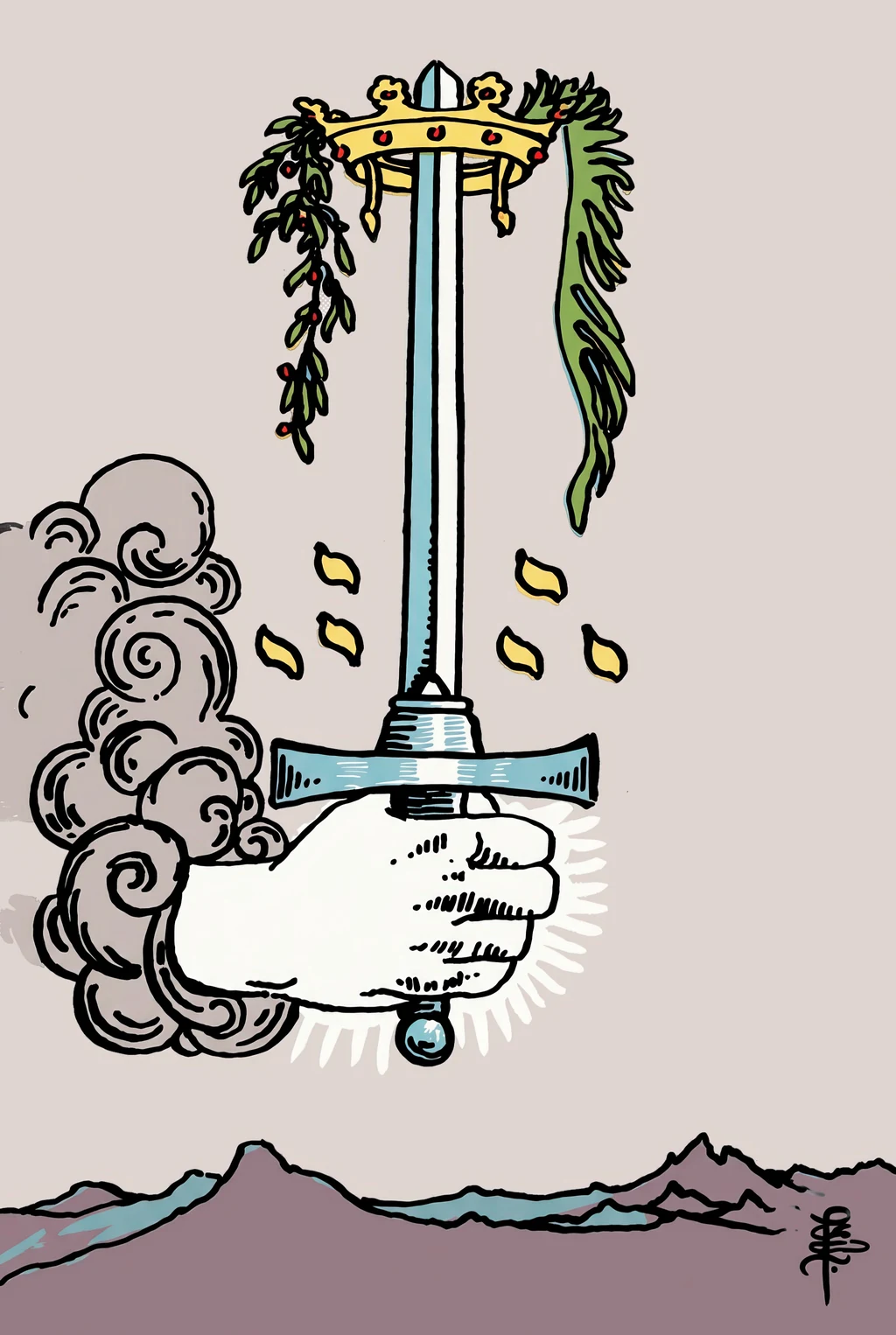
The sword rises above the mountain peaks, a crown encircling its tip. There is no opponent here, and no subject of dispute has been named. The hand holds the blade upright, without preparing to strike. The power is already present, but what it will serve remains open.
Waite saw this card as a force equally great in love and in hatred. Imagine words not yet spoken, but after which a conversation could never return to its former uncertainty. They could protect something precious or close off the possibility of reconciliation. For now, the hand simply holds the weapon; how it is used and what follows remain outside the scene.
Core meaning
Clear thinking, decisive words, and the ability to get to the heart of a matter. The Ace of Swords speaks to intellectual breakthroughs and the power of a decision that can either clarify a situation or sharpen its tensions.
- Key meanings:Clarity of thought
- New idea
- Truth
- Decisiveness
- Justice
- Triumph of force
- Key meanings:Confusion
- Faulty judgment
- Harsh words
- Rethinking an idea
- Inner clarity
- Destructive force
Image and symbols
Card image
A hand emerges from a cloud on the left, gripping the hilt of a vertical sword. White rays spread out around the hand. The tip passes through a golden crown, from which an olive branch hangs on the left and a palm branch on the right, as seen on the card.
Six yellow teardrop-shaped marks appear on either side of the blade. Jagged mountain peaks are visible below, with a broad expanse of light gray background above them.
Traditional context
For Waite, the Ace of Swords signifies the triumph of force: conquest, triumph, and the utmost expression of something. This force acts in both love and hatred, so his upright interpretation does not simply promise a favorable outcome. His additional list includes both great prosperity and great misfortune.
For the reversed card, Waite retains the same force but describes destructive consequences. He also records another divinatory interpretation: conception, childbirth, increase, and multiplicity. This is a separate historical strand, not a basis for drawing conclusions about pregnancy.
In modern RWS tradition, the emphasis often shifts to clarity of thought, truth, and communication. The upright Ace represents a new idea and a decisive realization; reversed, it may suggest confusion, misuse of the intellect, or reconsidering a plan. There is also a quieter interpretation: an idea has already emerged but is still being considered internally and is not yet ready to be expressed.
A hand emerging from a cloud, surrounded by rays of light
In a Hermetic reading, this is an image of a gift from above: the power of the suit appears as a possibility that has yet to be accepted and put to use.
A double-edged sword pointing upward
Intellect, discernment, and the power to decide. The two edges remind us that precise thinking and sharp words can both help and harm.
A crown encircling the sword’s tip
Triumph, conquest, and power. Waite also suggests the crown may carry a higher meaning, beyond the usual list of divinatory meanings.
An olive branch to the left of the sword
Peace and mercy. In the occult interpretation of Mathers, the two branches together represent a balance between mercy and severity.
A palm branch to the right of the sword
In modern interpretations, the palm represents victory. The Hermetic Book T connects it with suffering, keeping the difficult side of power alongside its triumph.
Six yellow teardrop-shaped marks on either side of the blade
These marks are read as instances of the Hebrew letter yod and associated with a gift descending from above. Mathers linked the six yods around the Ace of Swords to the six days of creation.
Mountain peaks at the bottom of the card
Difficulties that do not disappear when a clear idea emerges. The image links the possibility of a breakthrough with the need for perseverance.
Colors
- Light gray behind the sword
In modern symbolic interpretations, this emphasizes impartiality: the possibility of considering a question without choosing a side in advance.
Meanings
Ace of Swords — Upright
General
Overall meaning
The Ace of Swords marks a moment when the heart of a question comes into focus: a new idea appears, a precise answer emerges, or a decision takes shape. It is associated with logic, truth, clear communication, and a readiness to defend your position.
It is also a card of strength and overcoming obstacles. It can describe a decisive breakthrough and the triumph of a chosen course, but not necessarily a gentle turn of events. Resolve can become pressure, and clear words can still cause pain.
Possible support
Your strength lies in addressing a complex issue directly, expressing your thoughts precisely, and remaining determined in the face of obstacles.
Possible difficulty
A strong argument can become a way to silence disagreement. The card is out of balance when proving your superiority matters more than understanding the issue.
Focus
Consider both sides of the question and the facts that your decision depends on.
Reflection questions
- What has become clearer to me in this situation?
- What do I want to understand instead of simply proving I am right?
Relationships
Overall meaning
In a romantic relationship, the Ace of Swords highlights intellectual attraction, engaging conversation, and clarity about what each person expects from the other. It can point to discussing a long-standing concern and moving beyond things left unsaid.
That clarity does not always mean growing closer. Sometimes it helps you acknowledge that a relationship has run its course. In friendships and family relationships, the card also relates to openly discussing things that were previously understood differently.
A traditional reading centered on force adds another shade of meaning: intense attraction and strong emotions in which love is intertwined with assertiveness and the desire to win someone over.
Possible support
A willingness to speak plainly, together with genuine interest in how the other person sees the same issue, helps sustain the connection.
Possible difficulty
It can be difficult for a couple to acknowledge an uncomfortable truth or face a difference in views. The conversation may pass through disagreement before mutual understanding becomes possible.
Focus
Notice which question in the relationship remains unspoken. Clarity begins with discussing it, not trying to guess the other person’s answer.
Reflection questions
- What do I want to express more clearly in this relationship?
- Which difference in our perspectives is important for me to understand?
Work and study
Overall meaning
A new task, idea, or job that calls for thought and clear explanation. The Ace of Swords is associated with intellectual curiosity, learning, exchanging ideas, and developing a coherent plan.
In an ongoing project, it can point to a precise understanding of the problem and a decisive choice about what to do next.
Possible support
Your ability to make a reasoned case for a proposal, along with a willingness to learn what the new task requires, can provide support.
Possible difficulty
When moving into a new job, unfamiliar tasks call for learning and focus, even while some things remain unclear.
Focus
First, define the problem the project is meant to solve. Without that, even several good ideas may remain disconnected.
Reflection questions
- Which task do I understand clearly enough right now?
- What do I need to explain to my colleagues or project partners?
Money and resources
Overall meaning
In financial matters, the Ace of Swords is associated with a clear understanding of where things stand and a considered decision. It highlights careful calculation, precise terms, and the ability to set financial priorities.
Possible support
Comparing the facts, expenses, and long-term goals provides a more useful foundation than relying on a single impression of an offer.
Possible difficulty
An emotional impulse or pressure from loved ones can push careful calculation aside. This is especially relevant when someone asks to borrow money.
Focus
In a financial arrangement, it is worth clarifying what you can afford, what obligations you would take on, and how they may affect your relationships.
Reflection questions
- What information is my financial decision based on?
- Which obligation do I need to understand before agreeing?
Wellbeing and self-care
Overall meaning
In self-care, the card is associated with gaining clarity about your feelings and needs. It becomes easier to name exactly what is troubling you or what you are missing right now.
Possible support
Speaking or writing down a need can be more supportive than trying to guess what should help.
Possible difficulty
Intense thinking and facing an uncomfortable truth can make it harder to find inner calm.
Focus
Notice how clearly you express your needs and boundaries in everyday life.
Reflection question
Which of my needs is important to name right now?
Personal growth
Overall meaning
The Ace of Swords is associated with independent judgment and expressing your convictions clearly. It can mark a change in an old perspective when you begin to see where it was mistaken.
In self-reflection, the card invites you to face an uncomfortable truth: to name your own position more precisely instead of hiding it behind a familiar explanation.
Possible support
It helps to name what you recognize in yourself without immediately judging it.
Possible difficulty
A new perspective may disrupt a comfortable self-image. Acknowledging that can be harder than finding another explanation to defend it.
Focus
Distinguish an honest observation about yourself from the harsh inner commentary that follows it.
Reflection questions
- Which belief is it time for me to reconsider?
- What can I acknowledge about myself without blaming myself?
Ace of Swords — Reversed
General
Overall meaning
In the reversed Ace of Swords, a thought loses its clear form: information conflicts, decisions stall, and words fail to convey what you meant to say. The card can reflect a plan that does not work, a hasty conclusion, or the use of intellect to argue and exert pressure. In a reading centered on force, even an advantage already gained may have destructive consequences.
But the card can also speak to working through an idea internally. Understanding has begun to emerge, but it still needs time to become a coherent plan. This is different from complete confusion: the question is not whether the idea exists, but whether it is ready to be expressed.
Possible support
It helps to step away from argument or haste and calmly gather your thoughts. An unfinished idea can be given time without demanding an immediate answer.
Possible difficulty
False information and an inability to communicate clearly make choosing difficult. Meanwhile, pressure may build faster than understanding.
Focus
Check what remains unknown before taking someone else’s explanation or your first impression as the truth.
Reflection questions
- What do I need more to make this decision: information or time to think?
- Which thought am I still struggling to express precisely?
Relationships
Overall meaning
A conversation may create confusion rather than clarity: people understand words differently, assumptions are mistaken for what was actually said, and disagreement turns sharp. In a couple, the card can also relate to uncertainty about your own expectations of the relationship.
In friendships and family relationships, things left unsaid or avoiding a direct conversation can create tension and distance.
Possible support
Careful clarification helps: listen to the answer and return to what was actually said.
Possible difficulty
Harsh words can hurt more than the subject of the disagreement itself. Unspoken resentment may accumulate and surface again in later arguments.
Focus
Check whether the other person understands your words and whether you are responding to your own assumption instead of what they said.
Reflection questions
- Which statement should I clarify before drawing a conclusion?
- What am I finding hard to express without sounding harsh?
Work and study
Overall meaning
It is hard to turn an idea into a workable plan: direction is missing, expectations diverge, and communication breaks down. Impractical proposals, delays, and difficulty expressing the concept are possible.
Another interpretation concerns boredom: the work does not provide enough intellectual stimulation. At times, progress stalls because you keep gathering opinions without ever making a decision.
In learning, the card can indicate difficulty absorbing new information or a reluctance to take it in.
Possible support
Constructive feedback helps in a new role. It gives you a chance to refine your approach and build the skills you are missing.
Possible difficulty
Vague tasks and conflicting instructions make it difficult to understand your responsibilities and goals. Pressure instead of discussion only increases the tension.
Focus
Compare your current role with your professional goals. When taking on new responsibilities, also check whether you are trying to do too much at once.
Reflection questions
- Which agreement or expectation at work do I need to clarify?
- What is holding me back more: a poorly thought-out plan or a lack of interest in the task?
Money and resources
Overall meaning
Errors, incomplete information, and unclear agreements can distort the financial picture. At the center of this interpretation is the difficulty of understanding the terms.
Possible support
Getting the missing explanations and checking the underlying information can help before taking on a significant obligation.
Possible difficulty
When an unclear clause is assumed to be clear, a decision may rest on a mistaken understanding of costs or obligations.
Focus
Amounts, wording, and clauses in agreements that you do not yet understand deserve attention.
Reflection question
Which part of a financial agreement can I not yet explain in my own words?
Wellbeing and self-care
Overall meaning
The reversed Ace of Swords can describe tangled feelings and difficulty understanding what is happening inside. Thinking things through does not necessarily bring clarity: one anxious thought may give way to another.
Possible support
Rest, sleep, and a quiet walk may offer more support than another attempt to think everything through immediately.
Possible difficulty
Replaying the same worries drains energy without necessarily bringing understanding.
Focus
Notice whether overwhelm or fear is keeping you from naming how you feel honestly.
Reflection questions
- Which thoughts am I going over without gaining new insight?
- What kind of rest is available to me right now?
Personal growth
Overall meaning
The reversed Ace of Swords can point to reconsidering a plan that no longer aligns with what you want from life. Sometimes it is difficult to choose among several ideas and see which one is truly worth developing.
In self-reflection, it is also associated with resistance to an uncomfortable truth, especially when that truth challenges your familiar self-image. This is a different process from calmly considering an idea that has yet to take shape.
Possible support
Honest reflection on your motives and a willingness to revisit an earlier explanation can help.
Possible difficulty
Protecting a familiar self-image can turn reflection into an argument against what is already apparent.
Focus
Ask why an important thought remains unspoken: does it still need to be understood, or is it difficult to acknowledge to yourself?
Reflection questions
- Which plan no longer reflects what I want?
- What am I finding hard to acknowledge, even though I keep returning to the thought?
Roles in a spread
Position examples
A position gives the card a question, such as what helps or what gets in the way. That question shapes how you read its meaning.
Ace of Swords — Upright
Situation
An idea or realization emerges that changes how you see what is happening and helps you choose a direction.
Influence
New information or a clear observation from someone else may influence the situation by drawing attention to something you missed.
Motivation
The driving force may be a desire to know the truth, untangle a difficult question, or find a challenge that genuinely engages your mind.
Support
The ability to think precisely and express yourself clearly helps you work through a complex question without losing sight of what matters.
Obstacle
In the obstacle position, the card can highlight misunderstandings and a truth that is difficult to uncover or acknowledge. Without clarity, the question remains tangled.
Focus of attention
Pay attention to what can be established with reasonable certainty, even if the conclusion challenges your familiar view of the situation.
Next step
Establish the facts and hear both sides, then form your own decision.
Possible development
Greater clarity may open a new chapter: it becomes easier to see what decision to make and which idea to develop.
Ace of Swords — Reversed
Situation
The picture remains unclear: the information does not add up to a coherent explanation, and making a decision is difficult.
Influence
Conflicting advice and inaccurate information from others may deepen doubts and make it harder to form a clear picture.
Motivation
Sometimes the motive is a desire to avoid a truth that is hard to accept and escape an uncomfortable conclusion.
Support
A pause outside the argument can be a useful source of support: a chance to cool down and gather your thoughts before responding.
Obstacle
Incorrect information and difficulty putting thoughts into words make it hard to choose a direction. Acting without understanding may make the situation even more confusing.
Focus of attention
Notice where a thought remains unspoken and which words might be understood differently from how you intend them.
Next step
Step away from the confrontation and loosen your need to control everything. First, give yourself room to cool down and understand what is happening.
Possible development
If the lack of clarity persists, misunderstandings and difficulty making decisions may continue.
Combination examples
Card combinations are in development. For now, here are a few examples.
Ace of Swords + Ace of Wands
Ace of Swords ( upright) + Ace of Wands ( upright)
- Example question:
- What supports the start of a new endeavor?
- Example interpretation:
A clear idea meets courage and creative drive. This combination highlights a beginning in which understanding the direction goes hand in hand with the desire to act.
Ace of Swords + Ace of Cups
Ace of Swords ( upright) + Ace of Cups ( upright)
- Example question:
- What matters at the beginning of a close connection?
- Example interpretation:
Understanding and honesty join emotional depth, closeness, and compassion. At the start of a new experience, both clear thought and emotional responsiveness matter.
Ace of Swords + Ace of Pentacles
Ace of Swords ( upright) + Ace of Pentacles ( upright)
- Example question:
- What can a new endeavor build on?
- Example interpretation:
A thoughtful plan meets themes of stability and practical support. This pairing connects clarity with the possibility of giving a new beginning a firmer foundation.
Reading example
An imagined one-card reading shows how the meanings above can apply to a question. This is one possible interpretation.
Ace of Swords — Upright
Situation:
An opportunity to change jobs has come up. Everything feels familiar in the current role, but the work has become less engaging. The new offer is appealing, though it is still hard to tell exactly what needs to change.
Question:
What will help me make sense of this choice?
-
Card drawn:
Imagine drawing a card for the position «What will help» and getting Ace of Swords (upright).
Interpretation:
The Ace of Swords highlights clarity of purpose and intellectual interest. In this choice, it invites you to consider which kind of work would genuinely engage your mind, rather than simply feel different from what you know.
You could name what is missing now and clarify what tasks the new role would involve. That would let you compare the substance of the work, rather than just the familiar and the new.
Ace of Swords — Reversed
Situation:
An opportunity to change jobs has come up. Everything feels familiar in the current role, but the work has become less engaging. The new offer is appealing, though it is still hard to tell exactly what needs to change.
Question:
What will help me make sense of this choice?
-
Card drawn:
Imagine drawing a card for the position «What will help» and getting Ace of Swords (reversed).
Interpretation:
The reversed Ace of Swords draws attention to the uncertainty about what you want to change. A lack of interest in your current role does not yet tell you what a new one should offer.
Instead of gathering more and more advice, you could consider which activities you want to leave behind and which professional goals matter to you now. This can help you see what else you need to ask before accepting.
Yes / No
Ace of Swords — Upright
Why this answer
Clarity and a breakthrough favor moving forward. A positive answer is especially connected with making a decision, seeking the truth, and having an open conversation.
A clarification
A discovery may be uncomfortable or painful. What matters is being ready to learn the truth, rather than expecting only welcome news.
A question to consider
What truth do I need to take into account, even if it is uncomfortable?
Ace of Swords — Reversed
Why this answer
A negative answer is associated with confusion, an unclear direction, and the risk of mistaken judgment. In this reading, the card does not favor moving forward on a poorly considered basis.
A clarification
Do not rush a major decision while you are unsure what you want or what information is missing. This answer suggests seeking clarity first; it does not declare the idea impossible forever.
A question to consider
What do I need to clarify before making this decision?
Correspondences
Connections with numbers, elements and other symbols add depth to the card’s imagery. They can differ between traditions.
Number — I (1)
A beginning and potential that has not yet unfolded. For the Ace of Swords, this is the emergence of an idea and an independent way of thinking, not a plan already carried out.
Element — Air
Thought, speech and writing, judgment, and debate. In the Hermetic system, the Ace of Swords bears the title “Root of the Powers of Air.”
Astrology — Gemini, Libra, Aquarius
The connection to all three Air signs emphasizes thinking, exchanging ideas, and discernment. No single planet is assigned to the card here.
Astrology — Capricorn, Aquarius, Pisces
In the quadrant system, the Ace shares this region of the sky with the Princess of Swords, who corresponds to the Page in RWS. This is a different principle of correspondence, not the three Air signs and not a timeframe for an event.
Tree of Life — Kether in the world of Yetzirah
Kether links the Ace to the original power of the suit, before it unfolds into particular situations. For Swords, this is the primary potential of thought and discernment.