
Ace of Cups
Descriptions and symbolism are based on the card’s classic illustration in the Rider–Waite–Smith deck. Details of the artwork may differ in other editions of the deck.
This guide brings together traditional and modern readings. Interpretations and answers may differ between authors and schools.
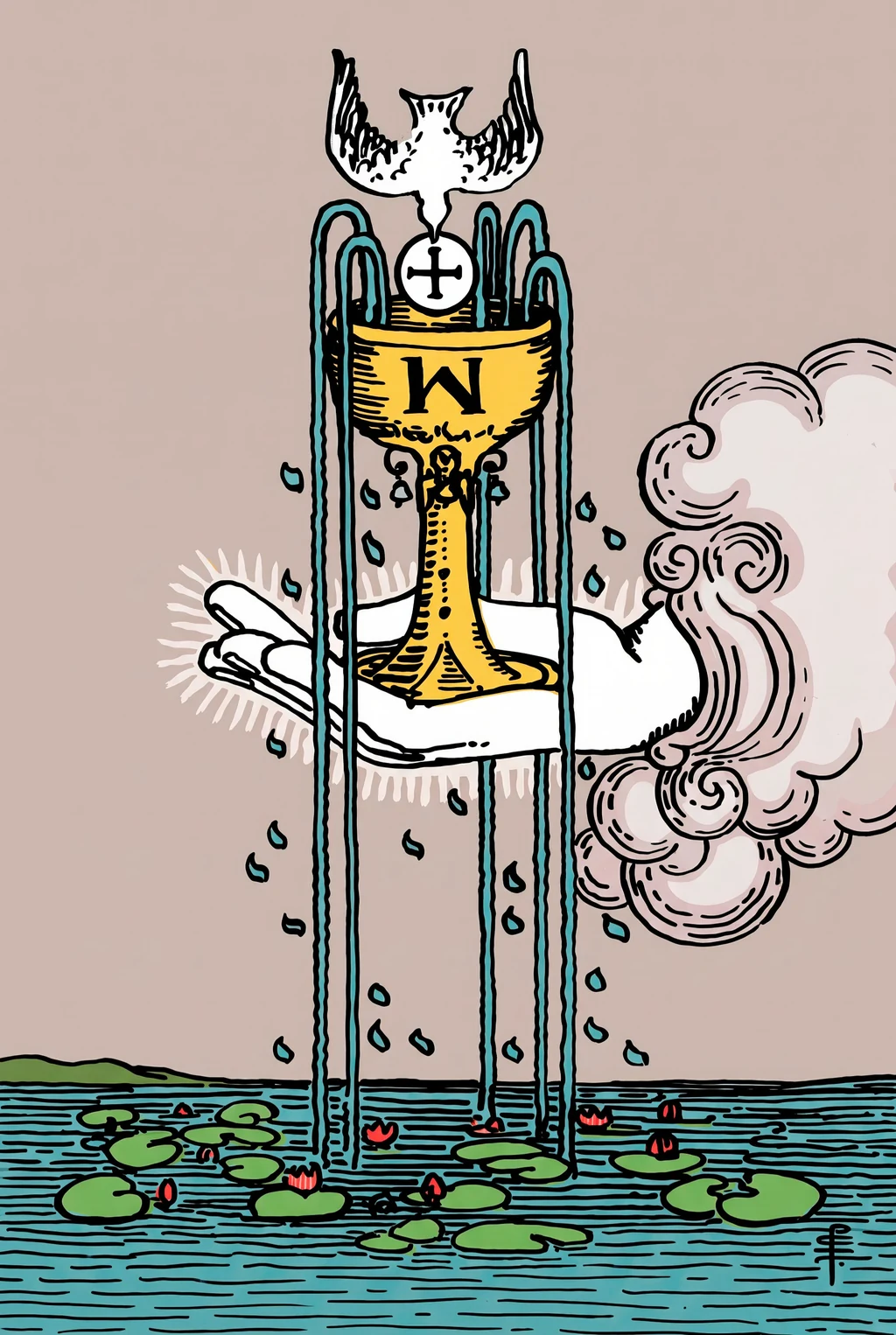
A brimming cup is offered on an open palm, as though inviting someone to share what can no longer be contained alone. The hand emerges from a cloud, and water spills over the rim. No human hand has yet reached out to receive the gift. The feeling has not become a shared story, but it is already seeking expression.
Waite connects the cup with the image of the Holy Eucharist. A dove descends toward it carrying a host, the communion bread marked with a cross. The vessel receives a gift from above and becomes a source in its own right: what it receives is immediately given to the world around it. The streams reach a pool filled with blooming lilies, carrying the gesture of giving far beyond the cup’s rim.
Core meaning
The Ace of Cups is associated with the birth of feeling, closeness, and creative inspiration. It offers a chance to open yourself to a new experience, to give care or receive it.
- Key meanings:New feelings
- Emotional openness
- Closeness
- Compassion
- Inspiration
- Intuition
- Key meanings:Held-back feelings
- Emptiness
- Emotional overwhelm
- Creative block
- Self-care
- Private feelings
Image and symbols
Card image
On the right, a hand emerges from a cloud, palm facing upward. It holds a golden cup with a black W-like mark. Five blue streams pour from the cup into the water below, with individual drops scattered around it.
A white dove with raised wings descends above the cup. In its beak is a round white disc marked with a cross. Green leaves and pink-red water lily blossoms appear below. A narrow strip of shore lies beyond the water, against a pale gray background.
Traditional context
For Waite, the Ace of Cups brings together joy, contentment, home, nourishment, abundance, and fertility with the image of the Holy Eucharist. The dove carrying a host, the thin bread used for communion, also makes a Christian reading of the cup possible. Mary K. Greer explores this image’s connection to the Grail and spiritual nourishment in detail.
In Waite’s main list of meanings, the reversed card is associated with insincerity, change, and instability. In a supplementary list in the same book, he gives a very different set of meanings: unyielding will and unalterable law. For the reversed card, he names an unexpected change of position. Waite cautions that these additions may differ from the main meanings and have little connection to the illustrations.
Modern readings emphasize the beginning of an emotional experience: new affection, inspiration, or compassion. Sergey Savchenko particularly highlights the intensity of the first feeling. The reversed card may suggest difficulty expressing emotions, but it can also describe a private inner process and a return of attention to yourself.
A palm supporting the cup
A gift being offered: an opportunity to receive a feeling or a new experience rather than seize it through effort.
The cloud surrounding the hand
In modern symbolic readings, it represents the spiritual source of a gift that has yet to take an ordinary, earthly form.
The overflowing cup
A vessel of feeling and receptivity. In a Christian, Grail-centered reading, it is a cup of spiritual nourishment and fullness.
Five streams pouring from the cup
They are associated with the five senses and the fullness of experience. In a Christian interpretation, Greer also suggests a connection to the five wounds of Christ.
A dove descending toward the cup
An image of the Holy Spirit and love descending from above. In broader modern readings, it is associated with peace and hope.
A round communion wafer with a cross in the dove’s beak
This symbol of communion connects the cup with spiritual nourishment and the acceptance of a sacred gift.
Yod-shaped drops around the cup
In a Hermetic reading, they evoke the creative principle and grace descending from above. Their letter-like form adds a sense of spiritual gift to the water.
The still surface of the water
An image of the depths of inner life, from which new experiences and self-understanding can emerge.
Water lilies on the surface
Growth toward the light and spiritual awakening. The flowers reinforce the themes of fertility and new life.
The W-like mark on the front of the cup
It has been read as W for “Water,” or as an inverted M referring to mother and mystery. There is no single established interpretation.
Colors
- White: the hand emerging from the cloud
In a Hermetic-Kabbalistic reading, the whiteness of the hand emphasizes the purity of the original gift and the unity of its source.
Meanings
Ace of Cups — Upright
General
Overall meaning
The Ace of Cups describes the beginning of a strong feeling and a readiness to respond to it. This may be affection, joy, compassion, a creative idea, or intuitive understanding.
The card is associated with emotional renewal after loneliness or pain. An encounter, an offer, or an inner response opens a possibility that has yet to take shape.
Possible support
Compassion and a willingness to be present can help where determination alone is not enough.
Possible difficulty
The difficulty may lie in your readiness to accept a new feeling: you want closeness, but opening up feels frightening.
Focus
Notice what moves you and makes you want to respond, even before it becomes a clear plan.
Reflection questions
- What do I feel drawn to respond to right now?
- What care would I like to give or receive?
Relationships
Overall meaning
In a romantic question, this can be the beginning of falling in love or a renewal of tenderness in an existing relationship. The focus is on sharing feelings and receiving care in return.
In friendship, the card is associated with a new heartfelt connection and deepening trust. In family life, it may describe greater mutual attention, understanding, and care.
Possible support
In a couple, closeness is supported by expressing feelings openly and paying attention to each other’s experiences. In friendships and family, empathy and caring involvement offer support as well.
Possible difficulty
At the beginning of a romance, a desire for closeness may coexist with a fear of vulnerability.
Focus
At the start of a romance, do not ask the first spark of feeling to promise an entire life together. For the Ace, what matters is that contact has begun.
Reflection questions
- How do I show someone that I enjoy being with them?
- Am I expecting too much from the first few dates?
Work and study
Overall meaning
Work may begin to feel engaging again: an inspiring project, a new role, or a fresh perspective on familiar tasks. For creative work, the Ace of Cups suggests an idea you want to bring to life.
The card can also describe friendly collaboration. In learning, it is especially relevant when you are developing skills in a creative field that genuinely interests you.
Possible support
Creative abilities and positive relationships with coworkers may help you exchange ideas more freely.
Possible difficulty
You may be held back by a fear that work you care about will be out of reach or fail to meet your expectations.
Focus
Notice which tasks renew your interest in work and where you can give them more room in your current role.
Reflection questions
- What task sparks genuine interest in me?
- What creative skill would I like to learn?
Money and resources
Overall meaning
In financial matters, the Ace of Cups is associated with satisfaction and the possibility of receiving support. It may point to an interest in earning through creative work or receiving material assistance.
Another focus is what money means to you: how well the way you earn it and the things you spend it on align with what matters to you.
Possible support
Available help may offer support, as can your ability to find a way to earn money through your creative skills.
Focus
Balance your enthusiasm for a new source of income against your material needs. Personal interest does not remove the need for that balance.
Reflection questions
- What way of earning money interests me beyond the income itself?
- Where do my financial choices align with what matters to me?
Wellbeing and self-care
Overall meaning
In terms of well-being, the Ace of Cups is associated with joy, emotional relief, and a renewed capacity to enjoy life. Warmth may come through connection, creativity, or attention to your own needs.
Possible support
A kind attitude toward yourself and time with people who make you feel warmth may offer support.
Possible difficulty
In a challenging position, the card may represent fear of an intense experience: the worry that a feeling will be too much to hold.
Focus
Notice sources of joy and care already available to you, rather than looking for them only in romantic relationships.
Reflection questions
- What interactions leave me feeling warmer and calmer?
- What activity brings me pleasure right now?
Personal growth
Overall meaning
The Ace of Cups is associated with accepting your sensitivity and expressing yourself more freely. You do not have to remake yourself into someone else before acknowledging love, joy, or creative interest.
In personal growth, the card also touches on your ability to receive care: being loved does not mean having to prove your usefulness all the time.
Possible support
Acknowledging your feelings and allowing yourself to receive care, rather than only giving it to others, can be a source of strength.
Possible difficulty
The habit of protecting your sensitivity may block new experiences if every chance for closeness feels like a threat from the outset.
Focus
Consider how easily you can accept care without feeling the need to prove your usefulness in return.
Reflection questions
- How do I receive care from others?
- What would I like to express without trying to earn approval?
Ace of Cups — Reversed
General
Overall meaning
In the reversed Ace of Cups, feelings cannot flow freely into expression. There may be withdrawal, disappointment, a loss of joy, or a creative block. At other times, there are so many feelings that they are hard to bear.
Another reading points inward. The feeling may still be alive, but private for now; before sharing it, you need to understand yourself and regain your strength. Protective distance is not always a refusal of closeness.
Possible support
The chance to express a feeling privately, through journaling, drawing, or another activity that feels right to you, may offer support.
Possible difficulty
Fear of rejection and a sense of unworthiness may make it difficult to accept care even when it is offered.
Focus
Distinguish the need to keep something private from a habit of suppressing what is ready to emerge. That difference can help you see whether a pause or careful expression would be more useful.
Reflection questions
- What is easier for me to experience on my own?
- Is there a feeling I have not yet found words for?
Relationships
Overall meaning
A gap may open between feeling and expression: it can be hard to speak of affection, receive care, or sense mutuality. In a romantic spread, the card is sometimes associated with disappointment, unreturned feelings, or the pain of a breakup.
In friendship and family, the focus may be on misunderstandings and emotional distance. Previous painful experiences can heighten caution, but needing personal space does not by itself mean a connection is gone.
The opposite imbalance is also possible: deep involvement can turn into pressure and a demand for constant closeness. The question then is not whether there is enough feeling, but whether closeness still leaves room for individuality.
Possible support
When there is a misunderstanding with a friend or family member, listening, talking openly, and attending to each other’s feelings may help.
Possible difficulty
In a couple, unspoken hurts and mistrust can sustain distance; silence does not resolve them on its own.
Focus
As a romance develops, respect your readiness to open up. If the connection drains you or does not feel safe, there is no need to rush into vulnerability.
Reflection questions
- What would I like to talk about when I feel ready?
- Am I rushing myself into romantic closeness?
Work and study
Overall meaning
Familiar work may stop feeling rewarding, while a new idea stalls. In a job search, the card is associated with disappointed expectations; within a team, it can reflect a lack of support and difficult communication.
It can also invite you to consider a mismatch between your work and personal interests. This is a reason to explore the source of dissatisfaction, not to automatically choose to quit.
Possible support
A break to recharge creatively and a conversation with someone familiar with the field that interests you may restore clarity.
Possible difficulty
Emotional stress and poor communication may interfere with work more than the difficulty of the task itself.
Focus
When considering a new job, evaluate more than the position itself. Do the communication style and nature of the work suit you?
Reflection questions
- What exactly has stopped engaging me at work?
- What do I need to know about a new workplace before deciding?
Money and resources
Overall meaning
The card may describe disappointment when expected help does not arrive, or dissatisfaction with your financial situation. Sometimes the material rewards are there, but earning them is emotionally draining.
Feelings can influence decisions, so it matters to distinguish the financial issue itself from the emotions it brings up.
Possible support
Reviewing your budget and obligations, with a financial consultation if needed, may provide a steadier foundation.
Possible difficulty
Unrealistic material expectations and habitual emotional responses to money may undermine stability.
Focus
Separate the practical financial question from the feelings it brings up. This can help you notice when a decision is being driven by strong emotion rather than the issue itself.
Reflection questions
- What expectation about money is influencing my decision right now?
- What would help me review my obligations more calmly?
Wellbeing and self-care
Overall meaning
The reversed Ace of Cups may describe emotional fatigue, diminished joy, or feelings that are too intense. Sometimes it calls for giving less to others and keeping more attention for yourself.
Possible support
Personal space and quiet forms of expression, such as private writing or creative work you do not need to share, may help.
Possible difficulty
Constantly giving to others without attending to your own needs may deepen a sense of emptiness.
Focus
Notice the limits of your emotional capacity. When you are overwhelmed, greater openness or taking care of everyone else is not necessarily helpful.
Reflection questions
- How much social interaction do I have the energy for right now?
- What is a comfortable way for me to express what has built up?
Personal growth
Overall meaning
The card’s inward turn is associated with returning attention to your own worth and needs. Acknowledging feelings you usually hide or consider inconvenient may be important.
This does not have to be a time of outward change. Self-understanding may first take shape in private reflection, without explanations to anyone else.
Possible support
A gentler attitude toward yourself may help: a feeling does not have to seem convenient or correct before you give it attention.
Possible difficulty
Feeling unworthy of love may keep you overly self-reliant even when you want closeness.
Focus
Notice whether you have learned to hide feelings to protect yourself from rejection. You can question that rule without treating it as an unchangeable part of who you are.
Reflection questions
- How do I treat myself when I need support?
- What rule about expressing feelings would I like to reconsider?
Roles in a spread
Position examples
A position gives the card a question, such as what helps or what gets in the way. That question shapes how you read its meaning.
Ace of Cups — Upright
Situation
An emotional response is emerging: a new attachment, inspiration, or an opportunity for warmer contact.
Influence
Another person’s care or a supportive environment may make it easier to open up to a new experience.
Motivation
The driving force may be a desire for closeness and a new experience that brings back joy and emotional engagement.
Support
Empathy is a source of support here: the ability to understand what someone is experiencing and offer your presence.
Obstacle
The obstacle may be a fear of opening up to a new feeling or being completely overwhelmed by it.
Focus of attention
Notice your sincere emotional response and the desire to express it.
Next step
Express a genuine response or offer help. What matters is the willingness to reach out, not securing a particular answer.
Possible development
If openness continues, the situation may move toward emotional renewal and closer connection.
Ace of Cups — Reversed
Situation
Feelings remain inside or are too difficult to express freely. Connecting with others may feel hard.
Influence
An environment lacking emotional warmth, where support is hard to find, may be influencing the situation.
Motivation
Restraint may come from a desire to protect yourself from pain or to avoid showing a feeling for fear of rejection.
Support
A gentler approach to yourself and the space to experience a feeling privately may offer support.
Obstacle
Mistrust, unresolved hurt, or a habit of shutting out care may be keeping the difficulty in place.
Focus of attention
Notice which feeling has gone unacknowledged and what keeps you from finding a fitting way to express it.
Next step
Care for yourself first and gain clarity about what you are feeling. If openness feels overwhelming right now, you can give less to others and keep some things private.
Possible development
If difficulties expressing feelings persist, distance and dissatisfaction with the connection may grow. Conversation and self-care offer possible ways to change this pattern.
Combination examples
Card combinations are in development. For now, here are a few examples.
Ace of Cups + The Magician
Ace of Cups ( upright) + The Magician ( upright)
- Example question:
- How can I express affection or bring warmth back into communication?
- Example interpretation:
The Magician’s initiative makes the feeling of the Ace of Cups visible through an expression of interest or a warm word. In a long-standing connection, this offers a chance to express familiar tenderness anew.
Ace of Cups + Ace of Wands
Ace of Cups ( upright) + Ace of Wands ( upright)
- Example question:
- How are feeling and creative impulse connected in a new beginning?
- Example interpretation:
An emotional response joins creative excitement and the courage to begin. The pair highlights the emergence of feeling and the impulse to act at the same time.
Ace of Cups + Ace of Swords
Ace of Cups ( upright) + Ace of Swords ( upright)
- Example question:
- How can I bring emotional response and clear understanding together?
- Example interpretation:
Feeling and receptivity meet clarity of thought and the search for truth. In this reading, it matters both to understand the emotion and to reflect on it precisely.
Ace of Cups + Ace of Pentacles
Ace of Cups ( upright) + Ace of Pentacles ( upright)
- Example question:
- How do an emotional beginning and the possibility of stability fit together?
- Example interpretation:
Emotional openness meets trust, stability, and material opportunity. The pair keeps both the emotional and the practical sides of a beginning in view.
Reading example
An imagined one-card reading shows how the meanings above can apply to a question. This is one possible interpretation.
Ace of Cups — Upright
Situation:
After a long break from socializing, you are invited to meet some new people. You are interested, but unsure whether you want to get to know anyone right now or spend a quiet evening alone.
Question:
How should I approach this invitation?
-
Card drawn:
Imagine drawing a card for the position «What to consider» and getting Ace of Cups (upright).
Interpretation:
The Ace of Cups speaks to a readiness to welcome a new emotional experience. Here, it helps you notice your interest in meeting someone without requiring you to know where that connection might lead.
You can see the invitation as a chance for a warm connection, not a commitment to become close right away. If the interest is genuine, one possible step is to accept without expecting the encounter to change your life.
Ace of Cups — Reversed
Situation:
After a long break from socializing, you are invited to meet some new people. You are interested, but unsure whether you want to get to know anyone right now or spend a quiet evening alone.
Question:
How should I approach this invitation?
-
Card drawn:
Imagine drawing a card for the position «What to consider» and getting Ace of Cups (reversed).
Interpretation:
The reversed Ace of Cups draws attention to emotional readiness and the need for personal space. In this situation, it helps to distinguish not wanting to meet new people from the fatigue that can make even an appealing invitation feel like a burden.
If you do not have the energy to go, you can decline or suggest another time. This lets you stay open to meeting people without forcing yourself to be outgoing.
Yes / No
Ace of Cups — Upright
Why this answer
The card favors openness, growing emotional closeness, and personal engagement in what you do. Its answer therefore leans toward “yes” in questions about connection, relationships, and work that feels personally meaningful.
A clarification
Honesty and a willingness to show your feelings matter when growing closer. If the question concerns reconciliation, both people need to participate; one person’s desire is not enough.
A question to consider
Are we both ready for the kind of closeness I’m asking about?
Ace of Cups — Reversed
Why this answer
Emotional barriers, dissatisfaction, or a lack of readiness make it harder to move forward. The answer therefore leans toward “no” for the step in question, including in relationships and work.
A clarification
Before making a new commitment, consider your readiness and unresolved feelings. In a new connection, this may mean “not now” rather than a final rejection of the possibility.
A question to consider
What do I need to understand about my feelings before making this decision?
Correspondences
Connections with numbers, elements and other symbols add depth to the card’s imagery. They can differ between traditions.
Number — I (1)
One is associated with beginnings and the still-unfolded potential of a suit. For the Ace of Cups, this is the first stirring of feeling or creative response.
Element — Water
The Ace represents the elemental force of Water in its original state: fertility, receptivity, and fullness. Modern readings connect it with emotion and intuition.
Astrology — Cancer, Scorpio, Pisces
The water signs are grouped as the shared astrological range of the suit. This does not assign the Ace to a single planet, sign, or specific decan.
Letter — Heh (ה), the letter of the Supernal Mother
In the Book T description of the Ace of Cups, this letter is suggested by the fountain’s spray and associated with the maternal, generative principle. This is a correspondence from the Golden Dawn system, not an interpretation of the W on the RWS cup.
Tree of Life — Kether, the Crown
The Aces correspond to Kether as the original source of each element’s power. The Ace of Cups expresses Water before its further division and development.
Tree of Life — Kether in Briah, the World of Creation
Briah is associated with the suit of Water; Kether in this world describes the source of feelings and receptivity before they take any definite form.