
Six of Swords
Descriptions and symbolism are based on the card’s classic illustration in the Rider–Waite–Smith deck. Details of the artwork may differ in other editions of the deck.
This guide brings together traditional and modern readings. Interpretations and answers may differ between authors and schools.
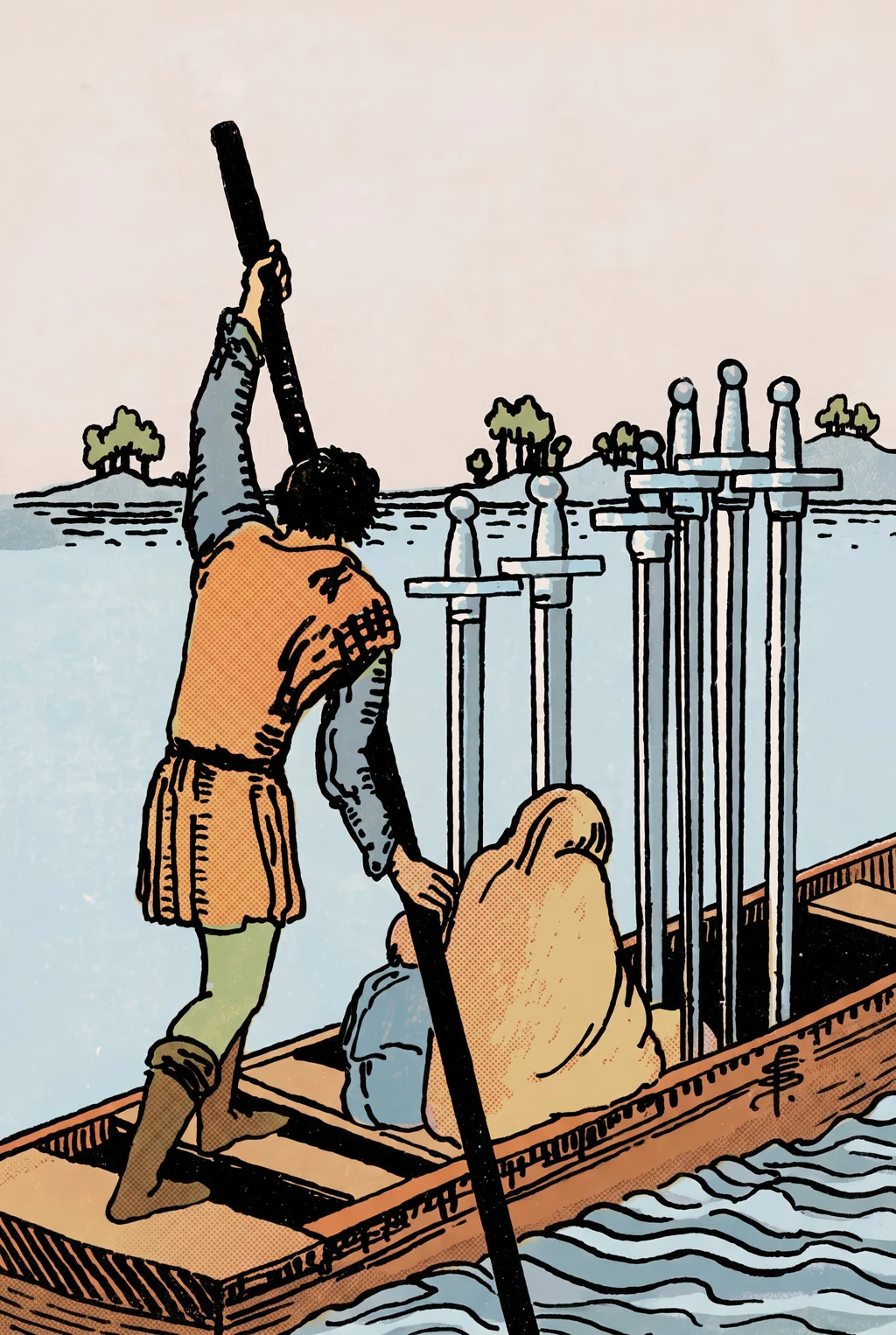
Two passengers sit side by side as a boatman ferries them toward the opposite shore. The adult figure is wrapped in a cloak and bent forward, with a child beside her. Their postures give the journey a sense of weary restraint. They are already moving, though there is no sign yet of joy at the change.
The water ripples alongside the boat, but its surface is smoother farther ahead. The boatman works his pole while the passengers sit quietly. In this peaceful crossing, we can see help that asks for no immediate happiness in return. To reach the other shore, they do not have to know how to steer the boat themselves.
Six swords travel with them. They stand before the passengers like worries that cannot be left behind simply by deciding to depart. What weighs on them is still close, but it no longer holds them on the shore they have left.
Core meaning
Moving from tension toward calmer conditions. The journey is already underway, but leaving the familiar can bring sadness, and past experiences travel with you.
- Key meanings:Transition
- Travel
- Gradual relief
- Distance
- Help
- Sadness of parting
- Key meanings:Difficult transition
- Return
- Delay
- Unfinished business
- Inner change
Image and symbols
Card image
A woman with her head covered and a child sit in a boat, their backs to the viewer. On the right, the woman is wrapped in a yellow cloak and leans slightly forward; the child, wearing blue, sits to her left. Behind them stands a man guiding the boat with a long pole.
Six swords are set vertically in front of the passengers, their points facing down. The water on the right side of the boat is rippled, while the surface farther away is calmer. Trees are visible on the distant shore beneath a pale gray sky.
Traditional context
For Waite, the central image is a crossing: a boatman takes passengers to the other shore, the current is calm, and the load is within his capacity. His divinatory list includes a journey by water, a route, a path, a messenger, an agent, and a means of escape from difficulty.
The reversed list is different: announcement, confession, public disclosure. A separate interpretation cited by Waite connects the card with a proposal of love. In his additional meanings, he mentions a pleasant journey and, for the reversed card, an unfavorable outcome in litigation. These are distinct historical lists, not a single rule that 'upright is good and reversed is bad.'
In modern Rider–Waite–Smith readings, the crossing more often represents leaving a difficult period behind. Relief can exist alongside sadness, and for Joan Bunning, the card also describes everyday listlessness: someone keeps going but does not yet feel uplifted.
In the system of the Golden Dawn, the card is called 'Lord of Earned Success' and is linked to results achieved after anxiety and effort. The intellectual dimension of this approach takes the name 'Science' in the Thoth Tarot; it should not be confused with the literal boat scene depicted by Smith.
Boatman with a long pole
Practical help with a transition. For Waite, the boatman's task is manageable: the crossing is made possible through concrete effort.
A woman leaning forward with her head covered
Quiet sorrow at parting. Change can happen without joy or outward confidence.
Child beside the woman
Vulnerability and the need for protection during change.
Six swords in front of the passengers
Thoughts, memories, and lessons carried along on the journey. In an intellectual interpretation, the swords emphasize the role of reason.
Boat crossing the water
The transition involves feelings as well as thoughts. The water gives the journey an emotional dimension.
Ripples beside the boat and smoother water farther ahead
A contrast between tension and calm. Difficulties are still close, but they no longer fill the entire scene.
Distant shore with trees
A destination and the prospect of change. The distance to the shore emphasizes that the crossing will still take time.
Colors
- Gray — the sky above the crossing
A muted, sorrowful atmosphere, without any sense of celebration.
- Yellow — the seated woman's cloak
In the intellectual interpretation offered by Parsifal’s Wheel, this color represents thought and the search for new understanding.
Meanings
Six of Swords — Upright
General
Overall meaning
Circumstances are changing: someone is moving away from difficulty and seeking calmer conditions. This may take the form of travel, relocation, a change of surroundings, or a different perspective on what is happening.
Change does not always bring joy. Leaving may be necessary and still bring regret; relief arrives gradually, while memories and the consequences of past experiences remain.
Possible support
Another person's help can make it possible to get through a difficult stage without facing it alone. They may offer guidance or take on part of the work.
Possible difficulty
Unfamiliar surroundings can heighten anxiety: even small inconveniences may feel more difficult before the transition is complete.
Focus
Clarify what the change is leading toward, not only what you want to leave behind.
Reflection questions
- What is changing in my life, even if the change does not bring joy yet?
- Whose help can I accept during this transition?
Relationships
Overall meaning
In a romantic relationship, the card can point to reconciliation after a difficult period, or to a separation followed by a gradual easing of pain. It is about leaving an old conflict behind, not necessarily leaving a partner.
In a literal reading, it may suggest relocating or traveling together, or a long-distance relationship. For someone who is single, it can also reflect a growing openness to meeting someone new.
Possible support
Quiet time together away from everyday distractions can help a couple reconnect.
Possible difficulty
In a relationship, walking away from every disagreement can take the place of conversation. Unresolved difficulties may then carry over into the next relationship.
Focus
In a new romantic connection, pay attention to its pace: growing closer gradually does not mean nothing is happening.
Reflection questions
- What conflict can we leave behind without ending the relationship?
- What pace of getting to know someone feels right for me now?
Work and study
Overall meaning
Moving out of a tense period at work: a change in role or workplace, more manageable conditions, or steady progress on a project. A move for work may also be literal.
The card can also describe returning to work after a break, when it takes time to regain your former pace.
Possible support
Support during a role change and experience gained in a previous job can both be valuable.
Possible difficulty
If a job involves relocation, the difficulty may lie in leaving a familiar life behind and slowly adjusting to a new stage.
Focus
If a project has stalled, the way the work is being done deserves attention: the old plan may need to be revised.
Reflection questions
- What working conditions do I want to change?
- Which parts of my past experience will help me in a new role?
Money and resources
Overall meaning
Financial pressure gradually easing and a return to a more stable position. Steady changes matter here, rather than a sudden financial windfall.
Possible support
Lessons from earlier financial difficulties can provide support if they change how you handle everyday spending.
Possible difficulty
Wanting to declare the difficulties over does not make financial obligations disappear. Without attention to them, familiar problems may return.
Focus
Even after some relief, it is worth continuing to keep track of expenses and account balances.
Reflection question
What habit helps me avoid falling back into past financial difficulties?
Wellbeing and self-care
Overall meaning
A gradual return to everyday life after stress or sadness. The intensity of difficult feelings may fade before energy and interest return.
There is also a more subdued reading: someone manages daily tasks but still feels listless and low.
Possible support
A chance to rest and a calm change of scenery can help ease ongoing tension.
Possible difficulty
There may be just enough energy for essentials, without the enthusiasm or pleasure of before.
Focus
Taking a break and resolving the underlying difficulty are not always the same. Notice what continues to trouble you even when you are away from familiar surroundings.
Reflection questions
- What kind of rest would suit me better right now than new experiences?
- What continues to trouble me even when I take a break?
Personal growth
Overall meaning
Moving toward a different understanding of yourself. Beliefs and habits that once seemed natural are being reconsidered; the past remains part of your experience, but it no longer has to determine every choice.
Possible support
Distance from familiar surroundings can help you see new possibilities and look at your experiences differently.
Possible difficulty
Old ideas about yourself may still limit your choices, even after your circumstances change.
Focus
It may help to separate a lesson you have learned from a belief that no longer fits your life.
Reflection questions
- What former belief about myself no longer fits?
- What lesson do I want to keep, even as I change the way I live?
Six of Swords — Reversed
General
Overall meaning
The transition is delayed, proceeds in fits and starts, or brings someone back to an old difficulty. Resistance to change, an unresolved issue, or an external constraint may be the cause; travel or relocation may also be postponed.
Another reading places the change within the person, in their beliefs and habits. In that case, a lack of outward movement does not mean that no inner work is taking place.
Possible support
An open conversation with someone willing to listen can help you avoid facing the difficulty alone.
Possible difficulty
Repeating old mistakes keeps the situation in place, even when efforts to change it continue.
Focus
Distinguish between not wanting to move forward and being in a situation where there is no available way out yet.
Reflection questions
- What is preventing me from completing this transition right now?
- What is changing in how I relate to this situation?
Relationships
Overall meaning
In a romantic relationship, it may be difficult to move beyond an old conflict or complete the emotional process of separation. Old hurts, attachment to a past relationship, or a sense of stagnation may resurface.
For a long-term couple, the card can also describe different paces of change: one partner is already reshaping their familiar routine while the other needs more time.
Possible support
In a long-term relationship, shared activities and interests that both partners want to return to can offer common ground.
Possible difficulty
Memories of the good times can keep someone in a relationship that no longer offers the closeness they want.
Focus
When getting to know someone new, notice whether the person is a good fit, or whether the connection appeals mainly as an escape from loneliness.
Reflection questions
- What am I holding on to: this relationship as it is now, or its past?
- What do we still need to discuss so we don't keep returning to the same conflict?
Work and study
Overall meaning
Changing jobs or roles, or handing over a project, is taking longer than expected. Sometimes circumstances stand in the way; sometimes old ways of communicating and solving problems recur in the new workplace.
Possible support
If the delay is caused by outside factors, you can keep preparing for the transition without treating the pause as a final rejection of change.
Possible difficulty
A tense work environment and the feeling that there is nowhere else to go make it harder to decide what comes next.
Focus
Consider how much of the conflict is being sustained by repeated arguments or defensive reactions, rather than working conditions alone.
Reflection questions
- If I move to another team, what difficulty might follow me?
- What can I prepare while the transition is on hold?
Money and resources
Overall meaning
Old financial difficulties remain unresolved or keep returning. Wanting to leave them behind quickly is at odds with how obligations and expenses are being handled.
Possible support
A calm review of the situation and help from a qualified professional with complicated obligations can provide support.
Possible difficulty
Putting off the task of examining financial obligations makes it harder to understand what needs to be addressed.
Focus
When finances are stable, postponing a major purchase may reflect prudence. It is worth distinguishing that from a habit of ignoring unresolved issues.
Reflection question
What financial issue am I avoiding because I don't want to look into it?
Wellbeing and self-care
Overall meaning
Distressing feelings linger, and the change may feel unfinished. Fear and recurring memories make it difficult to gain emotional distance from a painful period.
Possible support
Being able to talk openly with someone you trust can help you through a time when it is hard to gather yourself and move forward.
Possible difficulty
Confusion and fear can deepen a sense of helplessness, even when there is a desire to change something.
Focus
Make room for sadness over what was left behind: it can remain even after a decision that feels right.
Reflection questions
- Who can I talk to about what is still painful to carry?
- What am I still grieving, even though I've already made the decision?
Personal growth
Overall meaning
Personal change may unfold in solitude: someone reconsiders a familiar perspective and gradually leaves behind an old pattern of behavior. Another reading concerns resistance to that process and a return to what feels familiar.
Possible support
Understanding your own reasons for change and how it connects to your values can help you participate in it consciously.
Possible difficulty
Fear of the unknown can keep an old way of living in place, even when you want to change it.
Focus
Unfinished experiences deserve attention: what conclusion has not yet been reached, leaving you to face a similar difficulty again?
Reflection questions
- What view of myself am I reconsidering right now?
- Why does this change matter to me personally?
Roles in a spread
Position examples
A position gives the card a question, such as what helps or what gets in the way. That question shapes how you read its meaning.
Six of Swords — Upright
Situation
A transition is already underway: the old is being left behind, but the new circumstances still feel unfamiliar.
Influence
The consequences of earlier decisions may be prompting you to leave or change direction.
Motivation
A desire to end an exhausting conflict and find calmer conditions.
Support
Strength comes from accepting help rather than trying to manage everything alone.
Obstacle
Leaving a situation without addressing the underlying difficulty. What remains unresolved can cause trouble again somewhere else.
Focus of attention
Notice the memories and familiar reactions that remain even after circumstances change.
Next step
Consider a way out of an exhausting situation or a move to different surroundings. If needed, arrange support for the transition.
Possible development
Gradually moving away from a difficult period. Progress can begin before a sense of lightness or joy returns.
Six of Swords — Reversed
Situation
The transition remains unfinished: an attempt to leave gives way to a pause or a return to what came before.
Influence
A lack of help or an environment that keeps you in place can make change more difficult.
Motivation
A wish to preserve the familiar and avoid uncertainty, even when the current situation has become hard to bear.
Support
The opportunity to confide in someone you trust and work together to understand what is difficult to untangle alone.
Obstacle
An unresolved conflict holds your attention and prevents you from truly moving on to the next stage.
Focus of attention
Notice where change feels imposed on you, and consider what personal meaning you can find in it.
Next step
Return to what remains unresolved. If leaving is not yet possible, acknowledge that limitation rather than forcing the transition.
Possible development
The transition may take longer or involve returning to an earlier point rather than moving forward steadily.
Combination examples
Card combinations are in development. For now, here are a few examples.
Six of Swords + Three of Swords
Six of Swords ( upright) + Three of Swords ( upright)
- Example question:
- What happens to painful feelings after a difficult event?
- Example interpretation:
The pain is still present, but the person is beginning to leave a difficult experience behind.
Six of Swords + Four of Swords
Six of Swords ( upright) + Four of Swords ( upright)
- Example question:
- What matters in recovering from a stressful period?
- Example interpretation:
Together, these cards emphasize rest and the gradual return of strength.
Six of Swords + Eight of Cups
Six of Swords ( upright) + Eight of Cups ( upright)
- Example question:
- How might the decision to leave and move on be understood?
- Example interpretation:
Both cards reinforce the theme of leaving and continuing the journey; a literal trip is also possible.
Six of Swords + Eight of Wands
Six of Swords ( upright) + Eight of Wands ( upright)
- Example question:
- Could this transition refer to literal travel?
- Example interpretation:
This combination emphasizes the theme of travel, especially by water.
Reading example
An imagined one-card reading shows how the meanings above can apply to a question. This is one possible interpretation.
Six of Swords — Upright
Situation:
Things have become tense at work. There is an opportunity to move to another team, but I would be sorry to leave familiar colleagues, and the new working conditions are still unclear.
Question:
What should I consider when deciding whether to make a transition?
-
Card drawn:
Imagine drawing a card for the position «What to Notice» and getting Six of Swords (upright).
Interpretation:
The Six of Swords connects transition with relief that may also bring regret. Here, it helps separate attachment to colleagues from the question of how manageable the work will be.
It is worth finding out which conditions will actually change on the new team and who can help with the adjustment. The decision can then be seen not only as leaving familiar people behind, but also as moving toward a different way of working.
Six of Swords — Reversed
Situation:
Things have become tense at work. There is an opportunity to move to another team, but I would be sorry to leave familiar colleagues, and the new working conditions are still unclear.
Question:
What should I consider when deciding whether to make a transition?
-
Card drawn:
Imagine drawing a card for the position «What to Notice» and getting Six of Swords (reversed).
Interpretation:
The reversed Six of Swords draws attention to difficulties that could continue even after a change of workplace. In this example, it matters to distinguish what belongs to the current team from what might recur in another.
A first step could be to examine recurring conflicts at work and clarify what needs to change beyond the workplace itself. That gives you something concrete to discuss about future working conditions before accepting the offer.
Yes / No
Six of Swords — Upright
Why this answer
The card connects progress with leaving a difficult period behind, so it supports the possibility of moving forward. This 'yes' involves a transition that may also mean parting with what is familiar.
A clarification
If the question is whether everything will improve while things stay as they are, this 'yes' does not apply: the card is less supportive of expecting change without taking any steps forward.
A question to consider
What circumstances am I planning to change to move beyond a difficult situation?
Six of Swords — Reversed
Why this answer
Progress is difficult for now: the transition is delayed, or unresolved matters keep you in place. This 'no' concerns the possibility of moving forward with the current obstacles, not a final rejection of change.
A clarification
A delay may make sense if the transition is premature and calls for preparation or bringing earlier matters to a close. Not every pause means the change is unnecessary.
A question to consider
What do I still need to prepare for this transition?
Correspondences
Connections with numbers, elements and other symbols add depth to the card’s imagery. They can differ between traditions.
Number — VI (6)
A return to balance after conflict. Harmony is still being established here, rather than already achieved.
Element — Air
The suit of Swords belongs to the realm of thought. The transition can be understood as a change in perspective and ways of reasoning.
Astrology — Mercury in Aquarius, 10–20°
The astrological basis of 'earned success': overcoming difficulties is associated with effort and intellectual focus.
Tree of Life — Tiphareth in the world of Yetzirah
The sixth sephirah in the world of Air. For this card, the correspondence is associated with work, effort, and the restoration of balance.