
Seven of Swords
Descriptions and symbolism are based on the card’s classic illustration in the Rider–Waite–Smith deck. Details of the artwork may differ in other editions of the deck.
This guide brings together traditional and modern readings. Interpretations and answers may differ between authors and schools.
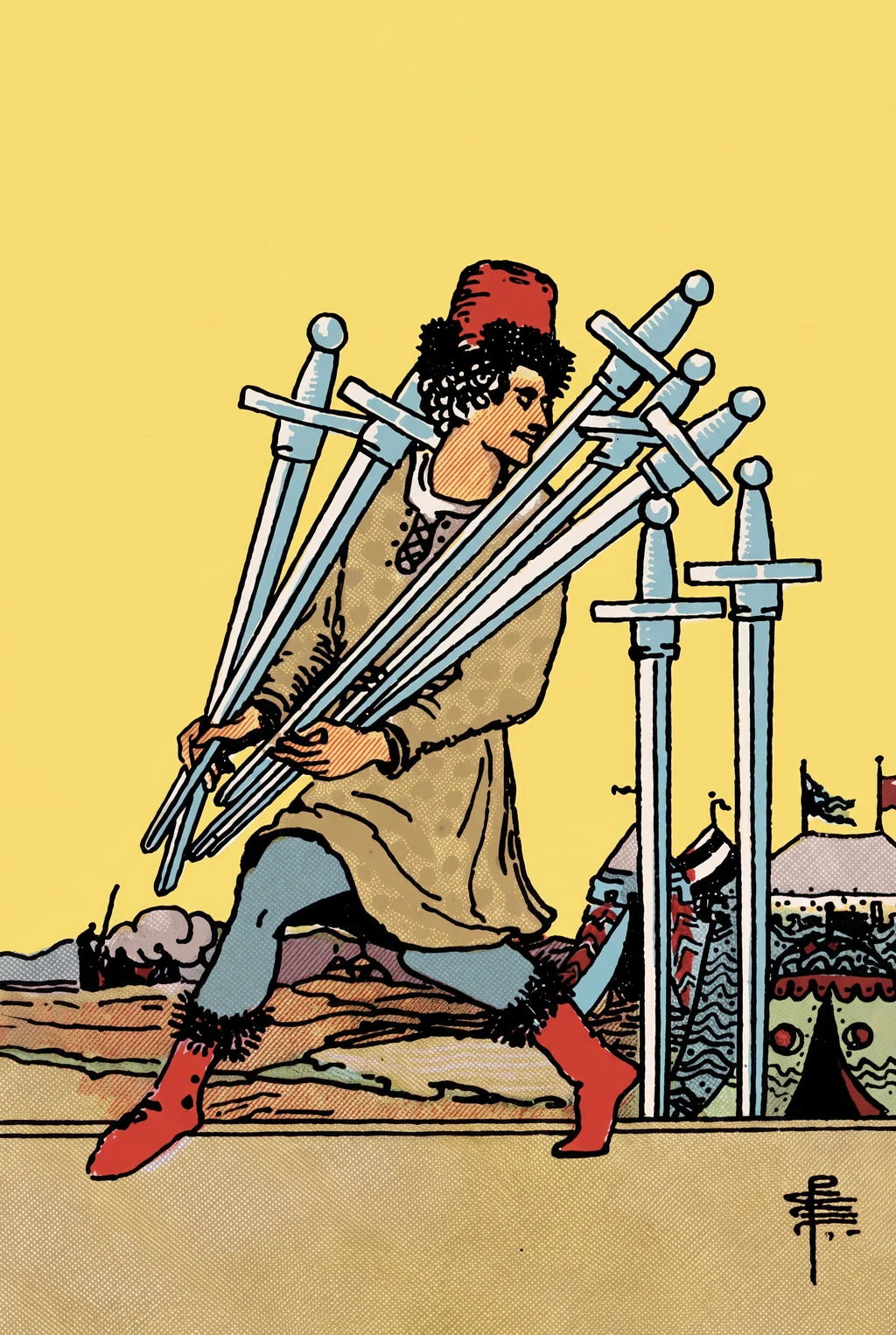
A man walks away from a camp but keeps looking back. Five swords occupy both his hands; he steps carefully, as if hoping to go unnoticed. The tents are still close. He acts apart from the others, without open confrontation.
His expression may suggest satisfaction with his own trick, as though the plan has already paid off. Yet two swords remain planted in the ground near the tents. He has managed to take some of the weapons, but still has to carry them far enough away. His hands are full, and his gaze is turned backward even as he needs to move forward. The plan is already making demands of the person who devised it.
Core meaning
The Seven of Swords pairs resourcefulness and an independent plan with secrecy. Taking an indirect route can be a sensible tactic, but it can also be a way to avoid the truth or responsibility.
- Key meanings:Strategy
- Secrecy
- Independence
- Indirect approach
- Avoidance
- Half measures
- Key meanings:Exposure
- Admission
- Making amends
- Self-deception
- Self-doubt
- Helpful advice
Image and symbols
Card image
A man moves to the left with his head turned to the right. He wears a red cap and red boots. He carries five swords by their blades, with the hilts pointing upward.
Behind him to the right, two more swords are planted in the ground. Tents with pennants stand in the background, and a group of people is visible in the distance on the left. The sky and most of the ground are yellow.
Traditional context
For Waite, the meaning extends beyond deception. The upright Seven of Swords signifies a plan, an attempt, desire, hope, and confidence, but also a quarrel, vexation, and a plan that may fail. Waite himself notes that these meanings pull in different directions and that the illustration offers no single clear explanation. For the reversed card, he gives helpful advice and instruction alongside slander and idle talk.
An additional list by Waite includes a favorable image of country life after achieving prosperity; for the reversed card, it notes that good advice may go unheeded. The author distinguishes this list from the meanings tied to the illustration.
In the Golden Dawn system, the card is called the “Lord of Unstable Effort”: a partial result can remain unfinished because of inconsistency. This is a separate occult framework, not a description of the actions of Smith's figure.
Modern RWS readings develop the visible story of a secret departure. Resourcefulness, independent strategy, concealment, and avoidance of responsibility sit side by side. When reversed, the focus may shift to admission and making amends, or to self-deception that keeps someone from seeing their own circumstances clearly.
A figure walking away from the camp
Independence and separation from the group. The wish to do things your own way can help, but it can also lead to isolation.
Careful steps on tiptoe
Acting unnoticed and avoiding confrontation. The gesture suggests both tact and the possibility of doing something in secret.
Head turned back
Vigilance and checking what has been left behind. A plan calls for attention not only to the goal but also to how others might respond.
Five swords held by their blades
An advantage gained has to be carried awkwardly. This grip draws attention to the risk hidden in a plan that appears successful.
Two swords left in the ground
Not everything can be carried away or completed. The remaining swords may represent an unfinished part of the plan or an important factor that has been overlooked.
A camp with tents
The group and its shared rules, which the figure is leaving behind. A personal plan is set against a sense of belonging to a community.
Small figures in the distance on the left
Other people who might notice what is happening or be involved in the conflict left behind. Their distance allows the consequences to be read as something still in the background.
A smile
Satisfaction with a clever plan or relief at the chance to slip away.
Patterned clothing and colorful tents
The similar fabrics can suggest a connection between the figure and the community. His departure can then be read as leaving his own people behind and breaking a bond of loyalty.
Colors
- Red — cap and boots
Willpower and the drive to get what you want. In this reading, active determination stands alongside a willful streak.
- Yellow — sky
The yellow sky is associated with mental activity and a carefully considered plan. The bright background also underscores the boldness of the action.
Meanings
Seven of Swords — Upright
General
Overall meaning
The Seven of Swords describes an independent plan that is not fully spoken about. Resourcefulness can help you find another route, protect your ideas, and avoid an unnecessary confrontation.
Another side of the card concerns deception, taking what belongs to someone else, and avoiding responsibility. Secrecy may offer an advantage, but a shortcut does not necessarily solve the problem: unfinished work, the risk of being found out, or a plan that fails may remain.
Possible support
Resourcefulness and the ability to find an indirect solution when direct confrontation is not helping.
Possible difficulty
Half measures and rushing: cutting corners instead of seeing the work through.
Focus
Consider why secrecy feels necessary: is it protecting the plan, or helping you avoid an uncomfortable truth?
Reflection questions
- What am I protecting by keeping my plan private?
- What difficulty am I trying to go around instead of resolving?
Relationships
Overall meaning
In romantic relationships, the card touches on things left unsaid, hidden plans, and attempts to maintain closeness without opening up fully. This can include deception or infidelity, but also small omissions made to keep the peace that gradually erode trust.
In friendships, the Seven of Swords can suggest distance and independence: personal boundaries can offer protection, while constant reserve keeps friends at arm's length. There can also be an imbalance when a connection serves only one person's interests.
Within a family, the card may touch on deception by loved ones and the feeling that others are taking advantage of your involvement.
Possible support
Personal space and independence that still leave room for open conversation about the relationship itself.
Possible difficulty
Unilateral decisions and avoiding conversation keep an important part of the relationship hidden.
Focus
When meeting someone new, notice both excessive suspicion and the urge to present yourself as someone you're not.
Reflection questions
- What do I find hard to discuss openly with someone close to me?
- Is the distance I've chosen helping my friendship?
Work and study
Overall meaning
In a work context, the card connects tactical thinking with plans kept private: sometimes it helps to prepare for a change or decision before discussing it. At the same time, it touches on office intrigue, taking credit for others' ideas, and the gap between a project's actual state and how it is reported.
In an educational context, another reading concerns finding an unconventional route into a desired program when the usual process has not worked.
Possible support
Choosing priority tasks instead of trying to take on every project and responsibility at once.
Possible difficulty
Behind-the-scenes competition: gossip, undermining someone's reputation, or taking credit for someone else's work.
Focus
Check any vague terms in an agreement and consider who benefits from leaving them unclear.
Reflection questions
- Which tasks truly require my involvement?
- Which part of the work agreement remains unclear?
Money and resources
Overall meaning
In financial matters, the Seven of Swords draws attention to opaque offers, the risk of deception, and questionable ways to make a quick profit. The lack of clarity may come from the other party to a deal or from your own wish to overlook uncomfortable terms.
Possible support
Careful planning rather than counting on an easy win.
Possible difficulty
The promise of quick money can make a questionable scheme seem more appealing than it is.
Focus
Hidden costs and conditions: look beyond the advertised price or benefit.
Reflection questions
- What costs are missing from this offer?
- Am I treating a promise of easy money as a reliable plan?
Wellbeing and self-care
Overall meaning
When it comes to well-being, the card can reflect the strain of constant vigilance and a habit of hiding difficulties. Another perspective is avoidance: an issue goes unattended while someone tries to convince themselves that no action is needed.
Possible support
An honest look at where your energy and attention go, rather than the appearance of self-care.
Possible difficulty
Constantly watching what you can show others and what you need to hide. This vigilance becomes a source of tension in itself.
Focus
Notice whether the search for a quick fix is replacing attention to what is truly bothering you.
Reflection questions
- What about my well-being am I trying not to notice?
- When do I find it hard to let my guard down?
Personal growth
Overall meaning
In personal growth, the Seven of Swords addresses convenient explanations for your own actions. You may believe a habit is under control or make yourself only a half-hearted promise so that it will be easier to break. The card invites you to notice where your mind helps you understand and where it helps you evade.
Possible support
Name the real reason for an action without immediately trying to justify or condemn yourself.
Possible difficulty
A habit of explaining everything in a way that obscures your own part in what happens.
Focus
Compare the explanation that sounds convincing with what you actually want to avoid.
Reflection question
What explanation for my behavior am I accepting too easily?
Seven of Swords — Reversed
General
Overall meaning
The reversed Seven of Swords may signify something hidden coming to light, a voluntary admission, or the return of what was taken. An old tactic comes into question: the indirect maneuver stops working, and a different approach is needed.
There is also an inward reading: a person may be deceiving themselves or doubting their right to act. Reversal does not always lead to honesty; it can show a growing reliance on tricks rather than a willingness to abandon them.
Possible support
Helpful advice and a willingness to ask for support instead of trying to manage alone.
Possible difficulty
A failed maneuver gives way to an even more elaborate trick, although the old approach no longer works.
Focus
Pay attention to advice that is easy to hear and just as easy to leave unused.
Reflection questions
- Which way of doing things is no longer helping?
- What useful advice have I not yet put into practice?
Relationships
Overall meaning
In a romantic relationship, the card may point to a confession, clearing up what has been left unsaid, or letting go of a role you felt you had to play to be loved. The possibility of speaking more honestly takes priority over keeping up appearances.
In friendship, naming a source of tension may open the way to an apology and renewed connection. But clarification can also reveal that the relationship was built on deception.
In family relationships, this reading touches on misunderstandings, openness, and the need to rebuild trust.
Possible support
A willingness on both sides to discuss the reasons for mistrust, rather than simply ending another argument.
Possible difficulty
A painful reassessment of closeness after a confession: trust has to be rebuilt, not assumed to have returned automatically.
Focus
When looking for a partner, notice whether you constantly feel the need to change yourself to be liked.
Reflection questions
- What can I do to clarify something I've left unsaid?
- Do I have to play a role to preserve closeness?
Work and study
Overall meaning
At work, a tactic may stop delivering results, prompting a rethink of how a project is run. Another reading concerns acknowledging mistakes, exposing dishonest actions, and trying to put things right.
The card can also suggest intrigue intensifying without those responsible being exposed. Recognizing a problem is not the same as resolving it fairly.
An inward-looking work interpretation concerns doubts about your competence: you may feel that others overestimate your abilities. That is not the same as actually misleading them.
Possible support
Clear agreements and a reputation for keeping your word.
Possible difficulty
Relying on a tactic that no longer works instead of changing your approach to the project.
Focus
If mistakes were made or important steps missed at work, identify what you can put right.
Reflection questions
- What needs to change about the way I manage this project?
- Which mistake at work can I address openly?
Money and resources
Overall meaning
Reversed, the card may relate to the discovery of a hidden cost in an agreement or the consequences of handling money carelessly. It can also suggest reassessing an earlier strategy: leaving risky tactics behind in favor of a more transparent approach.
Possible support
A willingness to change a risky way of handling money instead of repeating it.
Possible difficulty
Consequences of earlier decisions that can no longer be brushed aside.
Focus
Honesty in financial agreements and personal responsibility for them.
Reflection questions
- Which decision about money do I need to reconsider?
- What do I now understand about the true cost of this agreement?
Wellbeing and self-care
Overall meaning
Guilt, shame, and the tension surrounding something difficult to share can become an inner burden. This card orientation invites you to consider the cost of keeping a secret, not only the fear of its disclosure.
Possible support
A gentler attitude toward yourself and a conversation with someone you trust.
Possible difficulty
Fear of admitting a difficulty keeps someone tense and compels them to continue hiding it.
Focus
Look at habits you feel inclined to justify even though they make it harder to care for yourself.
Reflection questions
- Who can I talk to about what has been hard to keep to myself?
- What habit do I justify even though it gets in the way of caring for myself?
Personal growth
Overall meaning
One interpretation concerns feelings of inadequacy: you may doubt your skills and feel like an impostor. Another concerns self-deception, when a convenient account of events conflicts with your own beliefs. These are different situations: in the first, it matters not to diminish yourself; in the second, to acknowledge what you would rather turn away from.
Possible support
Recognizing your skills without dismissing them out of fear of failure.
Possible difficulty
Trying to call everything fine when what is happening conflicts with what matters to you.
Focus
Notice persistent doubts about your own honesty: are you repeatedly checking yourself?
Reflection questions
- Which of my abilities am I overlooking right now?
- What am I going along with just to preserve a convenient version of events?
Roles in a spread
Position examples
A position gives the card a question, such as what helps or what gets in the way. That question shapes how you read its meaning.
Seven of Swords — Upright
Situation
Some actions take place apart from the other people involved: a private plan, withheld information, or a way around shared rules.
Influence
Individual interests and information that participants are not sharing may be shaping the situation.
Motivation
The desire to protect your interests, stay independent, and avoid direct confrontation.
Support
The ability to focus on what matters most without taking everything on at once. Being selective keeps your attention on your own plan.
Obstacle
Too little effort disguised as a clever shortcut. Rushing leaves an important part of the work unfinished.
Focus of attention
The part of the plan that remains unspoken. It is worth distinguishing deliberate caution from evasiveness.
Next step
Consider a backup plan and a less conspicuous way to act. Sometimes it is better to step away from a confrontation than to keep fighting.
Possible development
Any advantage gained remains vulnerable: the plan may fall through, and a secret action could come to light.
Seven of Swords — Reversed
Situation
An old way of hiding or avoiding a problem is no longer working. There may be an admission, exposure of what was done, or a return to what needs to be corrected.
Influence
Useful criticism or outside advice that helps you reconsider your usual approach.
Motivation
The desire to stop hiding, acknowledge what happened, and try working with others instead of going it alone.
Support
Advice from someone else and the willingness to accept help. There is no need to prove that you can handle everything alone.
Obstacle
Doubling down on tricks after a setback instead of changing approach. Trying to outsmart the situation becomes part of the problem.
Focus of attention
Where it is time to abandon a clever maneuver and state your position openly.
Next step
Speak directly and put right what is yours to correct. If something was taken from someone else, consider returning it.
Possible development
An admission may be the start of making things right. If avoidance continues, the risk of exposure remains, along with the need to face the consequences.
Combination examples
Card combinations are in development. For now, here are a few examples.
Seven of Swords + The Hermit
Seven of Swords ( upright) + The Hermit ( upright)
- Example question:
- What does the desire to withdraw from others mean?
- Example interpretation:
The cards reinforce the theme of following a separate path and keeping a distance from other people.
Seven of Swords + Justice
Seven of Swords ( upright) + Justice ( upright)
- Example question:
- How does the way I act relate to responsibility?
- Example interpretation:
The cards create a contrast: the evasiveness of the Seven of Swords meets Justice's readiness to act openly and take responsibility.
Seven of Swords + Two of Swords
Seven of Swords ( upright) + Two of Swords ( upright)
- Example question:
- What sustains my reluctance to see the truth?
- Example interpretation:
The combination emphasizes turning away from the truth. Avoidance runs through both cards.
Reading example
An imagined one-card reading shows how the meanings above can apply to a question. This is one possible interpretation.
Seven of Swords — Upright
Situation:
Friends have invited you to join a group project. You like the idea, but you're not sure you can take on what's expected of you. Saying no feels awkward, but you don't want to promise more than you can deliver.
Question:
How can I decide whether to take part?
-
Card drawn:
Imagine drawing a card for the position «What will help me decide» and getting Seven of Swords (upright).
Interpretation:
The Seven of Swords highlights choosing your own priorities. Here, it suggests that you don't have to accept the entire offer just because turning it down feels awkward.
You can first decide which parts you genuinely want to take on and which you would rather decline. That gives you room to choose your role from the outset, rather than promise more than you want to and look for a way out later.
Seven of Swords — Reversed
Situation:
Friends have invited you to join a group project. You like the idea, but you're not sure you can take on what's expected of you. Saying no feels awkward, but you don't want to promise more than you can deliver.
Question:
How can I decide whether to take part?
-
Card drawn:
Imagine drawing a card for the position «What will help me decide» and getting Seven of Swords (reversed).
Interpretation:
The reversed Seven of Swords helps distinguish an unsuitable commitment from doubts about your abilities. You may want to take part but find it hard to admit that you'll need help.
You can talk openly with your friends about what support you would need to participate. If the project itself is not a good fit, you can still decline without pretending to agree.
Yes / No
Seven of Swords — Upright
Why this answer
Hidden information and evasive tactics weigh against a favorable answer. In the current uncertainty, the card offers little support for agreeing or moving ahead with the plan.
A clarification
Before agreeing, it is worth finding out what important information is missing and what lies beyond what is apparent.
A question to consider
What information do I need before I agree?
Seven of Swords — Reversed
Why this answer
The answer centers on a shift from concealment to openness. The chance to clarify what was hidden and deal with others more honestly supports a cautious yes.
A clarification
The more favorable reading depends on addressing the reasons for mistrust. It matters that earlier problems are actually being resolved, rather than merely replaced by a promise to be more open.
A question to consider
What shows that the earlier problems are actually being resolved?
Correspondences
Connections with numbers, elements and other symbols add depth to the card’s imagery. They can differ between traditions.
Number — VII (7)
Seven is associated with assessment, reflection, and the pursuit of knowledge. In the suit of Swords, that search may take the form of endlessly checking your own plan.
Element — Air
The element of thought and communication. Here, intellectual agility shows itself through strategy, caution, and control over what is shared with others.
Astrology — Moon in Aquarius; third decan, 20–30°
This correspondence is tied to the title “Lord of Unstable Effort.” It emphasizes inconsistency and the possibility of stopping before finishing what you started.
Tree of Life — Netzach in the World of Yetzirah
Netzach is associated with desire and feelings. In the suit of Swords, this suggests tension between a rational plan and an inner impulse.