
Six of Cups
Descriptions and symbolism are based on the card’s classic illustration in the Rider–Waite–Smith deck. Details of the artwork may differ in other editions of the deck.
This guide brings together traditional and modern readings. Interpretations and answers may differ between authors and schools.
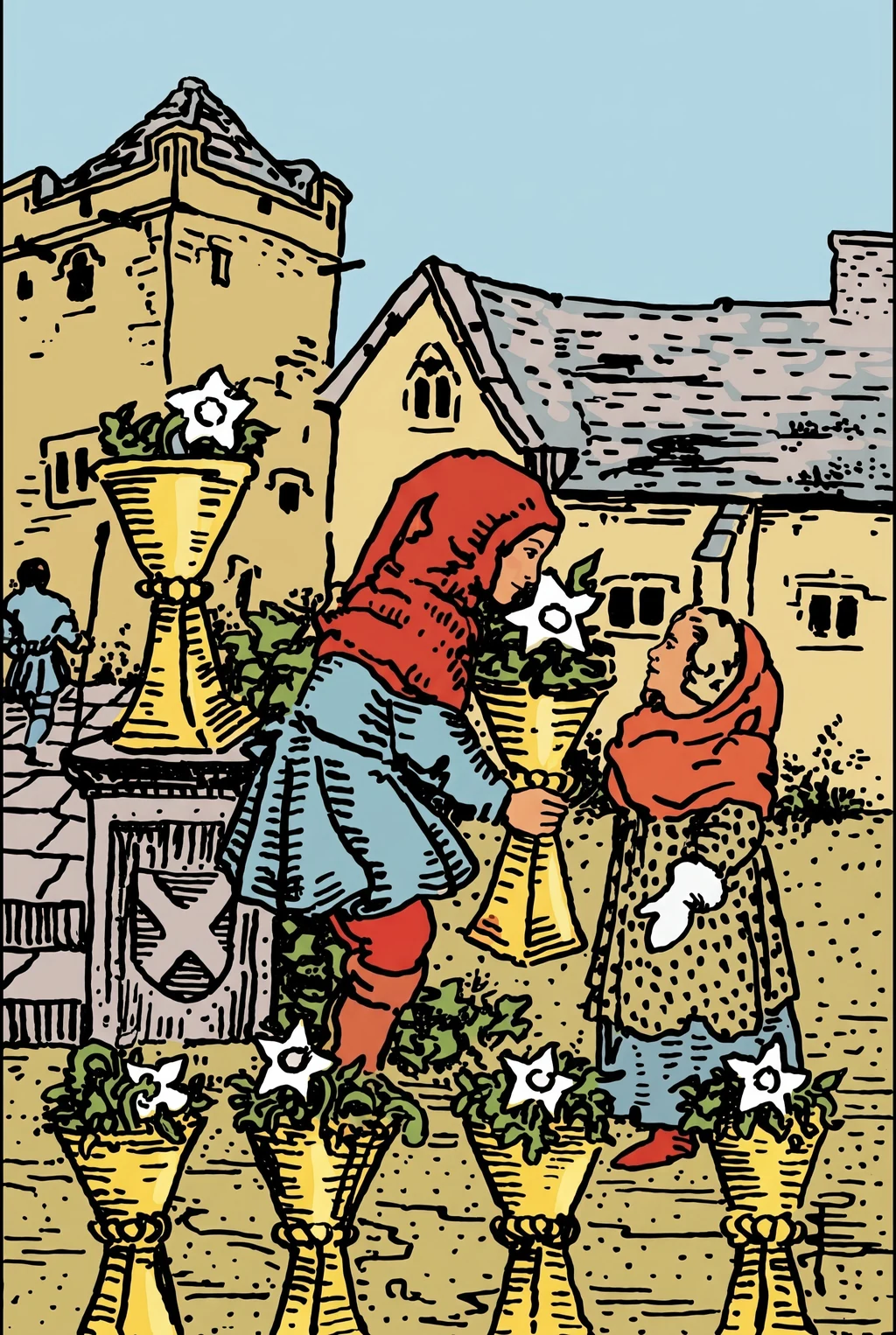
In a courtyard, a small ceremony of giving unfolds. One child bends toward another, holding out a cup from which a white flower grows. Sharing something beautiful takes few words. Buildings surround the children, while the world of adult concerns recedes into the background.
The scene feels like a memory that has kept not the date but the feeling of how someone once treated you. The day itself may have been forgotten long ago, yet someone’s kindness remains clear. The flower is still held out between the children: for them, the gift has not yet become a memory.
Core meaning
Memories of loved ones, childhood, and simple pleasures. The Six of Cups connects past and present through familiar warmth, care, and gifts.
- Key meanings:Memories
- Childhood
- Familiar joy
- Care
- Gifts
- Return
- Key meanings:Renewal
- Growing up
- Stuck in the past
- Letting go of the past
- Lack of play
Image and symbols
Card image
Two child figures stand in a courtyard among buildings. The taller figure on the left bends toward the smaller one on the right, offering a cup containing a white flower. The taller figure wears a red cap and blue clothing; the smaller one wears a patterned yellow cloak and a light-colored mitten.
Four cups holding white flowers stand in the foreground, with another on a stone pedestal behind the taller figure. A shield with intersecting lines appears on the pedestal. In the distance on the left, an adult carrying a long pole-like object walks toward a set of steps. Houses and a tower rise beyond the courtyard under a pale blue sky.
Traditional context
For Waite, this is primarily a card of the past: memories, childhood, and pleasures associated with what has been left behind. Yet in the same list he includes another upright interpretation: new connections, knowledge, and surroundings. He associates the reversed card with the future and renewal.
In Waite’s supplementary list, pleasant memories appear again for the upright card, while the reversed card is also given the meaning of receiving an inheritance soon. The author himself cautions that supplementary meanings may differ from the main list.
Modern Rider–Waite–Smith readings develop themes of kindness, mutual care, and familiar joy. The reversed card can signify either dependence on the past or freedom from it. In the Golden Dawn system, the Six of Cups is called the “Lord of Pleasure”; this is a separate layer of correspondences, not a description of all Waite’s meanings.
Two children
Childhood, early memories, and spontaneity.
A cup extended from one figure to the other
A freely given gift and the pleasure that giver and recipient can share.
Flowers in the cups
The gift of flowers is associated with passing down cherished family traditions.
A courtyard surrounded by buildings
The comfort and security of home. In a more uneasy reading, the enclosed space may suggest safety that also limits freedom.
An adult figure walking away on the left
The concerns of adult life receding, offering a brief chance to leave tension outside the scene.
A light-colored mitten on the smaller figure
The protection and vulnerability of someone receiving care.
Colors
- White — flowers in the cups
The purity and innocence of the feeling expressed by the gift.
- Red — cap of the taller figure
The red cap can suggest protection and vitality. Another possible emphasis is fire and the impulse to act.
- Yellow — the buildings and sunlit courtyard
The warmth, joy, and lightness of the scene.
- Blue — clothing of both figures
Water and inner feelings in modern symbolic interpretations.
- Green — leaves in the cups
A connection to the earth and the natural world in modern symbolic interpretations.
- Red — trousers of the taller figure and shoes of the smaller one
Red can suggest fire and the impulse to act, while the smaller figure’s red shoes may point to the beginning of a journey.
- Orange — boots of the taller figure and headwear of the smaller one
These details can be read as hints of challenges beyond the sheltered moment of childhood.
Meanings
Six of Cups — Upright
General
Overall meaning
The Six of Cups draws attention to old connections and familiar experiences: childhood, an old friendship, a favorite place, or a beloved activity. It can suggest returning to a person or memory that brings warmth, as well as exchanging care and gifts.
The past was not necessarily free of difficulties: memories can bring joy and longing at once. Waite also preserves another upright interpretation: becoming acquainted with new surroundings, people, and knowledge.
Possible support
A familiar person or activity may offer support and help restore emotional balance.
Possible difficulty
The familiar becomes limiting when it shuts out everything new. Fond memories then become a standard the present can never meet.
Focus
Notice why the past feels so important now; it may help explain the question behind the reading.
Reflection questions
- What period of my life do I keep returning to in my thoughts?
- What familiar things still bring me joy today?
Relationships
Overall meaning
In love, the card points to familiar closeness, memories of the beginning of a relationship, or reconnecting with someone from the past. In friendships and family, it speaks to shared history, traditions, and the ability to give and receive care.
A couple may have a familiar division of roles: one partner provides more care while the other receives it. This arrangement may work for both people; different responsibilities alone do not signal a problem.
Far from home, this theme may appear as longing for familiar places and loved ones.
Possible support
For a couple, happy shared memories can help restore warmth after a difficult period. This might mean returning to activities that first brought you together.
Possible difficulty
In a romantic question, fond memories can obscure the reasons an earlier relationship was difficult.
Focus
When reconnecting, consider what brings you together now and whether you both want to continue getting to know each other in the present.
Reflection questions
- What do I still value about our shared history?
- What do I want to learn about this person now, rather than reconstruct from memory?
Work and study
Overall meaning
The card speaks to experience already gained: skills from the past and a return to a path once set aside. It also appears in readings about working with children, teaching, and caregiving.
A familiar workplace may offer security, but it can also feel too predictable, with little room for engaging challenges.
Possible support
Skills and lessons from previous jobs, including what others taught you, can be useful.
Possible difficulty
Past success stops being helpful when it becomes a reason to keep using an outdated way of working.
Focus
When reconsidering your career path, remember not just the decisions that worked but also mistakes you might repeat.
Reflection questions
- What past experience could help me with my current task?
- Is there an earlier career path I would like to return to?
Money and resources
Overall meaning
In money matters, the card may point to a gift, a donation, financial help from family, or shared housing and resources. Some modern interpretations also include inheritance. Whether you are giving or receiving help depends on the question behind the reading.
Possible support
Help with housing or sharing family expenses can ease your financial burden and allow you to preserve your own resources.
Possible difficulty
Attachment to past financial decisions becomes a hindrance when circumstances change but the approach stays the same.
Focus
Notice what support already exists within your family: shared resources and help from loved ones may be relevant to financial matters.
Reflection question
What financial help from my family could I accept or offer?
Wellbeing and self-care
Overall meaning
Familiar places, simple pleasures, and time with loved ones can bring back a sense of calm. Nostalgia can also be bittersweet: a happy memory may remind you that a particular time in life has ended.
Possible support
Loved ones may offer practical help with everyday self-care. You do not have to refuse it simply because receiving care feels difficult.
Possible difficulty
A familiar source of comfort can become the only acceptable one. Fear of the unfamiliar then narrows the ways you can rest and find pleasure.
Focus
Do not expect a familiar way of finding comfort to resolve every difficulty once and for all.
Reflection questions
- What familiar activity helps me feel calmer afterward?
- How do I feel after revisiting these memories?
Personal growth
Overall meaning
Returning to old interests can help you remember what mattered before the familiar demands of adult life took over. A childlike openness here speaks to curiosity, creativity, and the ability to enjoy things without needing a special reason.
Possible support
A playful, creative approach can help you reconnect with your own interests instead of listening only to the demands you usually place on yourself.
Possible difficulty
Complete protection can stand in the way of growth if it removes not only difficulties but also the need to make your own decisions and take responsibility.
Focus
Pay attention to old creative dreams and interests you would like to revisit.
Reflection questions
- Which interest from my past still feels like my own?
- When does curiosity matter more to me than how things turn out?
Six of Cups — Reversed
General
Overall meaning
In modern readings, the relationship with the past changes. The card can describe being stuck in memories, refusing to acknowledge changes that have taken place, or, conversely, becoming ready to step out of an old role and live more independently.
Memories sometimes bring sadness instead of warmth. There is also the theme of lost spontaneity: responsibilities fill life, leaving no room for play or curiosity. In Waite's interpretation, the reversed card signifies the future and renewal, so it should not be reduced to a rejection of happy memories.
Possible support
Support comes from being able to acknowledge past mistakes without returning endlessly to self-blame.
Possible difficulty
An unresolved experience continues to get in the way if you avoid every reminder of it. Avoidance makes it hard to understand what remains unfinished.
Focus
Notice whether you are trying to recover your former life in its entirety rather than seeing the possibilities of your life now.
Reflection questions
- What am I still comparing with how things used to be?
- Where have I outgrown an old role?
Relationships
Overall meaning
In a question about love, the card may point to comparisons with a former partner, old resentments, or a wish to keep a renewed connection with someone from the past private from people you know. These are different situations, not a single sign of dishonesty.
In friendship, shared history may not be enough to sustain closeness today. In a family, the reversed card can suggest moving beyond childhood dependence, reconsidering familiar forms of protection, or not receiving the support you expected.
In an existing relationship, former care can become overprotection that leaves little room for independence.
Possible support
For an established couple, it can help to talk about past misunderstandings: what still hurts and what you still need to understand about each other.
Possible difficulty
Comparing a present relationship with only the happiest moments of a former one leaves little room to truly get to know someone.
Focus
In a relationship, notice whether past disagreements are becoming an ongoing tally of mutual grievances.
Reflection questions
- What in this connection belongs to the present, and what is held together only by memories?
- Is there an old disagreement I would like to discuss without keeping score again?
Work and study
Overall meaning
Familiar work may no longer hold your interest, and skills that were once sufficient may need updating. A change of workplace does not resolve the issue on its own if you bring the same old habits with you without questioning them.
In caring professions, another theme of the card is becoming too emotionally involved.
Possible support
Updating a specific skill through training or a colleague’s help may make it easier to meet current demands.
Possible difficulty
Fear of change keeps you in a familiar job, even though the work no longer feels satisfying.
Focus
If you are constantly thinking about leaving, notice whether your present responsibilities are being overlooked.
Reflection questions
- What has become routine in my work but no longer interests me?
- What knowledge am I missing for my work right now?
Money and resources
Overall meaning
A modern interpretation centers on financial maturity: managing your own resources more independently and moving away from dependence on family support. This does not necessarily mean a worsening financial situation.
In an additional divinatory list by Waite, the reversed Six of Cups has a separate meaning: receiving an inheritance soon.
Possible support
Managing your own money and taking greater responsibility for spending can provide a foundation.
Possible difficulty
Ways of handling money learned long ago may become obstacles if you keep following them regardless of current circumstances.
Focus
The point to reconsider is specific: which old habits still shape how you manage money?
Reflection questions
- Which financial decisions am I already making independently?
- What habit around money is it time for me to reconsider?
Wellbeing and self-care
Overall meaning
Revisiting the past may bring anxiety and sadness instead of rest. Another reading points to the weight of adult responsibilities: days become repetitive, and simple joy disappears.
Possible support
Rest that includes curiosity, play, or pleasure without anything to prove may offer support.
Possible difficulty
When caring for someone else, the demands may narrow your own life so much that there is no room for familiar relationships or rest.
Focus
Notice whether you have removed every activity you do simply out of interest or for enjoyment from your daily life.
Reflection questions
- Do I have an activity in my day that I choose purely for enjoyment?
- Which memory unsettles me now instead of offering comfort?
Personal growth
Overall meaning
The card can describe growing up, setting aside inherited limitations, and reconsidering an old idea of who you are. Or it may show how attachment to a former way of life delays that process.
An unfulfilled childhood dream does not necessarily have to remain your goal today. You can reconsider it without continually reproaching yourself for the years that have passed.
Possible support
Past experience supports growth when you can bring its lessons into your current life instead of trying to live in the past.
Possible difficulty
Familiar beliefs keep you tied to an old version of yourself, even as your interests and needs have changed.
Focus
Notice which expectations you once had of yourself no longer match what you genuinely want to do now.
Reflection questions
- What old expectation of myself do I no longer want to fulfill?
- What has changed for me since this dream first took shape?
Roles in a spread
Position examples
A position gives the card a question, such as what helps or what gets in the way. That question shapes how you read its meaning.
Six of Cups — Upright
Situation
Reconnecting with old relationships and familiar experiences becomes the central theme of the situation.
Influence
Past experience shapes the present; something long familiar may matter more than a new development.
Motivation
The desire to feel a familiar sense of safety and care again may be a driving force, especially if these are missing now.
Support
Support comes from reconnecting with what once brought familiar joy and helps restore a sense of balance.
Obstacle
Attachment to the familiar makes it hard to try something new, even when the old approach no longer answers the question at hand.
Focus of attention
Consider what makes the past especially meaningful in the present situation.
Next step
Return to a simple activity that leaves room for play, curiosity, and genuine interest.
Possible development
What comes next may involve reconnecting with people from the past and revisiting familiar themes.
Six of Cups — Reversed
Situation
The question centers on a changing relationship with the past: holding on to old ways or becoming ready to live more independently.
Influence
Learned family patterns continue to shape decisions, even though old roles may no longer fit.
Motivation
The desire to leave an overly predictable, sheltered life and encounter something new may be the driving force.
Support
Support may come from acknowledging past experiences without continually blaming yourself.
Obstacle
Avoiding an unresolved story from the past allows it to keep shaping the present.
Focus of attention
Notice whether responsibilities have crowded out everything that once let you play, explore, and simply enjoy yourself.
Next step
Stop trying to restore the past exactly as it was. If you regret something you did, consider acknowledging it and making amends for your part.
Possible development
If avoidance continues, old unresolved issues may keep slowing progress. Waite offers another reversed interpretation, focused on renewal and what lies ahead.
Combination examples
Card combinations are in development. For now, here are a few examples.
Six of Cups + The Star
Six of Cups ( upright) + The Star ( upright)
- Example question:
- What supports a kind exchange between people?
- Example interpretation:
The shared themes of kindness and willingness to give become stronger.
Six of Cups + Five of Swords
Six of Cups ( upright) + Five of Swords ( upright)
- Example question:
- What makes it difficult to remain kind in communication?
- Example interpretation:
The Six of Cups’ kindness and trust come into conflict with hostility and self-interest.
Six of Cups + Ten of Cups
Six of Cups ( upright) + Ten of Cups ( upright)
- Example question:
- What helps a family feel close?
- Example interpretation:
Happy shared memories support family warmth and a sense of closeness.
Six of Cups + Ten of Wands
Six of Cups ( upright) + Ten of Wands ( upright)
- Example question:
- What leaves no room for simple pleasures?
- Example interpretation:
The weight of responsibilities makes it hard to return to play and simple joys.
Reading example
An imagined one-card reading shows how the meanings above can apply to a question. This is one possible interpretation.
Six of Cups — Upright
Situation:
You want to message someone who was once a close friend. You have not spoken in a long time, and you are unsure whether anything still connects you beyond good memories.
Question:
What should I consider before getting back in touch?
-
Card drawn:
Imagine drawing a card for the position «What to Pay Attention To» and getting Six of Cups (upright).
Interpretation:
The Six of Cups draws attention to shared history and familiar warmth. Here, a memory could provide a natural reason to reach out, but it does not answer whether the closeness is still there.
You could begin with something you genuinely want to remember together and ask how the other person is doing now. That leaves room for the connection to grow in the present.
Six of Cups — Reversed
Situation:
You want to message someone who was once a close friend. You have not spoken in a long time, and you are unsure whether anything still connects you beyond good memories.
Question:
What should I consider before getting back in touch?
-
Card drawn:
Imagine drawing a card for the position «What to Pay Attention To» and getting Six of Cups (reversed).
Interpretation:
The reversed Six of Cups invites you to notice whether you want everything to be as it was. Your shared history may still matter, even if the closeness has changed.
Before reaching out, you can acknowledge that you want to get to know who this person is today, rather than seek confirmation of the friendship you once had. That way, your first message does not demand an immediate return to the old relationship.
Yes / No
Six of Cups — Upright
Why this answer
Leaning yes: familiar closeness, kindness, and simple joy support a positive reading of the question.
A clarification
Especially relevant to questions about rekindling an old connection or returning to an activity that once brought joy.
A question to consider
What past connection or source of joy do I want to bring into the present?
Six of Cups — Reversed
Why this answer
Leaning no: attachment to old ways of life and outdated habits makes it harder to move forward.
A clarification
Reconsidering old habits and being open to a new perspective matters more than trying to carry on exactly as before.
A question to consider
What old pattern am I holding on to in this situation?
Correspondences
Connections with numbers, elements and other symbols add depth to the card’s imagery. They can differ between traditions.
Number — VI (6)
Harmony and restored balance; in the suit of Cups, this numerical theme is associated with feelings and relationships.
Element — Water
The element of the suit of Cups, associated with feelings and relationships in modern interpretations.
Astrology — Sun in the second decan of Scorpio
For the “Lord of Pleasure,” this correspondence is associated with the beginning of joy and well-being.
Letter — First Heh (ה) of the name YHVH — correspondence of the suit of Cups
This applies to the entire suit of Cups and the world of Briah. It is not a separate path letter assigned specifically to the Six.
Tree of Life — Tiphareth in Briah
The sixth sephirah, associated with beauty and balance, in the world of the suit of Cups. In Book T, the card is associated with the beginning of desire, happiness, and pleasure.