
Ten of Wands
Descriptions and symbolism are based on the card’s classic illustration in the Rider–Waite–Smith deck. Details of the artwork may differ in other editions of the deck.
This guide brings together traditional and modern readings. Interpretations and answers may differ between authors and schools.
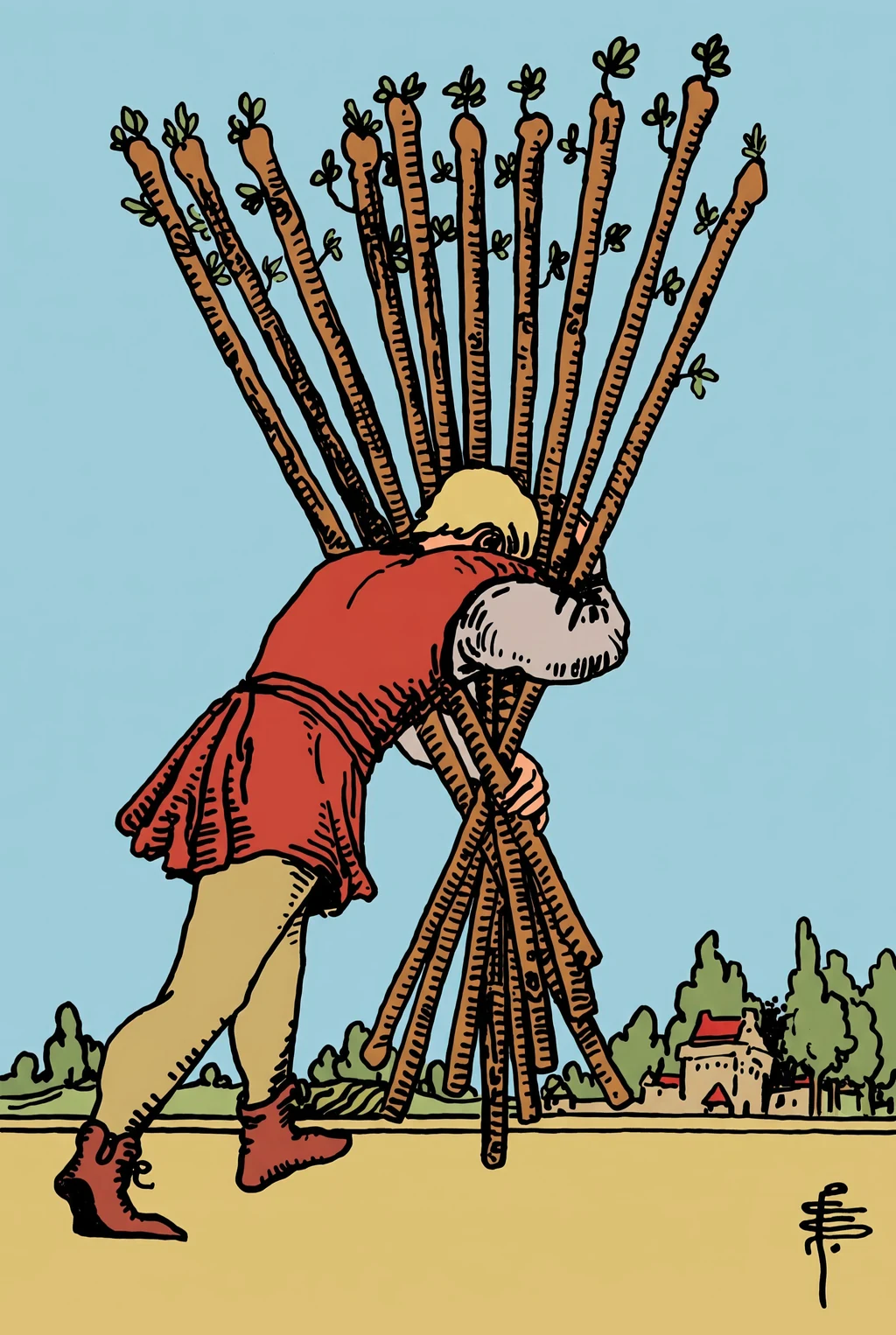
He has to carry it all at once. The figure on the Ten of Wands bends beneath a bundle of long staffs, gripping them with both hands. The load rises higher than he does; his head is lowered, and the wood blocks part of the way ahead. Only constant effort keeps it all together.
Waite noted that even success can become a burden. In this reading, the staffs might stand for things acquired and responsibilities willingly taken on. Gathered in one pair of hands, they demand more and more strength. Holding on to what has been achieved becomes work of its own, leaving little room to enjoy it.
Houses are visible ahead. He still has to reach them—with his hands full and his back bent.
Core meaning
Responsibilities have piled up until it's hard to see the goal beyond them. The Ten of Wands connects a heavy burden with responsibility, the cost of achievement, and the limits of one's strength.
- Key meanings:Heavy burden
- Responsibility
- Overload
- Perseverance
- The cost of success
- Completion of a chapter
- Key meanings:Putting down the burden
- Delegating responsibilities
- Hidden overload
- Refusing help
- Unfinished business
- Avoiding responsibility
Image and symbols
Card image
A person walks with their body bent forward and head lowered. They hold ten long wands in both hands in front of them, the upper ends fanning outward.
Buildings in a small settlement appear in the background.
Traditional context
In Waite's account, the card's central meaning is oppression and burden. Yet he also lists profit, acquisitions, and success: what has been achieved can itself become a heavy load. Waite mentions honor and conscientiousness, but sets them aside in favor of other interpretations.
His divinatory meanings also include false appearances, pretense, and treachery. For the reversed card, he lists opposition, difficulties, and intrigue. Waite acknowledges that some of the meanings he compiled cannot be reconciled with one another.
In the Golden Dawn system, the card is titled “Lord of Oppression.” Its force can act harshly and oppressively. When favorably expressed—what this system calls being well dignified—generosity and selflessness are also possible. This distinction does not correspond directly to upright and reversed orientations.
Modern RWS readings more often focus on workload and responsibility. A reversal may suggest either letting go of unnecessary obligations or continuing to carry too much alone.
One person carries the entire load
Responsibility rests with one person; help and shared duties remain outside the scene.
Bent body and lowered head
The posture conveys the weight of the load and the effort it takes to keep moving.
Ten wands gathered in front of the figure
Accumulated responsibilities fill both hands and block the view. Individual tasks make it hard to see the larger goal.
Settlement in the background
The destination connects the scene with the final stretch of work and the possibility of bringing a difficult chapter to a close.
Meanings
Ten of Wands — Upright
General
Overall meaning
Responsibilities take nearly all your strength, and progress feels difficult. This may be the demanding final stretch of an undertaking or the cost of what you've already achieved: success brings new concerns and the need to maintain the results.
The burden isn't necessarily meaningless. Sometimes someone accepts it for an important goal or to help others. But the card can also reflect outside pressure, with too much placed on one person's shoulders.
Possible support
Perseverance can help you through a difficult stretch when the load is temporary and you know why you're taking it on.
Possible difficulty
Trying to do everything at once leaves little room to choose what matters most and makes everyday responsibilities exhausting.
Focus
Distinguish your own responsibilities from the things you've grown used to doing for others. Not every request means you need to take the task on yourself.
Reflection questions
- What am I carrying this load for?
- Which responsibilities are actually mine?
Relationships
Overall meaning
In a partnership, family, or circle of friends, too much of the everyday responsibility may fall on one person. Relationships begin to feel more like a set of duties than a connection.
In a romantic relationship, the weight sometimes comes from outside: work and money worries leave little energy for closeness, even though the relationship itself isn't necessarily the source of the fatigue.
Possible support
In a partnership, support comes from a willingness to share everyday responsibilities rather than leave them to one person. If you're asking about finding a relationship, the card also leaves room for a pause and attention to your own needs.
Possible difficulty
Unequal contributions and regularly doing someone else's share can build resentment.
Focus
Notice whether the fatigue comes from the way the relationship works or from difficulties outside it. Those call for different conversations.
Reflection questions
- How do we divide everyday responsibilities?
- What else, beyond our relationship, is draining our energy right now?
Work and study
Overall meaning
The workload is becoming heavy, either because there are too many tasks or because the tasks themselves demand an unusual amount of effort. Sometimes this is the intense final stretch of a project; other times, it's an ongoing pattern in which nearly everything depends on one person.
Additional responsibilities may also come without a corresponding increase in compensation.
Possible support
Working together and delegating some tasks can help with a workload that's difficult to manage alone.
Possible difficulty
Reluctance to delegate can leave little time for the work to grow and gradually crowd out the interest that started it.
Focus
When new assignments come in, it's worth clarifying which existing tasks can wait rather than silently adding everything to the current load.
Reflection questions
- Is it the number of tasks or their difficulty that's holding me back?
- What can I discuss with the people I work with before taking on new tasks?
Money and resources
Overall meaning
Financial obligations feel like a heavy burden: payments, debts, or major expenses demand constant attention. The purchase or undertaking behind those obligations may be valuable, but maintaining it isn't easy.
Possible support
A calm review of obligations, a plan of action, and help with financial matters may offer support.
Possible difficulty
Large or accumulated payments limit your freedom to use your money and keep the pressure alive.
Focus
Don't replace a clear look at financial difficulties with either panic or an attempt to avoid thinking about them altogether.
Reflection question
Which required payments are having the greatest effect on my decisions right now?
Wellbeing and self-care
Overall meaning
Constant effort leaves little time to recover. The card can describe fatigue, tension, and the feeling that responsibilities keep coming even when you already need rest.
Possible support
Slowing down, getting sleep, and having time free of obligations create space for recovery.
Possible difficulty
If every free moment gets filled with tasks for others, your own rest ends up last in line again.
Focus
Notice how normal tiredness has become and whether you still have room to pause before taking on the next demand.
Reflection question
Is there time in my day for sleep and rest?
Personal growth
Overall meaning
Responsibility can become a habit of always being the person who handles everything for everyone. Your own wishes then take a back seat, and saying no to another request can feel like failing to live up to that role.
Possible support
Returning to what truly matters to you personally can help you choose your responsibilities more consciously.
Possible difficulty
Wanting to remain the indispensable person can make it hard to acknowledge your limits.
Focus
Consider which commitments still serve your goals and which continue only because they became part of your life at some point.
Reflection questions
- Has saying yes to requests become a habit?
- Which of the things I do still matter to me personally?
Ten of Wands — Reversed
General
Overall meaning
The burden can finally be shared, reduced, or set down. The reversed Ten of Wands may reflect relief after letting go of unnecessary obligations.
There's another reading, too: the burden remains, but someone carries it silently, doesn't ask for help, or becomes increasingly convinced they must manage alone. Sometimes overload ends in an abrupt rejection of every obligation. That kind of withdrawal is different from a considered decision to let go.
Possible support
Acknowledging your limits and accepting help can make it possible to find a more manageable way to handle what's necessary.
Possible difficulty
Keeping every concern to yourself hides the weight from others and makes it harder to receive help.
Focus
Distinguish unnecessary obligations from unfinished work. Sometimes a delay calls for returning to finish something, not abandoning it.
Reflection question
Which tasks can I hand off, and which do I still need to finish?
Relationships
Overall meaning
In a partnership, the card can point to difficulty sharing responsibilities. One person keeps everything on their shoulders, either trying to protect the other from problems or not trusting them to help; this creates distance.
In family and friendships, another theme is boundaries: caring for someone doesn't require endlessly tolerating treatment that causes harm.
Possible support
In a partnership, support comes from being able to acknowledge the difficulty openly and let your partner share in your common responsibilities.
Possible difficulty
Unilaterally stepping away from shared responsibilities may simply shift the entire burden onto the other person.
Focus
Look at what makes it hard to talk about problems: wanting to shield your partner from worries or doubting that they can help.
Reflection questions
- Is it easy for me to ask my partner for help?
- What will happen to our shared responsibilities if I stop taking care of them?
Work and study
Overall meaning
An overloaded way of working is changing. This could mean tasks are being shared more successfully, or it could be a forced stop because the previous workload is no longer sustainable.
The reason the pressure has eased matters to the reading: was the work divided among people, or has the energy to do it run out?
Possible support
Genuinely distributing work across a team, rather than keeping all tasks with one person, can provide support.
Possible difficulty
A task that's too complex or has grown too large can demand ever more effort without delivering a comparable result.
Focus
If you're consistently treated poorly at work, it's worth examining the conditions themselves rather than assuming you have an absolute duty to endure them.
Reflection questions
- Which tasks could we divide differently at work?
- What about my working conditions am I no longer willing to accept as normal?
Money and resources
Overall meaning
The financial burden may be easing if its underlying causes are already being addressed. Another reading points to growing difficulties when the obligations themselves, and the sources of pressure, remain unattended.
Possible support
Help with financial difficulties may provide support.
Possible difficulty
Prolonged financial strain can consume your attention and sustain ongoing worry.
Focus
Look at which actions are already changing the causes of the strain. Wanting to feel relief doesn't mean the obligations have actually decreased.
Reflection question
What am I already doing to address the causes of my financial strain?
Wellbeing and self-care
Overall meaning
This can suggest either relief after a difficult period or fatigue that's no longer easy to push through by sheer willpower. The card draws attention to the need for rest, especially when the habit of pressing on conceals how heavy the burden has become.
Possible support
A break and time without new obligations may help you recover more than another attempt to force yourself to keep going.
Possible difficulty
Always being ready to help everyone can leave your own well-being unattended.
Focus
Notice when saying yes to one more request takes away the rest you need.
Reflection question
What helps me truly rest, rather than just stop for a little while?
Personal growth
Overall meaning
The connection between responsibility and self-worth is being reconsidered. Sometimes a person clings to being overworked as proof that they're needed. Another reading is about letting go of activities and expectations that no longer hold personal meaning.
Possible support
Consciously choosing what to keep and what to let go of can help you stop maintaining an old workload out of habit.
Possible difficulty
Giving up everything at once can leave obligations that still matter unaddressed.
Focus
Examine the expectations that have formed around your constant help: what began as a free choice may gradually have become an assumed obligation.
Reflection questions
- Do I measure my worth by how much I get done?
- Which expectations do I keep meeting out of habit?
Roles in a spread
Position examples
A position gives the card a question, such as what helps or what gets in the way. That question shapes how you read its meaning.
Ten of Wands — Upright
Situation
Tasks have piled up around one person, and nearly all their attention goes toward keeping up with current commitments.
Influence
Responsibilities born of earlier success may be shaping the situation: what you've gained requires continuing effort and can become a burden in its own right.
Motivation
You may be driven by a desire to keep your promises and not let down those who have come to rely on your help.
Support
A temporary willingness to take on the difficult part of a task can help you move toward a meaningful goal.
Obstacle
The drive to do everything yourself leaves no time to reconsider your approach or develop the work itself.
Focus of attention
The relationship between effort and purpose deserves attention: getting a lot done doesn't necessarily mean the most important work is getting enough time.
Next step
Revisit your priorities: separate what is necessary from what isn't, and discuss handing off work that doesn't have to be done alone.
Possible development
If the work really is nearing its end, these efforts may bring a difficult chapter to a close. Yet success can bring new responsibilities rather than the complete freedom you expected.
Ten of Wands — Reversed
Situation
The card shows either a redistribution of responsibilities or the opposite: one person still carries everything alone, without speaking about the difficulties.
Influence
Repeated requests can create an expectation that help once offered freely will now be given all the time.
Motivation
You may be motivated by a desire to ease the pressure and live more simply, without giving all your attention to an endless stream of duties.
Support
Being willing to admit that the load is too much to carry alone, and accepting others' help, becomes a source of support in itself.
Obstacle
Staying silent about difficulties and holding on to all the responsibility makes it harder to share the load, even when the need for help is already clear.
Focus of attention
It's worth checking whether the current obstacle has to do with work that was considered finished too soon.
Next step
Set limits on new requests and return to others the responsibilities that belong to them.
Possible development
Consciously letting go of unnecessary obligations may bring a period of overload to an end. Another possible direction is coming to a halt under the pressure, when carrying on as before is no longer possible.
Combination examples
Card combinations are in development. For now, here are a few examples.
Ten of Wands + Four of Swords
Ten of Wands ( upright) + Four of Swords ( upright)
- Example question:
- How do effort and rest relate in this situation?
- Example interpretation:
The cards contrast a heavy workload with rest. The Four of Swords highlights a pause against the Ten of Wands' unrelenting effort.
Ten of Wands + Justice
Ten of Wands ( upright) + Justice ( upright)
- Example question:
- What role do accepted obligations play?
- Example interpretation:
Justice brings responsibility into sharper focus: this is not only about the weight of the work but also about being accountable for commitments already made.
Ten of Wands + Five of Wands
Ten of Wands ( upright) + Five of Wands ( upright)
- Example question:
- What makes it harder to move forward?
- Example interpretation:
The Five of Wands intensifies the theme of struggle and resistance. The Ten of Wands' burden grows heavier amid constant clashes and obstacles.
Reading example
An imagined one-card reading shows how the meanings above can apply to a question. This is one possible interpretation.
Ten of Wands — Upright
Situation:
There's more to take care of at home, and conversations with my partner increasingly revolve around what still needs to be done. I want to talk about the strain, but I'm not sure where to begin.
Question:
What should I consider before talking about our shared responsibilities?
-
Card drawn:
Imagine drawing a card for the position «What to pay attention to» and getting Ten of Wands (upright).
Interpretation:
The Ten of Wands draws attention to how the load is shared. The strain may come not from the relationship itself but from an overwhelming number of responsibilities, including work and money worries.
Before the conversation, it may help to distinguish shared responsibilities from outside pressures and identify what has become too much. That creates room to discuss the actual workload rather than turning it into a general accusation that the relationship has become a burden.
Ten of Wands — Reversed
Situation:
There's more to take care of at home, and conversations with my partner increasingly revolve around what still needs to be done. I want to talk about the strain, but I'm not sure where to begin.
Question:
What should I consider before talking about our shared responsibilities?
-
Card drawn:
Imagine drawing a card for the position «What to pay attention to» and getting Ten of Wands (reversed).
Interpretation:
The reversed Ten of Wands invites you to notice the difficulty of accepting help. In this situation, consider how easy it is to ask for help and trust someone else with part of the work.
The conversation can begin with what has become difficult and how your partner might take part. Abruptly stepping away from shared responsibilities without an agreement may only shift the burden onto someone else.
Yes / No
Ten of Wands — Upright
Why this answer
Too many responsibilities and intense pressure make it difficult to move forward. The card points more toward overload than favorable conditions for what you have in mind.
A clarification
What matters is whether the circumstances behind the overload are changing. Looking at the causes can help you see whether the obstacles behind this cautious “no” are still in place.
A question to consider
Are there circumstances that are causing me to take on too much right now?
Ten of Wands — Reversed
Why this answer
Letting go of burdensome responsibilities and working through difficulties create more favorable conditions for moving forward.
A clarification
This positive reading applies when unnecessary obligations are beginning to fall away and unresolved difficulties are being addressed.
A question to consider
Which unnecessary responsibilities am I actually managing to let go of?
Correspondences
Connections with numbers, elements and other symbols add depth to the card’s imagery. They can differ between traditions.
Number — X (10)
Completion of a cycle. In the Ten of Wands, this is linked to the final difficult effort and to responsibilities that may remain after a goal is reached.
Element — Fire
The suit's element is linked to action and initiative. In the Ten of Wands, the expression of that force reaches a demanding, burdensome limit.
Astrology — Saturn in Sagittarius, third decan: 20–30°
This combination corresponds to the “Lord of Oppression”: intense pressure, resistance, and the harsh use of force in pursuit of material goals.
Tree of Life — Malkuth of Wands; Malkuth of Yod
Malkuth links the Tens with the fixed, fully realized expression of force. For Wands, Book T emphasizes its harshness, naming cruelty, revenge, and injustice.