
Page of Cups
Descriptions and symbolism are based on the card’s classic illustration in the Rider–Waite–Smith deck. Details of the artwork may differ in other editions of the deck.
This guide brings together traditional and modern readings. Interpretations and answers may differ between authors and schools.
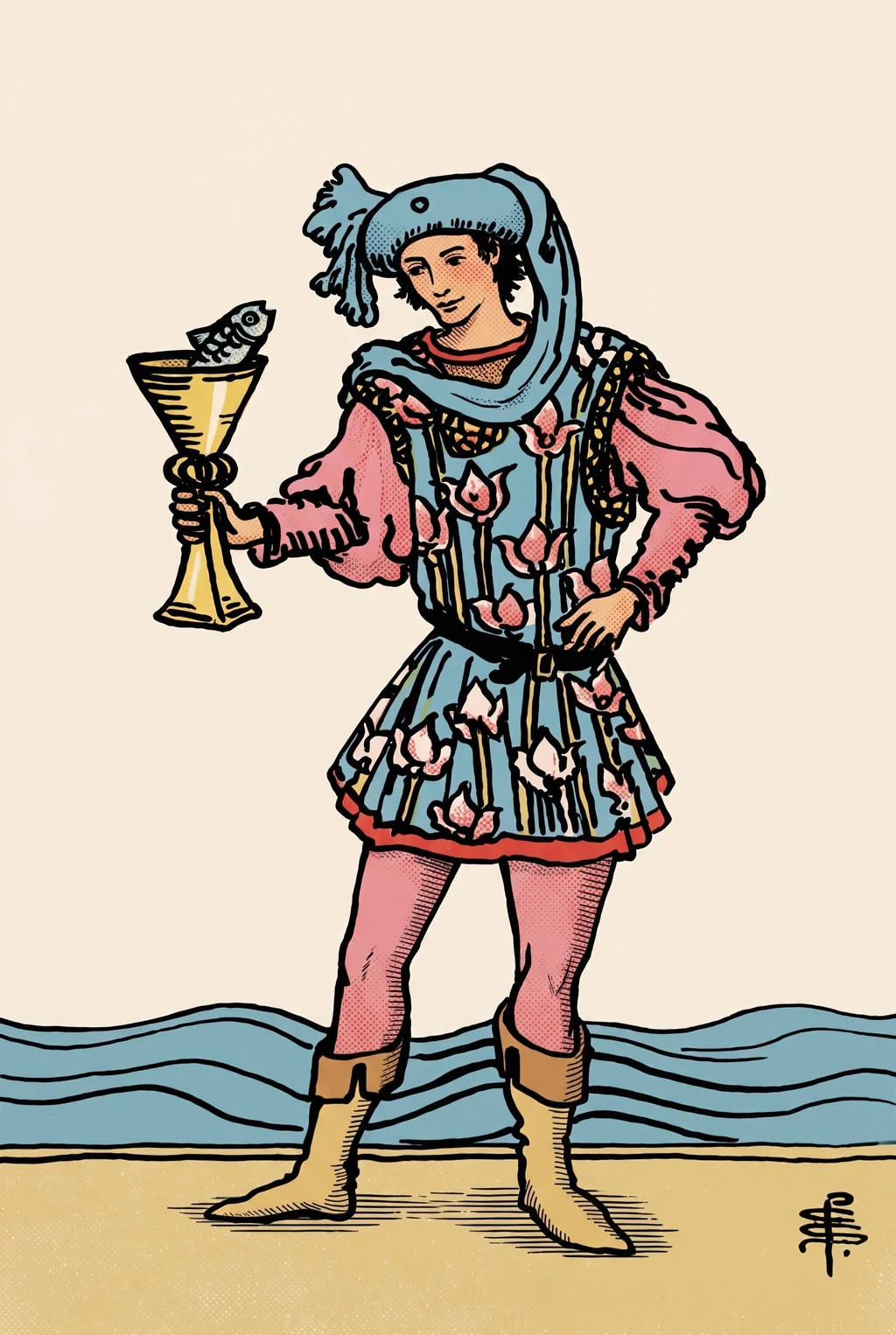
The Page of Cups meets the gaze of an unexpected visitor. A fish peeks out from the cup in his hand and looks directly at him. The young figure stands at ease, with his other hand resting on his hip; the strangeness of the encounter seems not to trouble him at all. An almost confidential, wordless conversation takes shape between the Page and the fish.
Waite saw images of the mind taking form here. The fish seems to make visible a thought or feeling that has not yet found words but has already caught the Page's attention. The sea remains behind him, yet its unfamiliar life has come very close, into the cup he holds before him. For a moment, the vessel's usual purpose is forgotten: now it is something to look into and meet another presence.
Core meaning
The Page of Cups speaks to first feelings, unexpected inspiration, and news that touches the heart. Its openness helps you begin, but it is no substitute for experience.
- Key meanings:First feelings
- Creative curiosity
- News
- Caring involvement
- Imagination
- Thoughtful reflection
- Key meanings:Shyness
- Creative block
- Idealization
- Hurt feelings
- A private idea
- Disappointment
Image and symbols
Card image
A young figure stands on the shore in a blue tunic decorated with pink flowers. Pink sleeves and stockings show beneath it, and the figure wears yellow-ochre boots with turned-down cuffs. A soft blue headdress with a long, folded drape covers the head. The left hand rests on the hip.
In the right hand, on the viewer's left, the Page holds a golden cup. A fish peeks out of it, turning its head toward the Page, who tilts his own head and looks back. A blue sea with waves stretches behind the figure, with a strip of sand underfoot. An even gray background fills the upper part of the image.
Traditional context
For Waite, the fish the Page observes is connected to images of thought taking form. His list of divinatory meanings brings together news, diligence, reflection, and a willingness to render service. Reflection and effort can also concern practical affairs.
His additional meanings are not limited to happy romance: a favorable omen appears alongside a person who has little luck in love. For the reversed Page, Waite gives attraction, attachment, seduction, deception, and trickery; his additional list also includes obstacles.
Modern interpretations speak more fully of first feelings and creative experiments. Reversal can suggest shyness, hurt feelings, or a fantasy disconnected from what is happening. Another reading concerns an unfinished idea that someone is still developing privately. As a Court Card, the Page can describe a way of participating in a situation rather than a literally young person.
The youthful figure of the Page
A student and a messenger: a feeling or idea is just beginning to emerge, and the experience needed to work with it is still developing.
The Page studies the fish in the cup
In Waite's interpretation, this represents attention to an image arising in the mind and taking visible form.
The cup raised in the right hand
A vessel for feelings and imagination. Here it suggests a still-unfamiliar emotional experience that can be noticed and expressed.
The fish emerging from the cup
An unexpected thought or feeling rising to the surface. The image is associated with intuition and creative insight.
Pink flowers on the blue tunic
When the pattern is read as water lilies, the flowers symbolize purity and the unfolding of feelings. The floral motif is also associated with beauty and growth.
The wavy sea behind the figure
The depth and shifting nature of emotion. The waves suggest that an outwardly calm posture does not mean an inner life at rest.
Colors
- Blue — the tunic
The blue of the Page's clothing can be read as spiritual receptivity.
- Pink — the shirt beneath the tunic
The emotional side of the image: sensitivity and a readiness to respond to feelings.
- Blue — the headdress and flowing scarf
In a modern reading, this color is linked to the world of feelings and inner life; the headdress can also suggest a dreamy disposition.
Meanings
Page of Cups — Upright
General
Overall meaning
The Page of Cups describes a moment when something moves you for the first time: a spark of affection, an unusual idea, or the wish to accept an invitation. You are only beginning to get to know this feeling or possibility.
The card also relates to news and a willingness to participate, help, and look closely at a situation. Traditional readings emphasize diligence and reflection; modern ones give greater weight to curiosity and imagination.
Possible support
Receptivity helps you stay open to an unfamiliar idea, while kindness allows you to offer support without pressure.
Possible difficulty
The wish to be liked can lead you to agree to things you do not want. Gentleness then turns into excessive accommodation, leaving your own needs unmet.
Focus
Notice what has caught your interest or moved you. An unusual idea is worth considering before dismissing it as frivolous.
Reflection questions
- What genuinely surprises or moves me right now?
- When do I agree to something just to avoid upsetting someone else?
Relationships
Overall meaning
In romance, this can be an early attraction, an invitation, a tender gesture, or the return of playfulness to a familiar relationship. A feeling may still come across awkwardly, but sincerely.
In friendship and family, the Page relates to caring and reconciliation: listening, offering support, apologizing, or being the first to reopen a kind conversation. A new friendship may also begin with lighthearted, curious exchanges.
Possible support
Small gestures of care and a willingness to hear another person's feelings without judgment help sustain connection.
Possible difficulty
The fear of upsetting someone close makes it hard to say no. Agreeing just to keep the peace can hide a very different wish.
Focus
At the start of a romance, consider whether plans for the future are racing ahead of getting to know each other. Notice what your conversations feel like right now.
Reflection questions
- What gesture of affection or care would I like to make?
- Can I say no to someone close to me when I don't want to agree?
Work and study
Overall meaning
This card relates to creative beginnings, learning, and the wish to find work that genuinely interests you. Imagination and empathy can matter both in the arts and in work that calls for understanding people.
The Page can also signify news about a job or a chance to try a new role. A beginner still has practical aspects of the work to learn.
Possible support
Imagination helps you suggest a fresh approach, while empathy brings greater consideration for others into collaborative work.
Possible difficulty
You may become so drawn to the idea of future work that you put off the steps needed to make it real. Inspiration alone does not build a skill.
Focus
If there is tension with a coworker, consider what a direct conversation might clarify before deciding that changing jobs is the only way forward.
Reflection questions
- What idea do I want to try in practice?
- What do I need to learn to turn this idea into more than a dream?
Money and resources
Overall meaning
In financial matters, the Page may describe an appealing opportunity, gift, or offer that matters primarily for its emotional significance. A small gesture of care does not necessarily mean substantial material support.
Another aspect of the card concerns hopes that have not yet been measured against real possibilities.
Possible support
Support comes from making a financial goal specific and achievable rather than expecting a dream to come true on its own.
Possible difficulty
An appealing idea can obscure the terms of an agreement. The danger of naivety here is mistaking what you want for what is already available.
Focus
Clarify exactly what is being offered and which terms are known. Gratitude or excitement does not determine the size or nature of an obligation.
Reflection question
What terms of this appealing offer do I still need to understand?
Wellbeing and self-care
Overall meaning
In everyday well-being, the Page relates to gentle attention to feelings and a renewed interest in what brings joy. Play, music, or creative work can offer ways to express an experience.
Possible support
You can support yourself through an activity that offers pleasure rather than simply demanding that you cope, such as music, drawing, or freely writing down your feelings.
Possible difficulty
When you're deeply in love, thoughts of closeness may occupy so much attention that switching off and falling asleep becomes difficult.
Focus
Notice which feelings you want to express and what activity might help you do so without self-criticism.
Reflection questions
- What activity helps me express my mood?
- Can I shift my attention from thoughts of closeness to rest?
Personal growth
Overall meaning
The Page of Cups invites exploration of your sensitivity and creative interests. You can discover parts of yourself that previously had no room to emerge and learn without expecting immediate mastery. How you present yourself can also be part of that exploration: finding your own style rather than simply following others' ideas of how you should look.
Possible support
Curiosity and trying unfamiliar things help you discover what you genuinely enjoy.
Possible difficulty
Other people's ideas of the right choice can drown out your own wishes, especially when approval matters more than your interest in what you are doing.
Focus
Notice which interest is truly yours, even if others do not yet take it seriously.
Reflection questions
- What would I like to learn simply because it interests me?
- In what decision do I rely too much on others' approval?
Page of Cups — Reversed
General
Overall meaning
A feeling or idea may remain unspoken because of shyness, self-criticism, or fear of being misunderstood. Another reading points in the opposite direction: emotions run high, and expectations race ahead of events. A message or canceled invitation may bring disappointment.
Keeping something private does not always mean being blocked. Sometimes an idea is still maturing, and it is too early to expose it to others' judgment. Traditional meanings also include attraction, attachment, seduction, and trickery; these require context rather than an automatic accusation of deceit.
Possible support
When an idea is still fragile, being able to develop it without premature judgment helps preserve your own interest in it.
Possible difficulty
Fear of not doing something well enough can stop you before the first attempt. The difficulty then lies not in a lack of ideas, but in the demand for a flawless result.
Focus
Distinguish between protecting an unfinished idea for now and giving up on it out of fear of judgment. From the outside, both can look like silence.
Reflection questions
- What am I finding difficult to express?
- Am I giving this idea time to mature, or putting off trying because I fear judgment?
Relationships
Overall meaning
In romance, the card may point to unspoken attraction, shyness, or disappointment when an idealized picture of a relationship meets reality. Sometimes hurt feelings and a need for constant reassurance interfere with communication; at other times, feelings are simply difficult to show.
In friendship, one reading concerns gossip, sharing confidences, and unequal effort. It invites reflection on how trust is handled rather than declaring that a friend is insincere.
Possible support
In a couple, calm conversations about feelings and rediscovering shared joy can help. In friendship, support comes from being able to tell someone you trust honestly what is troubling you.
Possible difficulty
Unspoken expectations can easily become a standard by which someone close to you is always doing something 'wrong.' This makes mutual understanding and conversation about real wishes harder.
Focus
Consider which wishes have been voiced and which the other person would have to guess. In friendship, consent before sharing personal details and care with confidences matter in their own right.
Reflection questions
- What do I expect from someone close to me without saying so directly?
- Am I treating what others have confided in me with care?
Work and study
Overall meaning
An idea may be appealing but not yet have a workable form. Fear of criticism makes it hard to discuss, and the demand to do it well from the start makes it hard to begin.
Another difficulty arises when the pursuit of income or recognition becomes the only reason for creative work and personal interest gets lost.
Possible support
Experimenting freely, without demanding perfection, can restore your interest in the work. It helps to remember what you enjoyed about the activity itself before expectations of success took over.
Possible difficulty
Feedback on your work may feel like a judgment of your entire creative ability. That reaction makes it harder to benefit from useful criticism.
Focus
Look at what is holding you back most: an unclear path to implementation, fear of judgment, or the loss of enjoyment in the work itself. These are different challenges.
Reflection questions
- What am I avoiding trying because I'm afraid of doing it badly?
- What did I enjoy about this work before I started expecting recognition?
Money and resources
Overall meaning
Emotion may shape a financial decision more than careful consideration: you may want to comfort yourself quickly, elicit a certain response with a gift, or avoid unpleasant numbers.
The card can also describe a gap between hoped-for income and the practical basis of a plan.
Possible support
Support comes from calmly reassessing a financial goal and separating what is achievable from what is wished for.
Possible difficulty
Trying to escape an unpleasant feeling through another risky decision may make the original difficulty worse.
Focus
Check the actual amounts and terms. If you're giving a gift or making a purchase, notice separately what emotional response you expect from it.
Reflection questions
- What feeling or response am I hoping this purchase will bring?
- Which part of the financial terms am I reluctant to examine?
Wellbeing and self-care
Overall meaning
There may be too many feelings to sort through all at once. The opposite is also possible: finding it hard to identify what you feel or how to express it.
Sometimes play and enjoyment are missing; at other times, outward cheerfulness serves to keep a difficult feeling out of view.
Possible support
Writing about your experiences and speaking with someone you trust can help you give your feelings a clearer form. A creative activity may also offer expression without the pressure to produce a result.
Possible difficulty
When feelings are continually pushed aside, they remain unexamined. In a strong emotional moment, it can be hard to distinguish the feeling itself from an immediate urge to act.
Focus
Notice whether you feel more overwhelmed by emotions or more unable to identify them. Let that distinction guide how you support yourself. If you seem cheerful on the outside, consider the difference between taking a break and avoiding a feeling.
Reflection questions
- What feeling am I struggling to put into words?
- Who can I speak with calmly about how I'm feeling?
Personal growth
Overall meaning
Self-doubt can silence an interest: you want to draw, write, or acknowledge a feeling, but your inner critic rejects the attempt in advance. Chasing approval can also pull you away from what you once enjoyed for its own sake.
Yet an idea kept private is not necessarily stalled. It may need personal time before you feel ready to share it.
Another imbalance comes from not wanting to examine your feelings: an easygoing exterior can take the place of more honest engagement with your own life.
Possible support
Trying things for yourself, without immediately showing them or seeking evaluation, helps you reconnect with your own interests.
Possible difficulty
When every attempt must immediately prove your worth, learning becomes difficult: a mistake feels like a reason to give up the activity entirely.
Focus
Separate the wish to keep something personal from the habit of dismissing yourself before you begin. An unfinished idea and a fear of trying anything call for different approaches.
Reflection questions
- What do I allow myself to do only after someone else approves?
- What idea would I like to keep developing privately for now?
Roles in a spread
Position examples
A position gives the card a question, such as what helps or what gets in the way. That question shapes how you read its meaning.
Page of Cups — Upright
Situation
A message, invitation, or first emotional response enters the picture. For now, understanding what sparked your interest matters more than treating a beginning as a finished result.
Influence
A kind message or invitation may influence the situation. What matters most is the emotional response it evokes, not the scale of any promises.
Motivation
The desire to be helpful, respond, and take part may be the motivation.
Support
In a position of support, the Page may represent a willingness to help and thoughtful involvement. Someone offers assistance or takes the time to understand a matter without claiming to know everything.
Obstacle
Being too accommodating becomes an obstacle: the desire not to upset anyone makes it difficult to acknowledge your own refusal or disagreement.
Focus of attention
Pay attention to a budding thought and your own response. It helps to consider carefully what is only beginning to take shape.
Next step
Express what has moved you: offer support, show affection, or give an unusual idea an initial form.
Possible development
One possible direction involves a new emotional or creative theme: a message, an invitation, or the start of an interest. This direction does not yet describe a mature outcome.
Page of Cups — Reversed
Situation
A feeling or idea has not yet found expression. The reason may be fear of judgment or a conscious wish to work things out privately first.
Influence
Other people's criticism, or the anticipation of it, can suppress an idea that is still taking shape. Sometimes their doubts have already become your own inner prohibition.
Motivation
Silence may come from the wish to protect an unfinished idea from interference and premature judgment.
Support
Time to develop an idea away from premature judgment can be a source of support. It helps when the idea is genuinely growing rather than being postponed indefinitely.
Obstacle
The demand to get everything right immediately becomes an obstacle. Self-criticism stops a thought from being expressed before there is even anything to develop.
Focus of attention
Check whether a response you hope for is being treated as one that has already happened. Pay particular attention to what was actually said and what still exists only in your expectations.
Next step
If emotions have taken over your attention, step back a little and look at the situation more calmly. Then express what you feel without exaggeration or demanding an immediate response.
Possible development
This theme may require a more mature way of handling feelings than your habitual response allows. If emotional uncertainty persists, difficulty expressing yourself will remain significant.
Combination examples
Card combinations are in development. For now, here are a few examples.
Page of Cups + The Fool
Page of Cups ( upright) + The Fool ( upright)
- Example question:
- What is worth considering before getting to know someone romantically?
- Example interpretation:
Openness to a new feeling and a willingness to meet someone without a story already written in advance. The combination suggests the possibility of a beginning, not a fully formed love story.
Page of Cups + Three of Swords
Page of Cups ( upright) + Three of Swords ( upright)
- Example question:
- What could help a conversation after hurt feelings in a relationship?
- Example interpretation:
Hurt feelings coexist with the possibility of gently reopening communication. This pair emphasizes an honest conversation that makes reconnection worth exploring.
Page of Cups + Seven of Cups
Page of Cups ( upright) + Seven of Cups ( upright)
- Example question:
- Where is my imagination helping, and where am I mistaking wishes for reality?
- Example interpretation:
A rich imagination becomes even more active, along with the risk of becoming absorbed in an appealing possibility with little grounding in what is happening. It helps to distinguish inspiration from a wished-for scenario.
Reading example
An imagined one-card reading shows how the meanings above can apply to a question. This is one possible interpretation.
Page of Cups — Upright
Situation:
You want to return to a creative activity you love, but it feels awkward to be a beginner again. You have a chance to do it with others, yet you hesitate to respond to the invitation.
Question:
What would help me find the courage to try?
-
Card drawn:
Imagine drawing a card for the position «What will help» and getting Page of Cups (upright).
Interpretation:
The Page of Cups connects new beginnings with curiosity and the pleasure of trying. In this situation, it invites you to notice your own interest, which is being overshadowed by the fear of seeming inexperienced.
You could accept the invitation for the simple chance to enjoy something you love again. You do not have to prove beforehand that you are already good enough.
Page of Cups — Reversed
Situation:
You want to return to a creative activity you love, but it feels awkward to be a beginner again. You have a chance to do it with others, yet you hesitate to respond to the invitation.
Question:
What would help me find the courage to try?
-
Card drawn:
Imagine drawing a card for the position «What will help» and getting Page of Cups (reversed).
Interpretation:
The reversed Page of Cups draws attention to the fear of making an imperfect attempt. Here, self-consciousness around others may overshadow the desire to return to something you enjoy.
You can first give yourself permission to try without an audience or evaluation. That privacy helps as long as it lets you begin rather than becoming a way to postpone returning indefinitely.
Yes / No
Page of Cups — Upright
Why this answer
Leaning toward yes. Openness, early interest, and a willingness to try support a new beginning. This reading is especially relevant to questions about feelings, communication, and creative ideas.
A clarification
Remember that this is an early stage: a new feeling or idea needs patience and care. Enthusiasm should not be mistaken for an established outcome.
A question to consider
Which opportunity do I genuinely want to explore?
Page of Cups — Reversed
Why this answer
Leaning toward no, in the sense of 'not now.' Unclear, restrained, or still-immature feelings make a confident response difficult. The reversed card suggests a lack of readiness, not a possibility closed for good.
A clarification
It may help to clarify where you stand on the question and name your feelings honestly. An unclear or unspoken wish makes a confident decision difficult for now.
A question to consider
What remains unclear about how I feel toward this decision?
Correspondences
Connections with numbers, elements and other symbols add depth to the card’s imagery. They can differ between traditions.
Number — XI (11)
If the Page is counted after the Ten, the number 11 symbolically marks the start of a new cycle. The RWS card itself has no such number.
Element — Earth of Water
The earthly aspect of the water suit concerns giving form to its images and feelings. In Book T, this rank is called the Princess, or Knave, of Cups.
Element — Air of Water
The airy rank of the Page combines with the water suit: thought and imagination shape how feelings are experienced.
Astrology — Cancer, Scorpio, Pisces
The connection comes through the water suit: sensitivity, imagination, and emotional response. This does not assign the Page to a single decan or zodiac sign.
Astrology — Pisces
This particular interpretation emphasizes the dreaminess, imagination, and sensitivity that link the Page to Pisces.
Astrology — Cancer
The emphasis on Cancer comes from themes of emotional beginnings, sensitivity, and the first open response.
Letter — Final Heh — the second ה in יהוה
The final Heh corresponds to the Princess, or Knave, and completes the action of the other courtly forces. Here the letter relates to a rank, not to an individual Major Arcana path.
Tree of Life — Malkuth
Malkuth gathers and completes the action of the other forces. The corresponding rank of Knave is associated with their manifestation and with the foundation for a new beginning.