
Nine of Cups
Descriptions and symbolism are based on the card’s classic illustration in the Rider–Waite–Smith deck. Details of the artwork may differ in other editions of the deck.
This guide brings together traditional and modern readings. Interpretations and answers may differ between authors and schools.
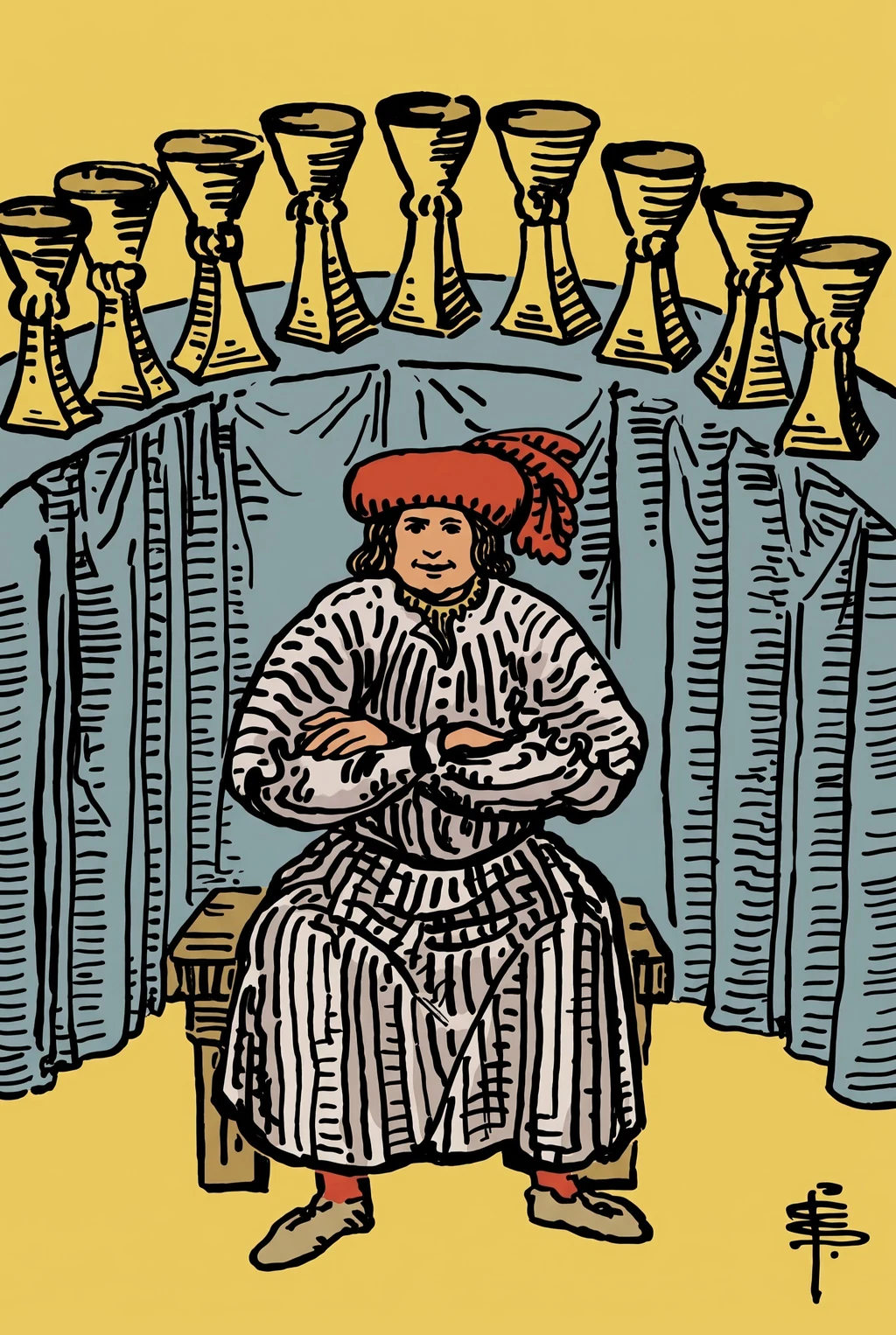
Waite finds the figure in the Nine of Cups after a feast: he has eaten his fill, and there is wine to spare. The man sits on a wooden bench with the air of someone who has everything he needs for now. His arms are folded across his chest; there is nothing to reach for and no need to hurry to his feet.
Behind him, nine cups stand on a fabric-covered display. They could be a small exhibition of successes: everything in view, everything in its place. There is a touch of theater in the arrangement, and both pleasure and pride in the satisfied face. The cups are set out to be noticed. The figure seems to linger before them, allowing himself a little more time to inhabit his contentment.
Core meaning
The Nine of Cups speaks of wishes fulfilled, pleasure, and satisfaction with the outcome. It also helps distinguish genuine joy from smugness and from success that falls short of expectations.
- Key meanings:Wish fulfillment
- Contentment
- Pleasure
- Success
- Gratitude
- Recognition
- Key meanings:Disappointment
- Dissatisfaction
- Excess
- Vanity
- Reconsidering desires
- Inner happiness
Image and symbols
Card image
A man in a long, light-colored robe, a red feathered hat, and red stockings sits on a wooden bench. He faces the viewer, smiling, with his arms crossed over his chest.
Behind him, nine golden cups are displayed on a high, semicircular stand covered in blue fabric. The background and foreground are yellow; there are no other people, plants, or landscape features on the card.
Traditional context
In Waite's interpretation, the card brings together concord and contentment with physical well-being, victory, success, and advantage. He describes a man who has thoroughly enjoyed his feast, but makes a distinction: the image shows the material side, while its meaning extends beyond it.
For the reversed card, Waite lists truth, loyalty, and liberty, followed by errors and imperfections, noting that interpretations differ. In a supplementary list, the upright card is favorable specifically for military personnel, while the reversed card is associated with successful dealings. These are distinct historical meanings and should not be folded into the modern shorthand that 'reversed means bad.'
In Book T of the Golden Dawn system, the Nine of Cups is called the Lord of Material Happiness. The wish fulfilled and the nearly complete realization of pleasure are already present, alongside generosity, vanity, and smugness. This list is not divided into upright and reversed meanings.
Modern readings develop the image of the 'wish card.' The upright orientation is associated with enjoying achievements and feeling grateful; the reversed orientation with dissatisfaction, excess, or discovering that the desired result did not bring the expected joy.
A smiling man seated on a bench
An image of contentment and physical comfort. The smile can express genuine joy, while his showy pose adds a hint of smugness.
Arms crossed over his chest
Confidence in what he has already gained. In a more guarded reading, the gesture suggests a desire to keep that pleasure to himself.
Nine cups arranged in a high arc
The cups resemble trophies: personal wishes, achievements, and sources of satisfaction are put on display.
A wooden bench with no cushioning
A simple place to rest, not a throne. Its limited comfort suggests pleasure as a moment worth experiencing, without expecting it to last forever.
Blue cloth covering the stand beneath the cups
The achievements are visible, but the support beneath them is hidden by fabric. The composition allows for a distinction between outward prosperity and what lies behind it.
Feather in the man's hat
A sign of success and merit to take pride in. In this reading, the feather complements the trophies displayed behind him.
Colors
- Red — hat and feather
Desire, enthusiasm, and a zest for life. The red hat is also associated with an active mind.
- White — the man's long robe
White can suggest purity, softening the impression of vanity: pride in oneself can remain a healthy sense of confidence.
- Yellow — background and foreground
A bright, open sense of joy. In modern symbolic interpretations, this color is also associated with emotional understanding.
- Blue — cloth behind the figure
The emotional and intuitive side of satisfaction. Blue allows the displayed achievements to be read as personally meaningful, not merely material.
- Red — stockings
A festive zest for life and sensual pleasure. The detail can hint at a celebration after success, adding to the man's relaxed pose.
Meanings
Nine of Cups — Upright
General
Overall meaning
A wish finds its fulfillment in reality, and the outcome brings pleasure. The card can describe the successful completion of an endeavor, recognition of success, or quiet contentment with how life is unfolding.
The pleasures here are down to earth: good food, an enjoyable gathering, rest, and a chance to celebrate your achievements. Yet confidence can easily become smugness when personal success turns into a reason to look down on others.
Possible support
Recognizing your own success without needing to confirm it through someone else's praise every time.
Possible difficulty
Self-satisfaction can become boasting and a desire to get back at those who doubted you.
Focus
Notice what has already worked out and brings you pleasure before turning your full attention to the next goal.
Reflection questions
- What brings me a sense of satisfaction right now?
- Which of my achievements am I still undervaluing?
Relationships
Overall meaning
In a relationship, the Nine of Cups is associated with the pleasure of intimacy, mutual affection, and enjoyable time together. The sensual side of the relationship matters as much as the joy of each other's company.
For family and friendships, this may be a warm gathering where it simply feels good to be together. The card also allows another reading: someone can be content without a romantic partner and feel no desire to enter a relationship merely for the sake of being in one.
Possible support
Mutual appreciation and the pleasure of each other's company strengthen the bond, in friendships and family relationships alike.
Possible difficulty
In romantic matters, overly demanding expectations of an ideal partner can make it difficult to appreciate a real person.
Focus
Make room for the good already between you: shared pleasure, appreciation, and the simple enjoyment of each other's company.
Reflection questions
- What do I enjoy about spending time with the people close to me?
- How do I feel about the possibility of being single?
Work and study
Overall meaning
Work can bring satisfaction not only through results, but also through having your skills noticed. The Nine of Cups describes reaching a professional goal, completing a successful project, and receiving recognition for your contribution.
In creative work, it especially captures the moment when you can share what you've made and feel proud of it.
Possible support
Skills demonstrated through your work give you reason to speak more confidently about your contribution instead of hiding your achievements.
Possible difficulty
Professional recognition can turn into overconfidence and an inflated view of your abilities.
Focus
As your work draws more attention, protect time for rest rather than treating every invitation as another obligation.
Reflection questions
- Which result of my work gives me a reason to feel proud?
- Where can I speak more clearly about my contribution?
Money and resources
Overall meaning
In material matters, the card is associated with prosperity, financial comfort, and enjoyment of what you've gained. This may be a financial goal you've reached or the chance to buy something you've wanted.
Another side of this state is spending for pleasure or for the impression your purchases make on others.
Possible support
The resources you already have may provide a foundation for comfort and enjoyment of what you've achieved.
Possible difficulty
Feeling prosperous can weaken your sense of restraint in spending: a purchase becomes a way to display success rather than acquire something you need.
Focus
Distinguish the pleasure of having enough from the belief that every financial risk is now justified.
Reflection questions
- Which purchase would genuinely make my life easier or bring me joy?
- What do I spend money on mainly to make an impression?
Wellbeing and self-care
Overall meaning
The card describes a pleasant sense of physical comfort and emotional satisfaction. In everyday self-care, this can mean enjoying rest, good food, beauty, and activities that delight the senses.
Possible support
The chance to rest and enjoy sensory pleasures helps bring your attention back to what makes everyday life enjoyable.
Possible difficulty
When you're feeling good, it can be easy to overindulge in food or entertainment. Pleasure and excess sit close together here.
Focus
Pay attention to the pleasant sensations already present that you usually miss in the rush of the day.
Reflection questions
- What actually helps me feel rested?
- How do I recognize when I've had enough pleasure?
Personal growth
Overall meaning
The Nine of Cups is associated with acknowledging your achievements and feeling good about yourself without constantly checking how others respond. Inner contentment matters as much as visible success.
The card also helps you name your own desires and distinguish them from a life shaped mainly around other people's expectations.
Possible support
Your own approval and respect for what you've done help you keep others from having the final say in how you value your life.
Possible difficulty
Pride stops being supportive when it turns into a comparison in which others must come out worse.
Focus
Notice which desires are truly yours and what already gives you a sense that life feels good, even without visible rewards.
Reflection questions
- What do I like about myself without comparing myself to others?
- Which desire can I confidently call my own?
Nine of Cups — Reversed
General
Overall meaning
The reversed Nine of Cups can describe an unfulfilled wish or a more complicated situation: the goal has been reached, but brings less joy than expected. Outward success and inner satisfaction no longer align.
The card is also associated with excess, vanity, and chasing new pleasures that quickly lose their appeal. Sometimes the obstacle is unrealistic expectations or hoping for a result without contributing to it. A more constructive reading is to reconsider both the wish and how you pursue it. Waite preserves a separate historical thread of truth, loyalty, and liberty alongside errors and imperfections.
Possible support
Acknowledging honestly what does not bring joy allows you to define success on your own terms instead of trying harder to impress others.
Possible difficulty
The pursuit of ever more pleasure or recognition can sustain dissatisfaction even amid visible achievements.
Focus
Check not only whether you got what you wanted, but also whether it meets the need that led you to pursue it.
Reflection questions
- What has fallen short of my expectations?
- Which wish deserves reconsideration rather than pursuit at any cost?
Relationships
Overall meaning
In close relationships, the card can point to unmet expectations and a lack of genuine connection. For romantic partners, this may be especially noticeable when the relationship looks successful from the outside, but meeting expectations alone does not create intimacy.
In another reading, seeking romance becomes a way to distract yourself from dissatisfaction with your own life. The relationship is then asked to solve something it cannot fully resolve.
Possible support
An open conversation about what's missing can help restore a deeper connection. This takes both people's involvement, rather than simply maintaining the appearance of a happy relationship.
Possible difficulty
An idealized picture of a relationship can obscure real needs. Excessive expectations make it harder to find satisfaction in what is actually happening between two people.
Focus
Distinguish difficulties within the relationship from personal dissatisfaction you hope to escape through romantic attention.
Reflection questions
- What would I like to talk about so we can understand each other better?
- What changes am I expecting from a relationship?
Work and study
Overall meaning
A desired job or professional achievement may turn out to be less enjoyable than imagined. The card can also describe an unmet goal, a lack of expected recognition, and disappointment with the results of your efforts.
In creative work, it may reflect dissatisfaction with what you've made and a sense of having to force the work forward. Waite gives the reversed card a different, additional meaning: successful business dealings. That meaning belongs to his separate list of divinatory interpretations.
Possible support
When choosing your next direction, consider satisfaction with the work itself, not only pay and prestige.
Possible difficulty
The expectation of a perfect job can clash with tedious, difficult, or uninteresting everyday tasks.
Focus
Ask whether the work itself brings you joy or whether the main goal has become winning approval. In creative work, stepping away from constantly showing your results may help you see the difference.
Reflection questions
- What am I missing in my day-to-day work?
- How much of my goal comes from interest in the work, and how much from a desire for recognition?
Money and resources
Overall meaning
A material goal may remain out of reach, while a purchase or expected payment may fail to bring the satisfaction you hoped for. Even with outward prosperity, the feeling that you don't have enough may remain.
The card is also linked to spending beyond your means and seeking contentment through one more purchase.
Possible support
Working with the resources you already have and setting an achievable goal may offer more support than counting on a perfect outcome.
Possible difficulty
Spending for pleasure or the appearance of success can exceed your means without easing inner dissatisfaction.
Focus
Check whether spending on pleasures is exceeding what you can afford. In this card, moderation also applies to money.
Reflection questions
- Which of my expectations about money is going unmet right now?
- Which expenses bring me less joy than I expected?
Wellbeing and self-care
Overall meaning
Entertainment and enjoyable purchases may lose their appeal when used to drown out dissatisfaction. The reversed card also describes an excess of pleasures that disrupts your usual sense of balance in everyday life.
Possible support
If you lack connection or support, you can reach out instead of trying to cope with loneliness through entertainment alone.
Possible difficulty
Pleasant experiences may keep piling up while satisfaction stays the same. Excess then becomes a way to avoid noticing what's missing.
Focus
Notice how familiar pleasures affect your well-being and rest afterward, not just the relief they bring in the moment.
Reflection questions
- Which kinds of entertainment leave me feeling better, and which leave me feeling worse?
- Who can I turn to when I need more support and connection?
Personal growth
Overall meaning
The card questions your usual definition of success. An achievement may meet other people's expectations and still not be what you want.
This opens a useful possibility: stop trying to prove you've succeeded and redefine what kind of life brings you satisfaction. An unfulfilled wish doesn't always need to be pursued further; sometimes it's worth asking whether it still feels like your own.
Possible support
Paying attention to your own desires helps you reclaim the right to define success for yourself.
Possible difficulty
Trying to impress others can take the place of understanding what you genuinely enjoy.
Focus
Notice which goal you still expect to make you happy, even though it no longer reflects what you want.
Reflection questions
- What does success mean to me?
- Which goal do I keep choosing out of habit?
Roles in a spread
Position examples
A position gives the card a question, such as what helps or what gets in the way. That question shapes how you read its meaning.
Nine of Cups — Upright
Situation
A desired outcome has been reached or is becoming tangible; enjoyment and satisfaction with what has been done are at the heart of the situation.
Influence
Joy and confidence can spread to those around you, inviting connection and shared celebration.
Motivation
The motivation may be a desire for personal fulfillment, not just to complete another task. Enjoying life itself becomes a meaningful goal.
Support
Recognizing your own success helps you avoid relying entirely on other people's opinions.
Obstacle
Displaying superiority can become a greater obstacle than a lack of achievements. Enjoyment of success gives way to a need to put others down.
Focus of attention
Notice what already brings satisfaction instead of overlooking it while waiting for the next achievement.
Next step
Give yourself time to enjoy what you've accomplished and appreciate the value of this moment.
Possible development
One possible direction involves a wish being fulfilled and a sense that you can enjoy what you've achieved.
Nine of Cups — Reversed
Situation
The outcome doesn't match expectations: wishes may go unfulfilled or stop bringing joy once they come true.
Influence
Measuring success by other people's standards can distance you from your own desires.
Motivation
The motivation may be a desire to appear more successful and gain recognition, even when the outcome itself no longer brings much joy.
Support
If you feel lonely or lack support, you can reach out rather than face that feeling alone.
Obstacle
Excess, unrealistic expectations, or hoping for results without taking part can stand in the way of satisfaction. Outward signs of success may not be enough.
Focus of attention
Distinguish between having a wish fulfilled and meeting the need behind it.
Next step
Reconsider the wish: you can let go of a goal that has lost its meaning or clarify the steps toward one that still matters.
Possible development
If you keep following others' standards, new achievements may leave the same sense of something missing.
Combination examples
Card combinations are in development. For now, here are a few examples.
Nine of Cups + The Empress
Nine of Cups ( upright) + The Empress ( upright)
- Example question:
- How does enjoyment of life show up in this situation?
- Example interpretation:
The Empress emphasizes the sensual side of the Nine of Cups: delight in beauty, comfort, and pleasant sensations.
Nine of Cups + The World
Nine of Cups ( upright) + The World ( upright)
- Example question:
- How does the goal you've reached feel to you?
- Example interpretation:
The World strengthens the theme of a heartfelt wish fulfilled and satisfaction with the result.
Nine of Cups + Seven of Cups
Nine of Cups ( upright) + Seven of Cups ( upright)
- Example question:
- Where might pleasure turn into excess?
- Example interpretation:
The Seven of Cups amplifies the Nine of Cups' tendency toward sensual excess.
Nine of Cups + Five of Cups
Nine of Cups ( upright) + Five of Cups ( upright)
- Example question:
- Which stands out more in how I view the outcome: satisfaction or regret?
- Example interpretation:
The Five of Cups sets regret against the Nine of Cups' contentment. Together, they highlight the tension between joy in what remains and grief over what has been lost.
Reading example
An imagined one-card reading shows how the meanings above can apply to a question. This is one possible interpretation.
Nine of Cups — Upright
Situation:
A long-held wish has come true: you now live on your own. People close to you are already asking about your next plans, but you're not yet sure which direction to take.
Question:
How can I figure out what I want next?
-
Card drawn:
Imagine drawing a card for the position «What to consider before choosing» and getting Nine of Cups (upright).
Interpretation:
The Nine of Cups draws attention to the pleasure of what you've already achieved. You can set aside the question of what's next for a little while: a new goal doesn't have to appear before you've had time to feel the change.
Notice what you enjoy about living on your own. That experience can make it easier to tell your next genuine desire apart from the expectation that you should immediately accomplish something else.
Nine of Cups — Reversed
Situation:
A long-held wish has come true: you now live on your own. People close to you are already asking about your next plans, but you're not yet sure which direction to take.
Question:
How can I figure out what I want next?
-
Card drawn:
Imagine drawing a card for the position «What to consider before choosing» and getting Nine of Cups (reversed).
Interpretation:
The reversed Nine of Cups invites you to ask whether the wish that came true was what you really wanted. Living on your own may have been an important goal, but what changes were you hoping the move would bring: more freedom, peace, or time for yourself?
Before setting a new goal, you can name which of those changes have happened and what's still missing. Your next choice can then respond to that need, rather than becoming one more visible achievement.
Yes / No
Nine of Cups — Upright
Why this answer
The card is associated with wishes fulfilled, favorable outcomes, and the pleasure of achievement. In questions about a desired outcome, it is therefore read as a positive answer.
A clarification
Consider what you expect from the outcome: this answer concerns genuine satisfaction, not just the outward signs of success.
A question to consider
How will I know whether the outcome truly makes me happy?
Nine of Cups — Reversed
Why this answer
The negative answer reflects a gap between expected and actual satisfaction. Even an outwardly successful outcome may not fulfill what you truly need.
A clarification
Examine your definition of success. A goal chosen to win others' approval may not bring personal satisfaction; this distinction explains the negative answer.
A question to consider
Am I pursuing this goal for myself or for other people's approval?
Correspondences
Connections with numbers, elements and other symbols add depth to the card’s imagery. They can differ between traditions.
Number — IX (9)
In Book T, the nines signify great strength resting on a stable foundation. In the Nine of Cups, this appears as fullness of pleasure and wish fulfillment.
Element — Water
Water corresponds to the entire suit of Cups. In this card, its theme appears through pleasure, emotional satisfaction, and the ability to enjoy what you've received.
Astrology — Jupiter in Pisces, second decan: 10°–20°
In the Book T system, this correspondence accompanies the nearly complete realization of pleasure, generosity, and contentment. The same list also preserves the shadow of vanity and excessive self-regard.
Tree of Life — Yesod, the ninth sephirah
For the Nine of Cups, Book T links Yesod with success, pleasure, happiness, and wish fulfillment. This is a Tree of Life correspondence, not a symbol drawn on the card.