
Ten of Swords
Descriptions and symbolism are based on the card’s classic illustration in the Rider–Waite–Smith deck. Details of the artwork may differ in other editions of the deck.
This guide brings together traditional and modern readings. Interpretations and answers may differ between authors and schools.
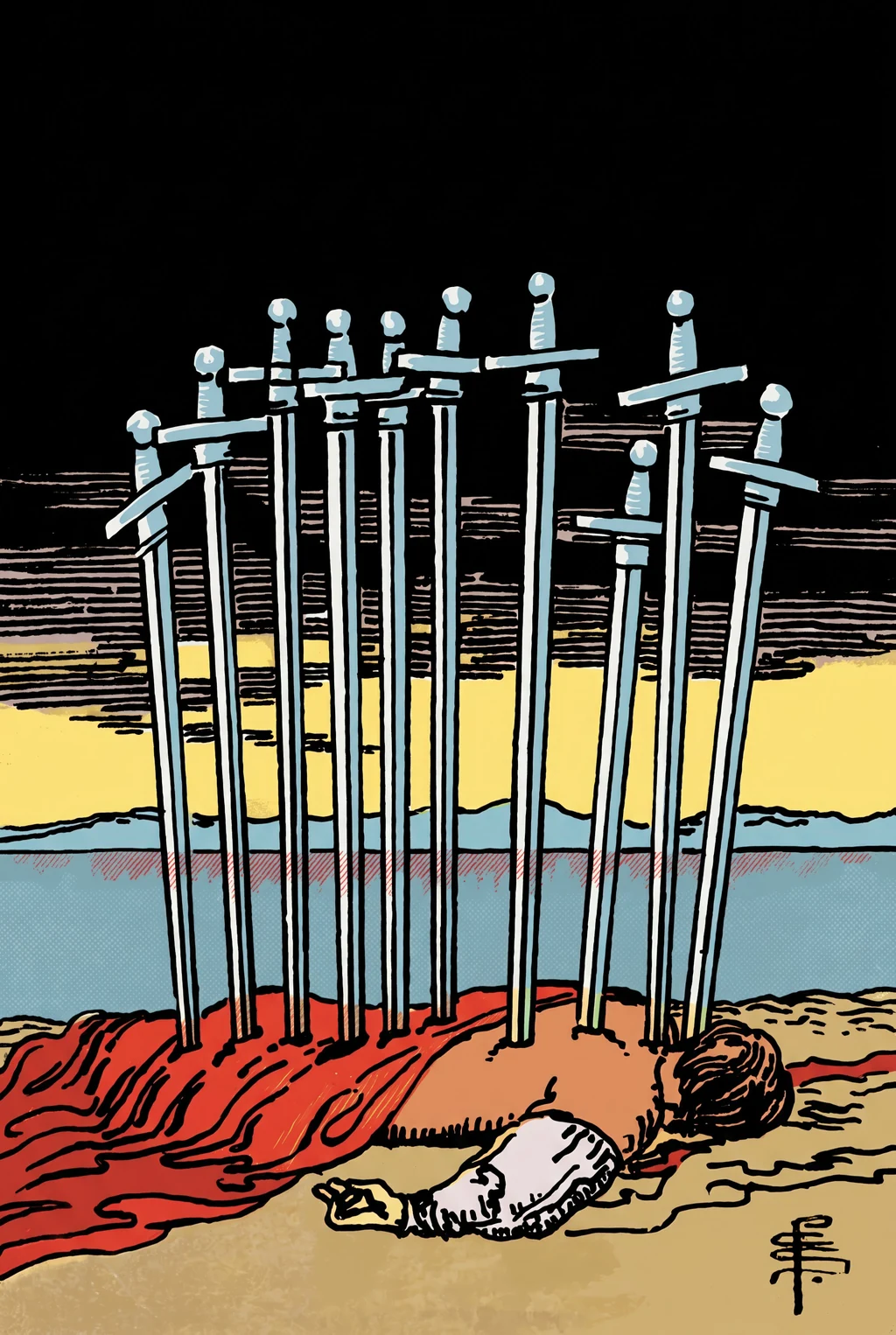
The figure on the Ten of Swords lies beside the water, with no resistance left in their posture. Ten blades pierce the body; one hand rests on the ground. The weight of this scene evokes a helplessness so deep that even the thought of trying once more feels unbearable.
Waite associated the image with pain and desolation, without describing it specifically as a card of violent death. Beyond the motionless figure lies still water, and a band of light appears beneath the black sky. There is an immense distance between the horror in the foreground and that light, even though both belong to the same image. The story has come to a halt close to the earth; the horizon remains open.
Core meaning
A painful ending, exhaustion, and a sense of utter defeat. The card brings together the weight of an ending and the possibility of no longer having to fight a battle that has run its course.
- Key meanings:Painful ending
- Defeat
- Betrayal
- Exhaustion
- Sorrow
- Accepting an ending
- Key meanings:Recovery
- Relief
- Resistance to an ending
- Returning to pain
- Reexamining beliefs
- Temporary success
Image and symbols
Card image
In the foreground, a person lies face down. Their head is on the viewer's right, with their legs extending to the left. A red cloth covers the lower body; the arm closest to the viewer is bent, with two fingers extended.
Ten swords are embedded along the back and torso. Their raised hilts stand out against the dark background.
Still water is visible behind the figure, with a low, mountainous shoreline in the distance. The upper sky is black, and a wide band of yellow stretches along the horizon.
Traditional context
For Waite, the card is associated with pain, sorrow, and desolation. Despite the violence of the scene, he explicitly notes that the Ten of Swords is not primarily a card of violent death.
His list of reversed meanings differs noticeably from many modern readings: advantage, profit, success, and favor, all unstable; power and authority are also named. An additional list includes a specific historical theme: military victory and the good fortune that follows it.
Modern RWS readings place greater emphasis on a painful ending and the experience of defeat. Joan Bunning notes the deliberate excess of ten swords: sometimes the image describes a feeling that 'everything is over' that goes beyond the setback itself. Reversed readings distinguish between recovery after a blow and resistance to an ending that prolongs a difficult period.
Astrological correspondences also depend on the system. The Golden Dawn associates the card with the Sun in Gemini. A. E. Thierens uses a different framework: Earth, the tenth house, and Capricorn, emphasizing material limitations and power.
A figure lying face down
The figure's posture conveys defeat and a lack of strength to keep fighting. In traditional readings, it is an image of pain and devastation.
Ten swords piercing the figure's back
The swords emphasize the finality of the blow. In a modern reading, their excessive number can heighten the sense of total defeat, even when the setback does not affect every part of life.
Two extended fingers on the hand closest to the viewer
The gesture recalls the Hierophant's hand raised in blessing. Elliot Adam connects this echo to accepting the inevitable and no longer running from fear.
Still water behind the fallen figure
The still water contrasts with the violence in the foreground. In a modern interpretation, it represents the peace that may come when the struggle ends.
Colors
- Red — the cloth covering the lower body
The red cloth may emphasize a dignity that remains intact. Another modern reading connects the color with courage and inner strength in the face of defeat.
- Black — the upper sky
The dark sky deepens the sense of calamity and painful experience. Its contrast with the bright horizon keeps the scene from becoming one of unbroken hopelessness.
- Yellow — the band of sky along the horizon
The light band can be read as a glimmer of hope and clarity after a difficult period. It points toward the possibility of change without erasing the defeat shown in the image.
Meanings
Ten of Swords — Upright
General
Overall meaning
The Ten of Swords represents a painful ending: the previous course of events has been interrupted, and there may be no strength left to keep fighting. It is an image of defeat, betrayal, and profound loss.
Sometimes the emphasis falls on a sense of total collapse: one setback feels as though nothing remains.
Possible support
Acknowledging the ending releases you from the need to carry on an exhausted struggle indefinitely. In this reading, clarity provides support: the earlier chapter really has ended.
Possible difficulty
A sense of helplessness can turn into waiting for someone else to fix everything. Your own response to what happened then falls out of view.
Focus
The extent of the actual loss and the feeling that 'everything is over' may be very different.
Reflection questions
- What has truly come to an end in my situation?
- Am I treating one setback as the end of everything?
Relationships
Overall meaning
In a romantic relationship, the card may point to a painful breakup, a breakdown of trust, or a moment when accumulated hurt becomes unbearable. After a separation, old wounds can make new intimacy difficult.
In friendship, it may suggest the end of a connection. In a family context, the interpretation is narrower: a painful breach of trust by someone close to you.
Possible support
After a painful breakup, it helps not to rush into a new connection. Past feelings need space so they do not define the next relationship.
Possible difficulty
Avoiding a difficult conversation leaves a painful issue unresolved between partners. Trying to endure it indefinitely can wear down the relationship itself.
Focus
In romantic relationships, the card draws attention to recurring pain: are you maintaining the connection at the cost of continually setting yourself aside?
Reflection questions
- What difficult conversation am I putting off?
- What from a past relationship is still affecting how I connect with others?
Work and study
Overall meaning
The card may describe the end of a job, position, or project, as well as exhaustion after an excessive workload. Sometimes the painful turning point involves a hostile environment, gossip, or broken trust among coworkers.
Possible support
The end of a work chapter offers a chance to reconsider professional goals and recognize where your efforts are no longer well spent.
Possible difficulty
A workload that has led to exhaustion and a conflict-filled workplace make it especially hard to continue. Persistence alone may not be enough.
Focus
What matters is exactly what is ending: a particular project, your current role, or your professional direction as a whole. That distinction shapes which work goals need reconsidering.
Reflection questions
- Which work goal is it time for me to reconsider?
- Am I continuing to work at the limit of my strength?
Money and resources
Overall meaning
In financial matters, the Ten of Swords may point to a serious loss or an investment that failed to meet expectations. An earlier financial plan no longer holds up.
Possible support
A cautious approach to the money you have left, without taking on further risk in an already difficult situation, may offer some stability.
Possible difficulty
Obligations beyond your ability to repay and unplanned purchases can deepen a shortage of money.
Focus
Pay particular attention to ongoing expenses tied to something that no longer brings the expected return.
Reflection questions
- Which expenses continue without bringing the expected return?
- Are new obligations making an existing money shortage worse?
Wellbeing and self-care
Overall meaning
Here, the card conveys extreme fatigue and the feeling of 'I can't go on.' After prolonged strain, even familiar tasks can feel overwhelming.
Possible support
Rest and everyday self-care can offer support when continuing at the same pace has become too difficult.
Possible difficulty
Trying to take on more than you can bear may turn fatigue into complete exhaustion.
Focus
The card invites you to notice the limit itself: the point when rest is needed, not another effort to push through.
Reflection questions
- What demands on me are too much right now?
- What is keeping me from allowing myself to rest?
Personal growth
Overall meaning
In personal growth, the card concerns facing something you have long wanted to avoid. The familiar habit of running from fear stops helping; there is a need to acknowledge vulnerability and understand what a painful experience can teach you.
Possible support
Fear becomes easier to examine when you can name it and talk about it with someone you trust.
Possible difficulty
Constant busyness can be a way to avoid facing fear. Outward activity then keeps the inner avoidance in place.
Focus
A setback can teach you something about your own reactions and earlier choices.
Reflection questions
- Am I hiding from fear by keeping myself constantly busy?
- What is this experience helping me understand about myself?
Ten of Swords — Reversed
General
Overall meaning
The reversed Ten of Swords can show pain gradually easing and the possibility of moving forward returning after a difficult period.
Another reading centers on resistance: you are still trying to hold on to a chapter that has ended or are reliving the moment of the blow. Here, the ending is near or has already happened, but letting go is difficult.
Waite also specifically lists temporary advantages, gain, and success.
Possible support
Accepting an unpleasant truth helps you see what you can work with now. That makes it possible to look for a solution rather than another way to avoid the problem.
Possible difficulty
Hoping everything will somehow go back to the way it was can keep you waiting in pain and prolong the process of leaving an ended chapter behind.
Focus
Distinguish the first signs of relief from a habit of returning to the moment of hurt. Both belong to the reversed interpretation, but each calls for a different kind of attention.
Reflection questions
- What has already become easier to bear?
- Which ended chapter do I keep returning to?
Relationships
Overall meaning
For a couple, this can suggest recovery after a crisis: tension is easing, but lingering hurts still need to be discussed. After a breakup that has already happened, the card may describe gradually returning to life without the former relationship.
There is also a more difficult reading: someone keeps holding on to a relationship that has already fallen apart. This meaning applies not only to romantic relationships but also to friendships.
Possible support
If both partners want to rebuild the relationship, an open conversation about misunderstandings and lingering hurts can provide support.
Possible difficulty
Continually returning to an old disappointment can close off the possibility of new relationships. The pain continues to shape intimacy even after the chapter itself has ended.
Focus
At the start of a new connection, it helps to compare promises with what the other person can actually offer now. Hope for recovery is no substitute for that clarity.
Reflection questions
- What has genuinely changed in how we communicate since the crisis?
- What do I want to keep from that past relationship as a lesson, without going back to it?
Work and study
Overall meaning
Relief may come after a layoff, a job change, or a difficult period. In another reading, the strain remains or grows: it has not yet been possible to leave a harmful work situation.
Possible support
Rethinking an earlier strategy and making adjustments informed by a setback can help you get your work life back on course.
Possible difficulty
Fixating on losing a job or a past professional defeat can make it difficult to move into the next chapter.
Focus
Consider the cost of staying in your current job: are the conditions still harming your well-being despite hopes of improvement?
Reflection questions
- What has already improved in my working conditions?
- What keeps drawing my attention back to a past setback?
Money and resources
Overall meaning
The card may describe recovering from a financial loss or a situation in which an even more serious financial collapse was avoided. The emphasis is on recovery, not getting rich quickly.
Possible support
After a loss, the resources that remain can provide a foundation for gradually regaining financial stability.
Possible difficulty
If money troubles are connected to losing a job, continually returning to that earlier defeat may make financial recovery harder.
Focus
In Waite's historical interpretation, gain and success are temporary. A single improvement does not yet mean lasting financial stability.
Reflection questions
- What signs show that my financial situation is recovering?
- Am I mistaking a one-time gain for lasting improvement?
Wellbeing and self-care
Overall meaning
The strain may gradually ease, bringing relief and cautious hope. Both can coexist with pain that has not yet passed.
Possible support
Paying attention to your body's everyday needs and your emotional state can help. You can ask for support when you need it.
Possible difficulty
Denying sadness or trying to brush aside difficult feelings can get in the way of gradual relief.
Focus
Your emotional state still needs attention during recovery. The first signs of relief do not remove the need to care for yourself.
Reflection questions
- When do I notice myself beginning to feel better?
- What help could I ask for so I do not have to handle everything alone?
Personal growth
Overall meaning
After a difficult experience, your understanding of yourself and how to build your life may begin to change. The reversed card is associated with reexamining beliefs that sustained a sense of defeat and seeking a more fitting direction in life.
Possible support
It helps to acknowledge a difficult reality and see the problem as something you can work through, rather than only as a threat.
Possible difficulty
A belief that discounts your abilities before you even try can keep the sense of defeat alive.
Focus
Reconsider ideas about yourself and past plans that no longer fit your life as it is now.
Reflection questions
- Is there a belief that makes me assume I will fail before I even try?
- What no longer fits in the way I used to see myself?
Roles in a spread
Position examples
A position gives the card a question, such as what helps or what gets in the way. That question shapes how you read its meaning.
Ten of Swords — Upright
Situation
Things have reached a painful limit. The card can describe the end of a chapter after which it becomes difficult to keep pretending that everything is as it was.
Influence
A breach of trust may be shaping the situation. The effects of a painful truth or betrayal may have changed how you see what is happening.
Motivation
A wish for sympathy and for someone to come to your aid in a difficult situation.
Support
Support may come from clearly recognizing a limit: you no longer need to convince yourself that a story that has run its course must continue.
Obstacle
Waiting for someone else to rescue you can deepen the feeling of being stuck: it is hard to find your own answer when the entire decision is left to others.
Focus of attention
Notice the fear you may be trying to hide from through busyness or constant distraction.
Next step
Consider ending a struggle that has already run its course rather than putting more effort into holding on to what is over.
Possible development
One possible direction involves bringing an earlier chapter to a close. A new beginning may follow a painful turning point if the ending can be acknowledged.
Ten of Swords — Reversed
Situation
The effects of a painful blow are still apparent, but their hold may be weakening. Another possibility is that a chapter is ending, but you have not yet been able to let it go.
Influence
Past pain that has not yet been left behind may be shaping your present perspective. The event is over, but the experience of it continues.
Motivation
Reluctance to leave the familiar behind and fear of the unknown may drive the wish to preserve something that has already reached its end.
Support
It helps to face an unpleasant reality directly and deal with the difficulty itself instead of continually avoiding it.
Obstacle
Resisting an ending whose time has come can prolong a difficult period. An earlier chapter is being held onto even though it no longer works.
Focus of attention
Consider whether your sense of defeat is being reinforced by a belief that dismisses your own abilities before you even try.
Next step
Do not rush a decision you are not ready to make. The card offers room to consider a pause before your next move.
Possible development
Holding on to an earlier chapter may prolong the process of parting with it. As that resistance eases, gradual recovery becomes possible.
Combination examples
Card combinations are in development. For now, here are a few examples.
Ten of Swords + Eight of Swords
Ten of Swords ( upright) + Eight of Swords ( upright)
- Example question:
- What intensifies the feeling of helplessness?
- Example interpretation:
Together, these cards strengthen the theme of powerlessness: the experience of defeat meets the feeling that nothing you do can influence what happens.
Ten of Swords + The Chariot
Ten of Swords ( upright) + The Chariot ( upright)
- Example question:
- Do I still have any influence over the situation after a setback?
- Example interpretation:
In Bunning's system, these are opposing cards: the Ten of Swords emphasizes defeat, while The Chariot offers a contrast through self-assertion and the ability to achieve victory.
Ten of Swords + The Hanged Man
Ten of Swords ( upright) + The Hanged Man ( upright)
- Example question:
- What part of this situation involves self-sacrifice?
- Example interpretation:
This pairing reinforces the theme of self-sacrifice and setting aside your own interests.
Ten of Swords + Ten of Cups
Ten of Swords ( upright) + Ten of Cups ( upright)
- Example question:
- How can I cope with the hurt after an argument and identify the support I can turn to?
- Example interpretation:
The Ten of Swords in the position “What is difficult right now” describes the hurt after an argument and the feeling that everything has fallen apart. The Ten of Cups in “What I can draw support from” draws attention to relationships where warmth and mutual care remain. Friends or family may offer support, even if the argument was with a partner.
This reading helps separate a painful conflict from the other relationships in your life. You can name what hurt and decide whom you would like to talk to. Reconnecting with your partner will require a separate conversation: support from friends does not, by itself, resolve the conflict between you.
Reading example
An imagined one-card reading shows how the meanings above can apply to a question. This is one possible interpretation.
Ten of Swords — Upright
Situation:
After the breakup, you sometimes manage to distract yourself, but then you find yourself rereading old messages and wondering whether to reach out one more time. You are not sure whether you want to clear something up or get the relationship back.
Question:
What can help me avoid getting stuck in this story?
-
Card drawn:
Imagine drawing a card for the position «What Can Help» and getting Ten of Swords (upright).
Interpretation:
The Ten of Swords brings an ending that is painful to accept into focus. In this situation, it invites you first to separate the breakup that has already happened from the hope that the right message could undo it.
You can ask yourself what, exactly, was left unsaid. If there is no new question and you simply want to hold on to the old connection, one possible step is to stop keeping it alive through messages and give yourself room to grieve the loss.
Ten of Swords — Reversed
Situation:
After the breakup, you sometimes manage to distract yourself, but then you find yourself rereading old messages and wondering whether to reach out one more time. You are not sure whether you want to clear something up or get the relationship back.
Question:
What can help me avoid getting stuck in this story?
-
Card drawn:
Imagine drawing a card for the position «What Can Help» and getting Ten of Swords (reversed).
Interpretation:
Here, the reversed Ten of Swords connects the first signs of recovery with a return to old pain. You can notice the moments when you manage to shift your attention elsewhere, separately from the habit of opening your old messages again.
You do not have to decide right now whether to reach out again. You can give that wish some time and see whether a specific question remains once the next wave of feelings has settled.
Yes / No
Ten of Swords — Upright
Why this answer
The card is associated with endings, serious obstacles, or a course of events that has run its course. As a practical answer, it does not support the expectation that the current situation will continue favorably.
Ten of Swords — Reversed
Why this answer
The card leans toward 'yes': a difficult period is easing, opening the possibility of recovery. The answer points to moving forward after a crisis, not immediate success.
A clarification
Moving forward requires attention to unresolved problems and an effort to rebuild. If the question concerns getting back together after a relationship has already ended, there is a separate reading that leans toward 'no': moving beyond the pain may mean moving on rather than renewing the old connection.
A question to consider
What unresolved issue needs my attention so recovery can continue?
Correspondences
Connections with numbers, elements and other symbols add depth to the card’s imagery. They can differ between traditions.
Number — X (10)
The number ten represents a process brought to completion. In this card, that completion appears as the limit of a difficult period of mental strain or conflict.
Element — Air
The element of the suit is associated with the mind and reasoning. Here, their destructive side comes to the fore: thought can lose touch with reality.
Element — Earth
For Thierens, the card emphasizes the pressure of material necessity: what carries weight and power in real life also imposes limits.
Astrology — Sun in Gemini, 20°–30°
The card corresponds to the third decan of Gemini. For Crowley, this association highlights the destructive workings of reason when disconnected from reality.
Astrology — 10th house; Capricorn
The tenth house and Capricorn connect the card with social standing, formal authority, and the limitations that accompany material influence.
Tree of Life — Malkuth of Vav; the world of Yetzirah
The tenth sephirah of the World of Formation represents a completed, manifested outcome. The card's title, 'Lord of Ruin,' connects this position with discord and the destruction of plans.