
Seven of Wands
Descriptions and symbolism are based on the card’s classic illustration in the Rider–Waite–Smith deck. Details of the artwork may differ in other editions of the deck.
This guide brings together traditional and modern readings. Interpretations and answers may differ between authors and schools.
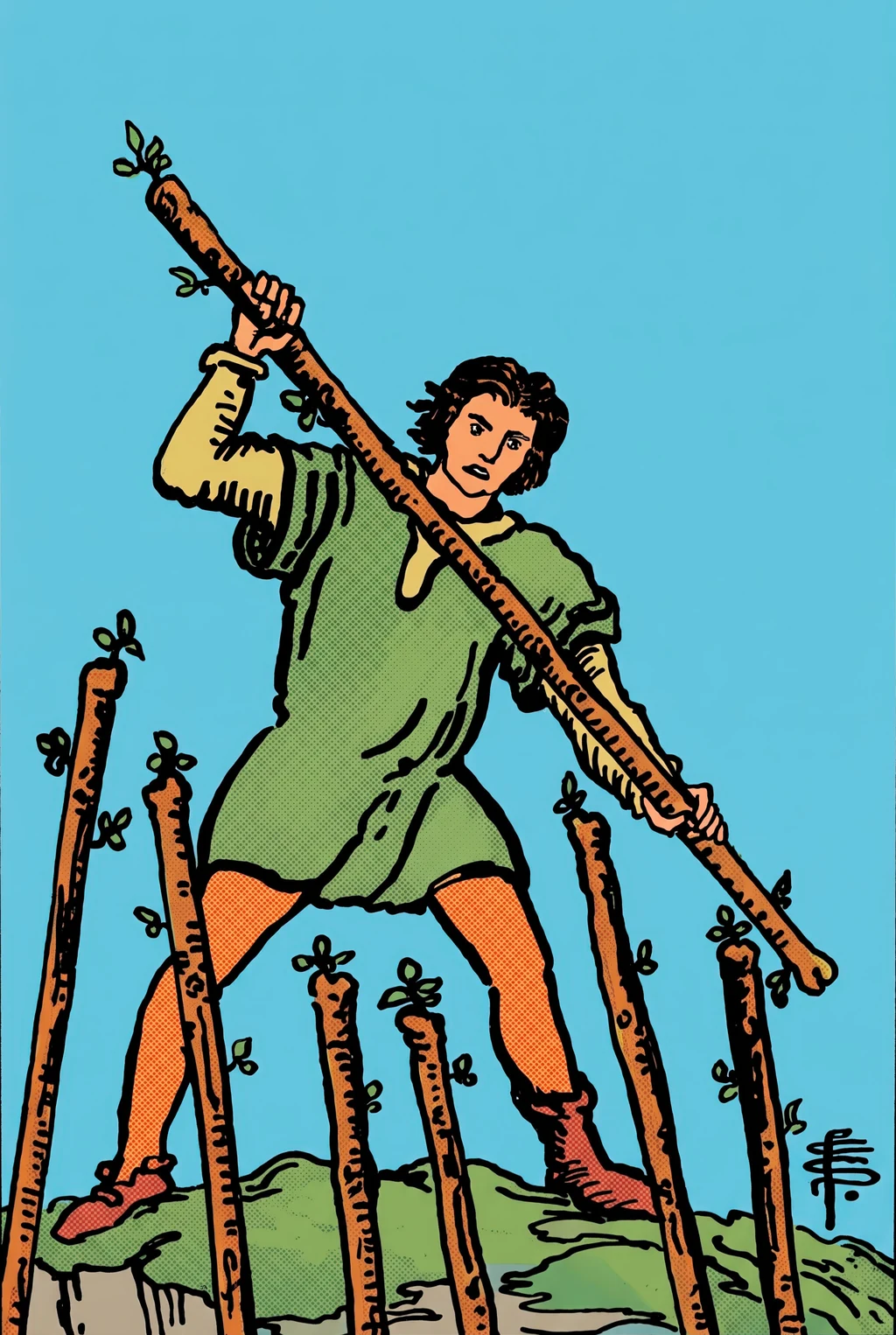
A young man is holding off an assault from below on his own. Six staffs are pointed toward him, while he grips his own staff with both hands, his feet planted wide on an uneven ledge. His mismatched shoes lend the encounter a sense of suddenness, as though he had to defend his ground before he had time to prepare properly.
The high ground helps him, but it does not remove the pressure. His opponents still have to reach him; he has to keep his footing on the edge and meet the next thrust. Their faces are hidden from view, drawing all attention to the person they are trying to dislodge. The young man leans into the assault, but his feet remain on the ledge.
Core meaning
The Seven of Wands depicts resilience under pressure: having to defend your position, beliefs, or what you've achieved. You have an advantage, but holding on to it takes effort.
- Key meanings:Resilience
- Defending your position
- Courage
- Disagreement
- Competition
- Conviction
- Key meanings:Confusion
- Anxiety
- Indecision
- Overwhelm
- Giving in to pressure
- Excessive defensiveness
Image and symbols
Card image
A young man stands on rocky high ground, his feet planted wide apart as he holds a long staff in both hands. He wears a green tunic and red stockings, with a different shoe on each foot.
Six other wands rise toward him from below. The people holding them are not visible in the composition. A blue sky stretches behind the figure, and water runs near his feet.
Traditional context
For Waite, the key word for this card is valor. The opponents are more numerous, but the defender stands on higher ground. In his interpretation, resistance therefore carries the possibility of success. In matters of ideas, the card represents discussion and verbal dispute; in business, it relates to negotiation, exchange, and competition. For the reversed card, Waite names perplexity, difficulties, and anxiety, and warns against indecision.
In the Book T of the Golden Dawn order, the Seven of Wands bears the title "Lord of Valour." Victory there depends on courage and effort, while quarrels, threats, and victories in matters of little importance also belong to its meaning. The interpretation depends on the surrounding cards rather than a simple rule that upright is good and reversed is bad.
Modern interpretations add the defense of what has been achieved and the protection of personal boundaries. Joan Bunning emphasizes that defending a position and taking an assertive offensive stance can alternate. The card can also be read as standing up for other people, especially those who struggle to make themselves heard.
One person facing six wands pointed toward him
Courage in the face of opponents who outnumber you. Standing alone here does not mean being helpless.
A staff held in both hands in a defensive stance
Active defense: the figure meets the challenge and refuses to give up his ground without resistance.
Six wands rising from below
Several sources of opposition: rivalry, objections, and pressure that must be answered all at once.
Rocky high ground beneath the figure's feet
The advantage of a strong position. Despite being outnumbered, the defender has something solid to stand on.
Mismatched shoes
They may suggest haste and being caught unprepared for a confrontation, or the ability to adapt to the unexpected. Elliot Adam reads the mismatched shoes as an image of individuality and a refusal to conform.
Leaves on the wands
The vitality and active force of the suit. Even in this scene of confrontation, the wands remain living branches covered in leaves.
Water near the figure's feet
Emotional investment in what the figure is defending. Beneath an argument over a position may lie a deep personal attachment.
Colors
- Blue — the sky behind the figure
Expressing your position clearly and communicating in a way that involves not only speaking, but also hearing the response.
- Green — the ground
Growth and the ability to remain resilient in difficult conditions.
- Red — the stockings
Drive and urgency of action, adding to the tension of the scene.
Meanings
Seven of Wands — Upright
General
Overall meaning
The Seven of Wands represents a confrontation in which you need to hold your ground. It may involve an open disagreement, competition, or defending your beliefs against a majority that does not share them.
The situation is tense, but you are not powerless: the defending side has an advantage. The card brings resistance together with the possibility of standing up for what matters to you, rather than promising an easy victory.
In a more proactive reading, it can also represent taking the initiative: advocating for a change that others resist.
Possible support
A favorable starting position and courage help you stand firm even against greater numbers.
Possible difficulty
Constantly defending yourself is exhausting. Responding to every objection can distract you from what you set out to accomplish.
Focus
Distinguish important disagreements from demands that do not deserve so much of your energy right now. When conflicts multiply, identify the ones that matter most first.
Reflection questions
- What exactly am I trying to defend in this disagreement?
- Which objections truly need a response from me?
Relationships
Overall meaning
In a partnership, the card may represent protecting the relationship from outside interference or standing up for your own position within it.
In close relationships more broadly, it concerns maintaining boundaries and mutual respect under external pressure.
When getting to know someone new, there may also be an element of competition for the attention of someone you're attracted to.
Possible support
Confidence in the importance of the relationship can help you withstand outside disapproval.
Possible difficulty
You may have to defend the relationship against critics, including friends and relatives.
Focus
When speaking with your partner, pay attention not only to expressing your position but also to how your words come across. Being direct does not require being harsh.
Reflection questions
- Is our disagreement about the relationship itself or about other people's disapproval?
- Can I express disagreement without attacking?
Work and study
Overall meaning
At work, this card speaks of competition, negotiation, and defending your professional position. You may have to demonstrate the value of an idea, stand firm on terms, or maintain your principles in an environment where you're being asked to compromise them.
Another professional interpretation concerns working independently and preparing to start your own business. What matters here is independence and a willingness to put in the work, not just the initial enthusiasm.
Possible support
Your abilities and the conscientious work that helped you establish your professional position provide a foundation.
Possible difficulty
Competition complicates agreements: terms are challenged, and professional discussions can turn into verbal battles.
Focus
For independent work, preparation matters, as does understanding how much effort the venture will require.
Reflection questions
- What results can I draw on when defending my work?
- What preparation do I still need before working independently?
Money and resources
Overall meaning
The main financial interpretation concerns protecting what you've earned and safeguarding savings when financial decisions come under pressure or are challenged.
In a favorable reading, the card can also relate to increased income or a higher valuation of property you already own.
Possible support
Savings and long-term plans help you maintain stability in the face of future expenses.
Possible difficulty
The difficulty may lie in having to protect what you've accumulated from claims made by others.
Focus
When additional money comes in, consider not only the increase itself but also how it fits into your longer-term plans.
Reflection questions
- What savings do I want to preserve for future expenses?
- How would additional income change my long-term plans?
Wellbeing and self-care
Overall meaning
In everyday self-care, the card speaks of persistence in maintaining habits that support your well-being. These habits can be difficult to sustain under stress or when you're tempted to return to less helpful routines.
Possible support
Support from dependable people and a manageable pace can help. Perseverance does not mean taking on every obligation.
Possible difficulty
Too many obligations can be draining, even when you're deeply determined to keep going.
Focus
Notice what pace allows you to preserve your strength when the demands keep coming.
Reflection questions
- What habit helps me get through demanding days?
- Does my current pace leave room for recovery?
Personal growth
Overall meaning
This card concerns independent judgment and staying true to your beliefs when others do not support them. Personal growth here means learning not to shape every choice around someone else's approval and standing up for your right to decide for yourself.
Holding to your principles may also mean refusing to participate in gossip or going along with a group's opinion simply to be accepted.
Possible support
Experience in facing fear becomes a source of strength: courage shows itself through action even while doubt remains, not only after doubt disappears.
Possible difficulty
Pressure from the majority makes independent choices harder. Another imbalance arises when defending your principles gives way to a need to always be right.
Focus
Consider whether the issue you're fighting over still truly matters. The effort you've already invested does not, by itself, make continuing the struggle necessary.
Reflection questions
- What do I genuinely disagree with, even without support from others?
- Does this principle still matter to me, or am I reluctant to let go because of the effort I've already spent?
Seven of Wands — Reversed
General
Overall meaning
The pressure may exceed what you feel able to withstand. Anxiety and indecision build, making it difficult to defend what matters to you. You may give in to pressure or abandon something important to avoid an argument.
Another imbalance is becoming so defensive that you create conflicts yourself. A more constructive reading involves ending a struggle that is no longer worth the effort.
Possible support
Taking a break may offer support, allowing you to regain your composure after many obligations and conflicts.
Possible difficulty
Confusion makes choosing difficult. Indecision may keep the situation unresolved.
Focus
Stepping away to find peace and giving up something important too soon can look much the same. What matters is the reason for stepping back, not merely the act of yielding.
Reflection questions
- What do I want to step away from right now: the undertaking itself or the constant arguments surrounding it?
- What decision am I putting off because I feel uncertain?
Relationships
Overall meaning
In a partnership, the reversed card may represent giving in to outside pressure or lacking the strength to defend the relationship. The opposite imbalance arises when that defense becomes so rigid that the relationship's real problems go unaddressed.
When seeking a relationship, it may suggest exhaustion with getting close to someone or excessive persistence that leaves the other person no room to respond.
In questions about reconciling with a friend or relative, the card can also suggest softening your position: becoming willing to hear the other side and stop arguing simply to win.
Possible support
When trying to reconcile, it helps to be willing to acknowledge your part in what went wrong and listen to someone close to you without immediately objecting.
Possible difficulty
In an established relationship, progress may be delayed by indecision. This can reflect either fear of change or timing that doesn't feel right.
Focus
Defending a relationship against criticism can cause you to overlook genuine difficulties within it. The substance of the criticism deserves attention.
Reflection questions
- Does the criticism of our relationship point to a specific problem worth discussing?
- What would help me hear someone close to me before I respond with objections?
Work and study
Overall meaning
At work, the card may describe being overwhelmed, feeling uncertain about your next decision, or being unprepared for competition. Maintaining your previous position becomes difficult.
A separate, unfavorable interpretation concerns compromising your professional principles to gain management's approval or advance your career.
Possible support
It may help to talk with someone you trust who has faced a similar situation at work.
Possible difficulty
Being overwhelmed and underprepared increases your vulnerability to workplace demands.
Focus
When looking for work, consider your network of contacts: your usual circle of people and opportunities may be too limited.
Reflection questions
- Who can I discuss a work-related difficulty with without having to pretend I'm confident?
- Am I compromising my professional principles to gain approval?
Money and resources
Overall meaning
Financial matters may feel like pressure that's difficult to manage. The reversed card is also associated with reduced caution around spending and uncertainty about incoming money: a promised payment or raise may still be in doubt.
Possible support
In financial disagreements, flexibility may provide support: a willingness to reconsider how you defend your interests and look for a less confrontational approach.
Possible difficulty
Excessive confidence in future earnings may encourage unnecessary spending.
Focus
Future expenses and savings deserve attention, as they can easily be overlooked when you're focused on what you want right now.
Reflection questions
- What money am I already counting on that I haven't received yet?
- Could I approach this financial disagreement differently without giving up my interests?
Wellbeing and self-care
Overall meaning
Here, the card relates to exhaustion from constant resistance, vulnerability, and doubts about your own strength. Pressure may come from outside or from an inner critic that never lets you stop judging yourself.
Possible support
Rest, reassessing priorities, and seeking help when anxiety and tension have become difficult to bear may all offer support.
Possible difficulty
Fear of confrontation may lead you to avoid not only disagreements but also your own goals. Stepping back in this way does not necessarily make the tension disappear.
Focus
The focus here is anxiety itself: what triggers it, and where you need help with your feelings or actions.
Reflection questions
- Which situations leave me finding it especially hard to recover?
- What kind of help do I need when anxiety makes it difficult to act?
Personal growth
Overall meaning
An inner conflict may arise between making your own choices and wanting approval. Under criticism, you may feel tempted to change who you are or abandon a belief, even though it still matters to you.
Possible support
Rebuilding self-esteem and confidence in your own position may provide support.
Possible difficulty
The desire to fit in may crowd out your willingness to be yourself and openly express disagreement.
Focus
Notice any habit of trying to win everyone's agreement. Someone else's disagreement does not, by itself, mean you need to keep proving that your choice is valid.
Reflection questions
- What am I tempted to give up simply to make the criticism stop?
- Whose approval has become a requirement for making my own choices?
Roles in a spread
Position examples
A position gives the card a question, such as what helps or what gets in the way. That question shapes how you read its meaning.
Seven of Wands — Upright
Situation
Your position is being challenged, and you have to respond to resistance. The defending side is outnumbered but retains an advantageous position.
Influence
External opposition shapes the situation: others challenge the ground you hold or the position you've taken.
Motivation
The motivation may be a desire to protect your beliefs and your right to make your own decisions, even when people in authority disagree.
Support
An existing advantage offers support: you can hold your ground even without the backing of a majority.
Obstacle
The obstacles are open opposition, competition, and verbal clashes that demand a continuing response.
Focus of attention
Pay attention to your arguments and the reasons behind your choices, especially when you have to defend your position publicly.
Next step
State your position clearly. The card also allows for taking the initiative: proposing a change without waiting for everyone to agree.
Possible development
As long as the advantage holds, the confrontation may be resolved in the defender's favor.
Seven of Wands — Reversed
Situation
Finding your footing in a confrontation has become difficult: anxiety and confusion make it hard to take a clear position.
Influence
Other people's criticism may leave you feeling that you constantly have to justify your choices.
Motivation
The motivation may be a desire to fit in and avoid standing out from those around you.
Support
Cooperation and accepting help may offer support, replacing the need to keep proving your independence.
Obstacle
Indecision prevents you from choosing where you stand and makes it difficult to move beyond confusion.
Focus of attention
Pay particular attention to rigidity that keeps you from considering another point of view.
Next step
Reconsider your involvement in an argument that no longer serves a purpose. If you're uncertain, you can postpone a new confrontation rather than enter it with the last of your strength.
Possible development
If you continually avoid confrontation, important goals may give way to the desire to avoid objections.
Combination examples
Card combinations are in development. For now, here are a few examples.
Seven of Wands + The Magician
Seven of Wands ( upright) + The Magician ( upright)
- Example question:
- What can you draw on when defending an idea at work?
- Example interpretation:
The Magician adds professional skill to the Seven of Wands' resilience. Here, those skills help you respond to objections about the idea and maintain your professional position.
Seven of Wands + The Fool
Seven of Wands ( upright) + The Fool ( upright)
- Example question:
- What does a new venture facing skepticism need?
- Example interpretation:
The Fool's initial impulse meets the need to stand behind the path you've chosen. The Seven of Wands adds persistence where a new idea lacks support.
Seven of Wands + Nine of Wands
Seven of Wands ( upright) + Nine of Wands ( upright)
- Example question:
- What does this pair emphasize in a confrontation?
- Example interpretation:
Together, these cards strengthen the theme of defending your position and refusing to yield.
Seven of Wands + Three of Pentacles
Seven of Wands ( upright) + Three of Pentacles ( upright)
- Example question:
- How does defending your position relate to the possibility of working together?
- Example interpretation:
This pair contrasts confrontation with collaboration: the teamwork of the Three of Pentacles stands opposite the defensive position of the Seven of Wands.
Seven of Wands + Five of Swords
Seven of Wands ( upright) + Five of Swords ( upright)
- Example question:
- What view of the people involved in the disagreement becomes stronger?
- Example interpretation:
This combination reinforces an adversarial view of the situation, in which your own side is set against everyone else.
Reading example
An imagined one-card reading shows how the meanings above can apply to a question. This is one possible interpretation.
Seven of Wands — Upright
Situation:
You're planning to move, but your loved ones keep raising new objections. After these conversations, it's hard to tell whether you're doubting your decision or simply tired of arguing.
Question:
How should I approach these objections?
-
Card drawn:
Imagine drawing a card for the position «What to Consider» and getting Seven of Wands (upright).
Interpretation:
The Seven of Wands highlights defending an independent decision under pressure. Here, it helps you recognize that the number of objections is not, in itself, proof that moving is a mistake.
You can return to your reasons for moving and identify exactly what you're standing up for. This gives you a foundation for responding clearly to your loved ones without making their agreement a requirement for your own choice.
Seven of Wands — Reversed
Situation:
You're planning to move, but your loved ones keep raising new objections. After these conversations, it's hard to tell whether you're doubting your decision or simply tired of arguing.
Question:
How should I approach these objections?
-
Card drawn:
Imagine drawing a card for the position «What to Consider» and getting Seven of Wands (reversed).
Interpretation:
The reversed Seven of Wands draws attention to exhaustion from constantly defending yourself. Wanting the conversations to stop does not necessarily mean that moving is no longer important to you.
You can take a break from the argument, then calmly consider the specific concerns being raised. This leaves room to reconsider your decision without requiring you to change it solely to put an end to the criticism.
Yes / No
Seven of Wands — Upright
Why this answer
Yes. Upright, the positive answer is tied to courage and the ability to stand up for what you want in the face of resistance.
A clarification
Moving toward your goal means standing by your decision and responding to objections. In this case, "yes" does not mean there will be no obstacles.
A question to consider
What part of what I want am I willing to stand up for, even if others object?
Seven of Wands — Reversed
Why this answer
No. Reversed, the answer is associated with feeling overwhelmed and losing the ability to hold your ground: there is not enough endurance left to continue the confrontation.
A clarification
Before continuing, it may help to reassess what you're fighting for and rebuild confidence in your own abilities.
A question to consider
Do I have the strength to continue this particular struggle?
Correspondences
Connections with numbers, elements and other symbols add depth to the card’s imagery. They can differ between traditions.
Number — VII (7)
Sevens are associated with a possible outcome that still depends on action. Strength requires the ability to use it effectively, and the outcome is considered alongside the surrounding cards.
Element — Fire
Active force and drive. In the Seven of Wands, the theme of fire is expressed through the courage to face resistance.
Astrology — Mars in Leo, 20°–30°; third decan
This correspondence belongs to the card known as "Lord of Valour." It connects resistance and struggle with the courage needed to endure a trial.
Tree of Life — Netzach in Atziluth
Netzach, the seventh sephirah, is named "Victory"; Atziluth is associated here with Fire. For this card, the emphasis falls on courage in the face of resistance rather than unconditional triumph.