
King of Cups
Descriptions and symbolism are based on the card’s classic illustration in the Rider–Waite–Smith deck. Details of the artwork may differ in other editions of the deck.
This guide brings together traditional and modern readings. Interpretations and answers may differ between authors and schools.
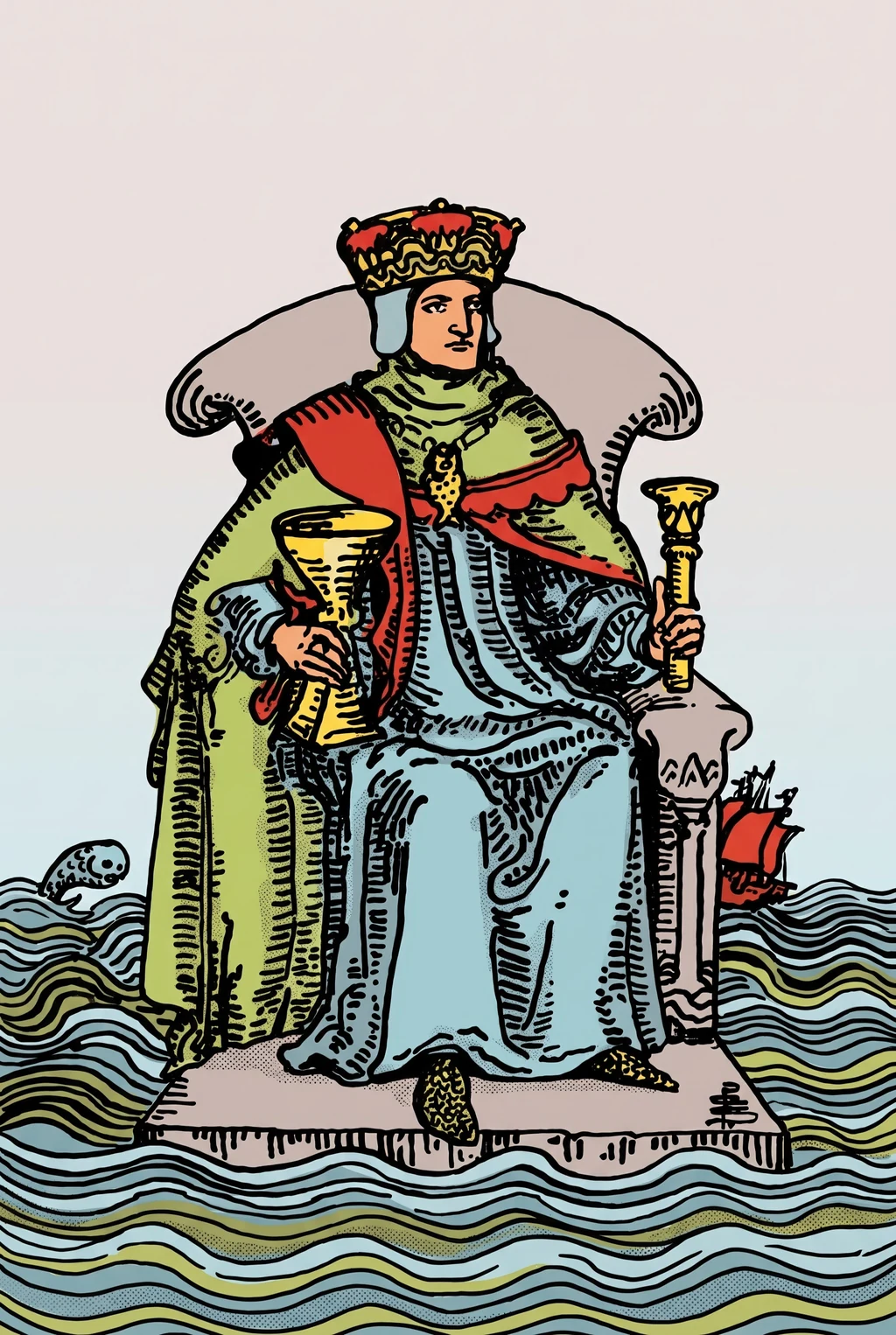
The King of Cups has no quiet harbor from which to watch the turmoil at a distance. His throne stands amid the waves. He holds his cup steady, as though the movement of the water need not pass into his every gesture.
A ship passes nearby, and waves surround the throne’s stone foundation. Amid this movement, it is easy to imagine someone you could trust with a difficult feeling: he would listen without letting another person’s anxiety overwhelm the conversation. Composure leaves room for compassion. In his other hand is a short scepter, held beside the open cup that remains before him.
Core meaning
The King of Cups brings together deep feeling, composure, and responsibility. He represents an attentive adviser who understands people and keeps a clear head in tense situations.
- Key meanings:Emotional maturity
- Compassion
- Diplomacy
- Responsibility
- Wise counsel
- Creative mind
- Key meanings:Suppressed feelings
- Mood swings
- Emotional pressure
- Deception
- Inner work
- Self-compassion
Image and symbols
Card image
The king sits on a tall gray throne set on a stone platform amid the waves. His body faces the viewer, while his head is turned to the right. He wears a blue robe, a gold-and-green cloak with red lining, and a crown with red ornaments. A fish-shaped pendant hangs on his chest.
In his right hand, on the viewer’s left, he holds an open golden cup; in his left is a short scepter. Patterned shoes peek out from beneath his clothing, with the toe of one extending beyond the edge of the platform.
A dolphin leaps from the water on the left, while a ship with red sails appears on the right. A gray sky stretches behind the throne.
Traditional context
For Waite, the King of Cups represents a responsible person willing to help, as well as justice, art, science, and a creative mind. His list includes figures from business, law, and religion. This is a broader image than simply a loving partner or a calm listener.
There is also an important inconsistency within the book: an additional list for the upright King warns of hostility from an influential person and help that conceals hypocrisy. For the reversed card, the main list names deception, extortion, injustice, vice, scandal, robbery, and loss. Waite himself notes that the additional meanings contradict one another.
Modern readings place emotional maturity at the center: the ability to feel, understand others, and take responsibility for one’s actions. Reversed, the card can point to suppressed feelings, loss of composure, or emotional pressure. Another reading turns inward, toward self-compassion and the examination of one’s own reactions.
The king sitting calmly amid the waves
Composure amid strong emotions: feelings remain present without dictating every response.
His head turned away from the cup
In a modern reading, this can suggest a practiced ability to handle emotions without needing to focus on them constantly.
The cup in his right hand
Feelings and the ability to handle them with care.
The scepter in his left hand
Authority and the ability to lead; beside the cup, it brings the right to act together with an understanding of feelings.
The stone throne on a platform in the sea
Steadiness that holds even when the surrounding circumstances are unsettled.
The fish pendant on his chest
Creativity and a connection to the inner life.
The crown
Recognized authority and control over what one is responsible for.
The restless sea
The changing nature of emotions, with their rises and falls.
The dolphin leaping from the water on the left
The fluid side of emotional life. In a spiritual reading, the dolphin also represents a connection to what lies beneath the visible surface.
The sailing ship on the right
The ability to navigate difficult feelings while staying composed. The ship is also associated with the practical, material side of life.
The toe of a shoe extending beyond the platform
This detail can suggest a cautious openness to others’ feelings without losing one’s own footing.
Colors
- Blue — the king’s long robe
The color connects the figure to Water, the element of Cups.
- Gold — the cloak
Emphasizes the king’s status and authority. In an elemental reading, the cloak’s gold is also associated with Fire.
- Red — the crown’s ornaments and the cloak’s lining
Desire, passion, and genuine feeling beneath an outwardly reserved manner.
- Red — the ship’s sails
Ambition and the drive to move toward a goal.
- The green tint of the cloak
The color can be linked to the life and growth supported by emotional maturity.
- Gray — the sky
May emphasize a calm, slightly cool distance from one’s own feelings.
Meanings
King of Cups — Upright
General
Overall meaning
The King of Cups represents emotional maturity: feeling deeply while keeping a clear head and taking responsibility for your actions. Diplomacy, patience, and the ability to hear different sides are among his qualities. In a reading, the card can describe an aspect of the situation, your own way of responding, or the figure of a trusted adviser.
The card also has a creative side, joining imagination with an understanding of people. In Waite’s traditional list, this includes art, science, and a creative mind.
Possible support
Calm advice and the ability to see several points of view can help without reducing a disagreement to one side winning.
Possible difficulty
Restraint becomes an obstacle when it means keeping feelings unspoken and avoiding a necessary conversation. An additional list by Waite offers another warning: an influential person may only be pretending to help.
Focus
Notice whether a calm tone still leaves room to speak openly and set your own boundaries.
Reflection questions
- In which conversation do I need to remain both calm and honest?
- Whose advice could I seek without handing over the decision?
Relationships
Overall meaning
In a romantic partnership, the card speaks to reliability, mutual respect, and feelings that can hold up through more than easy conversations. Difficult subjects can be discussed without an immediate defensive or hostile response.
In family life, the King of Cups may represent someone others turn to for considered advice. In friendship, this quality appears as a willingness to listen and offer support when someone close is struggling.
In a family reading, the card can also express a desire to start a family or take more dependable care of loved ones.
Possible support
Support comes from a conversation where feelings and difficult subjects can be named without fearing that honesty alone will start an argument.
Possible difficulty
In a partnership, always being the calm, supportive one can leave little room for that person’s own vulnerability.
Care within a family can become overly indulgent when concern for someone close causes their actions’ consequences to be overlooked.
Focus
Notice whether reliability in a relationship comes with open sharing of feelings. A consistently calm manner alone is not enough for closeness.
Reflection questions
- Can I speak about difficult things as freely as I offer support to someone else?
- How do I usually show loved ones that I am listening?
Work and study
Overall meaning
At work, the King of Cups is associated with leadership, mentorship, and conflict mediation. This approach considers both the task and the people involved, so cooperation is not built on humiliation or bursts of irritation.
The card can also describe looking for work that balances practical demands with personal interest. Professional figures associated with it include teachers, counselors, and people in creative fields.
Possible support
Guidance from an experienced mentor and the ability to bring people together in a discussion can help move a task forward.
Possible difficulty
Work decisions can make it difficult to balance practical calculation with understanding people. Relying only on logic or only on feelings makes collaboration harder. In a separate practical reading, the card also cautions against manipulative behavior by colleagues or business partners.
Focus
When considering work, look beyond practical benefits to how well it meets emotional needs.
Reflection questions
- Who could help me navigate a difficult conversation at work?
- What is being overlooked in my decision: the practical task or an understanding of people?
Money and resources
Overall meaning
In money matters, the card describes thoughtful spending and the stability that comes from considered decisions. Generosity goes hand in hand with good judgment, and feelings about money need not be the sole basis for a choice.
Possible support
This reading draws support from the habit of thinking through a financial decision before acting.
Possible difficulty
The difficulty highlighted here is avoiding the reality of one’s financial situation.
Focus
Before a major purchase, weigh its practical value against the emotional need you hope it will meet.
Reflection questions
- What need am I trying to meet with this purchase?
- Is there a money matter I am not yet ready to face?
Wellbeing and self-care
Overall meaning
In everyday well-being, the King of Cups is associated with emotional steadiness and meeting stress calmly. This does not mean having no feelings: you can notice and express them while continuing to care for yourself.
Possible support
A steady daily routine and the chance to receive attentive support can help.
Possible difficulty
Even when you seem balanced on the outside, it can be difficult to express your feelings fully.
Focus
Notice whether your feelings find expression or are merely set aside behind a calm exterior.
Reflection questions
- What feelings are difficult for me to express right now?
- What helps me keep my usual rhythm on stressful days?
Personal growth
Overall meaning
In personal growth, the card is connected to self-understanding and responsibility for your reactions. Maturity means taking feelings into account without letting a passing mood completely change your beliefs and decisions. Your creative and emotional life remains part of who you are, not an obstacle to reason.
Possible support
Observing your own feelings, including through journaling, can help you understand yourself better.
Possible difficulty
In developing composure, it is possible to mistake emotional distance for maturity. The difficulty comes when outward calm leaves no room to acknowledge your own feelings honestly.
Focus
Notice whether you can stay connected to your beliefs during intense emotions without rejecting the feelings themselves.
Reflection questions
- What belief do I want to hold on to even when I feel overwhelmed?
- Do I understand my feelings, or am I simply trying not to show them?
King of Cups — Reversed
General
Overall meaning
The reversed King of Cups can describe two different imbalances: feelings erupt in sharp reactions, or they are held back so tightly that a person becomes detached from what is happening. In another reading, an understanding of people is used to exert pressure, and care becomes a way to get one’s own way.
There is also an inward-facing interpretation: attention shifts from supporting others to exploring your own feelings. Here, the reversal is connected to self-compassion and finding a more conscious way to relate to emotions, rather than necessarily suggesting ill intent.
Another possible imbalance involves dependence on approval: support from others becomes necessary to feel secure.
Possible support
A conversation with a neutral person who helps you understand your feelings without getting drawn into the conflict may offer support.
Possible difficulty
The difficulty arises when influence depends on guilt, inconsistency, or a desire to punish someone through their own feelings.
Focus
Distinguish between expressing your feelings openly and using them to control someone else’s response.
Reflection questions
- Am I sharing how I feel, or trying to provoke a particular response?
- What am I putting off when I pretend nothing has hurt me?
Relationships
Overall meaning
In a partnership, the card can suggest unspoken needs, sharp responses, or a situation where support depends mostly on one person’s efforts. Another interpretation involves emotional pressure: sensitivity is used to manage the relationship rather than understand each other.
In family life, it may describe a tense atmosphere where irritation is taken out on others at home and everyone feels they must brace for the next reaction.
In friendship, this reading draws attention to broken reciprocity: support is not returned, or familiar boundaries are no longer respected.
Another family interpretation concerns double standards: relatives are forgiven anything while being expected to show unconditional loyalty and remain silent about uncomfortable matters.
Possible support
In a partnership, it may help to speak directly about what each person needs rather than expecting the other to guess from their mood.
Possible difficulty
Keeping important things unspoken, and reacting sharply when they are raised, can stand in the way of closeness. In a partnership, this becomes harder when one person’s efforts take the place of mutual involvement.
Focus
In a new romantic relationship, compare someone’s words with how consistently they behave toward you.
Reflection questions
- What need of mine have I not yet expressed directly?
- What am I carrying in this relationship without discussing it?
Work and study
Overall meaning
At work, the card can describe leadership driven by moods and pressure, with colleagues’ needs overlooked. Another reading concerns your own engagement: you stay in a job for the pay even though much of your former interest has faded. Emotional reactivity can also make collaboration difficult.
Possible support
If your interest has faded, revisit what once drew you to this work and see whether any of it still remains.
Possible difficulty
Irritability, resentful responses, and insensitive management make it harder to reach agreements and work together.
Focus
Look at the difference between appearing composed and being genuinely engaged in your work. Fatigue or a sense of disconnection may lie beneath familiar calm.
Reflection questions
- What first drew me to this work?
- What reaction of mine is making a work conversation more difficult right now?
Money and resources
Overall meaning
In money matters, the card is associated with spending under the influence of strong feelings and avoiding uncomfortable financial questions. Money may be used to bring temporary emotional relief rather than address what caused the distress. In another practical reading, the card warns of the risk of financial deception.
Possible support
When seeking financial guidance, a qualified professional with a verifiable reputation may offer support.
Possible difficulty
Impulsive spending and poor decisions become a problem when mood replaces an assessment of the financial situation.
Focus
Notice purchases made for emotional relief and money matters that remain unaddressed.
Reflection questions
- What feeling am I trying to change by spending money?
- What money matter am I putting off?
Wellbeing and self-care
Overall meaning
In everyday life, the card can describe emotional overload, withdrawal from communication, or feelings building up beneath a composed exterior. Coldness in this reading does not necessarily mean indifference; sometimes it is a way of shutting out feelings that have become too intense.
Possible support
Having a safe space to discuss your feelings, including with an appropriate professional, may offer support.
Possible difficulty
Trying to handle emotional ups and downs through irregular eating or drinking does not resolve the underlying emotional difficulty.
Focus
Notice what triggers a strong reaction and how long the feeling remains unexpressed.
Reflection questions
- What usually happens just before I want to shut everyone out?
- Who could I calmly talk to about what has been building up?
Personal growth
Overall meaning
The reversed King can represent a period of inner work: before helping others, a person examines their own emotional habits. This attention to oneself is not necessarily a retreat.
A more difficult reading involves harsh self-criticism or withdrawing so far that a person refuses to share what they have learned.
Possible support
Exploring your feelings attentively, without constantly blaming yourself for them, can deepen self-understanding.
Possible difficulty
Criticizing yourself over minor setbacks can make it harder to understand your reactions calmly.
Focus
Notice which feelings usually go unexamined and how they affect your behavior.
Reflection questions
- How do I speak to myself after a small mistake?
- What can I understand about my reaction before judging it?
Roles in a spread
Position examples
A position gives the card a question, such as what helps or what gets in the way. That question shapes how you read its meaning.
King of Cups — Upright
Situation
People’s reactions, and how those reactions are handled, matter here. The King of Cups represents calm, compassionate leadership that does not set aside responsibility.
Influence
A calm, patient person may set the tone for a conversation and ease tension between those involved.
Motivation
The motivation may be a desire to help, support another person’s growth, and share experience without expecting an immediate return.
Support
Listen to different sides, ease tension, and find words everyone can understand. Such an adviser helps bring clarity without asking anyone to surrender their independence.
Obstacle
An obstacle may be an imbalance between reason and emotion, with one side of a decision left out. In an additional reading by Waite, the difficulty involves an influential person whose offer of help may be insincere.
Focus of attention
Notice whether you remain open to your feelings beneath the familiar role of being the composed one.
Next step
Speak about your feelings openly and calmly while setting boundaries. Being composed does not mean avoiding the conversation itself.
Possible development
If communication remains patient and understanding, bonds between people may grow stronger.
King of Cups — Reversed
Situation
Feelings are either held inside or expressed abruptly and inconsistently. In this kind of interaction, it becomes hard to distinguish care from a desire for control.
Influence
Past emotional pressure may still affect the situation, making it difficult to trust your own perceptions.
Motivation
Distance may conceal a fear of facing one’s own feelings. In another reading, behavior is driven by a desire to get one’s way or punish someone else.
Support
Support from a neutral person may help you understand your feelings outside the tense interaction.
Obstacle
Knowledge of another person’s vulnerabilities can be used to pressure or punish them, or to impose one’s own decision.
Focus of attention
Consider where care turns into controlling someone else, and where emotional restraint becomes a refusal to communicate.
Next step
Explore what is behind a strong reaction and find a safe way to express what has built up, rather than continuing to hold everything inside.
Possible development
If feelings keep building without being expressed, the tension may eventually lead to an emotional outburst.
Combination examples
Card combinations are in development. For now, here are a few examples.
King of Cups + Temperance
King of Cups ( upright) + Temperance ( upright)
- Example question:
- How can I maintain balance when my feelings conflict?
- Example interpretation:
Temperance strengthens the King of Cups’ ability to bring different feelings into balance. Together, the cards can suggest patiently reconciling needs and seeking a more even emotional state.
King of Cups + The Tower
King of Cups ( upright) + The Tower ( upright)
- Example question:
- How can I move through sudden change without losing my composure?
- Example interpretation:
The Tower’s sudden change meets the King of Cups’ composure. The combination invites attention not only to the upheaval but also to the possibility of moving through it with emotional steadiness and support.
King of Cups + Queen of Cups
King of Cups ( upright) + Queen of Cups ( upright)
- Example question:
- What helps partners support each other?
- Example interpretation:
The Queen’s sensitivity and the King of Cups’ steadiness come together in an emotionally attentive partnership. In this example, mutual understanding and respect for both people’s needs matter more than strong attraction alone.
Reading example
An imagined one-card reading shows how the meanings above can apply to a question. This is one possible interpretation.
King of Cups — Upright
Situation:
Someone close asks for help, but you are struggling to find the energy to give it. Saying no feels awkward, yet agreeing out of duty alone does not feel right either.
Question:
How should I discuss this request?
-
Card drawn:
Imagine drawing a card for the position «How to approach a conversation» and getting King of Cups (upright).
Interpretation:
The King of Cups brings compassion together with the ability to maintain boundaries. In this situation, you can hear the request without automatically treating it as an obligation to agree.
It may help to say plainly what you have the capacity to do right now and what is beyond you. Caring about someone close does not require hiding your own limits.
King of Cups — Reversed
Situation:
Someone close asks for help, but you are struggling to find the energy to give it. Saying no feels awkward, yet agreeing out of duty alone does not feel right either.
Question:
How should I discuss this request?
-
Card drawn:
Imagine drawing a card for the position «How to approach a conversation» and getting King of Cups (reversed).
Interpretation:
The reversed King of Cups draws attention to the feelings behind an unspoken refusal. Agreeing out of discomfort may leave resentment inside, while an abrupt response can express that resentment so sharply that the request itself gets lost in the argument.
Before answering, you can acknowledge your fatigue and reluctance, then be direct about what you can do. Here, the card helps distinguish a clear refusal from resentment left to build.
Yes / No
King of Cups — Upright
Why this answer
Yes. This positive answer is connected to emotional maturity, sound judgment, and a willingness to discuss the matter openly. The reading supports moving forward thoughtfully.
A question to consider
Can I discuss this decision calmly and openly?
King of Cups — Reversed
Why this answer
No. In this reading, the negative answer is associated with inconsistency and the use of feelings for one-sided gain. That dynamic does not support moving forward together.
A clarification
If you are asking about an agreement, notice whether actions match words and whether everyone’s feelings are respected. A failure in these areas explains the negative reading.
A question to consider
Where do words and actions align on this matter, and where do they diverge?
Correspondences
Connections with numbers, elements and other symbols add depth to the card’s imagery. They can differ between traditions.
Number — XIV (14)
In a sequence where the Court Cards continue the count beyond ten, the King is assigned 14. The author reduces it to 5 and associates it with mediation and adapting strength to circumstances. The number itself does not appear on the RWS card.
Element — Water
The element of the suit of Cups. Waite directly connects it to the card’s seascape.
Element — Air of Water
The Air quality of this rank is linked to guiding feelings with reason. In this approach, the RWS King corresponds to the Prince of Cups in the Golden Dawn system, not to its mounted King.
Element — Fire of Water
In this framework, the King expresses the active, guiding quality of Water: emotional strength expressed through mentorship and diplomacy.
Astrology — 20° Libra to 20° Scorpio
The zodiacal span of the Air court card in the suit of Water. This correspondence belongs to the chosen alignment of ranks, not to the identity or birth date of a person in a reading.
Letter — Vav (Vau)
The letter belongs to the Prince rank as the third part of a fourfold Court Card system. Here, it applies only within the system that aligns the RWS King with that rank.