
Queen of Cups
Descriptions and symbolism are based on the card’s classic illustration in the Rider–Waite–Smith deck. Details of the artwork may differ in other editions of the deck.
This guide brings together traditional and modern readings. Interpretations and answers may differ between authors and schools.
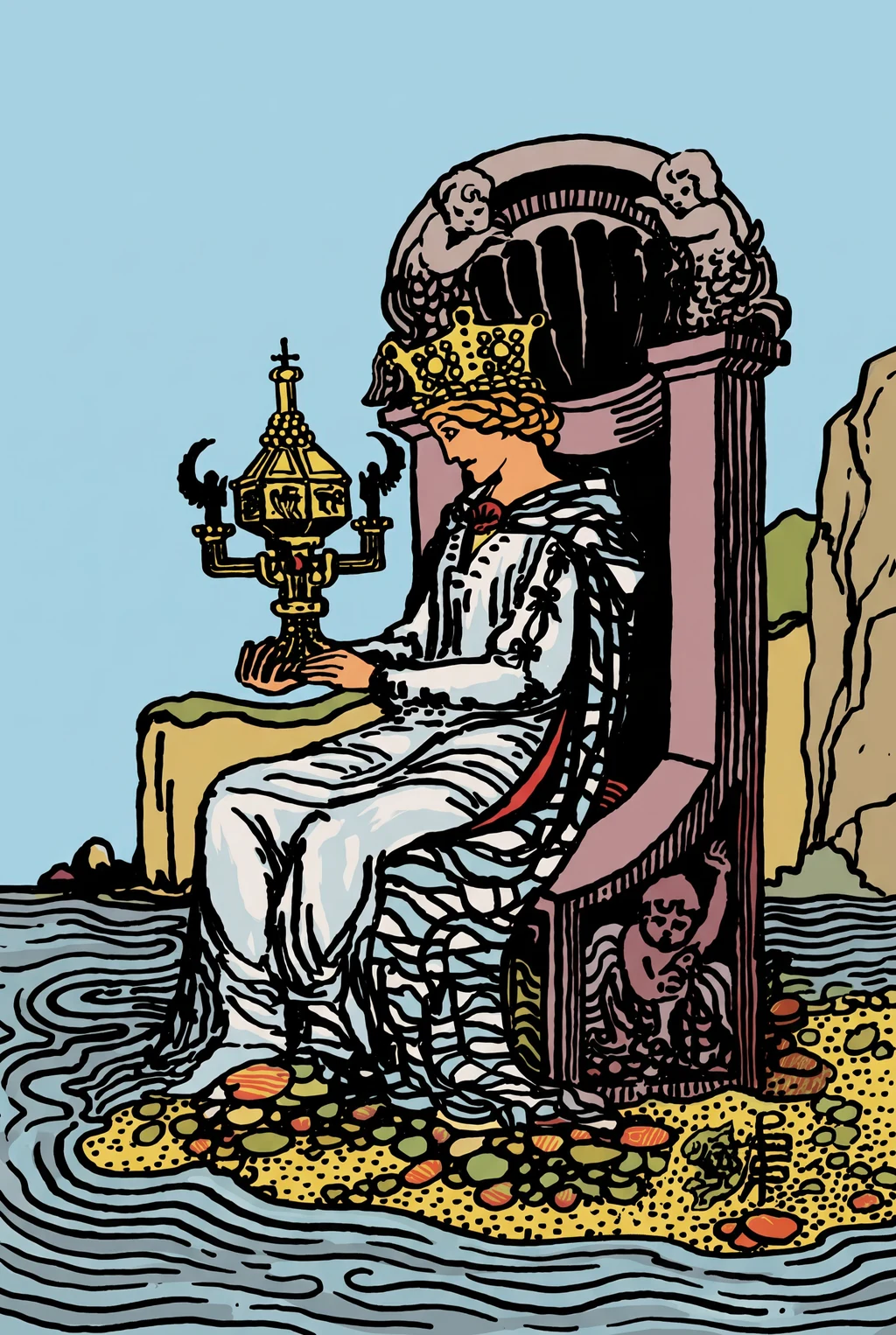
The Queen gazes into the closed cup, as though listening for something that cannot be understood at a glance. Her attention is not wandering around the room or turned toward an audience. Her hands, face, and the vessel form a small, sheltered space. The sea beside her continues to move, but it does not compel her to answer every wave.
The cup is closed, yet she does not turn away. The Queen leans toward it more intently, as though even silence has details that patient listening can reveal. It is a way of sitting beside someone dear who has not yet found the words. You do not repeat the question more loudly; you wait, staying close.
Core meaning
The Queen of Cups brings together sensitivity, imagination, and care. She draws attention to feelings and to how we can nurture closeness without losing touch with ourselves.
- Key meanings:Sensitivity
- Intuition
- Care
- Imagination
- Emotional maturity
- Devotion
- Key meanings:Emotional overwhelm
- Suppressed feelings
- Blurred boundaries
- Dependence on others’ responses
- Self-care
- Inward attention
Image and symbols
Card image
The Queen sits on a tall, carved throne on the right side of the image. Her face is turned to the viewer’s left, and her gaze is lowered to the closed cup she holds in both hands. She wears a golden crown and a blue-and-white cloak over a light-colored dress, with red lining and a red clasp at her throat.
The cup is decorated with winged figures on either side and a cross on top. A shell-shaped canopy rises above the back of the throne; small sea figures are carved into the throne itself, one holding a fish.
The throne stands at the edge of the sea. Colorful pebbles lie below, and a coastal cliff is visible in the distance on the left. A pale blue sky stretches above the water. Her feet are hidden by her clothing.
Traditional context
For Arthur Edward Waite, the Queen is not simply lost in dreams: she sees and acts, and her actions nourish her dreams. His divinatory list brings together a loving intelligence, devotion, wisdom, vision, pleasure, and happiness. The image of a caring wife and mother reflects the language of this historical source.
Waite gives an ambiguous reversed meaning: he allows for both a good woman and an outwardly distinguished but unreliable figure. His additional meanings do not form a single consistent system either: they include a questionable character when upright and an advantageous marriage when reversed. These are different older divinatory lists, not grounds for automatically treating the reversed card as bad.
In modern readings of the RWS deck, empathy, intuition, and emotional maturity come to the foreground. The card may represent a person of any gender, a way of engaging with a situation, or one of your own qualities. The reversal can be read as emotional excess, suppressed feelings, dependence on others’ responses, or a need to direct care toward yourself.
The Hermetic correspondences of the Golden Dawn belong to a separate symbolic layer. In Book T, the Queen of Cups is described as “Water of Water,” receptive and strongly influenced by her surroundings. In that system, unfavorable cards around her are not the same thing as her being reversed.
The crowned Queen
Emotional maturity and the capacity to care. The crown emphasizes command of her inner world.
An intent gaze at the cup
Attention to inner images, feelings, and intuitive understanding.
An ornate cup with a lid
Deep feelings and an inner life kept private. The closed vessel may symbolize treating personal experiences with care.
Winged figures and a cross on the cup
In a modern symbolic reading, these details give the vessel a sacred quality: the inner world deserves protection and respect.
A stone throne with a shell-shaped back
A meeting of solid ground and water imagery: emotional receptivity remains grounded.
Sea figures carved into the throne
A connection to imagination and the depths of inner life. The marine motif continues the element of Cups.
A fish held by a figure on the throne
The contents of the unconscious expressed through imagery of the sea.
The shell-shaped clasp of the cloak
A shell holds and protects something soft and vulnerable. Here, the image suggests keeping feelings safe.
The sea beside the throne
Feelings, intuition, and the unconscious; the calm surface reinforces the theme of inner composure.
The boundary between water and land
Where feelings meet conscious understanding. You can attend to emotions without being consumed by them.
Colorful pebbles at the water’s edge
These details can suggest small discoveries made through self-observation: individual feelings and images that gradually come into view.
The open sea and the coastal cliff on the left
The distant view can be read as the expanse of inner life and the depth of the unconscious.
A flowing cloak that falls toward the water
The cloak resembles water but remains the Queen’s garment. In a modern reading, this detail can connect emotional receptivity with maintaining personal boundaries.
Colors
- White — the main fabric of the dress
Purity of feeling and sincerity of intention.
- Light and dark blue — the cloak, water, and sky
The element of water connects the figure to her surroundings. Quiet shades of blue emphasize receptivity and emotional composure.
- Red — the cloak lining and clasp
Warmth, will, and active engagement complement the Queen’s contemplative nature.
Meanings
Queen of Cups — Upright
General
Overall meaning
The Queen of Cups represents a deep, attentive response to what is happening. Compassion, imagination, intuition, and responsiveness to feelings all matter here. The card can describe a supportive person or a way of being involved that gives emotions their due.
Her care takes action: listening, understanding, helping. But sensitivity does not mean taking on other people’s struggles as your own. Waite also associated the card with wisdom, pleasure, and happiness.
Possible support
Someone who listens attentively without judgment. Your own ability to accept a feeling without rushing to fix it can also be a source of support.
Possible difficulty
Getting caught up in feelings and dreams can push practical concerns aside. Sensitivity does not always come with a clear-eyed assessment of what is possible.
Focus
Notice your emotional response, including the uncomfortable parts. You do not need to dismiss it just because words are hard to find.
Reflection questions
- What do I feel when I stop looking for the right answer?
- Who can I talk to about this without having to justify myself?
Relationships
Overall meaning
In a partnership, the card is associated with tenderness, devotion, and attentiveness to emotional needs. Trust matters, as does the ability to speak personally without fear of ridicule.
In family and friendships, it represents a caring presence and mutual support. This is a closeness expressed not only in words but through everyday involvement.
When meeting someone new, it suggests openness to emotional intimacy. After a breakup, that same image of care may apply to your own grief: it needs room, not pressure to recover immediately.
Possible support
The connection is strengthened by listening to each other and showing care through a simple, thoughtful gesture.
Possible difficulty
The wish to keep the peace can lead to unspoken resentment. It becomes especially difficult when a partner is expected to guess what has not been said.
Focus
Consider whether caring for loved ones still leaves room for your own needs. Supporting someone does not require forgetting yourself.
Reflection questions
- What should I say directly instead of waiting for someone to guess?
- What gesture of care would be appropriate in this relationship?
Work and study
Overall meaning
At work, the Queen of Cups speaks to understanding people, mentoring, creative sensitivity, and cooperation. She may represent a supportive colleague or your own ability to recognize what a team needs.
When choosing a job or project, earnings are not the only consideration. Emotional engagement matters too: does the work offer a sense of human or creative purpose?
Possible support
Thoughtful mentoring and calm collaboration can help. Listening makes it easier to understand someone else’s task and support their work.
Possible difficulty
You risk becoming the person colleagues always turn to for comfort, taking on more emotional labor than your own work allows.
Focus
When changing jobs, retraining, or choosing a project, look for work where your sensitivity is genuinely useful and your interest is engaged.
Reflection questions
- Which part of my work do I genuinely enjoy being involved in?
- Whose calm feedback would help me right now?
Money and resources
Overall meaning
Money here is connected to care: helping loved ones, supporting a meaningful cause, or creating comfort. Generosity makes sense as long as it does not leave you unable to meet your own needs.
The card may also represent material help from a caring person. That is a separate theme of support, not an indication of how much income you will receive.
Possible support
Support may come from a kind person or someone more comfortable handling the practical side of money matters.
Possible difficulty
The urge to help out of guilt or rescue someone immediately can make generosity more than you can afford.
Focus
Before offering financial help, consider its limits: how much can you give while still covering your own expenses?
Reflection questions
- Can I give this amount without sacrificing my own needs?
- Who can I turn to for practical help with money?
Wellbeing and self-care
Overall meaning
The card highlights the emotional side of everyday well-being: noticing tension, accepting your feelings, and caring for yourself without harshness. Rest and human support matter here just as much as attending to responsibilities.
Possible support
Quiet rest, time in nature, or a conversation with someone around whom you do not have to hide your feelings.
Possible difficulty
Sensitivity can make other people’s troubles a constant source of worry. Concern for others begins to erode your own peace.
Focus
Notice emotional fatigue and whether you are able to respond to your own need for rest and support.
Reflection questions
- What kind of rest makes it easier for me to notice my feelings?
- Who can I talk to calmly about what is wearing me down?
Personal growth
Overall meaning
The Queen of Cups is connected to understanding yourself through feelings and inner images. You may become better able to recognize what truly moves, delights, or troubles you.
Here, you develop the ability to give yourself the same attention you usually offer others.
Possible support
Treating yourself gently and making time for reflection can help you understand your feelings.
Possible difficulty
It is easy to set your own needs aside when someone else’s approval matters more than your own response.
Focus
Notice your response before you begin judging it. It may help you understand what matters to you personally.
Reflection questions
- What feeling helps me understand what matters to me?
- How does my relationship with myself change when I stop criticizing myself?
Queen of Cups — Reversed
General
Overall meaning
With the Queen of Cups reversed, sensitivity may lose its balance: feelings become overwhelming, other people’s moods are taken too personally, or your own feelings go unspoken. Another possibility is coldness and withdrawal that make emotional connection difficult.
Care can sometimes turn into a need to be indispensable or a way of applying pressure through guilt. But the reversal can also suggest turning inward: attending to your feelings, restoring boundaries, and caring for yourself after giving so much to others.
Possible support
Being able to receive support, not only give it, can help. Attending to your own needs makes care more reciprocal.
Possible difficulty
It can be hard to separate your own experience from the feelings stirred up by other people’s words and moods. Decisions may then be driven by emotional pressure.
Focus
Consider where helping has become an obligation and where you hide your own feelings to avoid disappointing others.
Reflection questions
- How much of what I am feeling right now is actually mine?
- Where do I need the support I keep offering to others?
Relationships
Overall meaning
Reciprocity and boundaries may be strained in close relationships: one person constantly comforts and supports the other, leaving almost no room for their own feelings. In a romantic partnership, care can sometimes take on a parental role instead of being shared as equals.
Another possibility is emotional withdrawal and misunderstanding. Difficulty expressing feelings can affect not only a couple but also family and friendships. When meeting someone new, the card also draws attention to the difference between the closeness you hope for and how the connection is actually developing.
There is also a gentler reading: the feelings remain, but closeness requires patience and respect for the other person’s pace.
After a breakup, a lingering attachment does not necessarily mean the relationship should be resumed.
Possible support
An attentive conversation may help, one in which both people can express their feelings without guessing or deciding for each other.
Possible difficulty
Overgiving, constantly needing reassurance of closeness, or using guilt to apply pressure can make the relationship unequal.
Focus
Distinguish your own needs from the attempt to hold on to a relationship at any cost. Even when feelings remain, you can notice when caring has begun to demand more than you can give.
Reflection questions
- Can I ask for support in this relationship?
- When do I agree out of care, and when out of fear of disappointing someone?
Work and study
Overall meaning
A work environment or project may be emotionally draining. Constantly trying to accommodate colleagues, a manager, or clients makes it harder to hear your own needs and do your share of the work.
The card is also associated with feeling undervalued and becoming less engaged. In creative work, inspiration may fade, while fear of criticism makes it difficult to share or develop an idea.
Possible support
A supportive colleague or mentor may help you regain your composure and find a more manageable balance between work and rest.
Possible difficulty
Someone else’s dissatisfaction can easily become another obligation: help, reassure, or do the work for them. Your own tasks receive less attention.
Focus
Consider which expectations are actually part of your job and which have grown out of a habit of taking responsibility for other people’s moods.
Reflection questions
- What has become my responsibility at work without a clear agreement?
- Who can I ask for support without passing my task on to them?
Money and resources
Overall meaning
Purchases may be used to briefly ease difficult feelings without addressing their cause. Another possibility is giving loved ones more material support than you can afford, when saying no feels cruel even though your own funds are running low.
Sometimes emotional strain leads to avoiding money matters: it becomes hard to look at expenses or discuss the terms of helping someone.
Possible support
If spending feels difficult to manage, help from another person may provide support.
Possible difficulty
Spending to find emotional relief or prove you care may exceed what you can afford, while the underlying feeling remains.
Focus
Notice whether giving money has become a way to avoid the guilt of saying no. The limits of your help need to account for your own expenses too.
Reflection questions
- What feeling am I trying to ease with this purchase?
- What will happen to my expenses if I agree to provide this help?
Wellbeing and self-care
Overall meaning
Exhaustion after a long period of caring for others may come to the forefront. Your needs get lost among other people’s feelings, and there is too little rest.
The reversal also allows for a helpful turn inward: giving attention back to your own state, spending time away from others’ requests, and acknowledging feelings that have built up.
Possible support
Restorative self-care and the chance to accept another person’s help instead of giving yet again.
Possible difficulty
Taking on other people’s emotions makes the burden heavier. It can be hard to stop when every need someone expresses feels like your own responsibility.
Focus
Consider whether any time in your day is free from other people’s requests. Fatigue from caring for others deserves attention too.
Reflection questions
- Which requests can I put off so I can rest?
- What kind of support would be easiest for me to accept right now?
Personal growth
Overall meaning
The card invites you to examine your relationship with your feelings: they may be suppressed, confused with other people’s expectations, or treated as the sole measure of your worth. The need to feel needed can sometimes make it difficult to recognize what you want for yourself.
Turning inward helps you distinguish your own needs and the reasons behind familiar reactions. This is not a rejection of sensitivity, but a search for a more independent relationship with yourself.
Possible support
Time alone and writing down your feelings can help you hear your own response without immediately seeking someone else’s approval.
Possible difficulty
Your sense of self may depend too heavily on being needed and useful. Then it becomes difficult to tell the wish to help from the need to prove your worth.
Focus
Notice feelings you usually leave unacknowledged and the recurring reasons you put yourself last.
Reflection questions
- What do I choose for myself when no one needs my help?
- Do I need gratitude to believe that my care has value?
Roles in a spread
Position examples
A position gives the card a question, such as what helps or what gets in the way. That question shapes how you read its meaning.
Queen of Cups — Upright
Situation
Feelings and human connection are at the heart of the situation. What matters is having room to express an experience and be heard.
Influence
A caring person may be involved, someone whose sensitivity helps others open up and feel supported.
Motivation
The desire to care, to be present, and to support the emotional well-being of others.
Support
Help from someone who can listen closely and offer support without judgment.
Obstacle
Daydreaming and emotional involvement can crowd out practical reasoning.
Focus of attention
Your own emotional response, especially a feeling you have not yet found words for.
Next step
Listen and give the other person room to express their feelings without rushing to judge.
Possible development
With continued attentive listening, communication may become more open and mutually understanding.
Queen of Cups — Reversed
Situation
Emotional involvement has become excessive, or feelings have been suppressed. The task is to distinguish the experience from its effect on what is happening.
Influence
Other people’s emotional demands or expectations can add to the strain if you treat them as your personal duty.
Motivation
The need to feel needed can keep you in a constant caregiving role and reinforce another person’s dependence.
Support
The chance to receive care and restore your strength instead of once again giving more than you have.
Obstacle
Blurred boundaries and absorption in other people’s feelings make it hard to hear yourself and think calmly about the issue.
Focus of attention
The difference between your own needs and the drive to be constantly useful. Unspoken feelings deserve attention too.
Next step
Turn your attention back to your feelings and needs. If you have been giving too much, begin by recovering rather than making another promise to help.
Possible development
If feelings continue to be suppressed, inner tension may build and become harder to bear.
Combination examples
Card combinations are in development. For now, here are a few examples.
Queen of Cups + The High Priestess
Queen of Cups ( upright) + The High Priestess ( upright)
- Example question:
- What should I understand about my inner response?
- Example interpretation:
This pairing emphasizes intuition and inner knowledge. The Queen’s feelings meet the High Priestess’s contemplative stillness, drawing attention to what remains difficult to put into words.
Queen of Cups + King of Pentacles
Queen of Cups ( upright) + King of Pentacles ( upright)
- Example question:
- How can different ways of caring complement each other in a relationship?
- Example interpretation:
The King of Pentacles’ practical reliability complements the Queen of Cups’ emotional presence. One way of caring provides stability, while the other helps express warmth; mutual respect is essential to this reading.
Queen of Cups + Ace of Wands
Queen of Cups ( upright) + Ace of Wands ( upright)
- Example question:
- How are my interests connected to the desire to create something new?
- Example interpretation:
The Queen of Cups’ emotional engagement joins the creative spark of the Ace of Wands. Together, the cards describe personal desire and inspiration moving in harmony.
Reading example
An imagined one-card reading shows how the meanings above can apply to a question. This is one possible interpretation.
Queen of Cups — Upright
Situation:
Someone close to you is going through a difficult time and often turns to you. You want to be supportive, but it is unclear what would actually help or how much you can offer right now.
Question:
How can I support someone close to me without forgetting myself?
-
Card drawn:
Imagine drawing a card for the position «How to Show Up» and getting Queen of Cups (upright).
Interpretation:
The Queen of Cups highlights attentive presence. Here, helping may begin with listening, without immediately offering solutions or taking the other person’s troubles on as your own.
You can ask what kind of support is needed and offer what you truly have the capacity to give. That gives your care a clear shape without leaving your own needs out of the conversation.
Queen of Cups — Reversed
Situation:
Someone close to you is going through a difficult time and often turns to you. You want to be supportive, but it is unclear what would actually help or how much you can offer right now.
Question:
How can I support someone close to me without forgetting myself?
-
Card drawn:
Imagine drawing a card for the position «How to Show Up» and getting Queen of Cups (reversed).
Interpretation:
The reversed Queen of Cups draws attention to the boundary between caring and exhaustion. Here, she invites you to consider whether the wish to support someone has become an obligation to be available at any time.
If helping has already left you tired, you can begin by acknowledging that and making clear what you can offer right now. Sometimes it is kinder to say when you can talk than to agree to a conversation you no longer have the energy for.
Yes / No
Queen of Cups — Upright
Why this answer
Yes. The Queen of Cups supports a decision grounded in emotional clarity, attentiveness to yourself, and caring involvement.
A clarification
This is not necessarily a call to act immediately. The answer may encourage trusting your feelings while calmly watching how the situation unfolds.
A question to consider
How do I feel about this decision when I stop rushing myself?
Queen of Cups — Reversed
Why this answer
No. Reversed, the card points to emotional imbalance, overwhelm, or dependence that does not support moving in the direction you are considering right now.
A clarification
Before making an important decision, the first step is to regain emotional steadiness. This speaks to your present state, not a permanent prohibition against the possibility itself.
A question to consider
Which feeling is influencing my answer most strongly right now?
Correspondences
Connections with numbers, elements and other symbols add depth to the card’s imagery. They can differ between traditions.
Number — III (3)
Three corresponds to Binah, with which the Queens are associated. This is a link to understanding and giving form to what is perceived, not a number printed on the card.
Element — Water
The suit of Cups is associated with feelings, relationships, and intuitive perception.
Element — Water of Water
The Queen’s watery nature is intensified by the element of her suit: receptivity, imagination, and sensitivity to influences.
Astrology — 20° Gemini to 20° Cancer
The Queen is assigned a span of the zodiac running from Gemini into Cancer. This is the card’s place within the Hermetic system, not the zodiac sign of a person it represents in a spread.
Letter — Heh (ה), the first Heh in the name YHWH
The general correspondence for Queens: receiving and developing an initial impulse, giving it stability.
Tree of Life — Binah
The sphere of understanding and form. In this card, it emphasizes the capacity to hold an experience and give it expression.